Any passive etf or index or fund investors here?

PostCountWarrior[+1]

Arch-Supremacy Member
Joined
Jul 17, 2008
Messages
21,953
Reaction score
2
Any recommendations for buying and holding long term?

I am have been buying the CIMB Dividend ETF to hold for long term. It invests in a portfolio of regional stocks with high dividend yields. It is listed on the SGX.

I also like Phillip Singapore Real Estate Income Fund as it invests in a portfolio of REITS, but I have yet to buy this yet. I think there are some people who like REITS and can consider this alternative as it offers you diversification.

My investing journey has been mixed with buying stocks. Some did well while some crashed. Net net I am still okay, but to save me the trouble of paying the broker commissions on my small stock purchases and to get better portfolio diversification, I have since turned to indices, etfs and funds. Anyone share the same view?

pcw +1
 

Asphodeli

Arch-Supremacy Member
Joined
Jul 8, 2001
Messages
22,390
Reaction score
3,686
Any recommendations for buying and holding long term?

I am have been buying the CIMB Dividend ETF to hold for long term. It invests in a portfolio of regional stocks with high dividend yields. It is listed on the SGX.

I also like Phillip Singapore Real Estate Income Fund as it invests in a portfolio of REITS, but I have yet to buy this yet. I think there are some people who like REITS and can consider this alternative as it offers you diversification.

My investing journey has been mixed with buying stocks. Some did well while some crashed. Net net I am still okay, but to save me the trouble of paying the broker commissions on my small stock purchases and to get better portfolio diversification, I have since turned to indices, etfs and funds. Anyone share the same view?

pcw +1

First question, are you a dividend player? different people have different investment strategies. Personally, I treat UTs (with dividend payout) as an interest-bearing savings account :s13:

ETFs are alright, just beware of tracking error and check if they give out dividends. But I rather buy component stocks of the index than the ETF itself, hehe.

The Phillip Singapore Real Estate Income Fund looks interesting as you don't have to keep track of the corporate drama and hoo-has, but the fund fees puts me off. Some more its Singapore-focused, might as well buy the REIT directly off SGX.
 

PostCountWarrior[+1]

Arch-Supremacy Member
Joined
Jul 17, 2008
Messages
21,953
Reaction score
2
First question, are you a dividend player? different people have different investment strategies. Personally, I treat UTs (with dividend payout) as an interest-bearing savings account :s13:

ETFs are alright, just beware of tracking error and check if they give out dividends. But I rather buy component stocks of the index than the ETF itself, hehe.

The Phillip Singapore Real Estate Income Fund looks interesting as you don't have to keep track of the corporate drama and hoo-has, but the fund fees puts me off. Some more its Singapore-focused, might as well buy the REIT directly off SGX.
Thanks for sharing. If your pockets are deep, then yes you might be better off buy the individual components yourself so you can achieve diversification. But my pockets are not so deep so etfs and indices allow me diversification.

Yes I like dividend stocks that give me upside on capital gains as well.

pcw +1
 

w1rbelw1nd

Master Member
Joined
Dec 12, 2010
Messages
3,115
Reaction score
6
Any recommendations for buying and holding long term?

I am have been buying the CIMB Dividend ETF to hold for long term. It invests in a portfolio of regional stocks with high dividend yields. It is listed on the SGX.

I also like Phillip Singapore Real Estate Income Fund as it invests in a portfolio of REITS, but I have yet to buy this yet. I think there are some people who like REITS and can consider this alternative as it offers you diversification.

My investing journey has been mixed with buying stocks. Some did well while some crashed. Net net I am still okay, but to save me the trouble of paying the broker commissions on my small stock purchases and to get better portfolio diversification, I have since turned to indices, etfs and funds. Anyone share the same view?

pcw +1

Well, I am a fellow index investor here! Like you, I am sick of looking at individual stocks. My gains and losses seem a lot more unpredictable than I expected.

Anyway I am not investing using CIMB S&P ethical dividend ETF, simply because its expense % is quite high (at 0.65% for only manager fee!!). I am finding Nikko AM STI ETF's total expense ratio of 0.39% quite high already!
 

platopus

Senior Member
Joined
Dec 11, 2014
Messages
690
Reaction score
11
I do a three fund portfolio of

Sti etf: 30%
A35 sg bond index etf: 40%
Vanguard all world high div yield: 30%

DCF: $1000 a mth
For simplicity sake, I buy the vhyd first in USD $3600 ($300 x 12) for the year n dcf $700 a mth thru posb for convenience.


I did not include in my portfolio but sometimes I do have additional income, I buy some SLV iShares silver trust (maybe abt 5% of my entire portfolio). Mainly because its abt 15usd which I think its cheap compared to its 2011 high of 46, so I do buy slv now n then as a small hedge n wager (entirely based on my gut feeling, no research)


Other than that I am a conservative 60/40 guy
 
Last edited:

Bedokian

Senior Member
Joined
Apr 5, 2007
Messages
2,199
Reaction score
7
I am not really a true blue index investor here but I have the STI ETF and the VEA ETF, in a way for growth and to be exposed to the targeted markets as a whole rather than picking shares individually. However, I do have individual counters as I practice dividend investing, and a small portion of my portfolio for speculative plays.
 

medscy

Member
Joined
Apr 17, 2006
Messages
497
Reaction score
5
Hello,I'm thinking of getting an index etf... comtemplating between spdr sp500 vs spdr sti etf... the former seems to have a better performance for the past 3 to 5 years... but v ex and in usd... any thoughts on this?
 

wahkao3

High Supremacy Member
Joined
Mar 6, 2005
Messages
26,805
Reaction score
24
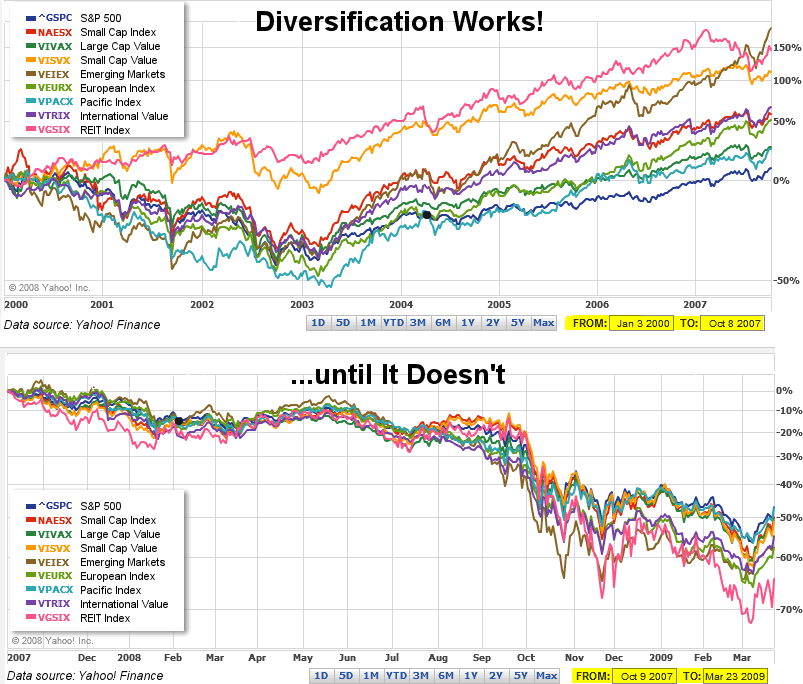
diversification is overrated. its a nice sales pitch for those fund managers selling their non performing ETF
diversification-2000-present.gif
 

frenchbriefs

Banned
Joined
Jun 12, 2011
Messages
45,422
Reaction score
4
diversification is overrated. its a nice sales pitch for those fund managers selling their non performing ETF
diversification-2000-present.gif

does this prove anything?everyone's gonna lose in a bear market,but if u compare with the portfolios of every trader out there against the s&p during 2008,i bet 90% of them have bigger losses than the index.
 

antonpoh

Arch-Supremacy Member
Joined
Oct 3, 2012
Messages
15,222
Reaction score
2,526
diversification is overrated. its a nice sales pitch for those fund managers selling their non performing ETF
diversification-2000-present.gif

Correct.. diversification actually increase your risk if you don't know what to invest.

Let's say you only invest in VISA from 2008 till now.
 

Shiny Things

Supremacy Member
Joined
Dec 13, 2009
Messages
9,560
Reaction score
770
Hello,I'm thinking of getting an index etf... comtemplating between spdr sp500 vs spdr sti etf... the former seems to have a better performance for the past 3 to 5 years... but v ex and in usd... any thoughts on this?

OK, here's the deal.

You generally want to invest in indexes that track the market you care most about. That's because you're going to need that money when you retire - so you don't want to run the risk of investing everything in, oh, say, Russia, and having it all disappear up the spout. (Conversely, you also don't want to risk Singapore having a great couple of decades and your portfolio underperforming, because then you won't be able to afford to retire in Singapore.)

If you're a Singaporean investor, that's the STI.

And if anything, you don't want to pay attention to the previous few years' performance. Index funds tend to mean-revert - so the fund that was a good performer over the last few years is likely to underperform its competitors over the next few years.

So, again, you want to own the STI.

It's totally OK to have some of your portfolio in overseas stocks if you're younger - by the time you retire, though, you'll want to bring it all back to Singaporean stocks and bonds.

You can buy bond ETFs as well, and that's a really good idea if you want to get diversified. Bonds tend to go up when stocks go down, so your portfolio ends up less volatile - and, crucially, you can sell some of the bonds to buy stocks when those stocks are underperforming.

Here's a chart that shows what I'm talking about. Remember 2008 when everything shat the bed? Bonds didn't: Treasury bonds (the TLT line in the graph below) had a great year in 2008. Corporate bonds (LQD) were down smalls. US municipal bonds (MUB, issued by cities and states) were flat (up if you include the dividends).

If you were 100% in stocks at the end of 2008, you were thinking "oh fudge my life is ruined I ain't gonna have no money to buy my son the G.I. Joe with the kung-fu grip!". But if you were in a mix of stocks and bonds, you were thinking "wow it was a bit of a rough year wasn't it, I'm down 20-30%, but it's not the end of the world, maybe I should rebalance and buy some stocks, more champagne, don't mind if I do".

diversification is overrated. its a nice sales pitch for those fund managers selling their non performing ETF

Here's another chart for that exact same time period as your "until it doesn't" chart, but this time including some bond funds. Now look me in the eye and tell me diversification is overrated.

diversification.png
 

Shiny Things

Supremacy Member
Joined
Dec 13, 2009
Messages
9,560
Reaction score
770
I'm your guy for index ETF stuff and asset-allocation-style investing. Let's take a look at what you've got.

Any recommendations for buying and holding long term?

I am have been buying the CIMB Dividend ETF to hold for long term. It invests in a portfolio of regional stocks with high dividend yields. It is listed on the SGX.

Hmm. Look, dividend-focused investing is controversial. I basically ignore yields on my stock funds; Dividend Warrior doesn't. Both are totally valid investing strategies!

We got to a point late last year / early this year where dividend stocks were trading completely out of alignment with their valuations; people flooded into them because they thought divvy stocks were an alternative to low-yielding bonds (hint: they're not). This isn't always the case; sometimes dividends are cheap, sometimes they're expensive.

This particular fund doesn't strike me as a very good idea, though. They charge an awful lot in management fees (0.65%, compared to the STI ETFs, which charge about 0.3%-ish and still yield the better part of 3%); and investing in funds like this sort of misses the point of index investing. The idea is to invest in low-cost, passively-managed funds that don't have a lot of turnover.

(Also, my favourite bit is that they're fiddling their benchmarks! Have a look at the fund factsheet: they benchmark to a price-return index, so an index without dividends; but they show their own performance in total-return format (including dividends). Considering the fund yields 5%-ish, they're giving themselves a gigantic head-start over their benchmark. That's Dodgy Fund Marketing 101, and CIMB should be ashamed.)

Unless you really need the dividend payments for something (and you probably don't, c'mon), I think you'd be better off with this money in a lower-cost index ETF. Sadly there aren't any general-Asia-focused index ETFs listed in Singapore, but the STI ETF is a good start; if you're willing to go over to the American exchanges you can get a similar exposure there at much lower cost. Is that something you've got access to?

I also like Phillip Singapore Real Estate Income Fund as it invests in a portfolio of REITS, but I have yet to buy this yet. I think there are some people who like REITS and can consider this alternative as it offers you diversification.

I'm not a big fan of REITs in general (I don't own any myself), but I'm not entirely opposed to them. Still, I can't help thinking this is one case where you wouldn't want to go for a fund: that thing charges 0.75% upfront and 0.8% every year to just take your money and stick it in a bunch of Singaporean REITs. There's no reason you should have to pay that much money for that. This is one case where you might want to do it yourself.

You've generally got the right idea. Stock-like things for a big chunk of your portfolio; bond-like things for a smaller chunk of your portfolio; I think the only thing we disagree on is the actual funds to use.
 

PostCountWarrior[+1]

Arch-Supremacy Member
Joined
Jul 17, 2008
Messages
21,953
Reaction score
2
I'm your guy for index ETF stuff and asset-allocation-style investing. Let's take a look at what you've got.


Hmm. Look, dividend-focused investing is controversial. I basically ignore yields on my stock funds; Dividend Warrior doesn't. Both are totally valid investing strategies!

We got to a point late last year / early this year where dividend stocks were trading completely out of alignment with their valuations; people flooded into them because they thought divvy stocks were an alternative to low-yielding bonds (hint: they're not). This isn't always the case; sometimes dividends are cheap, sometimes they're expensive.

This particular fund doesn't strike me as a very good idea, though. They charge an awful lot in management fees (0.65%, compared to the STI ETFs, which charge about 0.3%-ish and still yield the better part of 3%); and investing in funds like this sort of misses the point of index investing. The idea is to invest in low-cost, passively-managed funds that don't have a lot of turnover.

(Also, my favourite bit is that they're fiddling their benchmarks! Have a look at the fund factsheet: they benchmark to a price-return index, so an index without dividends; but they show their own performance in total-return format (including dividends). Considering the fund yields 5%-ish, they're giving themselves a gigantic head-start over their benchmark. That's Dodgy Fund Marketing 101, and CIMB should be ashamed.)

Unless you really need the dividend payments for something (and you probably don't, c'mon), I think you'd be better off with this money in a lower-cost index ETF. Sadly there aren't any general-Asia-focused index ETFs listed in Singapore, but the STI ETF is a good start; if you're willing to go over to the American exchanges you can get a similar exposure there at much lower cost. Is that something you've got access to?


I'm not a big fan of REITs in general (I don't own any myself), but I'm not entirely opposed to them. Still, I can't help thinking this is one case where you wouldn't want to go for a fund: that thing charges 0.75% upfront and 0.8% every year to just take your money and stick it in a bunch of Singaporean REITs. There's no reason you should have to pay that much money for that. This is one case where you might want to do it yourself.

You've generally got the right idea. Stock-like things for a big chunk of your portfolio; bond-like things for a smaller chunk of your portfolio; I think the only thing we disagree on is the actual funds to use.

thanks for your reply. wow, didnt know they fudge with the figures with the CIMB dividend etf.

Expenses aside, I like it because based on the past dividend, it yields around 5.2%. I will stop buying when the yield drops below 5% and look for something else. I dunno if its just me, but I like that 5% cushion (though it's not certain that I will get that expected 5% dividend) and the potential upside. It also invests in Malaysia, Hong Kong and Thailand stocks so it saves me the trouble of buying them.

That current REITS fund gives around 5.1% now. I think good S-Reits now yield lower than that while the more lousy ones yield more, so you gotta hold a basket of them to be safe. I agree that expense ratio is high but if you really like S-Reits, this is the only diversified one around. If you have the pockets to seek diversification on your own then yes, please buy them one by one. The ideal price for a holding of stock is around 10k in my view (you buy lower than 10k, you still pay the same commission as a 10k purchase). Assuming you want 15 stocks to be diversified, you need 150k then, which currently now I don't have. Lower number of less than 15 stocks worth 10k each = concentration risk. 15 stocks worth less than 10k each= more commission charges. I am of course assuming the magic number for diversification is 15, you may have other ideas. We haven't even talked about one's stock picking ability in beating the benchmark here yet.

As for just buying STI, I think its a gd idea but it should not be a concentrated position. In fact I think if someone advocates say 60/40 and that 60% is equities and that full 60% is the STI then I don't think its a good idea. Stock markets don't go up forever. People look at the STI and S&P and think that they do but ask them to look at the Nikkei in 1990s and Shanghai Stock Exchange after 2009 (though it did bounce back recently). If you were a Japanese or Chinese and had been buying into them consistently like every month or every quarter during that period, I doubt you have made your money back as of now. I would not touch the STI with my own savings but would use the CPF SA to buy them as thats the only 'risky' asset class they allow me to buy that gives me a chance to beat the CPF SA of 4% return over time. Using that to buy also helps me in not having a concentrated position in the STI for my overall portfolio.

Please feel free to disagree with me. I like how this thread is going. Can I ask what you are holding now?
 

JobHunter

Senior Member
Joined
Jul 6, 2013
Messages
550
Reaction score
0
Shinything

how do you check the price for QL3.SI? Yahoo finance show it like countless spike every month 0.0?
 

Shiny Things

Supremacy Member
Joined
Dec 13, 2009
Messages
9,560
Reaction score
770
Shinything

how do you check the price for QL3.SI? Yahoo finance show it like countless spike every month 0.0?

The Yahoo finance figures are stuffed - it confuses the SGD share class (the price at the top of the spikes) with the USD share class (the price at the bottom of the spikes). Use the charting on the SGX's website.
 

Shiny Things

Supremacy Member
Joined
Dec 13, 2009
Messages
9,560
Reaction score
770
Expenses aside, I like it because based on the past dividend, it yields around 5.2%. I will stop buying when the yield drops below 5% and look for something else. I dunno if its just me, but I like that 5% cushion (though it's not certain that I will get that expected 5% dividend) and the potential upside.

Yeah, fair point. The reason I don't pay attention to dividends is that they're not the whole story when it comes to returns - capital gains are just as important (and where I am, in America, capital gains get favourable tax treatment if you hold the stock for more than a year, so that's a consideration as well).

My other concern with dividend-focused strategies is that blindly buying dividends gets you into uncomfortable situations like buying NLY, TEI, or WHX - all stocks that have phat div yields but are horrible messes behind the scenes for various reasons.

(If you're interested: NLY yields >10% but it owns a truckload of leveraged mortgage bonds, so it's going to get disastrously squeezed in a rate-rise scenario; TEI yields 7% but it's full of imploding rubbish like Ghanaian and Ukrainian sovereign debt; and WHX yields more than 100% but it's going to go to zero in about three months because of the way it's structured.)

That current REITS fund gives around 5.1% now. I think good S-Reits now yield lower than that while the more lousy ones yield more, so you gotta hold a basket of them to be safe. I agree that expense ratio is high but if you really like S-Reits, this is the only diversified one around.

Yeah, I get you, and I absolutely agree. I'd like it if it charged less - look at it this way, it's taking one-sixth of your yield - but you're absolutely right on your later points that it's a hell of a lot easier to buy the fund than it is to build these things yourself.

As for just buying STI, I think its a gd idea but it should not be a concentrated position. In fact I think if someone advocates say 60/40 and that 60% is equities and that full 60% is the STI then I don't think its a good idea.

Yeah, also agree. You need to skew toward Singaporean assets if you're a Singaporean investor, because SGD is the currency you need to retire in; but you certainly don't need to be BOLIVIAN long just Singaporean equities. A 50-50 mix of STI ETF vs VWRD, or something like that, is fine for young investors (as you get older you want to dial the proportion of overseas equities down, at the same time as you're dialing your overall proportion of equities down).

It's sort of a shame there aren't any low-cost target-date funds available in Singapore. Anyone out there at a fund house who wants to have a crack at this? You know Vanguard's going to come in and eat your lunch at some point, so you might as well get in there first.

Please feel free to disagree with me. I like how this thread is going. Can I ask what you are holding now?

Sure mate, absolutely. Couple of disclaimers first:
  • I'm a US-focused investor, so the majority of my portfolio is in US assets. You should probably focus on Singaporean assets, and skew your mix that way.
  • On a related note, I'm based in California, so I get a tax break on the interest payments on Californian muni-bonds. These aren't the right investment for everybody.
  • I'm 31, so by my "110 minus your age" rule I'm 79-21 between stocks and bonds. This won't be an appropriate mix for older or younger investors.

With that out of the way, here's my mix. It's all in ETFs of various sorts, because ETFs are absolutely the best way for regular retail investors to invest:
  • 79% stocks
    • 40% US large-cap
    • 5% US mid-cap
    • 29% developed-market ex-USA large-cap
    • 5% emerging-market large-cap
  • 21% bonds
    • 9% short-dated muni-bonds
    • 9% long-dated California muni-bonds
    • 3% US junk bonds
Plus an emergency fund (six months' expenses) that I've stuck in a high-yield savings account so I can get to it quickly if I need it.

I'm tossing around the idea of ditching the savings account and investing that money in the short-term bond fund instead. US brokers are pretty good with the quick withdrawals.
 
Last edited:
Important Forum Advisory Note
This forum is moderated by volunteer moderators who will react only to members' feedback on posts. Moderators are not employees or representatives of HWZ. Forum members and moderators are responsible for their own posts.

Please refer to our Community Guidelines and Standards, Terms of Service and Member T&Cs for more information.
Top