NTU penalises 3 students over use of AI tools; they dispute university’s findings
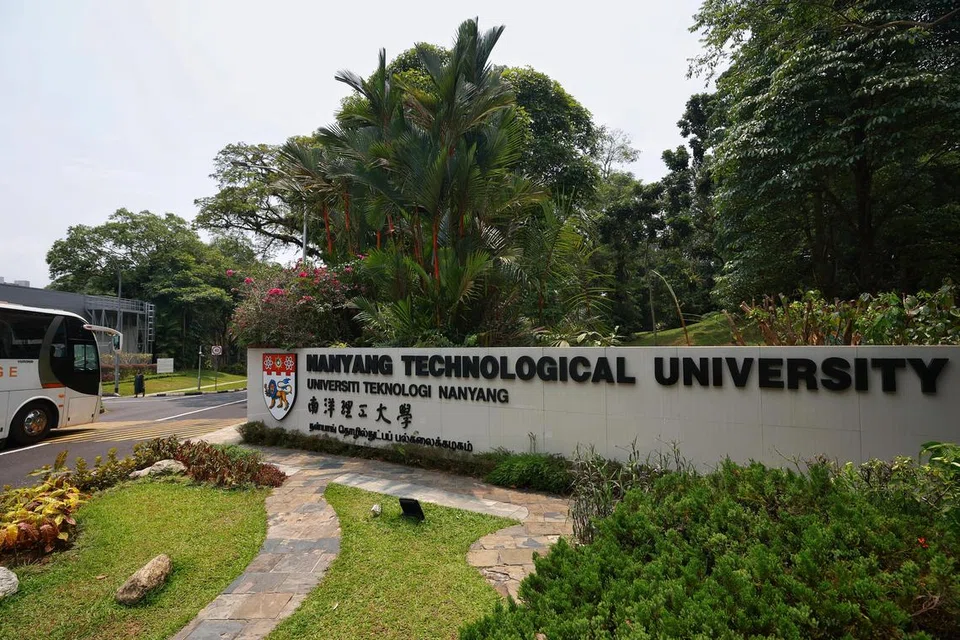
NTU said the students were penalised for academic misconduct as the assignments contained non-existent academic references and statistics or broken web links.ST PHOTO: KEVIN LIM
SINGAPORE – The Nanyang Technological University (NTU) has confirmed that three students got zero marks for an assignment after they were found to have used generative artificial intelligence (Gen AI) tools in their work.
They were penalised for academic misconduct as the assignments contained non-existent academic references and statistics or broken web links, the university said.
All three students, who were enrolled in a module on health, disease outbreaks and politics, were investigated in April. They were given the opportunity to present their cases during a formal review, NTU said on June 22 in response to queries from The Straits Times.
Two admitted to using Gen AI tools while the third claimed to be unaware that the platform they used – which markets itself as an AI-powered essay-writing service – fell under that category, NTU said.
A spokesperson for NTU’s School of Social Sciences said the course’s instructor – whom ST understands is Assistant Professor Sabrina Luk – had “explicitly prohibited” the use of AI tools for written assignments throughout the semester.
NTU said students were reminded multiple times that using Gen AI would result in a zero grade for the assignment, a sanction that was formally communicated to all three students in early May. It accounted for 45 per cent of the overall grade for the course.
The university added that citing non-existent sources “undermines the credibility and authority of academic writing”, and is a serious form of academic misconduct.
NTU’s response comes after a Reddit post made by one of the students on June 19 went viral. In the post, she claimed she was accused of using AI for a final essay for a particular module because she had made errors in her citations and used a reference organiser.
A reference organiser is a software tool that helps collect and organise references and citations.
The student, who requested to remain anonymous, told ST she had provided proof of her writing process, including a time-lapse of her writing recorded by Draftback, a Google Chrome extension that records one’s writing process, but was not met with leniency.
She was told she had committed academic fraud, resulting in a permanent academic warning and a drop in her grade point average.
The Year 3 public policy and global affairs student said she tried making a formal appeal to the school’s academic board. However, her attempts to reschedule the necessary consultations before appeal deadlines were unsuccessful.
In response to NTU’s June 22 statement, she said that all three students had provided updated citations of the sources – challenging the issue of them using “non-existent sources”. She added that the professor had acknowledged these updates.
In an e-mail exchange seen by ST, she had sent the professor the updated sources and a final essay that corrected the citation mistakes.
“I deeply regret not double-checking my citations and rushing through the process,” her e-mail said, adding that she understands the “importance of academic integrity”.
In response, the professor thanked her for the journal articles and the updated final essay in an e-mail.
The Year 3 student also claimed she was “shut down” whenever she tried to present her case, and the professor had told her there was “no negotiation”.
“When I appealed through the academic integrity officer, there wasn’t even a panel,” she said, adding that this happened over a brief e-mail exchange and not face-to-face.
A second student from the same degree course told ST he was accused of academic fraud over allegedly fake or inaccurate citations despite his explanations and evidence suggesting otherwise.
The Year 4 student said his professor had initially deducted 10 marks from his assignment after accepting his account that he had used AI tools to locate information, not to generate content.
However, he said that NTU’s School Academic Integrity Officer overruled the decision and issued a zero grade without a hearing, which gave him a formal misconduct record.
The student said he appealed against the decision without success.
ST understands that the third student, who is in Year 4 and used ChatGPT to organise her references, also disputed the findings.
In March 2024, ST reported that students enrolled in Singapore universities
have been allowed to use AI tools to complete their assignments. However, they cannot flout rules on academic honesty and plagiarism, among other things.
All six autonomous universities, including NTU, said they have adopted this position.
- Additional reporting by Emerald Lo