Before raising GST, More taxes from INTRODUCING levy on foreigner PMET? (Employment pass holders)

cherry6

Banned
Joined
Jan 16, 2007
Messages
11,993
Reaction score
445
Before raising GST, More taxes from INTRODUCING levy on foreigner PMET? (Employment pass holders)
Singapore can consider levy on foreign PMEs
Currently, foreigner on employment pass pay ZERO foreigner levy. "There is no Foreign Worker Levy for Employment Pass holders."
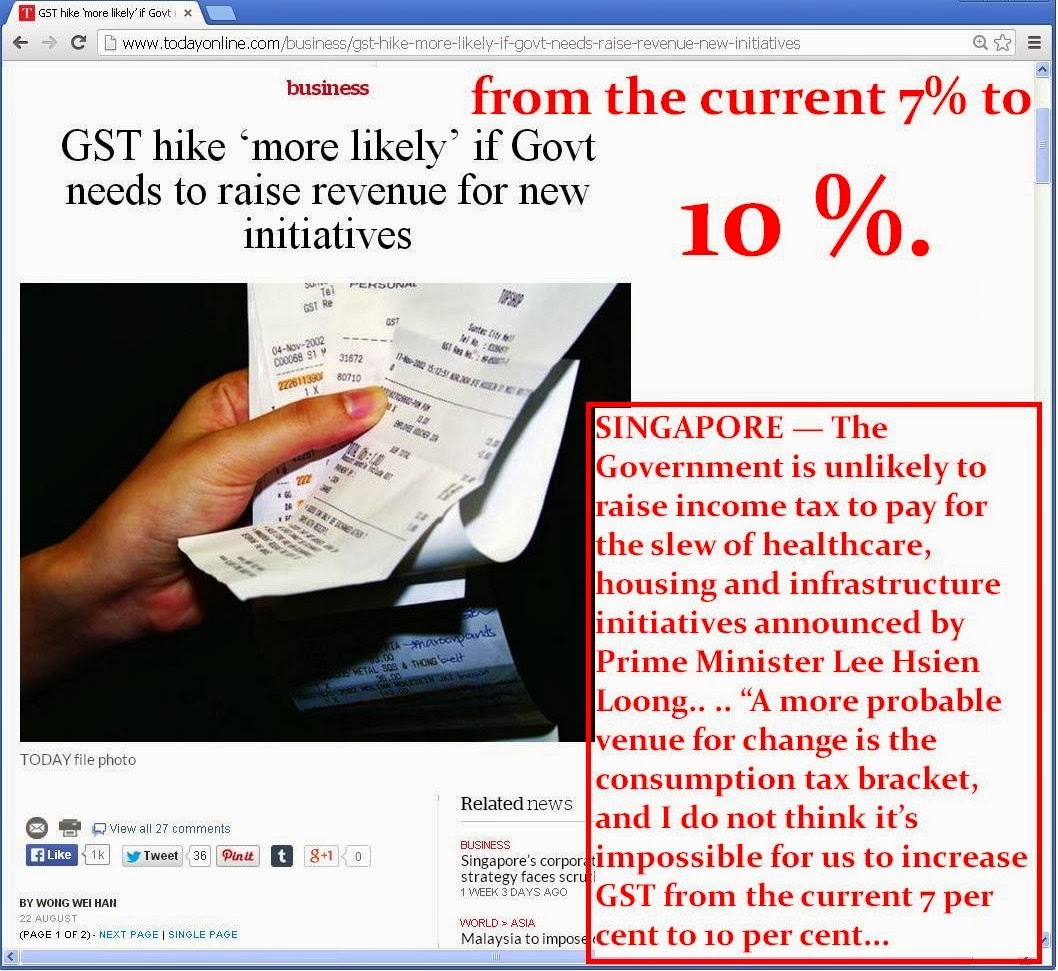
They want to raise GST soon, possibly just after 2016GE:...
GST+hike+%E2%80%98more+likely%E2%80%99+if+Govt+needs+to+raise+revenue+for+new+initiatives-TDY+(22Aug2013).JPG
(IMG source)

voices TODAY
Singapore can consider levy on foreign PMEs
LIM KAY SOON
PUBLISHED: 4th JUNE 2014.
The Government has said the economy would suffer if Singapore were to impose restrictions on employment of foreign professionals, managers and executives (PMEs), as companies would move to countries with lower PME costs.
Companies that are established here, though, would not move out over just one cost factor — a foreign PME levy.
Singapore offers them many benefits to operate here, compared with elsewhere. These include: Among the lowest corporate tax rates in the world, efficient infrastructure such as air and sea ports and robust public utilities, clear and effective business laws and a safe business environment — no burning of factories, et cetera.
A levy would level the playing field and rebalance living standards between local and foreign PMEs.
After all, Singaporeans have contributed to the said benefits for firms, by doing National Service to ensure a safe environment. We also pay civil servants and government officials well to ensure efficient business regulations and keep corporate tax low.
Should the companies that choose to move away due to a foreign PME levy do so, it is not worth holding them back.
Ultimately, if too many locals are allowed to be replaced by foreign PMEs, the latter would eventually return to their home countries with enhanced skill sets and experiences, further strengthening those economies, to the detriment of Singapore.
 
Last edited:

Inix

Arch-Supremacy Member
Joined
Jan 1, 2000
Messages
13,525
Reaction score
0
I finally found something that you posted @ HWZ that do resonate with me. Rather than taxing PMEs, I would tax employers 16.5% for the 1st $5K of the PME's income on a monthly basis.

This will put foreign PME to be equal with Singaporean PME as Employers are "taxed" 16.5% for hiring Singaporeans when they pay employer contribution. I would also tax employers another 1% on a monthly basis for male foreign PMEs for the basis of a NS contribution until they turn 45 years old. This might make the fact that local male PMEs have to go back to do NS on a yearly basis a more palatable affair to employers as it would probably account to around 8% of business downtime per male employee

But I wonder how much it will actually contribute?
 

cherry6

Banned
Joined
Jan 16, 2007
Messages
11,993
Reaction score
445
I finally found something that you posted @ HWZ that do resonate with me. Rather than taxing PMEs, I would tax employers 16.5% for the 1st $5K of the PME's income on a monthly basis.
This will put foreign PME to be equal with Singaporean PME as Employers are "taxed" 16.5% for hiring Singaporeans when they pay employer contribution. I would also tax employers another 1% on a monthly basis for male foreign PMEs for the basis of a NS contribution until they turn 45 years old. This might make the fact that local male PMEs have to go back to do NS on a yearly basis a more palatable affair to employers as it would probably account to around 8% of business downtime per male employee
But I wonder how much it will actually contribute?
Yup, it remains a CRYING SHAME that Singaporean PMETs are despised in their own country despite serving NS (so many other countries, citizens do not serve NS).
Singapore is a beautiful place to work and stay because Singaporeans who have served NS are both obedient (can accept scolding w vulgarities at their parents as all who have served real NS have experienced, 'cockroach, spider, sotong, kooniang' etc) and law-abiding (able to rush to wait etc, fear of going DB etc).

In any case, since there is raising instructions/ warnings amongst PAP Ministers for MPs to rubber stamp GST raise from 7 to 10% despite persistent inflation year after year to raise more $$$ to meet annual budget requirements, I believe that the lack of foreigner PMET levy remains a GAPING HOLE in the Singapore tax revenue landscape.

Firstly, by having levy only for S-pass and work permit holders as well as dependency ratios, PAP gahmen is implicitly encouraging Singaporeans to do workpermit style jobs either for their artificially boosted pay (more expensive to hire foreigners due to levy which is IN EXCESS of employer CPF component)/ encouraged to live easy life as phantom worker by submitting their bank/CPF account number to many employers, looking productive on paper, yet doing absolutely NOTHING except make up headcount numbers: I.e, occupation = phantom worker.

Foreigner PMET are also ought NOT to want to be citizen/ PR: as such, SAF of the future will have great difficulty recruiting NSmen members: and neither will companies encourage foreigner PMETs to apply: since employing even a PR would entail having to pay CPF: an extra liability for company owners.

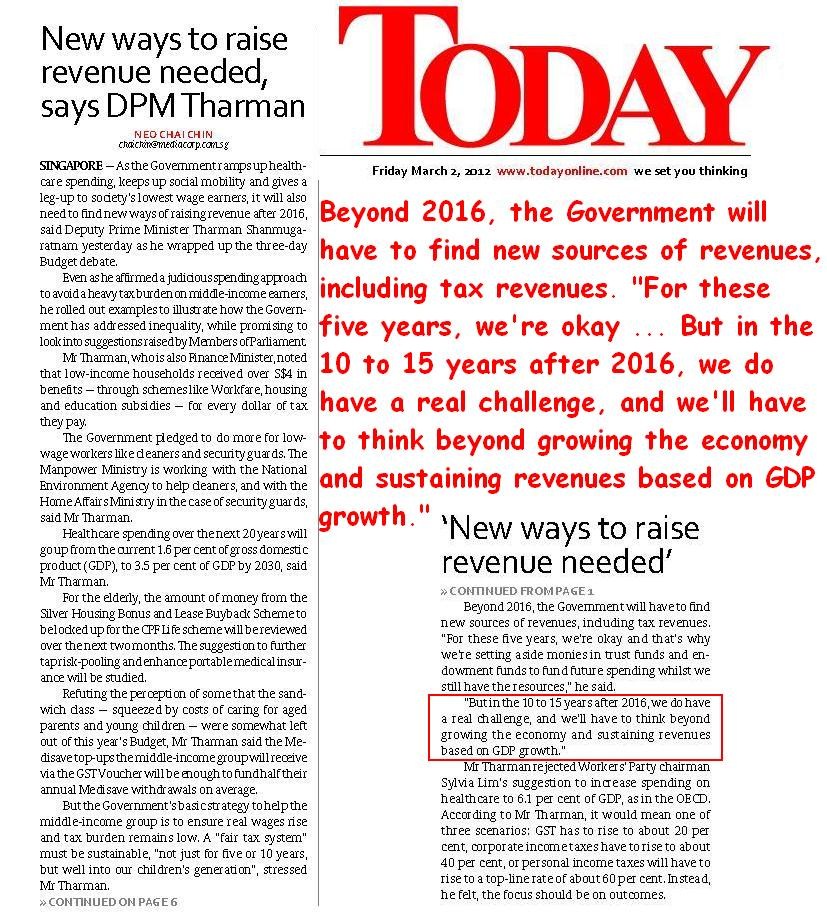
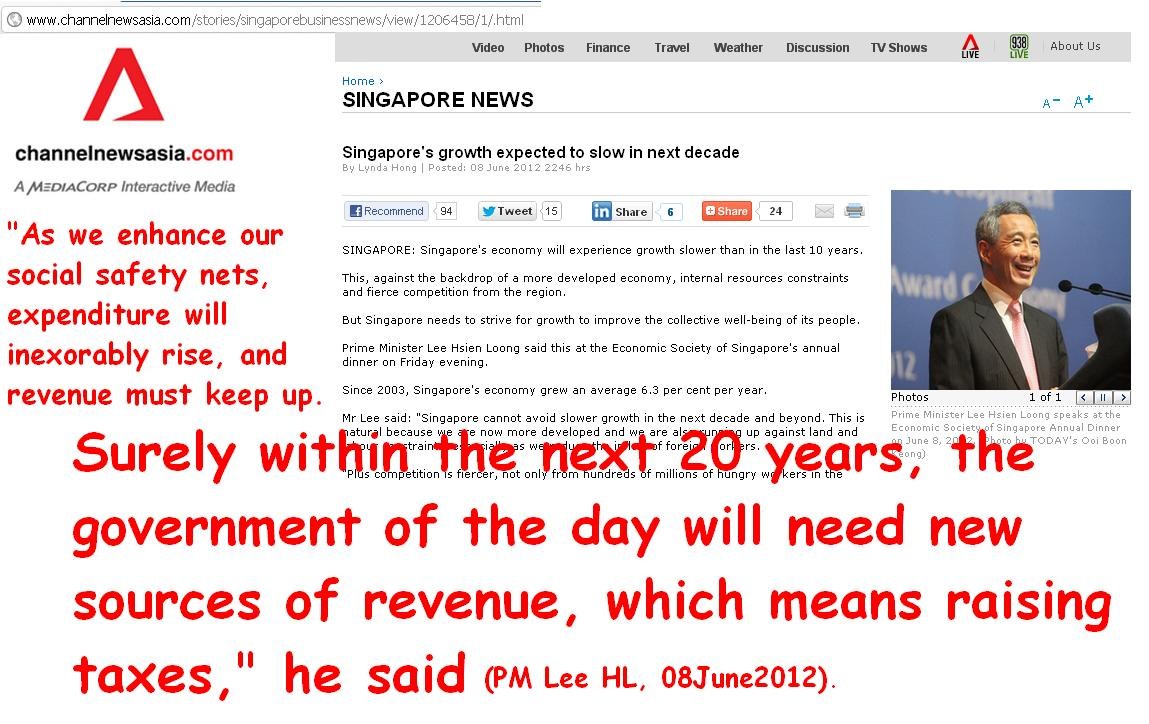
The approach of the 2016GST monster:
120302-+New+ways+to+raise+revenue+needed,+says+DPM+Tharman,+quote.JPG

Singapore%27s+growth+expected+to+slow+in+next+decade.JPG

GST+hike+%E2%80%98more+likely%E2%80%99+if+Govt+needs+to+raise+revenue+for+new+initiatives-TDY+%2822Aug2013%29.JPG
 
Last edited:

shashimi

Arch-Supremacy Member
Joined
Sep 6, 2010
Messages
12,890
Reaction score
3
the government should find extra way of taxing the high net individual. eg. capital gain tax
 

cherry6

Banned
Joined
Jan 16, 2007
Messages
11,993
Reaction score
445
the government should find extra way of taxing the high net individual. eg. capital gain tax

Capital gains tax say only is EASY, but in practise: VERY VERY DIFFICULT to implement because it is TOO DEPENDENT on WHEN the owner sells the property/possession. Also, it is only the rich who have holding power (pass property through generations), the middle class will sell because they might need the $$$ for medical treatment.

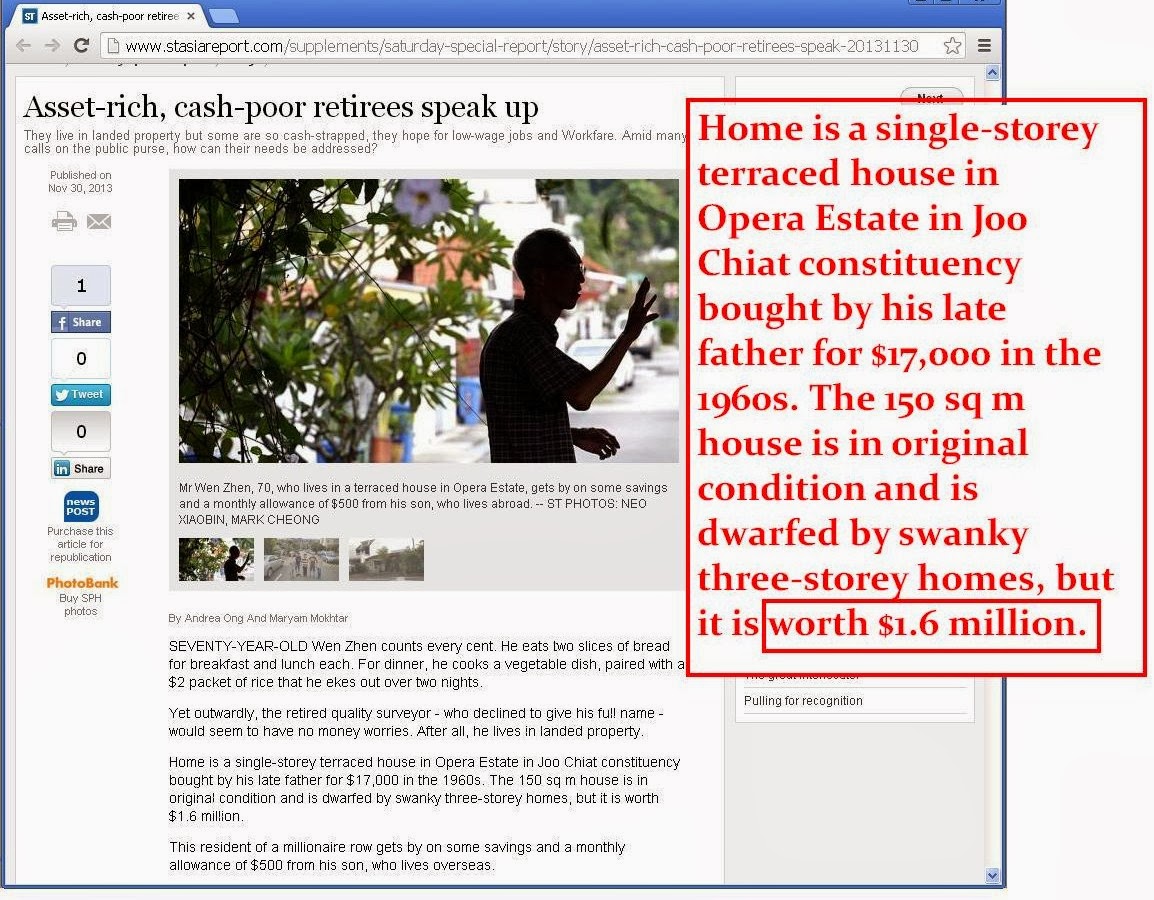
E.g. Joo Chiat terrace house: bought (1960s)= $17k, now priced $1.6million: so how to tax vs someone who made like S$1.583 million over one month buying and selling commodities/ futures etc: so method of tax will be too complicated: so the gahmen uses income tax method to tax, of course the commodity trader could have lost just as much the month before, so net net: he too pays zero tax if the profit/loss cancels out.

That said, gahmen can also increase property tax from the current 4% discount rate for owner occupants: make it 7% just like GST is: 7%: of course Singaporeans will get rebates, with PR getting 50% less etc. A home with 5 Singaporean occupants should also get more rebates than a home with 2 Singaporean occupants or 5PR occupants to be fair...
Asset-rich,+cash-poor+retirees+speak+up+(ST30Nov2013).JPG
(IMG source)
 
Last edited:

cherry6

Banned
Joined
Jan 16, 2007
Messages
11,993
Reaction score
445
Failed gahmen policy makes hiring foreigner PMET a cheaper/wiser option.

Failed gahmen policy makes hiring foreigner PMET a cheaper/wiser option.
The letter by Mr Lim Kay Soon lists 3 (if not 4) important reasons:
- The company did not need to pay CPF contributions for them;
- Their salary expectations were lower than Singaporeans'; and
- Their skill sets and experiences were on a par with those of Singaporeans.
4th reason: just like Singaporean workers, foreigner PMETs DO NOT CURRENTLY ATTRACT ANY PAYABLE WORK LEVY.
He ends with:
"At the moment, the local PME retrenchment rate is still high as employers are hiring foreigners for the cost savings.
Over the medium to long term, this will weaken Singapore's economy as local PMEs will become structurally unemployed as they lose their skills and employability."

Local PMEs don't have it easy
Published on May 31, 2014 1:22 AM
I REFER to the report ("MPs want more protection, support for local PMEs"; Tuesday)
When I was the general manager of a local IT company and, subsequently, a financial controller for a Dutch multinational corporation, I preferred hiring foreign mid-level staff for the following reasons:
- The company did not need to pay CPF contributions for them;
- Their salary expectations were lower than Singaporeans'; and
- Their skill sets and experiences were on a par with those of Singaporeans.

The total cost differential between local and foreign professionals, managers and executives (PMEs) was 20 to 40 per cent.
An Asian foreign employee with a degree and work experience can easily afford a city apartment and family sedan in his home country if he makes $200,000 during his stint here.
In Singapore, $200,000 would allow a Singaporean with the same qualifications to buy only a three-room HDB flat in outlying regions like Woodlands or Jurong. A family car would set him back by $120,000.
An Asian foreigner's cost of living back home is so much lower than ours. Hence, he is more willing to work for $3,000 to $5,000 a month. But a Singaporean graduate earning $4,000 a month will be trying to keep up with inflation.
It does not make sense that a foreign PME working here has a bright future, while his Singaporean counterparts are struggling with their living expenses, unless they are in strong sectors like banking and health care, where pay is high.
A levy is imposed when one hires a maid, but there is no such tax for hiring foreign PMEs. No wonder foreign PMEs were replacing local ones at an increasing rate until tighter restrictions were imposed last year.
At the moment, the local PME retrenchment rate is still high as employers are hiring foreigners for the cost savings.
Over the medium to long term, this will weaken Singapore's economy as local PMEs will become structurally unemployed as they lose their skills and employability.

Lim Kay Soon
The quoted report:
MPs want more protection, support for local PMEs
May 27, 2014. ; Janice Heng; The Straits Times
20140527-FooMeeHar-ZB%20copy.jpg

SINGAPORE - More protection and support should be given to professionals, managers and executives (PME), urged several MPs.
In the face of foreign competition, this "sandwiched class" needs more attention from the authorities, they said yesterday on the first day of debate on the President's Address.
Ms Foo Mee Har (West Coast GRC) made one of the strongest calls, saying firms should give qualified Singaporeans priority over foreigners for PME jobs. "It is time that we move our manpower policies for PMEs from a defensive, anti-discrimination position to one where we actively promote and champion the hiring and development of Singaporeans."
She noted that from August, firms will have to advertise on a jobs bank for 14 days before applying to hire foreign PMEs.
Yet the eventual decision is still up to them, she said. "The Manpower Minister further emphasised that (this) is not about 'Hire Singaporeans First' - but many are asking, 'Why not?'"
She wanted employers to have to prove that if a foreigner is hired, it is only because there are no suitable locals. Firms that hire foreigners should also be obliged to have a formal system for training and developing Singaporeans, and to ensure skills from foreign hires are transferred to locals.
"I believe that the current negative sentiment against foreign talent will ease when Singaporeans no longer feel that their livelihoods are threatened," she said.
If the issue of jobs for Singaporeans is not managed well, such resulting sentiments "can send the wrong signals to employers and foreign investors", noted Mr Zaqy Mohamad (Chua Chu Kang GRC).
Labour MP Patrick Tay (Nee Soon GRC) proposed several ways to help PMEs.
The Singapore Workforce Skills Qualifications framework of training courses should have a greater focus on PMEs, not just rank-and-file or mid-level staff.
Government funding should be more accessible to individual PMEs, and not just for firms.
Companies should be given incentives to let employees pursue a "second skill" during work hours.
And industries which regularly lay off employees - such as finance - could provide better support for the retrenched, he said. This could take the form of subsidies and payments, to act as a form of "unemployment insurance" to tide them over. "If the PME is laid off with no fault of his or her own, employers have a moral responsibility to see through the career transition for them."
For Non-Constituency MP Lina Chiam, the issue was that firms are being treated too well in comparison with workers. She called for "policies that favour Singaporeans, not an absolute growth model" for the economy.
This article was first published on May 27, 2014.
MPs want more protection, support for local PMEs, AsiaOne Singapore News
 
Last edited:
Important Forum Advisory Note
This forum is moderated by volunteer moderators who will react only to members' feedback on posts. Moderators are not employees or representatives of HWZ. Forum members and moderators are responsible for their own posts.

Please refer to our Community Guidelines and Standards, Terms of Service and Member T&Cs for more information.
Top