
You are using an out of date browser. It may not display this or other websites correctly.
You should upgrade or use an alternative browser.
You should upgrade or use an alternative browser.
Installing a 'whole house' surge protector.
- Thread starter Apparatus
- Start date
More options
Who Replied?Ok found this list of most reliable electrical services. I'm in the process of callng each to find who can
1) replace my 30yrs+ old circuit breaker box
2) add a whole-house surge protector
3) meggering at the Circuit Breaker
https://www.thebestsingapore.com/living/10-reliable-electrical-services-in-singapore/
I have spoken to a few electricians previously and talked to them about my house Circuit Breaker trip if subject to heavy thunderstorm and lightning...........I mean really strong thunder and lightning like a bomb explosion type near to my block. And all of them told me it's my house electrical wiring too old need to be replaced. I wonder whether changing of electrical wiring would give them more profits besides simply changing a Circuit Breaker box and adding a whole-house surge protector?

1) replace my 30yrs+ old circuit breaker box
2) add a whole-house surge protector
3) meggering at the Circuit Breaker
https://www.thebestsingapore.com/living/10-reliable-electrical-services-in-singapore/
I have spoken to a few electricians previously and talked to them about my house Circuit Breaker trip if subject to heavy thunderstorm and lightning...........I mean really strong thunder and lightning like a bomb explosion type near to my block. And all of them told me it's my house electrical wiring too old need to be replaced. I wonder whether changing of electrical wiring would give them more profits besides simply changing a Circuit Breaker box and adding a whole-house surge protector?
Last edited:
My about 30 yrs old Circuit Breaker box filled to the brim.

Added a new 40KA SPD(Surge Protector Device)

The new and larger Circuit Breaker box with the 40KA SPD added to the extreme right side with some space for future addtion of mcbs to the extreme left side, if needed.
The new ABB Type AC RCCB is now in place of the previous old ELCB


Meggering of wiring still show wires are in good condition of about 2 Mega Ohm(red scale). The higher the Mega Ohm the better. A few hundred Ohms indicates poor wiring condition and need to be replaced.
Also, performed trip test to make sure the RCCB is working

host pictures
Added a new 40KA SPD(Surge Protector Device)
The new and larger Circuit Breaker box with the 40KA SPD added to the extreme right side with some space for future addtion of mcbs to the extreme left side, if needed.
The new ABB Type AC RCCB is now in place of the previous old ELCB
Meggering of wiring still show wires are in good condition of about 2 Mega Ohm(red scale). The higher the Mega Ohm the better. A few hundred Ohms indicates poor wiring condition and need to be replaced.
Also, performed trip test to make sure the RCCB is working
host pictures
Last edited:
Now, I have Type 2 whole-house surge protection. I have also added Type 3 surge protection at the point of use by using APC surge-protected power strips. The higher the surge energy the better is the surge protector.
https://www.apc.com/shop/sg/en/products/APC-Performance-SurgeArrest-6-outlets-230V-UK/P-PM6-UK
Note that if you have DC devices at home like UPS, LED lightings etc then a Type A RCCB is required.
As of now there's no Type A RCCB being approved by the local authorities yet. So no electrical shop is carrying it for now.
However, if you buy online and install yourself then you take the risk of any consequences.
The electrical contractor I chose is 1ST ELECTRICAL SERVICES from below
https://www.thebestsingapore.com/living/10-reliable-electrical-services-in-singapore/
FYI
Types of RCCB(aka RCD). The old version is called ELCB
Type AC: Ensures tripping for residual AC currents. The type AC RCCB can only be used on "regular" AC power, like what you get from a utility or local generator.
Type A: Ensures tripping for residual AC currents and pulsating DC currents. Type A RCCB means they can
protect when the output of a device, typically electronics, is "pulsed DC", meaning what's called a "PWM output" (PWM stands for Pulse Width Modulation). Things like Solar Inverters and UPS systems create an "approximation" of AC power by pulsing DC (from batteries for instance) to make it looks like AC, called "pseudo AC".
Type B: Ensures tripping for residual AC currents, pulsating DC currents and smooth DC currents
Note :- UPS can come with "stepped" sine wave or true smooth sine wave. So check the type of UPS you are having then match the type of RCCB to it.
https://www.apc.com/shop/sg/en/products/APC-Performance-SurgeArrest-6-outlets-230V-UK/P-PM6-UK
Note that if you have DC devices at home like UPS, LED lightings etc then a Type A RCCB is required.
As of now there's no Type A RCCB being approved by the local authorities yet. So no electrical shop is carrying it for now.
However, if you buy online and install yourself then you take the risk of any consequences.
The electrical contractor I chose is 1ST ELECTRICAL SERVICES from below
https://www.thebestsingapore.com/living/10-reliable-electrical-services-in-singapore/
FYI
Types of RCCB(aka RCD). The old version is called ELCB
Type AC: Ensures tripping for residual AC currents. The type AC RCCB can only be used on "regular" AC power, like what you get from a utility or local generator.
Type A: Ensures tripping for residual AC currents and pulsating DC currents. Type A RCCB means they can
protect when the output of a device, typically electronics, is "pulsed DC", meaning what's called a "PWM output" (PWM stands for Pulse Width Modulation). Things like Solar Inverters and UPS systems create an "approximation" of AC power by pulsing DC (from batteries for instance) to make it looks like AC, called "pseudo AC".
Type B: Ensures tripping for residual AC currents, pulsating DC currents and smooth DC currents
Note :- UPS can come with "stepped" sine wave or true smooth sine wave. So check the type of UPS you are having then match the type of RCCB to it.
Last edited:
A circuit breaker has no relationship to what a surge protector does. Circuit breakers are for overcurrent protection. Will take anywhere from tenths of seconds to tens of minutes to disconnect an overcurrent on wires to appliances..
Surge protectors is about connecting a completely different (microseconds long) current to earth ground electrodes. For currents that must be on that wire and not on any wires to appliances. That 40kA protector does nothing without a low impedance (ie less than 3 meter) connection to earthing electrodes. Earth ground probably needed upgrading to make that protector effective.
Circuit breakers do not need that earthing wire to operate.
Earthing hardwire must have no sharp bends, must be separated from other non-grounding wires, has no splices, cannot be inside metallic conduit, and must be that short to create a low impedance connection.
Lightning is typically 20,000 amps. So a minimal 'whole house' protector is 50,000 amps. Apparently 40kA is a maximum for that box. So it will have to do.
Surge protectors is about connecting a completely different (microseconds long) current to earth ground electrodes. For currents that must be on that wire and not on any wires to appliances. That 40kA protector does nothing without a low impedance (ie less than 3 meter) connection to earthing electrodes. Earth ground probably needed upgrading to make that protector effective.
Circuit breakers do not need that earthing wire to operate.
Earthing hardwire must have no sharp bends, must be separated from other non-grounding wires, has no splices, cannot be inside metallic conduit, and must be that short to create a low impedance connection.
Lightning is typically 20,000 amps. So a minimal 'whole house' protector is 50,000 amps. Apparently 40kA is a maximum for that box. So it will have to do.
Last edited:
40KA is NOT a max for my box. There's still some space left/right inside the box.A circuit breaker has no relationship to what a surge protector does. Circuit breakers are for overcurrent protection. Will take anywhere from tenths of seconds to tens of minutes to disconnect an overcurrent on wires to appliances..
Surge protectors is about connecting a completely different (microseconds long) current to earth ground electrodes. For currents that must be on that wire and not on any wires to appliances. That 40kA protector does nothing without a low impedance (ie less than 3 meter) connection to earthing electrodes. Earth ground probably needed upgrading to make that protector effective.
Circuit breakers do not need that earthing wire to operate.
Earthing hardwire must have no sharp bends, must be separated from other non-grounding wires, has no splices, cannot be inside metallic conduit, and must be that short to create a low impedance connection.
Lightning is typically 20,000 amps. So a minimal 'whole house' protector is 50,000 amps. Apparently 40kA is a maximum for that box. So it will have to do.
Actually, can get a 65KA from HAGER but shop say no stock on hand but must place order for it. Other brands have 80KA, 100KA, 140KA as well
The higher the KA the better the protection but the higher the "Let-through" voltage as well. Examples for HAGER
20KA SPD with "Let-through" voltage of about 1.3KV
40KA SPD with "Let-through" voltage of about 1.5KV
65KA SPD with "Let-through" voltage of about 1.8KV
so the downstream devices must be able to withstand the "Let-through" voltage otherwise they'll be damaged. The way out is to use Type 3 point-of-use surge protector strip/wall socket before the devices. This will further suppress the "Let-through" voltage very much down further, thus giving the protection needed. The higher the surge energy for the surge protector strip/wall socket the better.
The SPD is installed inside the Circuit Breaker Box so whatever 3m wiring or not the wiring is there. Alternatively, you can install the SPD outside the circuit breaker box.
I'll monitor the SPD performance when there's hard lightning strikes in the future. If it's still shorted then I'll go for 65KA SPD
Circuit breakers and fuses are current-activated devices, whilst SPD is a voltage activated device. When over current/voltage hits a fuse/SPD the fuse will blow and the SPD will become shorted. Both will need to be replaced. The circuit breaker will be opened and thus protect the circuits. You can reset the circuit breaker afterwards.
Last edited:
The higher that current number, then the lower the resulting surge voltage will be. A concept taught to first semester engineers. It is a current source. Voltage only increases when something foolishly tries to 'block' or 'absorb' a surge - such as a plug-in protector.The higher the KA the better the protection but the higher the "Let-through" voltage as well.
...
so the downstream devices must be able to withstand the "Let-through" voltage otherwise they'll be damaged. The way out is to use Type 3 point-of-use surge protector strip/wall socket before the devices. This will further suppress the "Let-through" voltage very much down further,
Higher tens of thousands of amps define a protector's life expectancy over many decades and many direct lightning strikes. Protection during each event is defined by that low impedance connection to and the quality of earth grounds. The better (lower impedance and more conductive) that connection to earth means a surge is less likely to be anywhere inside.
Let-through voltage says nothing about how well protection works. Let-through voltage only defines what service voltage can connect to that protector. For 120 volt service, that protector must be at least 330 volts. For 230 volt service, it must be something well above 500 volts. For telephone, that let-through voltage is often somewhere between 200 and 300 volts. In every case, let-through voltages defines a voltage so that normal service voltages do not destroy that protector.
Type 3 protectors are so grossly undersized as to be more than 10 meters from a main power panel and earth ground. So that is does not attempt too much protection - and therefore threaten human life. Plug-in protectors, essentially, have no earth ground. But worse, can even compromise (bypass) what is already superior protection inside electronics. Yes, sometimes make damage easier.
An IEEE brochure demonstrated this. A protector in one room earth a surge 8,000 volts destructively through a TV in the adjacent room. That protector has no low impedance (ie less than 3 meter) connection to earth ground electrodes. So it earthed that surge destructively through a best connection - that TV.
Only Type 1 and Type 2 protectors are sufficient sized to make that low impedance connection to earth.
That existing panel may not have a sufficient connection to earth. And just to be clear, every ground is different; with a different adjective preceding the word "ground". Relevant here is one specific ground - single point earth ground.
A protector is only as effective as its low impedance connection to and the quality of those earthing electrodes. Protectors are only a connection device to what does all protection. So that a surge is not anywhere inside. Then best protection, already inside all appliances, is not overwhelmed.
Devices that would suppress ('block' or 'absorb') a surge are best called scams. Are typically inferior to protection already inside appliances. But sure are profitable.
Yes, the higher the KA the longer the surge protector can last by absorbing more hits.
Your quote
For 120 volt service, that protector must be at least 330 volts. For 230 volt service, it must be something well above 500 volts. For telephone, that let-through voltage is often somewhere between 200 and 300 volts. In every case, let-through voltages defines a voltage so that normal service voltages do not destroy that protector.
Unquote
I think UL states the best clamping voltage is 330V for 120V service. Anything higher than that is not better. And UL test does not indicate for 230V service if I'm not wrong. More likely Type 3 surge protectors for 230V are indicated in surge energy. If you check out power strips with surge protection locally you'll find the surge energy being indicated instead of clamping voltage. Do you know where to find one locally which indicates the clamping voltage because surge energy is a bit tough to accept/reject? From what I read from the net one with more than 1KJ is recommended.
Quote from below link
IEEE let-through rating and UL 1449 compliance
The 'Institute of Electrical and Electronics Engineers' (IEEE) Let-Through Voltage rating is based on a test that subjects a Surge Protector to a 6,000 volt spike. The rating equates to the amount of excess voltage that reaches connected equipment. The lower the number, the better the performance of the Surge Protector is. Underwriter's Laboratory's UL1449 surge protection safety standard uses these ratings to help users gauge performance. UL's best Transient Voltage Surge Suppressor (TVSS) Let-Through Voltage rating is "300V".
Unquote
https://www.apc.com/shop/us/en/products/APC-Essential-SurgeArrest-6-Outlet-Wall-Mount-120V/P-P6W
Your quote
That existing panel may not have a sufficient connection to earth. And just to be clear, every ground is different; with a different adjective preceding the word "ground". Relevant here is one specific ground - single point earth ground.
Unquote
Staying in a high rise HDB flat for me don't give me much choice unlike staying in landed property. You can even implement Type 1 whole house surge protection if you stay in a landed property. If you stay in a landed property you can do all the right things to protect your house/appliances. For me I just have to make use of what's being provided.
Your quote
Devices that would suppress ('block' or 'absorb') a surge are best called scams. Are typically inferior to protection already inside appliances. But sure are profitable.
Unquote
It's up to you how you see them lah. I have talked to people and they have experienced their TVs being blown when there's a strong lightning thunderstorm and, yes, they do not have SPD installed.........so so for better protection inside the devices
In fact, nowadays, devices with microprocessor and delicate electronics would require more protection against voltage surges apart from what's being provided in the device itself
Your quote
For 120 volt service, that protector must be at least 330 volts. For 230 volt service, it must be something well above 500 volts. For telephone, that let-through voltage is often somewhere between 200 and 300 volts. In every case, let-through voltages defines a voltage so that normal service voltages do not destroy that protector.
Unquote
I think UL states the best clamping voltage is 330V for 120V service. Anything higher than that is not better. And UL test does not indicate for 230V service if I'm not wrong. More likely Type 3 surge protectors for 230V are indicated in surge energy. If you check out power strips with surge protection locally you'll find the surge energy being indicated instead of clamping voltage. Do you know where to find one locally which indicates the clamping voltage because surge energy is a bit tough to accept/reject? From what I read from the net one with more than 1KJ is recommended.
Quote from below link
IEEE let-through rating and UL 1449 compliance
The 'Institute of Electrical and Electronics Engineers' (IEEE) Let-Through Voltage rating is based on a test that subjects a Surge Protector to a 6,000 volt spike. The rating equates to the amount of excess voltage that reaches connected equipment. The lower the number, the better the performance of the Surge Protector is. Underwriter's Laboratory's UL1449 surge protection safety standard uses these ratings to help users gauge performance. UL's best Transient Voltage Surge Suppressor (TVSS) Let-Through Voltage rating is "300V".
Unquote
https://www.apc.com/shop/us/en/products/APC-Essential-SurgeArrest-6-Outlet-Wall-Mount-120V/P-P6W
Your quote
That existing panel may not have a sufficient connection to earth. And just to be clear, every ground is different; with a different adjective preceding the word "ground". Relevant here is one specific ground - single point earth ground.
Unquote
Staying in a high rise HDB flat for me don't give me much choice unlike staying in landed property. You can even implement Type 1 whole house surge protection if you stay in a landed property. If you stay in a landed property you can do all the right things to protect your house/appliances. For me I just have to make use of what's being provided.
Your quote
Devices that would suppress ('block' or 'absorb') a surge are best called scams. Are typically inferior to protection already inside appliances. But sure are profitable.
Unquote
It's up to you how you see them lah. I have talked to people and they have experienced their TVs being blown when there's a strong lightning thunderstorm and, yes, they do not have SPD installed.........so so for better protection inside the devices
In fact, nowadays, devices with microprocessor and delicate electronics would require more protection against voltage surges apart from what's being provided in the device itself
Last edited:
First, UL says nothing about appliance protection. UL is about protecting humans. They do not care that a protector fails in testing. Only that a failure does not create a threat to human life. ie spit sparks or flame.
Second, 330 volts defines a protector for 120 volt service. It says nothing about protection. Only that a 200 volt protector and a 600 volt protector are not designed for 120 volt service.
A 600 volt protector does less protection for electronics because electronics have long been required to suffer up to 600 volt transients without damage. For 120 volt service, a 330 let-through voltage is required. Not higher. And not lower;.
Most electronics today have exceeded that "600 volt without damage" requirement. One Seasonic power supply defined its internal protection at 1,800 volts.
Ethernet was long required to suffer 2,000 volt transients without damage. This data interface chips (now obsolete) at https://forums.hardwarezone.com.sg/threads/installing-a-whole-house-surge-protector.6688280/ , clearly states 15,000 volts without damage.
Electronics are some of THE most robust appliances in a house. A reality not found where fear creates conclusions. Electronics have become more robust (not more sensitive) over the decades. Specification numbers say so. Wild speculation, from so many others who ignore numbers, deny reality. To promote fear; not knowledge.
Third, 8/20 microsecond waveforms do not define a let-through voltage. Those define a protector part's joule rating. A different and unrelated parameter. UL 1449 says nothing about protection. It rates a protector to be a lesser threat to human life. Problem with UL 1449? This still keeps happening.
Four, what determines how much spike reaches an appliance? Impedance and earth ground. UL does not test for nor discuss wire impedance nor earthing. Impedance (how a protector connects to earth ground) is a major factor in appliance protection. Impedance says nothing about human protection. So UL does not discuss it.
Some numbers. A plug-in protector tries to earth a tiny 100 amp surge down 50 feet of AC wire. That wire may be 0.3 ohms resistance. And 120 ohms impedance. 100 amps times 120 ohms is something less than 12,000 volts. Why less than? Because that spike must find other (destructive) paths to earth. Does same with a 330 volt protector or a 400 volt protector.
IEEE demonstrates this in a brochure. A protector in one room (without a low impedance - ie less than 10 foot - connection to earth) simply earthed that surge 8,000 volts destructively through a TV in an adjacent room. What difference would a 70 volt increased let-through voltage make? Nothing.
Why thousands of volts? Wire impedance. What paths are destructive and not destructive? UL says nothing. Since that is about appliance protection - not human protection.
A protector is only as effective as its connection to and quality of single point earth ground (all four words have electrical significance). Where does a let-through voltage have relevance? It doesn't. UL does not discuss that connect to earth ground nor the quality of earth ground electrodes. It is irrelevant to testing for human protection. And that is critical for making a protector effective.
Five, no protector does protection. Not one. A protector is only a connecting device to what does all protection. UL only tests the connecting device. UL says and tests nothing that actually defines and does protection. Protection of appliances is not the purpose of UL.
Six, being in a high rise means all such options are available and effective. Much of this research in the 1930s was done in the Empire State Building - also a high rise. A solution may be rented from the AC utility. First one of many options. However, if 'whole house' (Type 1 or Type 2) protectors are not properly earthed, then safest for both you and appliances is no Type 3 (plug-in) protector.
A protector, adjacent to electronics, can compromise (bypass) superior protection inside that appliance. As we engineers demonstrated in a design review. Where myths from observation were exposed and discounted.
Again, electronics (due to circuits required to power microprocessors) are among THE most robust appliance inside a house. For example, ethernet port must withstand up to 2,000 volts without damage. Another (now obsolete) interface chip defines protection up to 15,000 volts. (https://datasheets.maximintegrated.com/en/ds/MAX1487E-MAX491E.pdf) We use well proven science reported by numbers in datasheets.
Seven, talk to anyone who experienced something. Most will only make conclusions from observations. All were taught, in elementary school science, that any conclusion only from observation is classic junk science.
We first learn why electronics failed (ie damage created by plug-in protectors). Sometimes fix things by tracing a surge path (replacing only semiconductors that conducted that surge). And even submitted some analysis to design reviews. A conclusions only from observation is junk science. Best evidence comes from the dead body - an autopsy.
We first discover a human mistake that made damage possible). And then use well proven science to correct that human mistake.
Eight, many protection systems do not even have protectors. Best protection on TV cable is a hardwire to single point earth ground. No protector required or installed to have best protection.
Numerous urban myths to unlearn. Starting with UL. UL says nothing about protecting appliances. UL says nothing about where a surge harmlessly dissipates. UL only tests items for threats to human life. A protector can fail - do no protection. And still can obtain a UL 1449 listing. Because it did not spit sparks or threaten human life during testing. Even when failed.
Second, 330 volts defines a protector for 120 volt service. It says nothing about protection. Only that a 200 volt protector and a 600 volt protector are not designed for 120 volt service.
A 600 volt protector does less protection for electronics because electronics have long been required to suffer up to 600 volt transients without damage. For 120 volt service, a 330 let-through voltage is required. Not higher. And not lower;.
Most electronics today have exceeded that "600 volt without damage" requirement. One Seasonic power supply defined its internal protection at 1,800 volts.
Ethernet was long required to suffer 2,000 volt transients without damage. This data interface chips (now obsolete) at https://forums.hardwarezone.com.sg/threads/installing-a-whole-house-surge-protector.6688280/ , clearly states 15,000 volts without damage.
Electronics are some of THE most robust appliances in a house. A reality not found where fear creates conclusions. Electronics have become more robust (not more sensitive) over the decades. Specification numbers say so. Wild speculation, from so many others who ignore numbers, deny reality. To promote fear; not knowledge.
Third, 8/20 microsecond waveforms do not define a let-through voltage. Those define a protector part's joule rating. A different and unrelated parameter. UL 1449 says nothing about protection. It rates a protector to be a lesser threat to human life. Problem with UL 1449? This still keeps happening.
Four, what determines how much spike reaches an appliance? Impedance and earth ground. UL does not test for nor discuss wire impedance nor earthing. Impedance (how a protector connects to earth ground) is a major factor in appliance protection. Impedance says nothing about human protection. So UL does not discuss it.
Some numbers. A plug-in protector tries to earth a tiny 100 amp surge down 50 feet of AC wire. That wire may be 0.3 ohms resistance. And 120 ohms impedance. 100 amps times 120 ohms is something less than 12,000 volts. Why less than? Because that spike must find other (destructive) paths to earth. Does same with a 330 volt protector or a 400 volt protector.
IEEE demonstrates this in a brochure. A protector in one room (without a low impedance - ie less than 10 foot - connection to earth) simply earthed that surge 8,000 volts destructively through a TV in an adjacent room. What difference would a 70 volt increased let-through voltage make? Nothing.
Why thousands of volts? Wire impedance. What paths are destructive and not destructive? UL says nothing. Since that is about appliance protection - not human protection.
A protector is only as effective as its connection to and quality of single point earth ground (all four words have electrical significance). Where does a let-through voltage have relevance? It doesn't. UL does not discuss that connect to earth ground nor the quality of earth ground electrodes. It is irrelevant to testing for human protection. And that is critical for making a protector effective.
Five, no protector does protection. Not one. A protector is only a connecting device to what does all protection. UL only tests the connecting device. UL says and tests nothing that actually defines and does protection. Protection of appliances is not the purpose of UL.
Six, being in a high rise means all such options are available and effective. Much of this research in the 1930s was done in the Empire State Building - also a high rise. A solution may be rented from the AC utility. First one of many options. However, if 'whole house' (Type 1 or Type 2) protectors are not properly earthed, then safest for both you and appliances is no Type 3 (plug-in) protector.
A protector, adjacent to electronics, can compromise (bypass) superior protection inside that appliance. As we engineers demonstrated in a design review. Where myths from observation were exposed and discounted.
Again, electronics (due to circuits required to power microprocessors) are among THE most robust appliance inside a house. For example, ethernet port must withstand up to 2,000 volts without damage. Another (now obsolete) interface chip defines protection up to 15,000 volts. (https://datasheets.maximintegrated.com/en/ds/MAX1487E-MAX491E.pdf) We use well proven science reported by numbers in datasheets.
Seven, talk to anyone who experienced something. Most will only make conclusions from observations. All were taught, in elementary school science, that any conclusion only from observation is classic junk science.
We first learn why electronics failed (ie damage created by plug-in protectors). Sometimes fix things by tracing a surge path (replacing only semiconductors that conducted that surge). And even submitted some analysis to design reviews. A conclusions only from observation is junk science. Best evidence comes from the dead body - an autopsy.
We first discover a human mistake that made damage possible). And then use well proven science to correct that human mistake.
Eight, many protection systems do not even have protectors. Best protection on TV cable is a hardwire to single point earth ground. No protector required or installed to have best protection.
Numerous urban myths to unlearn. Starting with UL. UL says nothing about protecting appliances. UL says nothing about where a surge harmlessly dissipates. UL only tests items for threats to human life. A protector can fail - do no protection. And still can obtain a UL 1449 listing. Because it did not spit sparks or threaten human life during testing. Even when failed.
Last edited:
No surge protector/mcb/rccb is perfect even if they get certified and meet regulatory requirements.
Yes, surge protected power strip can melt, mcb don't trip, rccb don't trip etc so does that mean we don't use them? There are many surge protectors in the market some branded and certified but many not. Care in selecting the right surge protector is essential.
Your quote
Six, being in a high rise means all such options are available and effective. Much of this research in the 1930s was done in the Empire State Building - also a high rise. A solution may be rented from the AC utility. First one of many options. However, if 'whole house' (Type 1 or Type 2) protectors are not properly earthed, then safest for both you and appliances is no Type 3 (plug-in) protector.
Unquote
Theoretically so. But in actuality you can see that some units in your block will trip when there's a strong lightning strike nearby your block. Lightning always takes the path of least resistance. Whatever surges caused by the lightning will go through your house and trip the mcb(maybe not depending on the magnitude of the surge) if your unit is of the least resistance. There is no Type 1 being provided for each HDB unit. Type 2 and 3 are used optionally by the owner. Like I mentioned before if you stay in landed property you can do all the right things for protection. With HDB you can only do with what's being provided for. And if you want to depend on your electronic devices for their built-in protection then go ahead.
All your household electrical/electronic devices are connected to the cicuit breaker box. Whether the connections are proper will depend on the electrician wiring up the box. Commoners will not know how.
Yes, surge protected power strip can melt, mcb don't trip, rccb don't trip etc so does that mean we don't use them? There are many surge protectors in the market some branded and certified but many not. Care in selecting the right surge protector is essential.
Your quote
Six, being in a high rise means all such options are available and effective. Much of this research in the 1930s was done in the Empire State Building - also a high rise. A solution may be rented from the AC utility. First one of many options. However, if 'whole house' (Type 1 or Type 2) protectors are not properly earthed, then safest for both you and appliances is no Type 3 (plug-in) protector.
Unquote
Theoretically so. But in actuality you can see that some units in your block will trip when there's a strong lightning strike nearby your block. Lightning always takes the path of least resistance. Whatever surges caused by the lightning will go through your house and trip the mcb(maybe not depending on the magnitude of the surge) if your unit is of the least resistance. There is no Type 1 being provided for each HDB unit. Type 2 and 3 are used optionally by the owner. Like I mentioned before if you stay in landed property you can do all the right things for protection. With HDB you can only do with what's being provided for. And if you want to depend on your electronic devices for their built-in protection then go ahead.
All your household electrical/electronic devices are connected to the cicuit breaker box. Whether the connections are proper will depend on the electrician wiring up the box. Commoners will not know how.
Last edited:
We, who spend many times less money for best protection, do not waste even a penny on a plug-in protector. Even 100 years ago, where surge damage could not happen, money was not wasted on plug-in magic boxes. But so many today are that easily scammed. Because hearsay, advertising and other sources of lies are that easily believed.No surge protector/mcb/rccb is perfect even if they get certified by some regulatory requirements.
Effective protection means even direct lightning strikes without damage to a protector. Why then would anyone waste tens of times more money on a protector that can melt?
Mcb, rccd, rcds, etc do not claim to or even try to protect from surges. Why even discuss them? Parameters make that obvious.
Nothing posted was only theoretical. Electronics atop the Empire State Building suffer about 23 direct lightning strikes annually. For the WTC, that number was 40 annually - without damage. Nothing theoretical about reality demonstrated by examples all over the world. How about some case studies.
So you don't pay for your electricity? if you do, then best protection is installed a meter that you rent.
But we know this. If Type 1 or Type 2 protectors are not properly installed, then best protection for appliances is using no Type 3 protectors. Again, an IEEE brochure demonstrated this. A protector in one room earth a surge 8,000 volts destructively through a TV in the adjacent room. That protector has no low impedance (ie less than 3 meter) connection to earth ground electrodes. So it earthed that surge destructively through a best connection - that TV. That Type 3 protector can even make surge damage easier.
What does a plug-in protector do? It connects a surge from any one wire onto all others. Now that surge has even more paths to find earth ground, destructively via nearby appliances. In short, makes damage easier if a Type 1 or Type 2 protector does not exist.
Also has a nasty habit of creating house fires. An example created by a plug-in protector that was not protected by effective protectors:
An effective solution (today and over 100 years ago) always answers this question. Where do hundreds of thousands of joules harmlessly dissipate. A proven solution remains functional for many decades after many direct lightning strikes (and other surges).Lizzie Steinmetz, 5, was getting ready for bed with her little brother when she heard a strange noise. "It was like a buzzing noise sound," Lizzie said. She said she saw flames shooting up from a surge protector sitting on top of her dresser.
Like I said, no protection device is perfect. However, having different tiers (like Type 1, 2 and 3) would offer better protection. Note that this is not the same as daisy-chaining surge protection devices, which is dangerous and prohibited.
There are certain criteria when choosing a Type 3 surged protected power strip and that Belkin example above apparently did not meet some. A Type 3 surge protector should come with UL-certified, having high energy absorption (1000J and above) and light indicators to indicate its functionality e.g. surge protection light, ground indicator light etc. A surge protector is only as effective as its earth ground, so it must be properly grounded.
The world has many manufacturers of surge protecting devices and many surge protecting devices are used in homes. They can't be wrong in all cases.............well, maybe sometime if not properly applied.
In Spore the ELCB has been replaced by the RCCB(aka RCD) because the latter offers better human protection. In the years to come I believe our authorities will mandate the use of SPD like the new 2020 NEC code in the US. FI, the purpose of the NEC is to protect people from electrical hazards, as well as to keep the property safe from things like electrical fires. Read more below
https://kbelectricpa.com/2020-nec-code-change-surge-protection-now-required/
There are certain criteria when choosing a Type 3 surged protected power strip and that Belkin example above apparently did not meet some. A Type 3 surge protector should come with UL-certified, having high energy absorption (1000J and above) and light indicators to indicate its functionality e.g. surge protection light, ground indicator light etc. A surge protector is only as effective as its earth ground, so it must be properly grounded.
The world has many manufacturers of surge protecting devices and many surge protecting devices are used in homes. They can't be wrong in all cases.............well, maybe sometime if not properly applied.
In Spore the ELCB has been replaced by the RCCB(aka RCD) because the latter offers better human protection. In the years to come I believe our authorities will mandate the use of SPD like the new 2020 NEC code in the US. FI, the purpose of the NEC is to protect people from electrical hazards, as well as to keep the property safe from things like electrical fires. Read more below
https://kbelectricpa.com/2020-nec-code-change-surge-protection-now-required/
Last edited:
One makes decisions AFTER numbers are obtained. An IEEE Standard says a properly earthed solution will do 99.5% to 99.9% of the protection. That means a Type 3 protector might do 0.2% more protection. Spend $1 per protected appliance for effective protection. Only and if that exists, then a plug-in protector adds tiny more protection costing tens of times more money.Like I said, no protection device is perfect. However, having different tiers (like Type 1, 2 and 3) would offer better protection. Note that this is not the same as daisy-chaining surge protection devices, which is dangerous and prohibited.
1000 joule plug-in protector does that little more for so many times more money. They know their target market.
IEEE adds more perspective (numbers):
Still, a 99.5% protection level will reduce the incidence of direct strokes from one stroke per 30 years ... to one stroke per 6000 years ... Protection at 99.5% is the practical choice.
None are wrong. Each protector only does what its specification numbers say. Whereas a scammed consumer never posts and ignores all numbers. Some protectors are profit centers. Using obscene profits to promote an image - and no effective protection. They are not wrong. They know their target market: consumers who deny facts with numbers.
Electrical code was also challenged to list ESE devices. With threats of lawsuits to bankrupt the NFPA. NFPA also rejected those ineffective devices. Probably for same reason they would not require Type 3 protectors. Type 1 and Type 2 protectors are now considered essential to protect human life. Apparently because Type 3 protectors create threats to human life. Are now required for same reasons why human threats, created by extension cords, resulted in arc fault circuit breaker requirements.
UL also says nothing about a protector being effective. And not the purpose of UL. UL is about human protection. UL standards for protectors were constantly upgraded. Because Type 3 protectors with a UL listing kept making fires due to catastrophic failure of tiny joule protector parts..
Manufacturers are not wrong. Plug-in protectors do exactly what a manufacturer desires. Consumers are easily wrong. For same reasons that a majority foolishly believed Saddam had WMDs. A majority also knew that smoking cigarettes increased health. In both examples, soundbites, subjective reasoning, hearsay, and massive advertising "proved" it was true. Easy is to sex it up - thereby deceive - when relevant numbers are ignored and not provided.
Cigarette manufacturers also were not wrong. They correctly identified and marketed to naive consumers.
A thousands joule protector is near zero. Numbers bluntly say why. Surges can be hundreds of thousands of joules. The educated and informed spend about $1 per appliance for solutions that make hundreds of thousands of joules irrelevant. Even electronics typically make a puny 1000 joule surge irrelevant. 1000 joules can destroy plug-in protectors. Manufacturer specifications say so. Examples say so. Consumers who ignore all numbers recommend it anyway.
Why would anyone spend tens of dollars for only five cent protector parts? Deception is easy. Eyes glaze over with numbers. Manufacturer knows their target market. For the same reason all those over the counter cold remedies (ie Airborne, Emergen-C) also so easily target naive consumers - for obscene profits. They are not wrong. A consumer, who all but begs to be scammed, is wrong.
Effective protection always answers this question. Where do hundreds of thousands of joules harmlessly dissipate? That number repeated how many times because it is constantly ignored here. Protection that is essential to protect Type 3 protectors.
Your telco has demonstrated same for over 100 years. Telephone lines go underground before entering a CO. Every wire connects to earth ground, as short as possible, via protectors in those vaults. Making a connection to earth as short as possible (ie low impedance). They also want protectors to be up to 50 meters distant from electronics. Separation (high impedance) is also essential for effective protection. Protectors must not be adjacent to electronics. To not make damage easier.
How many reasons with numbers expose urban myths?
If a plug-in protector is effective, then please post some numbers that say so. A 1000 joule protector is one step above near zero protection. Only those educated by advertising lies would promote that as a high energy device.
A protector is only as effective as its low impedance connection to and quality of earth ground. No plug-in protector has an earth ground connection. Must be far aways so as to not threaten human life. Numbers that define high profit, deceptively promoted, plug-in protectors as if magic boxes. That somehow do protection without any earth ground.
1000 joules is less protection that what is already inside most electronics. 1000 joules was never high energy protection. That myth is openly promoted to the most naive in advertising lies. Those manufacturers are not wrong. For the same reason Monster also sells ineffective products with obscene profit margins. They know their target market. They are not wrong. They successfully promote a puny 1000 joules as high energy - subjectively. The most naive automatically believe it - and believed that smoking cigarettes increased health.
ELCBs. RCCDs, GFCIs, etc are irrelevant to appliance protection. Have no place in a discussion of protectors. Numbers also say why 99.5% to 99.9% protection is the practical choice - for tens of times less money. Especially to protect least robust appliances: Type 3 protectors. All defined by numbers. All denied only using speculation and subjective reasoning.
Last edited:
To follow up, my APC Type 3 point-of-use surge protection devices just arrived
1) 1xBR1500GI UPS
2) 1xBackUp Battery BR24BPG for the above UPS
3) 1xBR900MI UPS
4) 2xSurgeArrest PM8-UK Power Strips with 8x outlets each
They are for the protection of my electrical/electronic items.
- UPS meant for continuous power supply to router, modem, hubs, ip cameras, safety detectors etc
- SurgeArrest surge-protected power strips for AV equipment, laptop, PC, TV etc
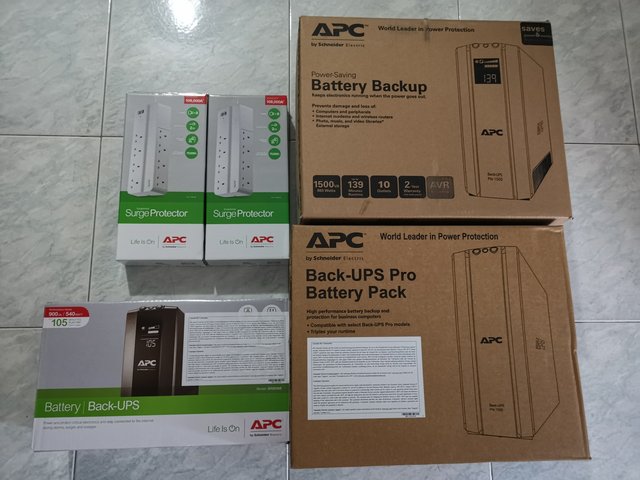
1) 1xBR1500GI UPS
2) 1xBackUp Battery BR24BPG for the above UPS
3) 1xBR900MI UPS
4) 2xSurgeArrest PM8-UK Power Strips with 8x outlets each
They are for the protection of my electrical/electronic items.
- UPS meant for continuous power supply to router, modem, hubs, ip cameras, safety detectors etc
- SurgeArrest surge-protected power strips for AV equipment, laptop, PC, TV etc
Last edited:
Ha....ha....ha......finally some advices given for surge protection here
https://www.asiaone.com/lifestyle/electrical-appliance-fires-who-will-compensate
Quote
Ensure that you do not overload your power extender and inculcate the habit of replacing them more frequently, every three - five years if it is constantly under high loads.
Unquote
https://www.asiaone.com/lifestyle/electrical-appliance-fires-who-will-compensate
Quote
Surge protection and adaptors
Should you have any appliances that are cheaply made or do not have the safety mark, ensure that there is proper grounding and surge protection. Purchase power extenders or adaptors that have surge protection and are well-grounded will reduce the risk of electrical fires. As much as possible, do not leave such appliances unattended.Ensure that you do not overload your power extender and inculcate the habit of replacing them more frequently, every three - five years if it is constantly under high loads.
Unquote
Last edited:

XcoldstarX
Arch-Supremacy Member
- Joined
- Nov 4, 2004
- Messages
- 10,939
- Reaction score
- 89
The article you linked seems more like an advertisement for fire insurance than providing numbers and data on surge protection.

etegration
High Supremacy Member
- Joined
- Jan 1, 2000
- Messages
- 25,054
- Reaction score
- 6
anything bestinsingapore.com or whatever **** can skip. you pay, you get on that list.The article you linked seems more like an advertisement for fire insurance than providing numbers and data on surge protection.

doki81
Arch-Supremacy Member
- Joined
- Jun 11, 2010
- Messages
- 12,220
- Reaction score
- 955
Hi TS, did your issue on DB tripped resolve with this SPD?Ok found this list of most reliable electrical services. I'm in the process of callng each to find who can
1) replace my 30yrs+ old circuit breaker box
2) add a whole-house surge protector
3) meggering at the **
https://www.thebestsingapore.com/living/10-reliable-electrical-services-in-singapore/
I have spoken to a few electricians previously and talked to them about my house ** trip if subject to heavy thunderstorm and lightning...........I mean really strong thunder and lightning like a bomb explosion type near to my block. And all of them told me it's my house electrical wiring too old need to be replaced. I wonder whether changing of electrical wiring would give them more profits besides simply changing a ** box and adding a whole-house surge protector?
@Apparatus
any devices to recommend to protect electronic equipment from power surges/spikes/Lightning strikes etc....
got any ups that can do the above without battery? or install a spd at DB box
any devices to recommend to protect electronic equipment from power surges/spikes/Lightning strikes etc....
got any ups that can do the above without battery? or install a spd at DB box
@Apparatus
any devices to recommend to protect electronic equipment from power surges/spikes/Lightning strikes etc....
got any ups that can do the above without battery? or install a spd at DB box
Have you read through the whole page? Only 1 page lah
If you stay in landed you can have Type 1 protection. If you stay in high-rise then only can have Type 2 and Type 3 protection. In the case of HDB the Type 1 is handled by HDB for its lightning protection
Last edited:
Important Forum Advisory Note
This forum is moderated by volunteer moderators who will react only to members' feedback on posts. Moderators are not employees or representatives of HWZ. Forum members and moderators are responsible for their own posts.
Please refer to our Community Guidelines and Standards, Terms of Service and Member T&Cs for more information.
Please refer to our Community Guidelines and Standards, Terms of Service and Member T&Cs for more information.
