GE2025: PSP to contest West Coast-Jurong West and Chua Chu Kang, says it will field fewer candidates
?
The press conference was fronted by PSP chief Leong Mun Wai, the party’s first vice-chairperson Hazel Poa, and chairman Tan Cheng Bock. ST PHOTO: MARK CHEONG
SINGAPORE – The opposition Progress Singapore Party (PSP) on April 6 said it will be contesting West Coast-Jurong West and Chua Chu Kang GRCs, and that it will be fielding fewer candidates this general election.
Party chief Leong Mun Wai did not provide details on how many candidates the party will put forward this election season. The party fielded 24 candidates in GE2020.
Asked about the reason for this, Mr Leong said that contesting a general election was a “very complicated affair”, citing problems like having dedicated manpower to canvass the ground. “Our conclusion from the last election is that we need to focus a bit more,” he added.
He also said that PSP is still working out plans to contest other constituencies.
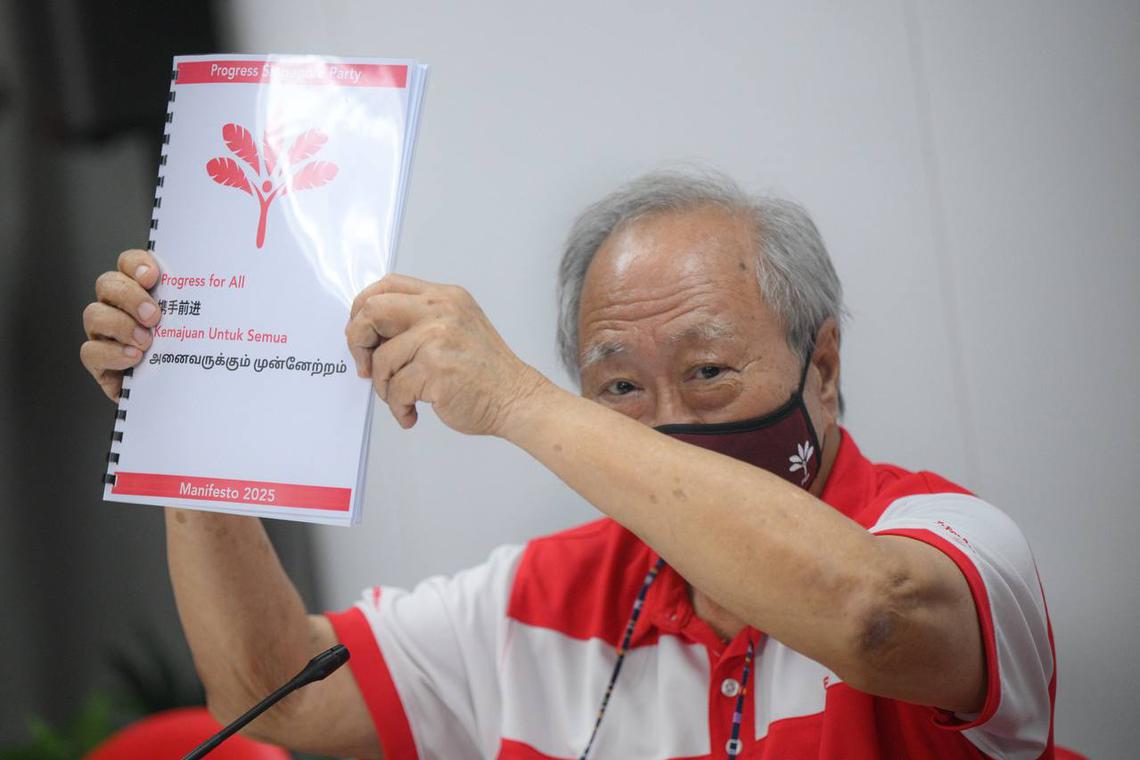
Mr Leong made this announcement at the launch event for PSP’s manifesto, which focuses on bread-and-butter issues such as cost of living and jobs.
The press conference was fronted by Mr Leong, the party’s first vice-chairperson Hazel Poa, and party chairman Tan Cheng Bock.
PSP chairman Tan Cheng Bock presenting the party’s manifesto and campaign slogan at the PSP headquarters on April 6. ST PHOTO: MARK CHEONG
The launch event makes PSP one of the first political parties to launch a manifesto ahead of the 2025 General Election.
The manifesto sets out over 60 policy ideas centred on several themes: the cost of living, housing, jobs and wages, social safety nets, education and governance.
Mr Leong said: “Most of the policies have already been proposed in Parliament. Among the new policies, many are aimed at strengthening protections for workers to secure livelihoods and improve work-life balance for workers.”
Mr Leong and Ms Poa are Non-Constituency MPs who have raised some of these issues in Parliament, including the need to reduce statutory working hours to 40 hours a week, down from the current 44 hours, and increasing annual leave entitlement from 12 to 14 days.
New policies being proposed in the manifesto include expanding non-academic pathways to university admission, mandating environmental impact assessments before major development works, and having MPs declare their public assets, Mr Leong added.
Ultimately, the most pressing issue the manifesto wanted to address is cost of living, Mr Leong said.
Ultimately, the most pressing issue the manifesto wanted to address is cost of living, Mr Leong said.
He added that the party had collected feedback from the public in formulating these policy suggestions. He also hopes the manifesto will demonstrate to the public that the party is capable of offering constructive alternative solutions to enable every Singaporean to benefit from the country’s progress.
“We will work hard to earn the trust of Singaporeans at the ballot box, so that we can champion these ideas in the next Parliament,” he said.
The manifesto’s executive summary outlined four areas that the party stands for: building a fair society, living with dignity, more pathways to success in education, and strengthening democracy and political institutions.
It then detailed the proposals, organised by theme.
On cost of living, the manifesto said that there has been a “major escalation in the cost of living” in Singapore since the last general election in 2020.
The increase in goods and services tax from 7 per cent to 9 per cent, as well as rising prices of housing and transport, added to the burden of Singaporeans, it says. But wages have “barely kept pace”, it added.
To combat this, the party proposed lowering GST to back to 7 per cent and exempting basic essential goods from the tax.
The manifesto also tackled housing policy, proposing that Singaporeans aged 28 and above be allowed to purchase two- and three-room Build-To-Order (BTO) flats, and resale flats of all types, in all estates. Currently, singles can only purchase resale flats and two-room flexi BTO flats at the age of 35.
It also made other recommendations that it said would make housing more affordable, including a reiteration of its Affordable Housing Scheme previously presented as a motion in Parliament in 2023.
This entails exempting Singaporeans from the cost of the land their flats are built on, unless they later sell their flats.
On jobs and wages, the manifesto proposed a minimum living wage of $2,250 per month for all resident Singaporean workers,
PSP also proposed that on social policies, more support be given for mental health services, among other things.
The party also proposed a series of policies aimed at the education system, including introducing a 10-year through-train programme where taking the PSLE is optional, as well as reduced class sizes.
On governance, the party proposed cutting ministerial salaries, and a review of the Protection from Online Falsehoods and Manipulation Act, Singapore’s fake news law.
This is the party’s second manifesto following its maiden electoral outing in GE2020.
Its 2020 manifesto, which spanned 13 pages, had broadly outlined the party’s ideas for Singapore’s economic, social and political development, and was largely focused on helping the Republic emerge from the Covid-19 pandemic. Its campaign slogan then was ‘You deserve better’.
It also focused on the cost of living as the top issue for voters, and criticised the Government’s response to the pandemic’s economic fallout.
The latest manifesto, which has 78 pages, represents the “voices of the people”, said Mr Leong, adding that it is a work in progress.
“Compared to 2020, we have further enhanced our interaction with residents and we have gathered more feedback from them,” he added.