
You are using an out of date browser. It may not display this or other websites correctly.
You should upgrade or use an alternative browser.
You should upgrade or use an alternative browser.
[CONSOLIDATED] Singapore General Election 2025 Discussion Thread
- Thread starter archkiller
- Start date
More options
Who Replied?

ServerGuySG
Member
- Joined
- Dec 31, 2015
- Messages
- 371
- Reaction score
- 397
The 阐教 and 无量仙翁 all wear white too and live in a white ivory palace up in the sky too

treeskull
Greater Supremacy Member
- Joined
- Mar 24, 2015
- Messages
- 86,894
- Reaction score
- 13,531
1. Protecting Underperforming Civil Servants: A Culture of Complacency
A well-functioning civil service is the backbone of any effective government. Unfortunately, Singapore’s civil service has developed a reputation for sheltering underperforming senior officials, even when their decisions or leadership fail to meet public expectations. There is no clear mechanism to hold these individuals accountable, and this culture of complacency trickles down, demoralizing hardworking officers and eroding public trust.Consider the recent controversies involving public healthcare or cybersecurity lapses. When major institutional failures occur, the response is often a generic committee review—rarely do we see concrete consequences for those responsible. This lack of accountability creates a dangerous precedent: it signals that seniority and connections matter more than competence or results.
The PAP has long defended the civil service as a “meritocratic” system, but meritocracy only works if there are consequences for failure. If the party cannot—or will not—address this rot at the core of our bureaucracy, how can we trust them to maintain Singapore’s high standards of governance?
2. **** and Cultural Integration: A Failure of Policy Design
The India-Singapore Comprehensive Economic Cooperation Agreement (****), signed in 2005, was intended to strengthen economic ties and create opportunities for Singaporeans. However, its implementation has raised legitimate concerns about unmanaged competition for jobs and cultural integration challenges that the PAP has failed to address adequately.First, the agreement’s provisions on the movement of professionals—while economically logical in theory—have disproportionately exposed local workers, particularly mid-career professionals, to competition from non-resident hires. Companies exploiting loopholes to prioritize cheaper foreign labor over Singaporeans have become a recurring complaint. While globalization demands openness, a responsible government must ensure fair safeguards for local employment. The PAP’s reluctance to revise ****’s terms or enforce stricter hiring audits demonstrates a disregard for workers facing displacement.
Second, rapid demographic shifts under such policies have strained social cohesion. Singapore’s multicultural identity is a strength, but successful integration requires proactive efforts to foster shared values and mutual understanding. When large cohorts of non-residents arrive without adequate support for cultural adaptation—such as language barriers or differing workplace norms—it risks creating parallel communities rather than a cohesive society.
This is not a critique of any nationality or culture. It is a critique of the PAP’s failure to balance economic agreements with social safeguards. Policies like **** demand complementary frameworks for integration: mandatory cultural orientation programs, stricter enforcement of fair hiring, and transparency about demographic impacts. Instead, the PAP has dismissed concerns as “xenophobic,” refusing to acknowledge valid anxieties about identity and belonging.
3. Leadership Uncertainty: Who in the 4G Team is Fit to Be Singapore’s Next Finance Minister?
The Finance Minister’s role is arguably the most critical in Singapore’s Cabinet, especially as the nation navigates global inflation, supply chain disruptions, and a looming recession. This portfolio demands not just political loyalty but proven expertise in macroeconomic strategy, fiscal innovation, and crisis management. Yet, the PAP’s 4G leadership has glaringly failed to identify—let alone groom—a clear successor with these credentials.
The broader issue lies in the PAP’s opaque succession framework. Who else in the 4G cohort is even positioned to take the helm? Current ministers like Gan Kim Yong (Trade and Industry) or Desmond Lee (National Development) lack direct experience managing monetary policy or sovereign wealth frameworks. Indranee Rajah (Minister in the Prime Minister’s Office) oversees fiscal policy coordination but has never led a ministry through a downturn.
The PAP’s insistence on rotating leaders through diverse roles—a “generalist” approach—might work for smaller portfolios, but the Finance Ministry is not a training ground. Global investors, credit rating agencies, and Singaporean businesses need certainty that our fiscal steward has deep technical mastery, not just political seniority.
If the 4G team lacks a credible candidate, why hasn’t the PAP acknowledged this gap? Why is there no plan to recruit or mentor individuals with financial sector expertise—even from outside politics? Voters deserve answers, not platitudes about “team-based leadership.”

yperic
Greater Supremacy Member
- Joined
- Jan 14, 2003
- Messages
- 88,073
- Reaction score
- 34,340
‘We are the yang to the yin of the PAP’: RDU chief Ravi Philemon

RDU chief Ravi Philemon said at their party’s rally tonight that a greater opposition presence in Parliament would provide a check and balance for the ruling party, and urged residents in the four constituencies RDU is contesting in to vote for them.
The RDU is going head-to-head with the PAP in Jurong East-Bukit Batok, Holland-Bukit Timah and Nee Soon GRCs, as well as Jurong Central SMC.
“In the Chinese tradition, we all know how important yin and yang is,” he said. “We know that where there is yang, there also needs to be yin. Where there is yin, there also needs to be yang.”
“In Singapore, I think we are missing one of the elements, which is why we do not have balance in our society. It is time to bring balance into society. It is time to bring yang into society. We are the yang to the yin of the PAP,” Mr Philemon said.
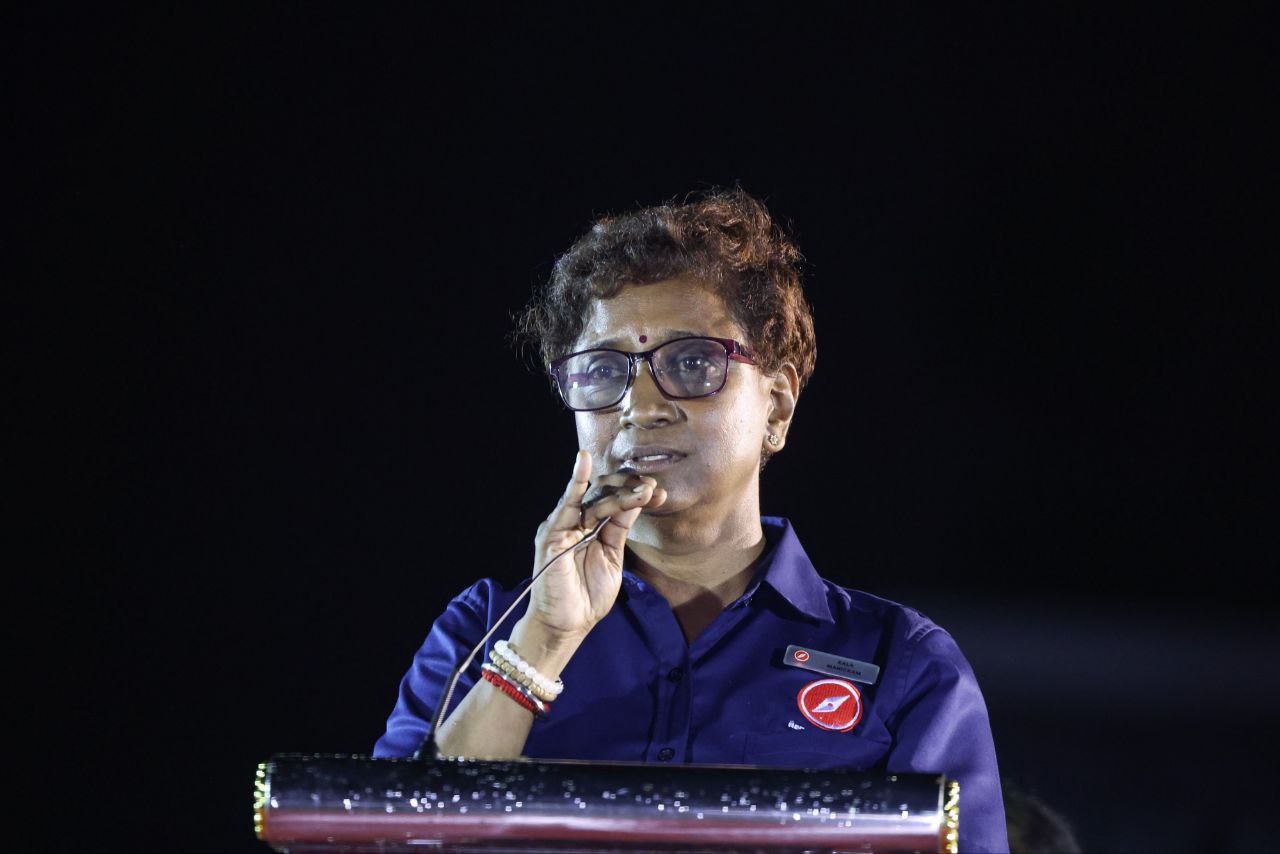
The party’s candidate for Jurong Central SMC Kala Manickam spoke up about cost of living issues. Getting emotional as she shared about the struggles faced by her parents when she was growing up, she said the struggle faced by my families – where both parents need to work to put food on the table – is something that needs to be “eradicated”.
She added that her party hopes to address the issue of underemployment and unemployment among the many “capable and talented” Singaporeans she said she has met.
ST PHOTO: BRIAN TEO
RDU chief Ravi Philemon said at their party’s rally tonight that a greater opposition presence in Parliament would provide a check and balance for the ruling party, and urged residents in the four constituencies RDU is contesting in to vote for them.
The RDU is going head-to-head with the PAP in Jurong East-Bukit Batok, Holland-Bukit Timah and Nee Soon GRCs, as well as Jurong Central SMC.
“In the Chinese tradition, we all know how important yin and yang is,” he said. “We know that where there is yang, there also needs to be yin. Where there is yin, there also needs to be yang.”
“In Singapore, I think we are missing one of the elements, which is why we do not have balance in our society. It is time to bring balance into society. It is time to bring yang into society. We are the yang to the yin of the PAP,” Mr Philemon said.
The party’s candidate for Jurong Central SMC Kala Manickam spoke up about cost of living issues. Getting emotional as she shared about the struggles faced by her parents when she was growing up, she said the struggle faced by my families – where both parents need to work to put food on the table – is something that needs to be “eradicated”.
She added that her party hopes to address the issue of underemployment and unemployment among the many “capable and talented” Singaporeans she said she has met.
ST PHOTO: BRIAN TEO

evildoer
Arch-Supremacy Member
- Joined
- Mar 11, 2007
- Messages
- 23,358
- Reaction score
- 3,973
no ler.. see, NCM still aroundsqueeze ah squeeze, and sinkies keep giving them mandate to squeeze.....
i imagine when they think they will lose power, most will run off somewhere else and enjoy.......

xdivider
Great Supremacy Member
- Joined
- Nov 8, 2000
- Messages
- 56,703
- Reaction score
- 16,701
as in no more control over govt.......thats when all the skeletons will come out from closet.......no ler.. see, NCM still around

treeskull
Greater Supremacy Member
- Joined
- Mar 24, 2015
- Messages
- 86,894
- Reaction score
- 13,531
4. Ministries Operating in Silos: A Failure of Leadership
One of the most glaring weaknesses in the current PAP government is the lack of effective communication and collaboration between ministries. Ministers are not just administrators; they are supposed to be leaders who bridge gaps between civil servants, align policies across departments, and ensure the machinery of government works cohesively. Instead, what we see today are ministries operating in silos, with little incentive to coordinate.The responsibility for this lies with ministers who either lack the will or the skill to foster collaboration. A minister’s role is not just to manage their own portfolio but to actively engage with counterparts to resolve overlaps and conflicts. If the PAP cannot ensure its ministers rise to this challenge, it raises questions about their fitness to lead a complex, modern Singapore.
5. The Green Plan 2030: Noble Goals, Questionable Pragmatism
Singapore’s Green Plan 2030 sets ambitious targets to achieve net-zero emissions by 2050, aligning with global climate agreements. While environmental stewardship is vital, the PAP’s approach risks imposing disproportionate financial burdens on households and businesses while offering negligible global impact.Costs Passed to Consumers
The Green Plan’s initiatives—from expanding solar infrastructure to phasing out internal combustion engines—require massive public and private investment. These costs will inevitably trickle down to consumers through higher utility bills, COE premiums, and increased prices for goods and services. For example, the push for green energy imports (like undersea cables from ASEAN nations) or hydrogen adoption could raise electricity tariffs by 20–30% over the next decade, disproportionately affecting all households.
While the PAP frames this as a “shared sacrifice,” it has not provided transparent cost-benefit analyses to justify the scale of spending. Why should Singaporeans bear such steep costs when the nation contributes just 0.1% of global emissions?
The Nuclear Red Herring
Worse, the Green Plan’s targets may force Singapore to prematurely adopt risky technologies like nuclear energy. Despite the government’s cautious stance, its a dangerous gamble for a densely populated city-state with no hinterland for error. A single incident could devastate Singapore’s reputation and security.
Rather than blindly following global trends, Singapore should prioritize practical, scalable solutions tailored to its unique constraints. For instance:
- Focusing on climate adaptation (e.g., coastal protection) rather than symbolic net-zero pledges.
- Incentivizing industrial efficiency over sweeping mandates that strain SMEs.


bigbossmanx
Member
- Joined
- Aug 22, 2009
- Messages
- 325
- Reaction score
- 22
...............Lost



runny yolk
Master Member
- Joined
- Feb 4, 2024
- Messages
- 4,453
- Reaction score
- 3,985
In the 90s, my parents were able to afford an executive hdb and car when they were in their early 30s, both are diploma holders in normal corporate jobs, not high flyers. I don't recall anything lacking in my childhood too. Fast forward to now, this is almost impossible for a couple with similar backgrounds. Singapore economy boomed since the 90s but who are the main beneficiary of it, whose pockets have been greatly enriched? I don't think it's the common Singaporean.Singaporean really have to realize one thing. Most of the problems now we are facing are mainly due to trade-off from PAP policies. We, Singaporean are being traded off.
In 2005 our population was 4.3, now 5.9m. In just 20 yrs, our population grew 1.6m.
Increase in population means infrastructure will be under stress, healthcare (why long wait for a bed in hospital, more and more expensive healthcare cost), public transport (stress on our rail system and buses), high housing prices, social problems due to too many foreigners even new citizens (how many 思家客 around you), our kids have to be in large class instead of smaller ones where more attention can be given to them), more difficult to find a childcare near our home...............etc
The PAP wanted economic growth at all cost and the tradeoff is us, Singaporean.
Do think about this. Another blank cheque for the PAP again?
evildoer
Arch-Supremacy Member
- Joined
- Mar 11, 2007
- Messages
- 23,358
- Reaction score
- 3,973
just IMAGINE IF they lost power... what will our president do ?as in no more control over govt.......thats when all the skeletons will come out from closet.......
ok,.. don't have to imagine.. not happening lol

Hakuna Matata
Supremacy Member
- Joined
- Oct 20, 2011
- Messages
- 5,878
- Reaction score
- 2,148
WLWLBBQL? 

whatheheck
Great Supremacy Member
- Joined
- May 18, 2012
- Messages
- 60,464
- Reaction score
- 15,035


treeskull
Greater Supremacy Member
- Joined
- Mar 24, 2015
- Messages
- 86,894
- Reaction score
- 13,531
7. Education Stagnation: Preparing Students for the Past, Not the Future
Singapore’s education system, once hailed globally for its rigor, has failed to evolve with the demands of a rapidly changing economy. While students excel at standardized testing, the system prioritizes rote memorization over critical thinking, adaptability, and real-world skills—leaving graduates unprepared for industries disrupted by AI, and digital innovation.
The Skills Mismatch Crisis
Employers increasingly report that graduates lack practical competencies like problem-solving, creative collaboration, or familiarity with emerging tools (e.g., data analytics platforms, AI-driven design software). Meanwhile, the Ministry of Education (MOE) clings to an outdated curriculum that sidelines coding, cybersecurity, and sustainability literacy—fields critical to Singapore’s economic future.
Neglecting Non-Traditional Pathways
The PAP’s insistence on a “one-size-fits-all” academic pipeline marginalizes students suited for vocational or creative careers. While countries like Germany and Finland integrate apprenticeships and project-based learning into mainstream education, Singapore funnels most resources into university preparation. This creates a paradox: a glut of degree holders competing for limited traditional roles.
The Innovation Deficit
A system that rewards conformity over creativity stifles the entrepreneurial mindset needed to drive Singapore’s next chapter. Startups and SMEs—the backbone of economic resilience—consistently cite difficulties hiring locals with risk-taking instincts or hands-on technical skills. Yet the PAP has done little to overhaul assessment frameworks (e.g., incentivize schools to prioritize innovation, creativity and self-learning)
The result? A generation of students trained for the economy of the 1990s, not the 2030s.
8. Coercive Governance: The “No Jab, No Job” Precedent
During the COVID-19 pandemic, Health Minister Ong Ye Kung defended the controversial “no vaccination, no job” policy, stating that unvaccinated individuals could be dismissed from their workplaces. While public health crises demand decisive action, this approach crossed a dangerous line by weaponizing livelihoods to enforce compliance—prioritizing expediency over empathy, and mandates over meaningful dialogue.
Undermining Trust Through Coercion
Vaccination is a personal medical decision, and Singapore’s high uptake rates (over 90%) demonstrated public cooperation. Yet the PAP chose to frame the unvaccinated not as citizens with legitimate concerns but as obstacles to be sidelined. Threatening job loss for vaccine hesitancy—a stance later walked back—alienated vulnerable groups, including those with medical exemptions or religious convictions. It also set a troubling precedent: Should the state wield employment as a lever to enforce future policies?
A Failure of Engagement
Contrast this with nations like New Zealand or Denmark, where governments used transparent communication, incentives (e.g., lottery systems), and partnerships with community leaders to boost vaccination. Singapore’s leadership, however, defaulted to punitive measures rather than addressing fears through education or empathy. This reflects a deeper institutional habit: the PAP governs by decree, not dialogue.
The Human Cost
For gig workers, freelancers, and low-wage employees—many without union representation or job security—the policy amplified anxiety. Workers faced an impossible choice: risk potential health complications or lose their ability to feed their families. The PAP’s refusal to acknowledge this moral dilemma—let alone provide robust financial support for those adversely affected—exposed a glaring lack of compassion in crisis governance.
Singapore’s education system, once hailed globally for its rigor, has failed to evolve with the demands of a rapidly changing economy. While students excel at standardized testing, the system prioritizes rote memorization over critical thinking, adaptability, and real-world skills—leaving graduates unprepared for industries disrupted by AI, and digital innovation.
The Skills Mismatch Crisis
Employers increasingly report that graduates lack practical competencies like problem-solving, creative collaboration, or familiarity with emerging tools (e.g., data analytics platforms, AI-driven design software). Meanwhile, the Ministry of Education (MOE) clings to an outdated curriculum that sidelines coding, cybersecurity, and sustainability literacy—fields critical to Singapore’s economic future.
Neglecting Non-Traditional Pathways
The PAP’s insistence on a “one-size-fits-all” academic pipeline marginalizes students suited for vocational or creative careers. While countries like Germany and Finland integrate apprenticeships and project-based learning into mainstream education, Singapore funnels most resources into university preparation. This creates a paradox: a glut of degree holders competing for limited traditional roles.
The Innovation Deficit
A system that rewards conformity over creativity stifles the entrepreneurial mindset needed to drive Singapore’s next chapter. Startups and SMEs—the backbone of economic resilience—consistently cite difficulties hiring locals with risk-taking instincts or hands-on technical skills. Yet the PAP has done little to overhaul assessment frameworks (e.g., incentivize schools to prioritize innovation, creativity and self-learning)
The result? A generation of students trained for the economy of the 1990s, not the 2030s.
8. Coercive Governance: The “No Jab, No Job” Precedent
During the COVID-19 pandemic, Health Minister Ong Ye Kung defended the controversial “no vaccination, no job” policy, stating that unvaccinated individuals could be dismissed from their workplaces. While public health crises demand decisive action, this approach crossed a dangerous line by weaponizing livelihoods to enforce compliance—prioritizing expediency over empathy, and mandates over meaningful dialogue.
Undermining Trust Through Coercion
Vaccination is a personal medical decision, and Singapore’s high uptake rates (over 90%) demonstrated public cooperation. Yet the PAP chose to frame the unvaccinated not as citizens with legitimate concerns but as obstacles to be sidelined. Threatening job loss for vaccine hesitancy—a stance later walked back—alienated vulnerable groups, including those with medical exemptions or religious convictions. It also set a troubling precedent: Should the state wield employment as a lever to enforce future policies?
A Failure of Engagement
Contrast this with nations like New Zealand or Denmark, where governments used transparent communication, incentives (e.g., lottery systems), and partnerships with community leaders to boost vaccination. Singapore’s leadership, however, defaulted to punitive measures rather than addressing fears through education or empathy. This reflects a deeper institutional habit: the PAP governs by decree, not dialogue.
The Human Cost
For gig workers, freelancers, and low-wage employees—many without union representation or job security—the policy amplified anxiety. Workers faced an impossible choice: risk potential health complications or lose their ability to feed their families. The PAP’s refusal to acknowledge this moral dilemma—let alone provide robust financial support for those adversely affected—exposed a glaring lack of compassion in crisis governance.
Important Forum Advisory Note
This forum is moderated by volunteer moderators who will react only to members' feedback on posts. Moderators are not employees or representatives of HWZ Forums. Forum members and moderators are responsible for their own posts.
Please refer to our Community Guidelines and Standards and Terms and Conditions for more information.
