

blankies
High Supremacy Member
- Joined
- Sep 27, 2000
- Messages
- 34,699
- Reaction score
- 1,448
He never. ...mrbrown i tot support PAP?
wing grow hard now dare to make fun of his master...
He never. ...mrbrown i tot support PAP?
wing grow hard now dare to make fun of his master...


no leh, isn't the purpose of COE and ERP to control the number of cars on the road?Kim Huat only made one valid point, PHV is competing in the private car category.
other than that I think Mr Siow arguments are quite valid
Mr J Siow, preash say more of such comments.. ur Acting Ministership will become Minister of State-ship.Comments
Jeffrey Siow’s COE defence sparks sarcastic call for ministers to give up cars to benefit more Singaporeans
Acting Transport Minister Jeffrey Siow’s defence of COEs for private-hire vehicles is drawing public backlash. Satirist mrbrown and netizens are sarcastically suggesting that ministers give up their own cars if they truly support a shared-use model for efficiency.
Acting Transport Minister Jeffrey Siow’s comments on the allocation of Certificates of Entitlement (COEs) have sparked a renewed wave of public scrutiny.
In a 11 June interview, Siow defended allocating COEs to private-hire vehicles (PHVs), arguing that doing so benefits a wider pool of Singaporeans compared to private car ownership.
Siow refuted suggestions that PHV operators inflate COE prices and hurt the car ownership aspirations of individuals.
He maintained that shared transport models ease congestion and reduce bidding pressure.
“Shared access benefits more people,” says Siow
“If you have one COE left to allocate, is it better… to give it to a private car owner who then drives maybe two trips a day and leaves the car in the garage, or is it better to share the car among a much larger group of Singaporeans who can have access to the use of a car when they need it? Surely it must be the latter, right?” Siow asked.
He underscored that Singapore’s limited land area prevents widespread private car ownership.
Thus, the COE system remains the government’s main tool to distribute limited road space equitably.
While no significant COE reforms are planned, Siow mentioned that current efforts focus on the implementation of ERP 2.0 and installation of on-board units across all vehicles
Satirical backlash: ‘Kim Huat’ weigh in
The policy defence quickly drew a satirical response from blogger Lee Kin Mun, known as mrbrown, who released a TikTok video on 17 June via his comedic alter ego Kim Huat.
Kim Huat proposed ministers relinquish their government-issued cars—renamed “Political Holder Vehicles”—and suggested they book PHVs for official duties using a “ministerial app.”
“Better yet, all ministers should give up their private cars, not efficient mah,” he quipped, mockingly echoing Siow’s reasoning.
The satire gained traction, with netizens amplifying the critique and questioning whether government leaders were prepared to embody the same shared-use values they promote.
Public pushback targets COE structure
Online platforms including Facebook page of the Straits Times, and The Business Times were soon populated with comments critical of Siow’s argument.
One user proposed that if PHVs are truly more efficient, ministers and their families should lead by example and give up private vehicles.
Another argued that the COE system now favours wealthy rental firms able to outbid individuals, undermining fairness and public trust.
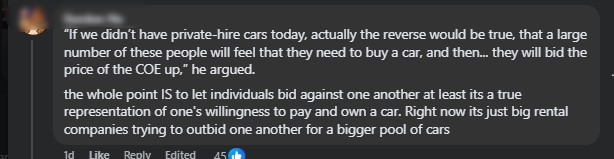
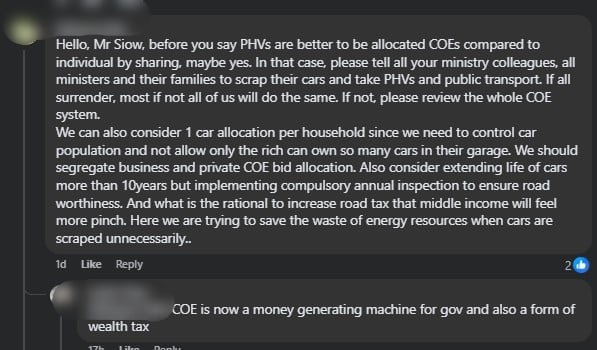
Several comments also pushed for reforms such as capping COEs per household, separating business and private quotas, and re-evaluating vehicle lifespan policies to improve equity and sustainability.
Rethinking COE’s original goals: congestion or revenue?
Debate intensified over the core objectives of the COE system. While it was originally introduced to manage congestion, some netizens suggested the policy has evolved into a tool for revenue generation.
One comment wrote: “The only reason to allow the system to remain unchanged is 70% of what we spend on vehicle ownership goes to the Government.”

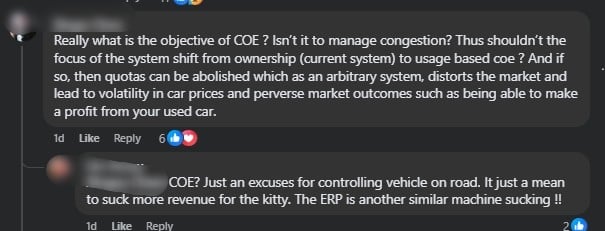
Others asked whether the system should shift from ownership-based quotas to usage-based COEs, which could more accurately target congestion control.
They argued that such a move could eliminate price volatility and market distortions associated with arbitrary quota releases.

Comments
Jeffrey Siow’s COE defence sparks sarcastic call for ministers to give up cars to benefit more Singaporeans
Acting Transport Minister Jeffrey Siow’s defence of COEs for private-hire vehicles is drawing public backlash. Satirist mrbrown and netizens are sarcastically suggesting that ministers give up their own cars if they truly support a shared-use model for efficiency.
Acting Transport Minister Jeffrey Siow’s comments on the allocation of Certificates of Entitlement (COEs) have sparked a renewed wave of public scrutiny.
In a 11 June interview, Siow defended allocating COEs to private-hire vehicles (PHVs), arguing that doing so benefits a wider pool of Singaporeans compared to private car ownership.
Siow refuted suggestions that PHV operators inflate COE prices and hurt the car ownership aspirations of individuals.
He maintained that shared transport models ease congestion and reduce bidding pressure.
“Shared access benefits more people,” says Siow
“If you have one COE left to allocate, is it better… to give it to a private car owner who then drives maybe two trips a day and leaves the car in the garage, or is it better to share the car among a much larger group of Singaporeans who can have access to the use of a car when they need it? Surely it must be the latter, right?” Siow asked.
He underscored that Singapore’s limited land area prevents widespread private car ownership.
Thus, the COE system remains the government’s main tool to distribute limited road space equitably.
While no significant COE reforms are planned, Siow mentioned that current efforts focus on the implementation of ERP 2.0 and installation of on-board units across all vehicles
Satirical backlash: ‘Kim Huat’ weigh in
The policy defence quickly drew a satirical response from blogger Lee Kin Mun, known as mrbrown, who released a TikTok video on 17 June via his comedic alter ego Kim Huat.
Kim Huat proposed ministers relinquish their government-issued cars—renamed “Political Holder Vehicles”—and suggested they book PHVs for official duties using a “ministerial app.”
“Better yet, all ministers should give up their private cars, not efficient mah,” he quipped, mockingly echoing Siow’s reasoning.
The satire gained traction, with netizens amplifying the critique and questioning whether government leaders were prepared to embody the same shared-use values they promote.
Public pushback targets COE structure
Online platforms including Facebook page of the Straits Times, and The Business Times were soon populated with comments critical of Siow’s argument.
One user proposed that if PHVs are truly more efficient, ministers and their families should lead by example and give up private vehicles.
Another argued that the COE system now favours wealthy rental firms able to outbid individuals, undermining fairness and public trust.
Several comments also pushed for reforms such as capping COEs per household, separating business and private quotas, and re-evaluating vehicle lifespan policies to improve equity and sustainability.
Rethinking COE’s original goals: congestion or revenue?
Debate intensified over the core objectives of the COE system. While it was originally introduced to manage congestion, some netizens suggested the policy has evolved into a tool for revenue generation.
One comment wrote: “The only reason to allow the system to remain unchanged is 70% of what we spend on vehicle ownership goes to the Government.”
Others asked whether the system should shift from ownership-based quotas to usage-based COEs, which could more accurately target congestion control.
They argued that such a move could eliminate price volatility and market distortions associated with arbitrary quota releases.
权力在手,天下我有! 你能拿我怎么样?!Yes. One important life lesson that everyone can learn as a human being is... dun preach something to others if you are not doing it.
论语,己所不欲,勿施于人。

Mr J Siow, preash say more of such comments.. ur Acting Ministership will become Minister of State-ship.
Those dunno the difference , it's a demotion.
He is Acting minister because he is still on probation.
Better screw up now and get demoted to minister of state bah.. u parachuters dun deserve anything at all.
HahaComments
Jeffrey Siow’s COE defence sparks sarcastic call for ministers to give up cars to benefit more Singaporeans
Acting Transport Minister Jeffrey Siow’s defence of COEs for private-hire vehicles is drawing public backlash. Satirist mrbrown and netizens are sarcastically suggesting that ministers give up their own cars if they truly support a shared-use model for efficiency.
Acting Transport Minister Jeffrey Siow’s comments on the allocation of Certificates of Entitlement (COEs) have sparked a renewed wave of public scrutiny.
In a 11 June interview, Siow defended allocating COEs to private-hire vehicles (PHVs), arguing that doing so benefits a wider pool of Singaporeans compared to private car ownership.
Siow refuted suggestions that PHV operators inflate COE prices and hurt the car ownership aspirations of individuals.
He maintained that shared transport models ease congestion and reduce bidding pressure.
“Shared access benefits more people,” says Siow
“If you have one COE left to allocate, is it better… to give it to a private car owner who then drives maybe two trips a day and leaves the car in the garage, or is it better to share the car among a much larger group of Singaporeans who can have access to the use of a car when they need it? Surely it must be the latter, right?” Siow asked.
He underscored that Singapore’s limited land area prevents widespread private car ownership.
Thus, the COE system remains the government’s main tool to distribute limited road space equitably.
While no significant COE reforms are planned, Siow mentioned that current efforts focus on the implementation of ERP 2.0 and installation of on-board units across all vehicles
Satirical backlash: ‘Kim Huat’ weigh in
The policy defence quickly drew a satirical response from blogger Lee Kin Mun, known as mrbrown, who released a TikTok video on 17 June via his comedic alter ego Kim Huat.
Kim Huat proposed ministers relinquish their government-issued cars—renamed “Political Holder Vehicles”—and suggested they book PHVs for official duties using a “ministerial app.”
“Better yet, all ministers should give up their private cars, not efficient mah,” he quipped, mockingly echoing Siow’s reasoning.
The satire gained traction, with netizens amplifying the critique and questioning whether government leaders were prepared to embody the same shared-use values they promote.
Public pushback targets COE structure
Online platforms including Facebook page of the Straits Times, and The Business Times were soon populated with comments critical of Siow’s argument.
One user proposed that if PHVs are truly more efficient, ministers and their families should lead by example and give up private vehicles.
Another argued that the COE system now favours wealthy rental firms able to outbid individuals, undermining fairness and public trust.
Several comments also pushed for reforms such as capping COEs per household, separating business and private quotas, and re-evaluating vehicle lifespan policies to improve equity and sustainability.
Rethinking COE’s original goals: congestion or revenue?
Debate intensified over the core objectives of the COE system. While it was originally introduced to manage congestion, some netizens suggested the policy has evolved into a tool for revenue generation.
One comment wrote: “The only reason to allow the system to remain unchanged is 70% of what we spend on vehicle ownership goes to the Government.”
Others asked whether the system should shift from ownership-based quotas to usage-based COEs, which could more accurately target congestion control.
They argued that such a move could eliminate price volatility and market distortions associated with arbitrary quota releases.


Wa Lao… why you don’t get it?no leh, isn't the purpose of COE and ERP to control the number of cars on the road?
doesnt it defeat the purpose if you farm it off to PHV drivers who are basically on the road the whole day?

How not to renew? Buying new car (for a similar size like my current one) is even more expensive la.Dont renew lor

He’ll tell you the coe is fully utilised for the benefit of the public….no leh, isn't the purpose of COE and ERP to control the number of cars on the road?
doesnt it defeat the purpose if you farm it off to PHV drivers who are basically on the road the whole day?


