Why do Netflix’s Korean films keep disappointing viewers?
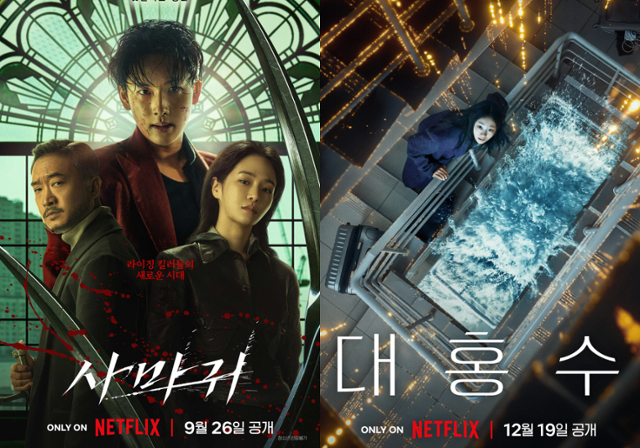
Posters for "The Mantis" and "The Great Flood" / Courtesy of Netflix
Netflix’s Korean original films are facing a slump, as several highly anticipated releases have failed to meet expectations, drawing mixed reviews despite their large-scale productions, star-studded casting and ambitious storytelling.
The latest example is “The Great Flood,” released on Dec. 19, which follows people fighting for survival inside a flooded apartment building after a catastrophic disaster. Marketed as a disaster blockbuster that blends science fiction elements with Korean sentiment, the movie shot to the top of Netflix’s global film rankings immediately after release but reactions have since split sharply. Critics say the film suffers from poorly connected plot devices, a weak link between its scenario and artificial intelligence concept, unbalanced character dynamics and an overly complicated narrative.
The criticism adds to a series of recent disappointments. Other Netflix Korean originals released this year including “The Mantis,” “Love Untangled” and “Wall to Wall” briefly climbed the rankings before quickly fading from view. Though each film differed in genre and theme, viewers raised similar concerns about uneven overall quality.
Strong expectations, weak results
For years, Korean productions on Netflix carried an informal mark of trust. According to global media analytics firm Ampere, Korean dramas and films accounted for the second largest share of viewing time among all non-English, non-U.S. content on Netflix as of May, representing about 9 percent of worldwide viewing, beating out U.K. and Japanese content.
Analysts say Netflix’s aggressive investment and relatively light regulatory constraints created space for creative experimentation, leading to international success stories such as the “Unlocked” and “Kill Boksoon,” which demonstrated the global potential of Korean filmmaking.
The brand power of Netflix combined with Korean creators and actors still generates strong buzz. The problem, observers say, begins after release. Many recent films failed to build positive word-of-mouth and viewer interest cooled rapidly. As disappointing projects pile up, anticipation for new titles is turning to skepticism.
Critics say the poorly received films share a common pattern. While the premises are novel, the storytelling foundation is weak. Large-scale spectacle and provocative elements are often emphasized over coherent structure.
Despite fresh concepts, the films are frequently seen as lacking the narrative density and fully developed characters needed to sustain engagement. New titles continue to appear but few have reversed the downward trend.
Industry watchers say it is now crucial for filmmakers to refocus on story depth and overall craftsmanship. Because streaming media viewers do not commit their time in the same way as theater audiences, projects that fail to convince viewers early on are easily abandoned. In this environment, narrative completeness matters above all, and a well made film ultimately moves audiences more than one that simply offers something new.
https://www.koreatimes.co.kr/entert..._swHEZXdRmJZ9ekXbm_aem_vacWb3xjkd0m00f_Eh_aSA