Broadwell Preview by Anandtech....

cenedra

Banned
Joined
Apr 9, 2009
Messages
11,121
Reaction score
0
i upgraded to a 4670k after using a q6600 for 7 or 8 years
the q6600 is now enjoy's it's 2nd lease of life in my sister's PC

mai tu liao lah. just upgrade. wait wait wait and u'll end up waiting for the next next next next gen chips

but the thing is, why upgrade when there's not much significant performance increase?

I just upgraded from my Q6600 (oced to 3.6ghz) to i2500k (oced to 4.6ghz) last week, and i dont really see much increase in performance for daily stuffs nor even gaming. Maybe it loads games like 1 or 2 sec faster? But cant really tell... My Q6600 can run any games i throw at it, i dont even know why i upgraded my CPU :s13:
 

Maeda_Toshiie

Supremacy Member
Joined
May 12, 2007
Messages
6,310
Reaction score
3
Intel does a little more than just a die shrink though. They did beef up the TLB and some other minor improvements.

Those are tweaks that may accompany a Tick, not substantial architectural changes seen in Tocks.

But IMHO, even if its Skylake, looking at current trends, I don't think there will be massive improvements. I think Skylake will be ~20% faster than Broadwell.

But I do like the power consumption improvements since we could increase core count and perhaps allow future apps/games to take advantage of more cores.

If you mean 20% IPC improvement, that may be physically impossible (all easy improvements have been made). Even the much vaunted Sandy Bridge didn't achieve it. Sandy Bridge's bigger achievement was ramping the stock clocks upwards.

If you mean 20% single thread performance, probably not possible unless Intel breaks its own rule on performance improvement to thermal cost ratio. (note that I am not referring to improvements through new instruction sets, but through architectural changes)
 
Last edited:

Yureak

Arch-Supremacy Member
Joined
Apr 30, 2008
Messages
18,905
Reaction score
33
Those are tweaks that may accompany a Tick, not substantial architectural changes seen in Tocks.


If you mean 20% IPC improvement, that may be physically impossible (all easy improvements have been made). Even the much vaunted Sandy Bridge didn't achieve it. Sandy Bridge's bigger achievement was ramping the stock clocks upwards.

If you mean 20% single thread performance, probably not possible unless Intel breaks its own rule on performance improvement to thermal cost ratio. (note that I am not referring to improvements through new instruction sets, but through architectural changes)

Thats the issue you see. Look at AMD TDPs vs Intel TDPs. If they push the thermal envelope higher (of course they wouldnt want otherwise they'd need a better stock cooler that'd cost them more) they can get much more power.

But us consumers are paying for intel's lazyness. Oh well lack of competition is leading to this
 

MoneyFace =p

High Supremacy Member
Joined
Dec 17, 2010
Messages
35,380
Reaction score
402
Thats the issue you see. Look at AMD TDPs vs Intel TDPs. If they push the thermal envelope higher (of course they wouldnt want otherwise they'd need a better stock cooler that'd cost them more) they can get much more power.

But us consumers are paying for intel's lazyness. Oh well lack of competition is leading to this

Such market is declining.... FAST...
 

Maeda_Toshiie

Supremacy Member
Joined
May 12, 2007
Messages
6,310
Reaction score
3
Thats the issue you see. Look at AMD TDPs vs Intel TDPs. If they push the thermal envelope higher (of course they wouldnt want otherwise they'd need a better stock cooler that'd cost them more) they can get much more power.

But us consumers are paying for intel's lazyness. Oh well lack of competition is leading to this

If for every 10% improvement, there is a corresponding 15% increase in TDP, then the TDP will continue to rise with every generation unbounded.

Firstly, no one wants to reach the point of a 1000W TDP CPU. Do you? Not even the NSA or any of the National Laboratories in the US (or for the matter, any research institute engaged in the use of supercomputing) will want such a CPU.

Secondly, there comes a point where phase change cooling is required. Who wants to use a CPU that requires N2 cooling?

-----------------

Those 200W CPUs from AMD are nothing but factory overclocked and binned silicon. Not even the upper management of AMD are so far removed from reality to think that such CPUs are anything but a publicity stunt.

Secondly, not even AMD thinks that continued increase in performance at the expense of TDP is the way forward.

Thirdly, Intel flirted with pushing performance at the expense of TDP (on an architectural basis), ie Netburst. <fill in the blank here yourself on what happened in history>
 
Last edited:

Yureak

Arch-Supremacy Member
Joined
Apr 30, 2008
Messages
18,905
Reaction score
33
If for every 10% improvement, there is a corresponding 15% increase in TDP, then the TDP will continue to rise with every generation unbounded.

Firstly, no one wants to reach the point of a 1000W TDP CPU. Do you? Not even the NSA or any of the National Laboratories in the US (or for the matter, any research institute engaged in the use of supercomputing) will want such a CPU.

Secondly, there comes a point where phase change cooling is required. Who wants to use a CPU that requires N2 cooling?

Definitely not an unrealistic increase but however a 200w-250w TDP is definitely comfortable as compared to a paltry 85w TDP now.

I draw nearly 800w on my overvolted GPU alone far overloading my PSU to a combined load of 1000w and i still dont need LN2.

Fact of the matter is with current technology (AIO or large Air Coolers) we have the necessary thermal headroom to push much higher TDPs in desktop grade hardware

The AMD TDP is simply an example of how much higher we can push things without compromising in other regards.

Unless if you tell me double the TDP cant reap any gains then I have nothing to say.

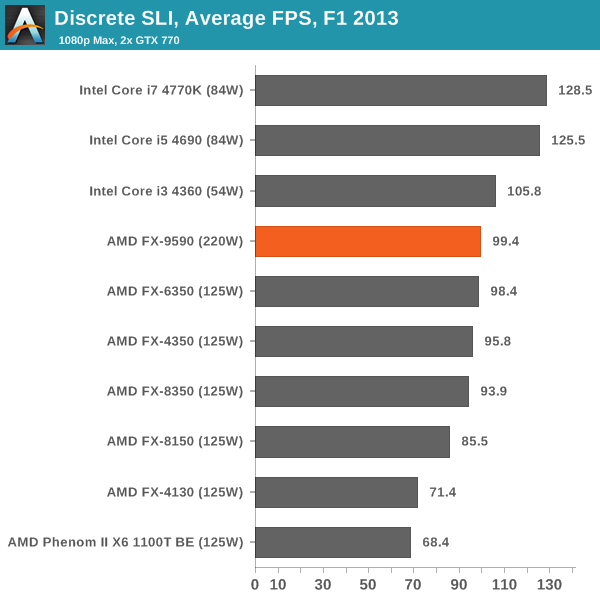
Otherwise I believe its a money saving move on the part of intel. After all 200w TDP AMDs @ 5ghz cant compete with 85w Haswell Chips like the 4690k/4790k. Theres just no competition for Intel

http://anandtech.com/show/8316/amds...l-the-fx9590-and-asrock-990fx-extreme9-review

66038.png
 
Last edited:

X-powerman

Banned
Joined
Aug 12, 2014
Messages
411
Reaction score
0
If for every 10% improvement, there is a corresponding 15% increase in TDP, then the TDP will continue to rise with every generation unbounded.

Firstly, no one wants to reach the point of a 1000W TDP CPU. Do you? Not even the NSA or any of the National Laboratories in the US (or for the matter, any research institute engaged in the use of supercomputing) will want such a CPU.

Secondly, there comes a point where phase change cooling is required. Who wants to use a CPU that requires N2 cooling?

I would say it depends on performance and operating cost. If 100 of these 1000W TDP CPU is as fast as the fastest supercomputer, it will be an engineering marvel and no one will complain that it needs cryogenic cooling.
 

X-powerman

Banned
Joined
Aug 12, 2014
Messages
411
Reaction score
0
Definitely not an unrealistic increase but however a 200w-250w TDP is definitely comfortable as compared to a paltry 85w TDP now.

I draw nearly 800w on my overvolted GPU alone far overloading my PSU to a combined load of 1000w and i still dont need LN2.

Fact of the matter is with current technology (AIO or large Air Coolers) we have the necessary thermal headroom to push much higher TDPs in desktop grade hardware

The AMD TDP is simply an example of how much higher we can push things without compromising in other regards.

Unless if you tell me double the TDP cant reap any gains then I have nothing to say.

Otherwise I believe its a money saving move on the part of intel. After all 200w TDP AMDs @ 5ghz cant compete with 85w Haswell Chips like the 4690k/4790k. Theres just no competition for Intel

AnandTech Portal | AMD

66038.png

I agreed. I would say performance sometimes matter more than TDP.

IBM's Power 7 and Power8 CPU has a TDP of 250W. In such cases, performance is clearly more important than TDP.
 

X-powerman

Banned
Joined
Aug 12, 2014
Messages
411
Reaction score
0
about time for quantum computing to replace silicon chips :s13:

Hmm..... I think quantum computer is still a distance away from gaining momentum in commercial sector.

But I think photonics could be the next big thing. Esp. with the amount of research going into it already. Commercial products are expected by 2020.

So we could have a hybrid of electronic and photonic components in our computers.
 

Maeda_Toshiie

Supremacy Member
Joined
May 12, 2007
Messages
6,310
Reaction score
3
Definitely not an unrealistic increase but however a 200w-250w TDP is definitely comfortable as compared to a paltry 85w TDP now.

I draw nearly 800w on my overvolted GPU alone far overloading my PSU to a combined load of 1000w and i still dont need LN2.

Fact of the matter is with current technology (AIO or large Air Coolers) we have the necessary thermal headroom to push much higher TDPs in desktop grade hardware

The AMD TDP is simply an example of how much higher we can push things without compromising in other regards.

Unless if you tell me double the TDP cant reap any gains then I have nothing to say.

Otherwise I believe its a money saving move on the part of intel. After all 200w TDP AMDs @ 5ghz cant compete with 85w Haswell Chips like the 4690k/4790k

AnandTech Portal | AMD

You want to push beyond 100W? See LGA-2011.

Video card != CPU. CPU dies are generally smaller than GPU dies, and the largest portion of the CPU dies is taken up by the L3 cache. The heat produced by a CPU die is concentrated on a much smaller area. This requires a larger temperature gradient to dissipate the same amount of heat.


There are two main ways to increase single core performance, a) increasing IPC, b) increasing clock rate.

The former is seeing diminishing returns, unless some genius in Intel (or somewhere) figures out a new approach to drastically improve performance. Dumping in more decoders yields diminishing returns; there is a limit to how much you can tweak a branch predictor. Caches and RAM can't get much faster without exploding fabrication cost sky high.

The latter is the Netburst/Bulldozer approach: lengthen the pipeline and let the clock rate rip...
 

Yureak

Arch-Supremacy Member
Joined
Apr 30, 2008
Messages
18,905
Reaction score
33
You want to push beyond 100W? See LGA-2011.

Video card != CPU. CPU dies are generally smaller than GPU dies, and the largest portion of the CPU dies is taken up by the L3 cache. The heat produced by a CPU die is concentrated on a much smaller area. This requires a larger temperature gradient to dissipate the same amount of heat.


There are two main ways to increase single core performance, a) increasing IPC, b) increasing clock rate.

The former is seeing diminishing returns, unless some genius in Intel (or somewhere) figures out a new approach to drastically improve performance. Dumping in more decoders yields diminishing returns; there is a limit to how much you can tweak a branch predictor. Caches and RAM can't get much faster without exploding fabrication cost sky high.

The latter is the Netburst/Bulldozer approach: lengthen the pipeline and let the clock rate rip...

The Extreme editions are already at 150w odd. But imagine what intel could do with 250w :)
 

Maeda_Toshiie

Supremacy Member
Joined
May 12, 2007
Messages
6,310
Reaction score
3
I agreed. I would say performance sometimes matter more than TDP.

IBM's Power 7 and Power8 CPU has a TDP of 250W. In such cases, performance is clearly more important than TDP.

First of all, Power architecture is a RISC type architecture, substantially different from the x86 CISC architecture (yes, I know that in modern x86 chips, the legacy instructions are translated for execution in a more hybrid RISC like underlying architecture).

Secondly, Power CPUs are 6/12 core CPUs, and are designed to handle even more threads that what Intel's HT can offer. They are designed to be massive multithreaded monsters for server/ mainframe usage. They have 8 hardware threads per core. The intention is to keep core as busy as possible (I know some HPC people try to write code to achieve that). Intel Xeons are grapes compared to the IBM durian.
 
Last edited:

Yureak

Arch-Supremacy Member
Joined
Apr 30, 2008
Messages
18,905
Reaction score
33
First of all, Power architecture is a RISC type architecture, substantially different from the x86 CISC architecture (yes, I know that in modern x86 chips, the legacy instructions are translated for execution in a more hybrid RISC like underlying architecture).

Secondly, Power CPUs are 6/12 core CPUs, and are designed to handle even more threads that what Intel's HT can offer. They are designed to be massive multithreaded monsters for server/ mainframe usage. They have 8 hardware threads per core. The intention is to keep core as busy as possible (I know some HPC people try to write code to achieve that). Intel Xeons are grapes compared to the IBM durian.

Indeed you are right its impossible to compare a processor of a different architecture like that offhand
 

12122012

Senior Member
Joined
Oct 5, 2009
Messages
952
Reaction score
28
Oh ok, I was wrong, looks like Crysis 3 do benefit from extra cores. But looking at the results, its not really a big difference compared to quad core CPUs. As you have said, a better graphics card will easily overcome the difference.

yup for those who don't want to wait can go for Haswell-E, for gamers go for better graphics cards...
nvidia-geforce-gtx-titan-sli-4-way.jpg
 
Important Forum Advisory Note
This forum is moderated by volunteer moderators who will react only to members' feedback on posts. Moderators are not employees or representatives of HWZ Forums. Forum members and moderators are responsible for their own posts. Please refer to our Community Guidelines and Standards and Terms and Conditions for more information.
Top