
manlymanly
Junior Member
- Joined
- Aug 31, 2014
- Messages
- 65
- Reaction score
- 13
Many thanks for your kindness BBCW... greatly appreciate it!


Yes, but only to a certain point. S$9,000/year is very roughly US$6,500/year. At that pace (even if fixed), and assuming some growth in your chosen fund's value, it'd probably take about 12 years for you to reach US$100,000 of total global stock index fund value. Once you reach that level Interactive Brokers no longer levies a monthly minimum commission of US$10. So IB then overtakes Standard Chartered to be less expensive in terms of costs (foreign exchange conversion, brokerage commissions).Am I right to say if I continue the same investment amount with the same frequency i.e. $1500 bimonthly, It is more cost effective to invest with Standard Chartered in the long run unless I increase my investment to above S$1000/month
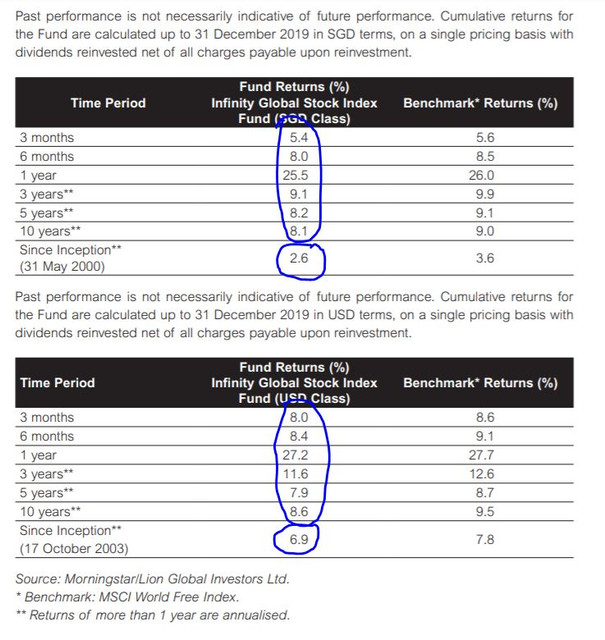
Well, you’d expect to see something like that if the Singapore dollar has appreciated relative to the U.S. dollar. And/or if the exchange rate didn’t work out so well when dividends were reinvested. I’d also look whether there are any differences in sales charges, expense ratios, and tax impacts.Do any of you know why the returns for the SGD class and USD class are so different?
Yes, but only to a certain point. S$9,000/year is very roughly US$6,500/year. At that pace (even if fixed), and assuming some growth in your chosen fund's value, it'd probably take about 12 years for you to reach US$100,000 of total global stock index fund value. Once you reach that level Interactive Brokers no longer levies a monthly minimum commission of US$10. So IB then overtakes Standard Chartered to be less expensive in terms of costs (foreign exchange conversion, brokerage commissions).
So if you wish to start with IB even though it's a little more expensive initially, go right ahead. That'll still work out fine. (You don't save very much during that ~12 year period.) But with IB you would buy your global stock index fund monthly since it costs no extra to do that. You'd pay US$10 per month no matter what, because that would cover your foreign currency conversion commission and your fund purchase commission. There's no need to "batch up" your monthly purchases.
Of course this is all based on today's charges. Occasionally Standard Chartered runs some special promotion, and likewise Interactive Brokers may lower its commissions.


It does apply, unless a lower treaty rate applies. There’s a slightly dodgy method to avoid the withholding on a Roth if she has a U.S. Social Security Number, there’s a U.S. mailing address on the account, and she keeps that address on the account. In that case the IRA custodian might not withhold, and since no tax is owed on the Roth (if it’s a qualified withdrawal) there’s no tax, interest, or penalty. But if the custodian ever asks for a W-9/W-8BEN, game over, so this isn’t reliable. And she wouldn’t want underwithholding on the Traditional side since that’d be costly.I’ve been searching online and simply cannot find a definitive answer — if something happens to me and my nonresident alien spouse ends up inheriting my Roth IRA, would a 30% tax withholding apply? All of the generic information and forms pertaining to this seem to indicate there would be. But in my mind that would only make sense if it was a Trad IRA. Note that I’ve already had the Roth well over 5 years.
Nope. She falls into the single US$11.58 million exemption just like everyone else.(*) However, one particularly special privilege she enjoys in this general area is that you can give her up to US$157,000 (2020 limit) per year without clawing into your estate tax exemption. That’s roughly 10X the general gift limit. I cannot remember off hand if someone has to file a gift return, but that’s the limit from a U.S. citizen to his/her nonresident alien spouse.I also understand that despite my spouse being non-US, the unlimited spousal exemption applies on estate tax coming from a US person.
Yes.I suppose that means she would have to file a 1040-NR in order to get back said withholdings.

Well, the first point is that she’s not required to withdraw from a Roth IRA. And she probably wouldn’t (not first anyway) if there are other assets and a Traditional IRA (and/or Traditional 401k) in the mix with withholding tax, 1040NRs, and RMDs. (The RMDs start at age 72 now.) Also, if your child or children inherit the Roth, they now have 10 years to drain it. (The 10 year rule started in 2020.) So if she inherits the Roth then passes it on, that 10 year period is shifted out (by the amount of time her lifetime exceeds yours), allowing the Roth to grow bigger U.S. tax free. For these reasons it’s generally wise to draw from the Roth last.I’m thinking about changing the beneficiary to one or both of my kids who are US persons to keep it simple. What would you suggest?
Yes, MediShield Life. You might also have employer-provided group medical insurance that covers preexisting conditions.HI BBCW, is there any shield like insurance for people who have pre existing condition like cancer?
Yes, MediShield Life. You might also have employer-provided group medical insurance that covers preexisting conditions.
There are a few exotic, expensive, “expat style” global medical insurance policies that cover preexisting conditions. Check with Pacific Prime since they have a nice Web site to compare various policies of that sort.
Yes, the IRA generally holds U.S. situs assets, but hypothetically it could be structured (or restructured) as U.S. estate tax immune. The typical way would be for the assets within the account to be repositioned into direct holding of individual bonds. Obviously those wouldn’t be municipal bonds (since tax free bonds within a tax advantaged account don’t make sense), but corporate and government bonds are fine for these purposes. I don’t think the IRA “wrapper” matters for these purposes. This kind of defeats the idea of longer tax free/tax deferred growth, though.Thank you once again BBC. My spouse has a SSN and could keep the U.S. address on the account. Good thought on her letting the account grow until passing along to our kids... however if she is still a NRA at that time, wouldn’t the 40% estate tax apply between her and our USC kids for amounts above $60k? I’m assuming an IRA is considered U.S. situs.
The SECURE Act (passed in December, 2019) threw a wrench into some inherited Roth plans, so I suppose you cannot be too clever for too long. The rules can change, and in this case they did.This Roth is about 10% of our net investable assets, and there are no other tax advantaged accounts in the mix. If estate tax will be an issue for our USC children, maybe having them inherit from me is the way to go. They would definitely want to spread the RMDs over 10 years for maximum tax free growth in the account.
The simple answer is they can, that there isn’t enough competitive market pressure and aren’t enough informed investors to lower these fees yet. Why do people buy high cost ILPs? Why are personal care products are so expensive in Singapore? It’s the same basic reason.Am I missing something? I don't understand why they price UT in such expensive way. What market are they targeting? Who would buy a UT with such fees? And why?
A few of them are, yes. Here's what Cigna says in their brochure, for example:Hi, u mentioned to have international health insurance for those with pre existing conditions. Are international health insurance more lenient to accepting ? I’ve never heard of such method to get insured
Without a pre-existing condition a 40 year old male citizen of Singapore living in Singapore buying Cigna's standard "Silver" plan with a 20% co-pay (up to a maximum US$2,000 out of pocket cost for covered services) would pay US$225.21 per month for worldwide coverage excluding the U.S. (Since it does provide near worldwide coverage you probably wouldn't need any travel medical insurance.) It's an excellent policy compared to Integrated Shield plans, though -- rather more comprehensive -- but as you can see it's also more expensive, and you cannot use MediSave dollars to pay for any of it.Cigna Global said:Pre-existing conditions
There may be some medical conditions that we agree to include at an additional premium. Our Underwriters will determine whether we are able to include a medical condition that would normally have been excluded. Where applicable, we will present you with a quote with the option to include the condition.
What I never understood is, you buy a "local" IP for your health. You buy young to cover in case you lose your employer coverage and whatnot.
Then you develop a condition and at 50 yo you decided to go live in Thailand or any other country.
How do you cover yourself? How do you switch insurance to cover you in the new country if you have a condition?
Yes, the IRA generally holds U.S. situs assets, but hypothetically it could be structured (or restructured) as U.S. estate tax immune.
Can your spouse benefit from an estate tax treaty? There are something like 16 countries that have estate tax treaties with the U.S.
To some extent you might be able to make your estate plan “IRS proof.” For example, you include instructions in your will that your spouse will inherit up to (cite part of the tax code) or (fixed figure), whichever is lower, of assets that are subject to (cite other part of the tax code). This gets a little complicated of course, but I did a little bit of this in some instructions I left in another obscure area of tax considerations. Also, I believe you can split the Roth IRA between heirs if you wish to do so.
What I never understood is, you buy a "local" IP for your health. You buy young to cover in case you lose your employer coverage and whatnot.
Then you develop a condition and at 50 yo you decided to go live in Thailand or any other country.
How do you cover yourself? How do you switch insurance to cover you in the new country if you have a condition?
Integrated Shield plans cover emergency care outside Singapore up to Singapore’s limits. They don’t cover medical evacuations or repatriations. There are a couple carriers that offer optional riders that start to expand the international coverage.International health insurance but I think local one still can reimburse u? As long as u remains as sg pr or citizen and that the claim is within ur limit.
Makes sense.That is a good point, it probably does depend on the investment. I have read that being in a brokerage account versus bank account can also impact U.S. situs as well.
I need to keep things as simple as possible for them. They won’t understand any of this.
