Singapore Treasury bills (T-bills)

reddevil0728

Great Supremacy Member
Joined
Dec 16, 2005
Messages
64,904
Reaction score
5,408
MODERATOR NOTE:
Bidding low for T-bills is a legitimate strategy for consumers if they deem that it is the right investment strategy for them. This forum will not tolerate attacks, insults or the use of derogatory terms (including, but not limited to "low ballers") against people adopting such strategies. Infractions will be issued without further warnings against forum members that persist in such attacks.

Bidding low for T-bills is a legitimate strategy for consumers if they deem that it is the right investment strategy for them. This forum will not tolerate attacks, insults or the use of derogatory terms (including, but not limited to "low ballers") against people adopting such strategies. Infractions will be issued without further warnings against forum members that persist in such attacks.

Do not discuss this policy in this thread. If you must, open a thread in the feedback forum.

EDIT: "Low ball" has a few meanings, which can be found on Wikipedia, NONE of which applies to auction bidding. It is obvious that the offenders are abusing the negative connotation used for the "buyer" variant that happens on Carousell as a derogatory term that has no place here.

---

Creating a separate thread for T-bills instead of mixing discussion with the likes of SSB.

This would be a good alternative to consider if you are looking at banks FD.

Just think of it as either a 6m or 12m tenor. "Safer" and for now "higher interest".

https://www.mas.gov.sg/bonds-and-bills/Singapore-Government-T-bills-Information-for-Individuals
https://www.mas.gov.sg/bonds-and-bills/auctions-and-issuance-calendar
Frequency: Application typically closes a day before the auction date and varies from bank to bank. so please make sure you check the bank internet banking you are applying with.

When you can start applying: Typically in the evening on the day it is announced. So check in the evening.

How to apply: If you refer to the link only can only apply through the 3 local banks. would suggesting using browser webpage to apply cause their apps may not supported.

DBS: Invest > Singapore Government Securities (SGS) > T-Bill >

Deadline to apply: Refer to the application page on ibanking for confirmation.

Outcome and refund: you will know the outcome of the auction on the day of the auction after it happens (auction takes place around 1 pm, so you should know not too long after that so just be patient to wait). if you are successful, the "interest" (or discount) will be refunded to you the same day by around 5pm. if you are unsuccessful, the amount should also be refunded to you by 5pm same day.

It has been reported that if you are successful

OCBC will send you a text and email to inform you
DBS will only send you a letter after the t-bill has been issued (see the issuance calendar for that)
UOB will send you a text

but in any case this is not really important as a refund of the interest already mean you are successful.

Credit: you can see the t-bill in CDP around 5pm (might take longer if overwhelming subscription) on the issue date. it isn't like SSB where there is an additional seperate portal you can log in to see. in any case seeing it in CDP is the most important since that's where it is held

in CDP you should be seeing 10 units if you applied for 1,000, as the face value is 100 per t-bill

End of Tenor: the face value will be credited to your bank account linked to CDP

If you need to sell before maturity:

i did it before in OCBC.

must go to bank, any branch, no need main branch. there is no other option. confirm cannot do online. not all in branch know, must ask and ask. they will ask you to fill up a form and then they help you sell the tbill, will take a few working days.

Multiple applications: users have reported that you can submit multiple applications, e.g., non comp, comp @ 2.5%, comp @ 3%.

CPFIS Application: can be done online via internet banking.

only the amount AFTER discount is deducted.

So e.g., apply 10k in the most recently concluded auction, where cut-off price is 98.577.

only $9,857.70 gets deducted.

Unlike cash, where 10k gets deducted, followed by a credit of 142.30.

deduction takes place sometime after auction and before issuance date.
investing-in-t-bills-img2.jpg

investing-in-t-bills-img-3.jpg


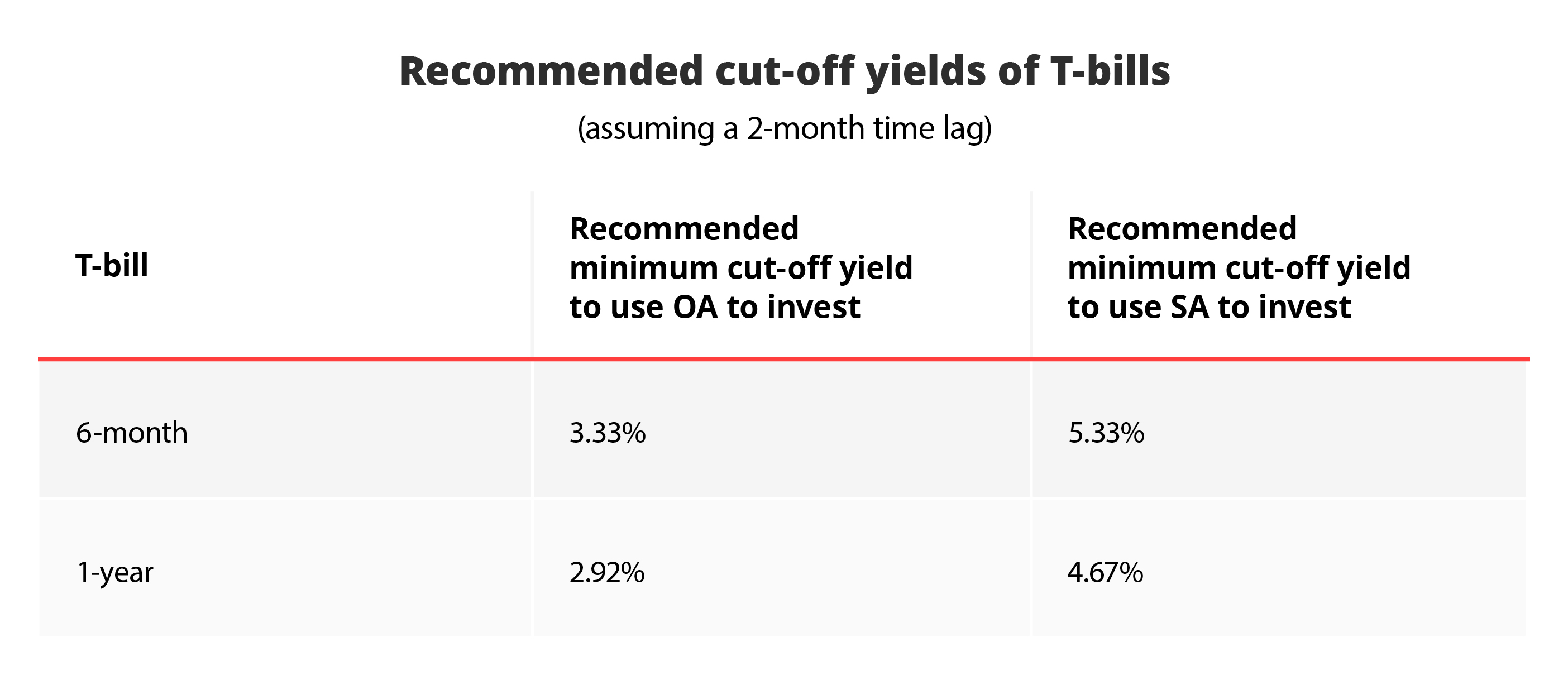
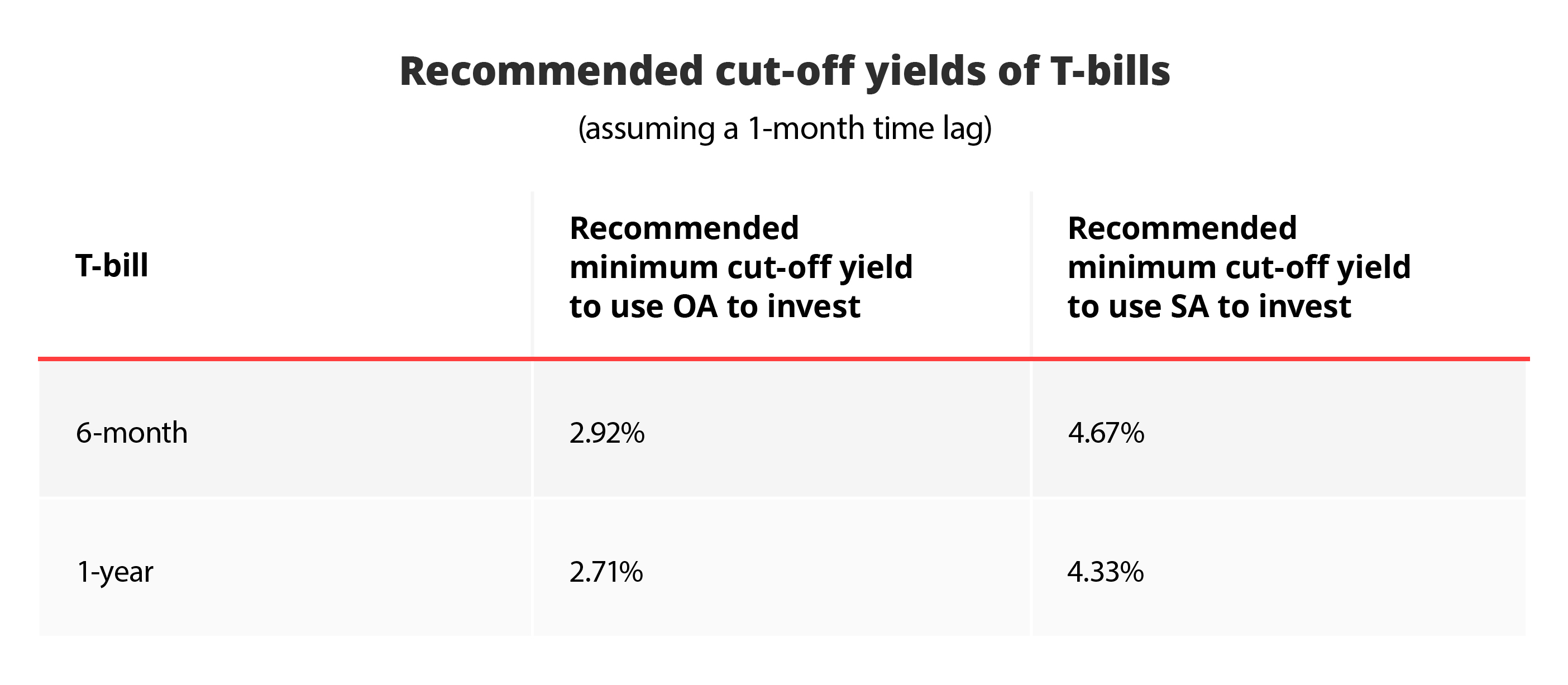
Losing CPF Interest... 7 (1m lag) or 8 (2m lag) months...

Lets use two examples...

BS24102S​

Auction date01 Feb 2024
Issue date06 Feb 2024
Maturity date06 Aug 2024

The above will not earn CPF interest for 7 months. cause

CPF gets deducted AFTER auction date but before issue date. so will deduct in feb 2024. hence no interest earned starting feb 2024

matures in aug 2024. you initiate. transfer back to CPF, interest start to earn sep 2024

Feb
Mar
Apr
May
Jun
Jul
Aug

7 months no interest earned in CPF

BS24106W​

Auction date 27 Mar 2024
Issue date 02 Apr 2024
Maturity date 01 Oct 2024

Caveat: this i can't be for sure when they deduct CPF (someone who got this can share), but i am assuming 28th Mar.

So in this case, deduct 28 mar, so mar no more interest from CPF
mature oct, transfer back to cpf. start to earn Nov

Mar
Apr
May
Jun
July
Aug
Sep
Oct

8 months no interest earned in CPF

Additional useful reference:
https://www.dbs.com.sg/personal/articles/nav/investing/investing-in-t-bills
https://investmentmoats.com/saving-...y-singapore-treasury-bills-t-bills-sgs-bonds/
 
Last edited:

reddevil0728

Great Supremacy Member
Joined
Dec 16, 2005
Messages
64,904
Reaction score
5,408
Short write-up about T-bills...

As at the time of writing, auctions for 6 months tenor happen fortnightly while 1 year tenor happen quarterly.

For details please look at the link provided to have a baseline understanding instead of asking questions here that is stated in the link. If you are unsure, do ask here, but at least show some effort that you at least look it up instead of expecting to be spoon fed.

How it works...

When you apply for T-bills, there are 2 options, competitive or non-competitive bids.

Non-competitive = you will accept whatever yield (i.e., Cut-off Yield) that came out from the auction. In other words, if the cut-off yield is 2%, think of it as if you interest on an annualised basis is going to be 2%.

So if you were to apply for $1,000 for a t-bill with 6 months tenor, you will almost immediately after the auction get back ~$10 upfront. Then your $1,000 will be credited back to you at the end of the 6 months.

Competitive = you want a baseline as to what yield you might want to accept. So example, you can find a yield of 2.5% somewhere else, so you wouldn't bid for T-bills if you don't get better than 2.5% from it, in that case you may want to put in a competitive bid of 2.55%.

Should the eventual cut-off yield be 2.7%, you will get the t-bill, but instead of getting a yield of 2.55%, you will get a yield of 2.7%.

Should the eventual cut-off yield be 2.2%, you will get nothing.

To conclude for Competitive

If your bid is < cut-off yield, you will definitely get the full allocation an the yield is the cut-off yield

If your bid is = cut-off yield, your allocation is pro-rata (stand to be corrected) and the yield is the cut-off yield

If your bid is > cut-off yield, you get nothing.

“Interest Refund” or the Discount

Use the cut-off price instead of yield to calculate as the yield is for reference and has rounding.

so for an example if the cut-off price is 98.823 and you apply for 1,000

You will get 11.77 refunded.

cause face value is 100 and minimum is 1,000.

so essentially you are getting 10x of 100 face value t-bill

Non-competitive vs Competitive - What is preferred and how to decide the bid if any?

Non-CompetitiveCompetitive
Advantages•Don’t have to bother about what bid to input•Able to determine what is the minimum yield you are willing to accept, if not you would rather not getting T-bill (how much to bid should be based on opportunity cost concept – see following discussion)
•Essentially ”free” protection so why not?
Disadvantages•No protection against black swan event of unusually low rate (vis-à-vis expected market yield) which you might be better of not putting the money in T-bill. E.g., assuming the 10k you are planning to put in 10k is yielding 2% interest in your bank account, but T-bill yield is 0.5%, you are better off not getting T-bill allocation)
•potential pro-rated allocation if over subscribed
•(Important to note, low probability of unusually low rather does not mean no probability – don’t conflate the two)
•Need to decide what bid to input
tl;dr there's really no benefit to apply for NC.

1. if you are ok to accept any yield, then a low comp bid will do the same trick.

2. with a low comp bid, you can get "guaranteed" fully allocation vis-a-vis NC (there's always the potential of an over sub and allocation of past issues, is not indicative of future issues)

Opportunity Cost concept to determine bid

Say u want to put 10k into t-bill.

Currently the 10k is in a normal bank account getting 2% interest.

logic dictates that unless Tbill interest is better than 2%, you will be better off leaving that 10k in the normal bank account (since there is added flexibility).

so better can just mean 0.01% more.

so in this case 2.01%.

If say u bid 2.01%, cut-off yield is 2.98%, u end up getting 2.98%.

If you go bid 2.99%, come out 2.98%, you get nothing.

2.98% vs 2% it is quite clear which is better

You want to avoid being 100% right for your comp bid also, as you get pro-rata allocation. someone was exactly right, but get 2% allocation of what they applied for. and the remaining 98% end up earning the rate of the next best alternative

Why NC bids impact COY and how is COY determined

Let’s say, nobody apply NC, and the full 40% set aside for NC goes fully to those people who bids C.

this will allow more C bid to be successful and thus the highest comp bid that’s successful will determine the COY.

but if ppl do NC, it reduces the supply of t-bill being allocated to ppl who bid comp, and thus the COY will be based on a smaller pool of Comp bidders and thus the COY will be lower.

so if say there are $10 worth of supply.

$4 allocated to NC.

only $6 allocated to C bid.

there are 10 C bids of $1 each. Bidding 1% to 10%.

So

1%
2%
3%
4%
5%
6% - if only $6 worth of supply, COY will be 6%
7%
8%
9%
10% - if got $10 worth of supply COY will be 10%

Yes, there's a cap to how much NC can impact COY, i.e., if it is oversub (>40%), then every additional dollar of NC will not impact COY. However, if it is undersub (<40%), then the impact is full on.

"Lowballing"

Scenario A


if say there's $10 worth of supply

and there are 11 applicants, each apply for $1

9 applicants applied for $1 each @ 6% COY

1 applicant applied for $1 @ 6.01% COY

1 applicant applied for $1 @ 6.02% COY

COY will thus be 6.01%

Scenario B

if say there's $10 worth of supply

and there are 11 applicants, each apply for $1

9 applicants applied for $1 each @ 0.01% COY

1 applicant applied for $1 @ 6.01% COY

1 applicant applied for $1 @ 6.02% COY

COY will thus be 6.01%

are the 9 applicants who applied for $1 each @ 6% COY

--

QNS: the 9 applicants who applied for $1 each. be it in scenario A or B. Can I ask you, why do you think the COY is not impacted by either decision of how much they bid?

So does the supposedly "lowball bid" matter?

--

Note:

I’m not encouraging anybody to put a low bid.

I’m suggesting to people who do NC, that it’s better to put a low C bid.

see above two posts for details
 
Last edited:

gold_eagle36

Senior Member
Joined
Nov 6, 2004
Messages
1,681
Reaction score
118
Can check 6 mths And 1 year t bills usually any significant difference in returns?
 

CaptainWu

Senior Member
Joined
May 18, 2019
Messages
1,077
Reaction score
209
I just watched a Youtube program and the econmist is saying that likely mid to late next year US will started to cut down interest rate as it steps into recession. I think that makes sense and if this holds then we should be putting funds in the coming 6 to 9 mths to T-Bills with interest rates go to its peak. Probably should be focus on the 1 year T-Bills and recycle the 6-mths one until its peak.

Any comments and advices?
 

reddevil0728

Great Supremacy Member
Joined
Dec 16, 2005
Messages
64,904
Reaction score
5,408
I just watched a Youtube program and the econmist is saying that likely mid to late next year US will started to cut down interest rate as it steps into recession. I think that makes sense and if this holds then we should be putting funds in the coming 6 to 9 mths to T-Bills with interest rates go to its peak. Probably should be focus on the 1 year T-Bills and recycle the 6-mths one until its peak.

Any comments and advices?
There are many people who said a lot of things that make sense. But the question is who will be right?

in any case there are only 4 1y auctions a year? While 6m is fortnightly, so not as if there are much choices.

just spread it out?
 

digisales

Senior Member
Joined
Nov 20, 2004
Messages
1,365
Reaction score
26

reddevil0728

Great Supremacy Member
Joined
Dec 16, 2005
Messages
64,904
Reaction score
5,408
From around July 2019 till now, the difference in market yields between 1 year and 6 months T-bills is minimal, around 0.015% pa.
How did you compare?

shouldn’t it be better to compare the last round where 1y and 6m was offered at the same time?

not talking about outstanding tranches where you can get in the secondary market
 

reddevil0728

Great Supremacy Member
Joined
Dec 16, 2005
Messages
64,904
Reaction score
5,408
hi, can i check the cut-off yield will be the interest we will be getting after the 6 months? i see there is still the median yield and average yield.

do we need to be concern of the cut-off/median/average price?
Just need to care about cut off yield and price.

unlike sgs or ssb where you get paid a coupon, for t-bill, you are buying it at discount off face value.

so using the recently concluded one,

cut-off yield is 2.36% with cut-off price of 98.823.

assume you put in an application of $1,000, if you are successful, after the auction, you will get back $11.77. At the end of 6 months you will get back $1,000.

so on an annualised basis, your return is 2.36%.
 

digisales

Senior Member
Joined
Nov 20, 2004
Messages
1,365
Reaction score
26
How did you compare?

shouldn’t it be better to compare the last round where 1y and 6m was offered at the same time?

not talking about outstanding tranches where you can get in the secondary market
the last 1y and 6m which issued on 19Apr, 1y is 2% while 6m was 1.32%. the difference for the both is quite big. did i read the data correctly?
 

reddevil0728

Great Supremacy Member
Joined
Dec 16, 2005
Messages
64,904
Reaction score
5,408
the last 1y and 6m which issued on 19Apr, 1y is 2% while 6m was 1.32%. the difference for the both is quite big. did i read the data correctly?
makes sense? usually the longer the tenure, they need to provide higher yield to account for interest rate risk
 

digisales

Senior Member
Joined
Nov 20, 2004
Messages
1,365
Reaction score
26
Just need to care about cut off yield and price.

unlike sgs or ssb where you get paid a coupon, for t-bill, you are buying it at discount off face value.

so using the recently concluded one,

cut-off yield is 2.36% with cut-off price of 98.823.

assume you put in an application of $1,000, if you are successful, after the auction, you will get back $11.77. At the end of 6 months you will get back $1,000.

so on an annualised basis, your return is 2.36%.
so we will be getting back the interest first, while the principle will have to wait till maturity.

is there any charges to participate in the auction?
 

lzydata

Supremacy Member
Joined
Oct 16, 2010
Messages
6,503
Reaction score
2,794
How did you compare?

shouldn’t it be better to compare the last round where 1y and 6m was offered at the same time?

not talking about outstanding tranches where you can get in the secondary market
I downloaded the market yields for 6 months and 1 year T-bills and the last continuous stretch where both are available is from July 2019 to now.

As 1 year T-bills are not offered that often and not at the same time as 6 months, don't think it is as helpful to compare that.
 

reddevil0728

Great Supremacy Member
Joined
Dec 16, 2005
Messages
64,904
Reaction score
5,408
I downloaded the market yields for 6 months and 1 year T-bills and the last continuous stretch where both are available is from July 2019 to now.

As 1 year T-bills are not offered that often and not at the same time as 6 months, don't think it is as helpful to compare that.
there are 4 times a year where 1y and 6m auctions happening at the same time.

if one is deciding at that time whether to 1y or 6m, would be a useful comparison right? or am i missing something.

trying to get to a more apple to apple comparison.
 
Important Forum Advisory Note
This forum is moderated by volunteer moderators who will react only to members' feedback on posts. Moderators are not employees or representatives of HWZ. Forum members and moderators are responsible for their own posts.

Please refer to our Community Guidelines and Standards, Terms of Service and Member T&Cs for more information.
Top