

testerjp
High Supremacy Member
- Joined
- Jan 29, 2006
- Messages
- 43,942
- Reaction score
- 13,795
Can collaborate between robots and can learn a lot faster, takes command through voice and don't require much training.
Slow like fug but they can work 24 hours, meaning 3 times more than humans on an average work day with no off day, no leave, no bonus, no kpkb.
Those who keeps thinking AI is a hype and useless, i hope it's a reality check to you.
This is only one of the big disruptions it can bring.
This is the update:
Introducing Helix
We're introducing Helix, a generalist Vision-Language-Action (VLA) model that unifies perception, language understanding, and learned control to overcome multiple longstanding challenges in robotics. Helix is a series of firsts:- Full-upper-body control: Helix is the first VLA to output high-rate continuous control of the entire humanoid upper body, including wrists, torso, head, and individual fingers.
- Multi-robot collaboration: Helix is the first VLA to operate simultaneously on two robots, enabling them to solve a shared, long-horizon manipulation task with items they have never seen before.
- Pick up anything: Figure robots equipped with Helix can now pick up virtually any small household object, including thousands of items they have never encountered before, simply by following natural language prompts.
- One neural network: Unlike prior approaches, Helix uses a single set of neural network weights to learn all behaviors—picking and placing items, using drawers and refrigerators, and cross-robot interaction—without any task-specific fine-tuning.
- Commercial-ready: Helix is the first VLA that runs entirely onboard embedded low-power-consumption GPUs, making it immediately ready for commercial deployment.
New Scaling for Humanoid Robotics
The home presents robotics' greatest challenge. Unlike controlled industrial settings, homes are filled with countless objects–delicate glassware, crumpled clothing, scattered toys–each with unpredictable shapes, sizes, colors, and textures. For robots to be useful in households, they will need to be capable of generating intelligent new behaviors on-demand, especially for objects they've never seen before.
The current state of robotics will not scale to the home without a step change. Teaching robots even a single new behavior currently requires substantial human effort: either hours of PhD-level expert manual programming or thousands of demonstrations. Both are prohibitively expensive when we consider how vast the problem of the home truly is.
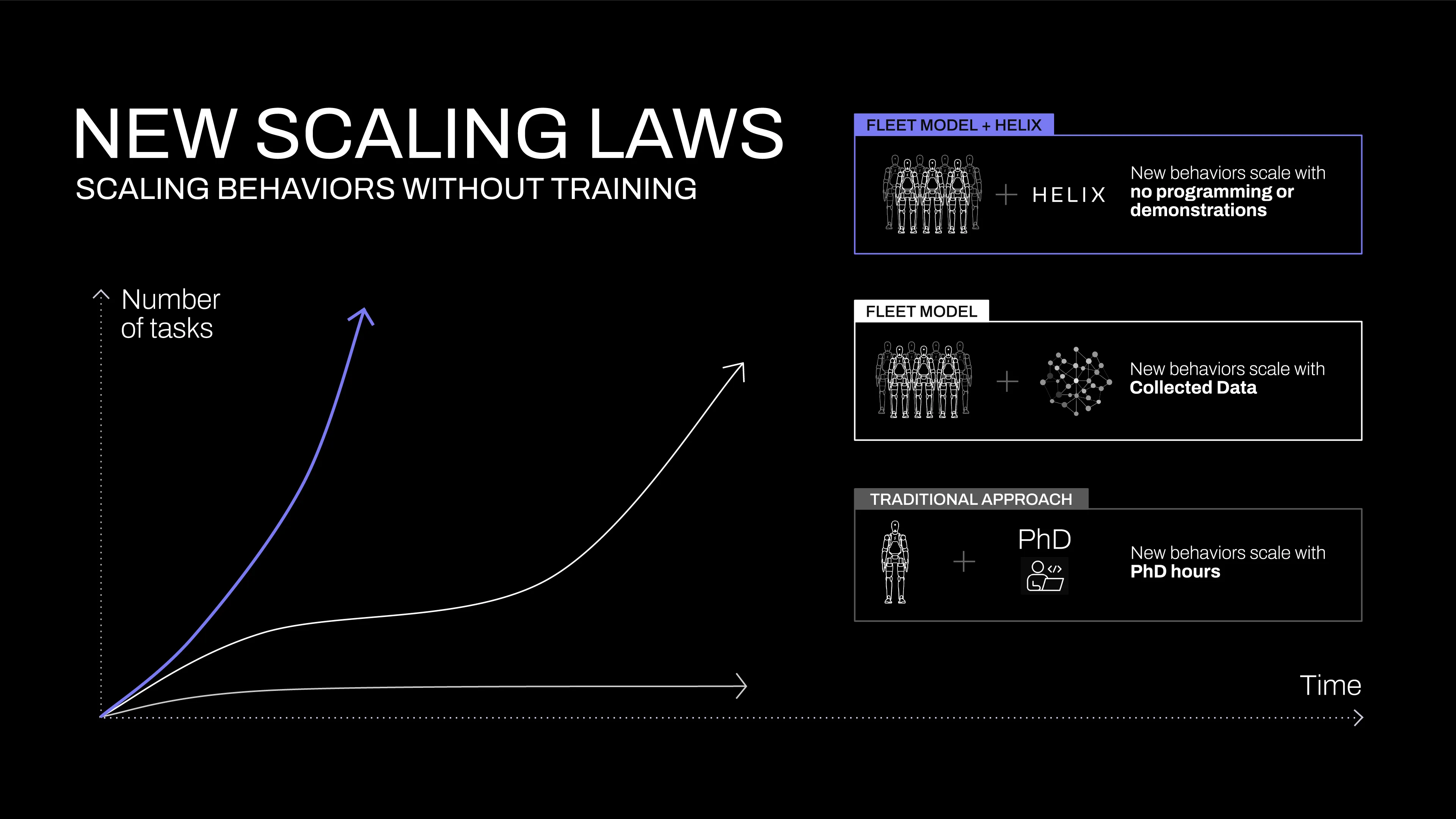
But other domains of AI have mastered this kind of instant generalization. What if we could simply translate the rich semantic knowledge captured in Vision Language Models (VLMs) directly into robot actions? This new capability would fundamentally alter robotics' scaling trajectory (Figure 1). Suddenly, new skills that once took hundreds of demonstrations could be obtained instantly just by talking to robots in natural language. The key problem becomes: how do we extract all this common-sense knowledge from VLMs and translate it into generalizable robot control? We built Helix to bridge this gap
This was 3 months ago when they were deployed at BMW.
Now that the robots can integrate to work together, it means can perform more automation
Meanwhile, China's Robots only seem to focus on maneuverability and do stupid things like dancing
Last edited:


