CPF SA Shielding hack - RIP (Obsolete)

vsvs24

Arch-Supremacy Member
Joined
Feb 3, 2018
Messages
11,345
Reaction score
3,706
SA interest does not differentiate sex of the CPF member.

But CPF life payout does as women are expected to live longer than men so monthly payout is lower.

My mother passed away at age 71. My father is very much alive at 91.

So more worth for males to top up RA compared to females since payout is higher and lifespan is unpredictable be in male or female ?
 

RedsYWNA

Senior Member
Joined
Sep 30, 2015
Messages
2,185
Reaction score
602
The key point that you have to live to around 90 to see the discontinued SA yield of 4.0% is correct.
Based on the latest life tables published by DOS, the probability of living to 90 if you are male is 22.7%.
Actually I am a bit confused, because on one hand, I see 2-4% yield range being highlighted, while some say the distribution rate is 6% range.
 

Oldnerd79

Senior Member
Joined
Jan 30, 2018
Messages
665
Reaction score
313
How many will have enough to go for ERS when they turn 55 without topping up with cash? For me it's gonna be OA+SA almost wiped out. Like that I won't ever get to feel the shiokness of doing lump sum CPF withdrawal after saving for so many years! If unlucky die before 65, save whole life for other people to enjoy ;(

I rather withdraw the $ at 55 only setting aside FRS. At least can see can touch the money.

Unless it's those 1M55 people, they will have no issue going for ERS for sure
 

henrylbh

Arch-Supremacy Member
Joined
Mar 9, 2004
Messages
16,161
Reaction score
864
I go Genting regularly with my friends. Every time we go, I tell them my hypothesis is that we will likely lose money. Despite me being right many times, they almost never believe me. They always cite the times when I was wrong and they left with winnings.

Genting has this nice system where if you clock a certain amount of play, they will comp you a free room. The exact amount is never advertised but it is not difficult to determine the empirical threshold where you will be awarded the room you want. The expected loss from the amount of required play is usually less than the cost of the room itself. The strategy I therefore deploy is to limit my play to the amount for the free room and then stop. in this way, I enjoy a positive expectations game and beat the house.

For anyone who wants to listen, CPF Life is a negative expectations game. I cannot prove it at this point in time but I am fairly confident I am right in the same way I am right about losing money gambling at Genting. If you want evidence of this, you will need to wait 10 to 20 years and see if CPF Life has large surpluses or deficits.

in light of the recent removal of SA shielding, there has been a lot of advice going round suggesting people should put even more money into CPF Life. This is bad advice. You cannot improve the odds of a negative expectations game by increasing your bet. If you do so, you will only end up losing more.

If you believe that CPF Life is a negative expectations game, then your optimum strategy is to put in the bare minimum via the BRS scheme. This is similar to the strategy I deploy at Genting where I play the bare minimum to get the free room. Draw out the maximum amount possible and consult a good financial planner on how best to deploy the money to meet your retirement needs.
Off topic, I used to stay at Genting every year, each time for whole week and believe it or not, I don't step into the casino. I so used to drive up and down Genting that I can take on any taxi in reaching the top :D And I free gear and roll down the karak hwy for a distance of nearly 8km. Those were the days. Now old.
 

aurvandil

Senior Member
Joined
Apr 11, 2019
Messages
1,865
Reaction score
1,149
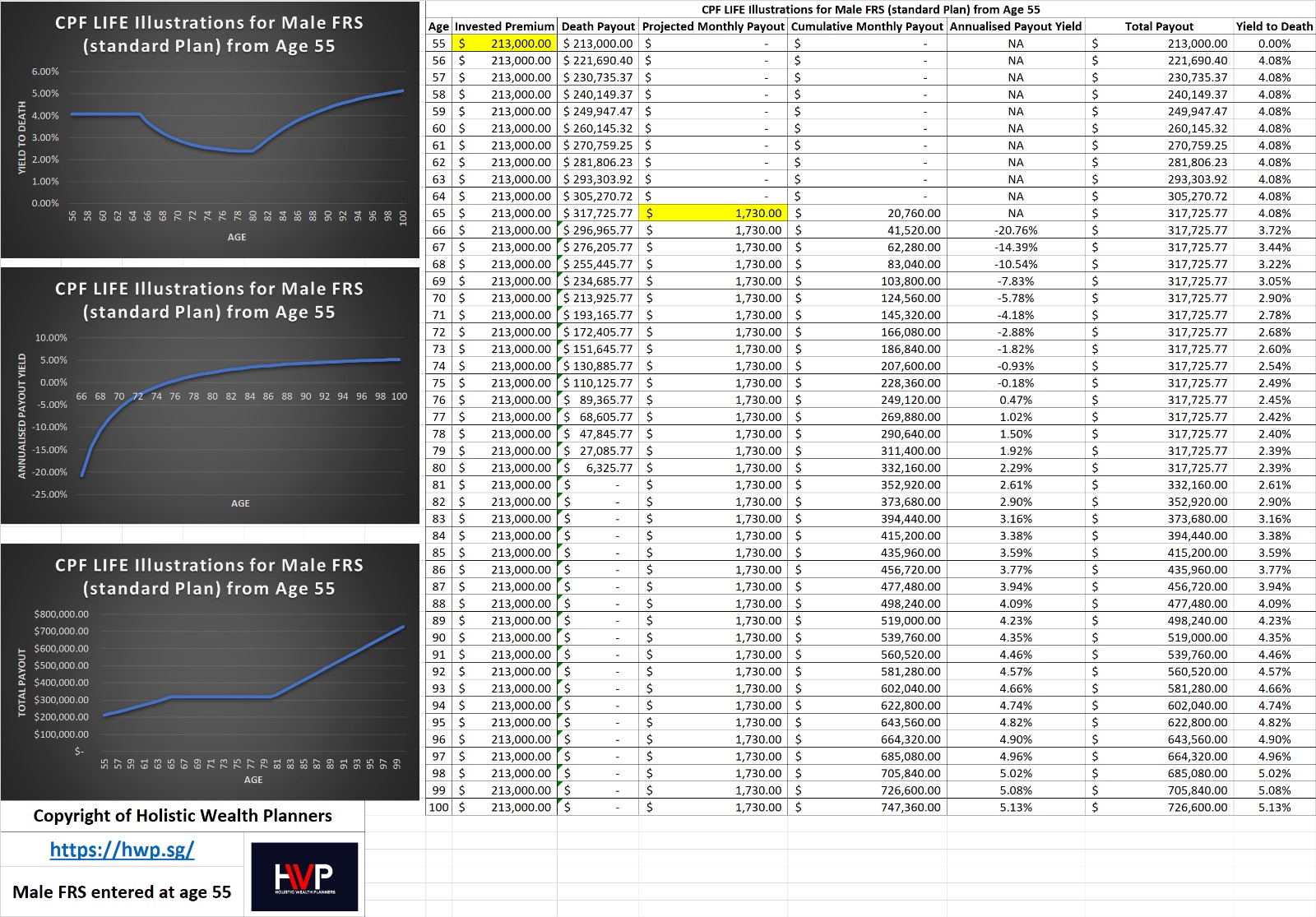
Actually I am a bit confused, because on one hand, I see 2-4% yield range being highlighted, while some say the distribution rate is 6% range.

I believe the 6% comes from 1M65. I have not seen his calculation and do not know how he got it. I am familiar with the 4% from Dr Wealth.

MaleFRS.jpg


Referring this sheet:

Col 1 shows the amount of Premium invested for FRS.
Col 4 shows the CPF Life annual payout starting at age 65.
Col 6 shows the total payout if death occurs in that year.
Col 7 shows the yield at death.

From this sheet, the yield to death only crosses the 4% mark if you make it to 88.
 

DevilPlate

Arch-Supremacy Member
Joined
Nov 22, 2020
Messages
12,250
Reaction score
5,165
Really no point comparing the yield and simi breakeven age for cpflife. It is an annuity product.
Maybe should make some comparison with pte annuities instead.

Its like some don’t believe in insurance and prefer self-insured route.
Some also say whole life insurance are “scammy” products as well.

I have friends that super anti-insurance, only have bare min medishield plan and hm insurance and nth else and laugh at us wasting premium over few decades insuring for nth…..whahahaha
*Those folks happen to be anti-cpf as well (and also anti pap if that matters)

Is there a strong correlation? Whahahah
 

fr33d0m

Master Member
Joined
Jan 8, 2008
Messages
3,709
Reaction score
729
If the CPF Life is so good, they wouldn't have to make it mandatory.

All they needed to do is show the amount of subsidy they are putting in and how the payout significantly exceeds the amount that a person puts in.

If they did this, I am very sure there will be a mad scramble to voluntarily max out the amount that a person can put in.

The reason they are not doing this is because the probability and the numbers do not allow them to do this.


stupidity abounds. too many with short sights... don't look afar, many here.

CPF LIFE is self-funded. What the government provides is just the guaranteed floor interest rate.

The government may help certain groups of people, that's out of tax payers' pocket.

The government does not make money for itself.....
 

vsvs24

Arch-Supremacy Member
Joined
Feb 3, 2018
Messages
11,345
Reaction score
3,706
Likewise, anti-cpf folks can leave bare min BRS as well
But the rules will change next year isn't it ?

If leave only BRS, even if pledge property, as long as you work beyond 55, SA portion for employment CPF goes to RA till you reach FRS. So no way to keep just BRS in future if continue working.
 

BBCWatcher

Arch-Supremacy Member
Joined
Jun 15, 2010
Messages
24,456
Reaction score
5,524
All you have to do is look at Safe Withdrawal Rates to see how much more expensive it would be to support a particular real retirement lifestyle without CPF LIFE.

Let’s look at a male, born in 1959 (so 65 now), $300,000 in his Retirement Account, starts Escalating Plan payouts now. That payout is $1,300 per month, a Year 1 payout percentage of 5.2%. That’s WAY above a Safe Withdrawal Rate if you were trying to support $1,300/month (2024 dollars) of retirement income. The famous Liberty Study suggested a SWR of 4% might be OK, but more recently experts think 3.5% is more realistic. Let’s look at both. To get $1,300/month at a 4% SWR you’d need $390,000 (+$90,000 more). Or if you don’t have that $90,000 extra you’ll need to drop your monthly retirement income from $1,300/month to $1,000/month (2024 dollars). At a 3.5% SWR you’d need $445,714 (+$145,714). Or if you only have $300,000 sorry, you’ll need to drop your drawdown to $875/month.

Both the 4.0% and 3.5% SWRs assume you’re invested in a typical retirement portfolio of stocks and bonds, probably 50-50 to 40-60. If you’re in SSBs, OA, T-bills, and fixed deposits then even 3.5% is way too risky.
 

BBCWatcher

Arch-Supremacy Member
Joined
Jun 15, 2010
Messages
24,456
Reaction score
5,524
But the rules will change next year isn't it ?

If leave only BRS, even if pledge property, as long as you work beyond 55, SA portion for employment CPF goes to RA till you reach FRS. So no way to keep just BRS in future if continue working.
Even if that were to happen (probably not, but if) you could withdraw those dollars every month. You’ve met the BRS, and you have a property pledge or charge in place.

We’ll know for sure when the rule change comes into effect and the CPF Board processes the first payroll cycle.
 

vsvs24

Arch-Supremacy Member
Joined
Feb 3, 2018
Messages
11,345
Reaction score
3,706
Even if that were to happen (probably not, but if) you could withdraw those dollars every month. You’ve met the BRS, and you have a property pledge or charge in place.

We’ll know for sure when the rule change comes into effect and the CPF Board processes the first payroll cycle.
My friend's case of having BRS only with property pledge because she does not have enough to go upto FRS. SA was zero at 55 because transferred to RA. Now she has slowly built up a bit of SA by continuing to work. And SA and OA can be withdrawn freely because BRS + property pledge.

But if the new rules is to close SA and transfer to RA just because she does not have FRS despite property pledge, then it is worse off for her as she prefers it to be available for withdrawal like now.

I have written to CPFB to query about the treatment of SA for those with BRS with property pledge - the balance as well as future employment contribution. No reply yet.

If the SA balance is really going to RA instead of OA, then she will have to withdraw her SA by Dec 2024. But the employment contribution from 2025 can't do anything about it.
 

aurvandil

Senior Member
Joined
Apr 11, 2019
Messages
1,865
Reaction score
1,149
Really no point comparing the yield and simi breakeven age for cpflife. It is an annuity product.
Maybe should make some comparison with pte annuities instead.

Its like some don’t believe in insurance and prefer self-insured route.
Some also say whole life insurance are “scammy” products as well.

I have friends that super anti-insurance, only have bare min medishield plan and hm insurance and nth else and laugh at us wasting premium over few decades insuring for nth…..whahahaha
*Those folks happen to be anti-cpf as well (and also anti pap if that matters)

Is there a strong correlation? Whahahah

Dr Wealth's Yield to Death explains it better than I ever could. That projected return is too low for me.
Even if you can make the magical 100, the yield to death is barely 5%.

That being said, CPF Life is excellent from a policy perspective. If it can be succesfully implemented, it would mean that there is no need raise taxes to meet the needs of the elderly poor in Singapore. This is especially important as Singapore ages. It is therefore very good to see so many in this thread who are keen to go all in for CPF Life.
 

DevilPlate

Arch-Supremacy Member
Joined
Nov 22, 2020
Messages
12,250
Reaction score
5,165
Dr Wealth's Yield to Death explains it better than I ever could. That projected return is too low for me.
Even if you can make the magical 100, the yield to death is barely 5%.

That being said, CPF Life is excellent from a policy perspective. If it can be succesfully implemented, it would mean that there is no need raise taxes to meet the needs of the elderly poor in Singapore. This is especially important as Singapore ages. It is therefore very good to see so many in this thread who are keen to go all in for CPF Life.
Who is in the right mind to go all in cpflife?
for those got nth much outside cpf at 55yo, ofc withdraw everything out lah and leave frs or brs amt.

anyway max 4xxk only…..usually most shd have frs by 55yo and only top up 200k thereabouts which most likely form 20-30% of their entire portfolio.

4% returns cui? How about 10y SGS at 3%? I plan to park some over there whahahaha
U see my point?
 

aurvandil

Senior Member
Joined
Apr 11, 2019
Messages
1,865
Reaction score
1,149
4% returns cui? How about 10y SGS at 3%? I plan to park some over there whahahaha
U see my point?

4% return on a SGD denominated instrument is of course not cui.
4% return but you must live to 88 to get it is cui.

If you want to think about your own family rather than fellow Singaporeans, you should seriously consider CPF Life Basic rather than CPF Life Standard.

For CPF Life Basic, only 10% to 20% is used to buy CPF Life. The balance is retained in the RA earning 4% interest. If anything happens to you before 88, the interest lost is only on the 10% to 20% used to buy CPF Life. This is especially useful if you have substantial amount of wealth outside of CPF RA which can be used to pay for your needs post 90 years when your RA is exhausted under this scheme.

To encourage particiaption in CPF Life, CPF Life Standard is currently the default offered to those that turn 55. You have specify that you want CPF LIFe Basic to get it. Over time, I expect they will remove CPF Life Basic in the same way the SA was removed.

On longevity, it is a myth that our life spans will continue to increase in a straight line. The low hanging fruit to extend human life have been plucked and barring a major breakthrough, we are likely to see declining increases to longevity. Also even if life can be extended, the quality of life suffers tremendously as you age. In planning for the final years, it is useful to consider hospice as an alternative to medical treatment for critical illness once you are past the age of 75.
 
Last edited:

BBCWatcher

Arch-Supremacy Member
Joined
Jun 15, 2010
Messages
24,456
Reaction score
5,524
My friend's case of having BRS only with property pledge because she does not have enough to go upto FRS. SA was zero at 55 because transferred to RA. Now she has slowly built up a bit of SA by continuing to work. And SA and OA can be withdrawn freely because BRS + property pledge.

But if the new rules is to close SA and transfer to RA just because she does not have FRS despite property pledge, then it is worse off for her as she prefers it to be available for withdrawal like now.
There’s no change to the withdrawal options. Just look through the Budget 2024 CPF rule changes and you’ll see no such changes.

I don’t think we know yet whether compulsory contributions (the former SA portion) will land in RA or OA for someone who chose the BRS with property pledge or charge, but it doesn’t matter much. Those dollars would still be available for withdrawal.

Particularly since SA is going away (but not only) your friend may wish to boost her retirement income by transferring OA dollars to RA (or leaving additional RA dollars in RA, as the case may be). She can do that now if she wishes, and (to the extent the transfer now involves OA dollars) she’d upgrade dollars from 2.5% to 4.08% (current rate) interest. That would make financial sense if she’s going to do that anyway in early 2025 when her SA dollars are downgraded to OA. If she’s not going to upgrade any current OA dollars then she can wait.

If she has a spouse or other family member who can transfer their OA dollars to her RA that’d help. She can strike any private understanding she wishes, for example she could promise to pay that family member back from her OA dollars in early 2025.
Who is in the right mind to go all in cpflife?
Actually, there are such cases. As an easy example, if you have creditors or adverse court rulings that would grab unprotected assets then you’d be very grateful for CPF and would protect as many dollars as allowed.

But you’re not allowed to buy “too much” CPF LIFE. There’s an inflow cap called the Enhanced Retirement Sum. Even if you jam as many dollars in as allowed you’re only going to get roughly a nursing home level of income. Which should be a sobering thought when you think about retirement income needs and how to protect yourself and your loved ones against lifestyle erosion.
4% returns cui? How about 10y SGS at 3%? I plan to park some over there whahahaha
U see my point?
I really think everyone needs to look at the Safe Withdrawal Rate on their investment portfolio and compare that to a CPF LIFE Escalating Plan payout. That’s a pretty fair comparison. If your portfolio is like that of many elder Singaporeans (SSBs, SGSes, fixed deposits, ordinary bank accounts, 3 year endowment plans) then a Safe Withdrawal Rate might be 3.0% — something like that. Even a mixed stocks-bonds portfolio (and well managed) only gets you to 4%, and a lot of experts recommend 3.5%. You either need a LOT more savings to sustain the same monthly retirement income CPF LIFE provides or you need to reduce your monthly income.

Does anybody want to make any counter argument to the previous paragraph? Have you even looked at Safe Withdrawal Rates and determined what SWR you’re going to use? Then computed how much retirement income you’d get? If not, what are you waiting for? Get out a spreadsheet or calculator and start figuring that out.
 

snowcrabramyeon

Senior Member
Joined
Apr 4, 2021
Messages
1,934
Reaction score
604
If I own a 5-rm flat rented out, don't think will be eligible for a lot of subsidies. If the whole unit rental income can at least cover the nursing home cost then should be fine, at that age I will only need to buy food, medicine, diapers lol probably $2k in today's dollars sufficient.
https://www.hdb.gov.sg/residential/...flat/types-of-flats/community-care-apartments

Have you considered selling your 5-rm flat and buying a CCA? CCA provides assisted living arrangements which could significantly reduce the possibility of needing to actually go to a nursing home. With this "downgrade", you can then release a substantial amount of cash, either to fully topup your RA to 4x, or as emergency fund for other living expenses.

As the CCA is effectively a 1.5 room flat, you would presumably get a bit more subsidies as compared to living in a 5 room flat. For the Bukit Batok CCA, you even have priority for Bukit Batok Care Home should you need to.

https://www.moh.gov.sg/docs/librari...partments-press-release-(10-dec-2020-6pm).pdf
 
Important Forum Advisory Note
This forum is moderated by volunteer moderators who will react only to members' feedback on posts. Moderators are not employees or representatives of HWZ Forums. Forum members and moderators are responsible for their own posts. Please refer to our Community Guidelines and Standards and Terms and Conditions for more information.
Top