✪ EDMW Canada Chit-Chat

cyke69sg

High Supremacy Member
Joined
Mar 28, 2005
Messages
38,164
Reaction score
19,926
Very expensive, right?

Chinese food at food court, one rice two side dishes around CAD$12 at least? Factoring inflation over these years.
I am going to eat this week.

All you can eat Alberta Wagyu teppanyaki. Also got sashimi and sushi. $60 per person


cyke69sg

High Supremacy Member
Joined
Mar 28, 2005
Messages
38,164
Reaction score
19,926
https://www.readthemaple.com/the-income-gap-in-canada-has-reached-a-record-high/


The Income Gap In Canada Has Reached A Record High​

The wealthiest amass more through higher salaries and passive income, while workers face stagnating wages.
Class Struggle
Adam D.K. King
by Adam D.K. King
July 28, 2025 ∙ 6 min read
The Income Gap In Canada Has Reached A Record High

Photo via PiggyBank on Unsplash.
upload in progress, 0

Earlier this month, Statistics Canada releaseddata showing that the income gap between the wealthiest and poorest Canadian households has reached a record high.
In the first quarter of 2025, the income gap shot up to 49 percentage points from 43.8 percentage points in 2021.
The gap the statistical agency is measuring is the difference in disposable income between the top 40 per cent and bottom 40 per cent of households. “Income” includes all money earned from wages and salaries, government transfers, as well as income earned from interest-bearing assets, such as investments and savings.
The primary mechanism driving the observed income polarization, as StatCan’s summary of the data explains, is that “the highest income households gained from investments, while the lowest income households’ wages declined.”
In other words, we’re witnessing more of the same. The wealthiest amass more through higher salaries and passive income from capital, while workers face stagnating wages.
For middle-income households, results were mixed. While labour income moderated from a year earlier, it grew at roughly the same rate as the total household average. On the other hand, the middle-income group saw investment income fall slightly.
The top 20 per cent of households, by contrast, saw by far the biggest income gains. Relative to one year earlier, these earners increased their disposable income by 7.7 per cent, with wages up by 4.7 per cent and investment income up by 7.4 per cent.
 

econ food

Supremacy Member
Joined
Jun 19, 2024
Messages
8,155
Reaction score
2,515
Ts..compare to Canada Chinese descent and Singapore ..Chinese descendants.. any major difference? Is that Canada Chinese girls more easy to chat akd date?
 

cyke69sg

High Supremacy Member
Joined
Mar 28, 2005
Messages
38,164
Reaction score
19,926
Ts..compare to Canada Chinese descent and Singapore ..Chinese descendants.. any major difference? Is that Canada Chinese girls more easy to chat akd date?
Canadian born chinese speak english with Canadian accent.

Tend to be more liberal and outgoing I think.
 

cyke69sg

High Supremacy Member
Joined
Mar 28, 2005
Messages
38,164
Reaction score
19,926
The White House says U.S. President Donald Trump has signed an executive order to increase a tariff on Canadian goods to 35 per cent.

However, Canadian goods that meet the terms of the Canada-U.S.-Mexico Agreement will not be subject to the tariff, which means the vast bulk of Canada's exports can still cross the border tariff-free.
 

cyke69sg

High Supremacy Member
Joined
Mar 28, 2005
Messages
38,164
Reaction score
19,926
https://www.cbc.ca/news/canada/edmo...edical-journal-launches-in-edmonton-1.7600785

Edmonton

Canada's first Black medical journal launches in Edmonton​

The Canadian Nigerian Medical Journal will help bridge healthcare gaps for Black Canadians​

jesmeen-gill.jpg

Jesmeen Gill · CBC News · Posted: Aug 04, 2025 5:00 AM MDT | Last Updated: 10 hours ago
A group of members pose in front of the table that hold the journal in a display box

The journal officially launched in Edmonton, with over 1000 Black doctors who attended. (Jesmeen Gill/CBC)

The Canadian Association of Nigerian Physicians and Dentists is launching the first Black health journal in Canada.
The Canadian Nigerian Medical Journal serves as a place where diagnoses, targeted treatments, and ongoing research are shared as they pertain to the Black community, with the goal of improving health outcomes for Black Canadians.
The launch took place this weekend in Edmonton, and the journal's editor-in-chief, Dr. Moses Ademola, hopes it will serve as a platform for unique insights and contributions from the Black medical community.

"Because of our background and culture and experiences we've had, we also tend to have some knowledge that is very unique, and we want to introduce that into an academic journal," he said.
A medical magazine sits in a display box on a table with infographics

The first edition of the Canadian Nigerian Medical Journal, published in August 2025. (Jesmeen Gill/CBC)
A Government of Canada public health agency study highlights the health inequities faced by Black individuals living in Canada.
According to the study, Black Canadians experience health and social inequities linked to processes of discrimination at multiple levels of society, including individual, interpersonal, institutional, and societal discrimination.
"This is a dream that we've always had for the last 24 years," said Dr. Modupe Tunde-Byass, a sectional head of the journal.
"Most of the people who are behind these journals have trained in two or three continents. So they are bringing knowledge, the skill set to be able to come up with this journal," she said.
"We're hoping to tap into everything that happens to all Canadians, even with more focus on people who look like us."
Medical journals are peer-reviewed scientific publications that distribute medical information to healthcare professionals and the public.
They serve as a platform for sharing research findings, clinical insights, and other relevant information to advance medical knowledge and practice.
"While it is published by a diaspora Black organization, it's actually an international medical journal that is peer reviewed and that will be available in print and as open access, so everybody can access it," said Dr. Segun Oyedokun, the journal's deputy editor.
"One of the things that also stands out is we don't expect others to pay high fees to submit their work, because we receive significant support from members," he added.

Ademola said he hopes the journal can shed some light on issues and topics that aren't often covered by other publications.
"This is just the beginning. There's an African adage that says that one can run fast, many can go further. We need more help. We want to go further with this," said Ademola.

ABOUT THE AUTHOR​

jesmeen-gill.jpg

Jesmeen Gill
Reporter
 

cyke69sg

High Supremacy Member
Joined
Mar 28, 2005
Messages
38,164
Reaction score
19,926
https://www.cbc.ca/news/business/canada-resilience-us-tariffs-1.7600931

Business

Why Canada's economy is showing resilience in the face of U.S. tariffs​

Despite job losses, Canadian consumption continues to grow 'modestly'​

canadian-press-logo.jpg

Craig Lord · The Canadian Press · Posted: Aug 04, 2025 9:45 AM MDT | Last Updated: 5 hours ago
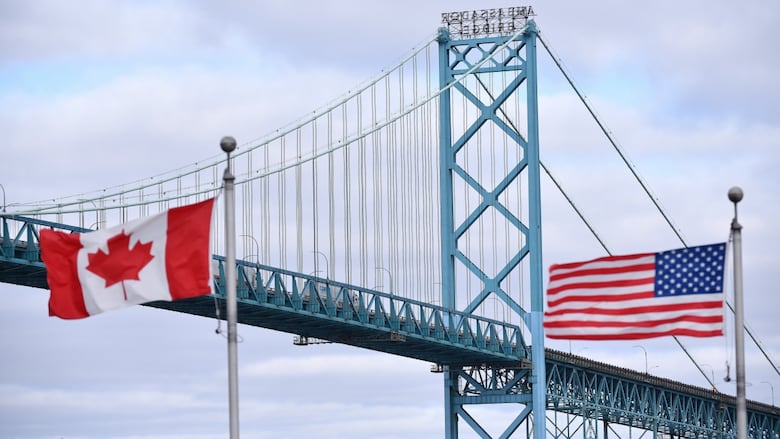
Canadian and American flags fly near the Ambassador Bridge at the Canada-USA border crossing in Windsor, Ont. On the left is the red and white Canadian flag, with a maple leaf in the centre and red vertical bands on the left and right sides. On the right is the American flag, with its red and white horizontal stripes and white stars on a blue background. The bridge spans across the image in the background against an overcast cloudy sky.

The Ambassador Bridge linking Windsor, Ont., to Detroit is shown in this file photo. Economists say Canada is holding up against U.S.-imposed tariffs. (Rob Gurdebeke/The Canadian Press)

Despite tariffs piling up over the past few months, economists say there are few signs of economic collapse — though Canada's economy is starting to show cracks.
TD Bank economist Marc Ercolao conceded it's a "bit of surprise" to see the economy holding up against a massive disruption from Canada's largest trading partner.
"Many months ago, ourselves — as well as other economic forecasters — had an outlook for a much weaker Canadian economy. Obviously, that isn't manifesting now," he said in an interview.

"We are avoiding the worst-case scenario."
Last week, Bank of Canada governor Tiff Macklem said Canada's economy is holding up under the weight of U.S. tariffs with "some resilience."
Just a few days later, U.S. President Donald Trump added 35 per cent tariffs on Canadian goods to a running tally that includes hefty duties on steel, aluminum, automobiles and, more recently, semi-finished copper.
On Thursday, Statistics Canada gave a glimpse at how the economy wrapped up the second quarter of the year when many of those tariffs came into full effect.
The agency sees a couple of small contractions in real gross domestic product (GDP) by industry in April and May, but its flash estimates show the economy rebounding somewhat in June.
If those early readings pan out, Statistics Canada said that would be good enough for flat growth overall on the quarter.
Some of those results are distorted by volatility — businesses rushing to get ahead of tariffs boosted activity in the first quarter, and that's giving way to weakness in the second quarter, for example.
It's still hard to pinpoint exact impacts tied to tariffs, Ercolao said, but a broad trend is emerging.
"What we can say over the last six months or so is that economic activity is somewhat flatlining."
Services sectors are holding up relatively well, but Ercolao said export-heavy industries such as manufacturing and transportation are bearing the brunt of the impact.

Bank of Canada says consumer confidence growing​

In an attempt to shore up some of that weakness, the federal government announced various programs to support tariff-affected workers, and broader plans to accelerate defence and infrastructure spending.
Macklem noted during his news conference Wednesday that business and consumer confidence are still low, but have improved according to the central bank's recent surveys.
While some trade-exposed sectors have faced job losses and unemployment has generally trended upward to nearly seven per cent, employers elsewhere in the economy continue to expand their payrolls.
"Consumption is still growing," Macklem said. "It's growing modestly. It's certainly being restrained by the uncertainty caused by tariffs. But it is growing and we expect that to continue through the third and fourth quarters."
Last week, the Bank of Canada kept its policy interest rate unchanged at 2.75 per cent in a third consecutive decision.
WATCH | Bank of Canada's governor gives reasons for holding the bank rate steady:


default.jpg

Bank of Canada says interest rate decision was made ‘independently of the political process’

5 days ago

When asked by a reporter for his response to Ontario Premier Doug Ford’s calls for a rate cut, Bank of Canada governor Tiff Macklem said the decision to hold the rate at 2.75 per cent was not a political one, and that the bank will make sure that a tariff problem ‘does not become an inflation problem.’
If the central bank were panicked about the Canadian economy's ability to withstand U.S. tariffs, Ercolao argued it would likely have lowered that rate.
The past week's GDP readings were good enough for BMO to raise its outlook for the third quarter into positive territory. Forecasters at the bank now expect Canada will avoid a technical recession this year.
BMO chief economist Doug Porter said in a note to clients Friday that Ottawa's personal tax cut at the start of the month and robust demand for domestic travel amid the trade war will boost the economy this quarter, as will "the less-dire sentiment" around economic forecasts.
Some other forecasters continue to pencil a tariff-induced recession into their outlooks.
In the Bank of Canada's monetary policy report released alongside the rate decision, it outlined one scenario for the economy assuming the tariff situation remains largely status quo.

Canada avoids a recession in that outcome. Growth in 2025 and 2026 remains overall positive, but half a percentage point lower than it would have been without the weight of tariffs.

Time to adapt, mitigate negative impacts​

Macklem told reporters the Bank of Canada would expect the economy to keep growing even with today's tariffs, "but it'll be on a permanently lower path."
"Unfortunately, the sad reality is that tariffs mean the economy is going to work less efficiently."
Porter said in his note that the actual impact of Trump's new 35 per cent tariff on Canada's economy could be less than the headline figure suggests.
Because of a carve-out for Canadian exports that are compliant with the Canada-U.S.-Mexico Agreement (CUSMA), BMO sees the effective U.S. tariff rate at roughly seven per cent under the new duties, less than a percentage point higher than it was before Friday.
But with CUSMA up for renegotiation in 2026, Porter said that 35 per cent tariff rate could loom as a "cudgel" over negotiations — taking full effect if the trade agreement expires without a new deal in place.

The Bank of Canada published a separate "escalation" scenario this week that would see the United States remove Canada's CUSMA exemption as it ramps up global tariffs.
Real GDP would drop an extra 1.25 per cent by 2027 in this more severe case; Porter said that this outcome would be "serious for sure, but far from disastrous."
Ercolao said much of the tariff doom and gloom earlier in the year was tied to the speed at which those import duties would be imposed.
But the on-again, off-again nature of U.S. trade restrictions to date has given businesses time to adapt to the new way of doing business and constant delays in implementation, he said.

"If we go back to when Trump began his presidency, had he went 100 per cent on his tariff plan right away, we probably would have seen a deep economic contraction just because it would have been so sudden," Ercolao said.
"Now we've been afforded that time to at least try to mitigate some of the negative impacts from what these tariffs were expected to do to the Canadian economy."

ABOUT THE AUTHOR​

canadian-press-logo.jpg

Craig Lord
Reporter
 

cyke69sg

High Supremacy Member
Joined
Mar 28, 2005
Messages
38,164
Reaction score
19,926
https://www.cbc.ca/news/politics/poilievre-immigraton-very-hard-cap-1.7584743

Poilievre calls for 'very hard caps' on immigration to better integrate newcomers​

'We need more people leaving than coming,' Conservative leader says​

john-paul-j-p-tasker.jpg

John Paul Tasker · CBC News · Posted: Jul 14, 2025 1:58 PM MDT | Last Updated: July 14
A man speaks at a podium in front of Canadian flags.

Conservative Leader Pierre Poilievre said the government is not doing enough to bring down Canada's immigration levels. (Adrian Wyld/The Canadian Press)

Conservative Leader Pierre Poilievre is calling for a tougher stance on immigration, saying Monday he wants to see "very hard caps" on the number of newcomers allowed into the country.
Speaking to reporters at a news conference in Ottawa, Poilievre said the country has struggled to integrate newcomers and he wants to see more people leaving than coming in "while we catch up."
"We have millions of people whose permits will expire over the next couple of years, and many of them will leave," he said. "We need more people leaving than coming for the next couple years."

Poilievre has been critical of the past Liberal government's handling of the immigration file. In the last election, he promised to "restore order" to what he called a "broken" system.
WATCH | Poilievre calls for lower caps on immigration:

default.jpg

Poilievre wants 'very hard caps on immigration'

1 month ago

Conservative Leader Pierre Poilievre told reporters on Monday there must be 'more people leaving' Canada than entering, without specifying how many.
And while he did vow during the campaign to "dramatically" reduce the number of temporary foreign workers and international students if elected, Poilievre is now saying Prime Minister Mark Carney should go even further by calling for negative net migration.
Immigration has been at the centre of his post-election messaging on social media and in his public remarks.
"Our country is divided and we're not able to integrate people at this pace," Poilievre said Thursday of the elevated immigration levels that led to record-high growth rates in the post-COVID era.
At the Calgary Stampede earlier this month, he said the Liberal government has pursued a "failed experiment with open borders."
"Immigration must be controlled. It must be in numbers we can absorb," he said.
While the last government did not have an "open border" policy, the number of people admitted hit levels not seen in decades.
In 2022 and 2023, for example, the population grew by 2.5 per cent and 3.1 per cent respectively — growth rates that were double or triple what was reported in years past, according to Statistics Canada data.
people board a bus

The federal government put limits on the number of non-permanent residents, such as international students, last year. (Steve Wadden/The Canadian Press)
According to population estimates, the country has grown by some 3.6 million people since early 2020.
That growth has been fuelled by a surge in non-permanent residents — many of whom were students and low-wage foreign workers.

Amid signs of stress — record-low rental vacancy rates, higher home prices, elevated youth and immigrant unemployment and troubling health-care access data — the last Liberal government dialled back the number of students and temporary foreign workers.
Those changes seem to be having an impact. StatsCan reported the population growth rate was 0.0 per cent in the first quarter of this year, the second consecutive quarter with a net drop in non-permanent residents.
Carney has vowed to keep those limits in place — and cap the number of non-permanent residents at five per cent of the total population by the end of 2027. That would be well below where it was at the start of the year.
Federal data suggests there were three million non-permanent residents in Canada in the third quarter of 2024. With a population of about 40 million, that works out to roughly 7.5 per cent.
A sign promoting student visas is pictured in Surrey, British Columbia on Monday, January 29, 2024.

A sign promoting student visas in Surrey, B.C., last year. (Ben Nelms/CBC)
The push to whittle down that figure to five per cent means even fewer international students will be admitted and businesses will be denied permits to import labour, if Carney's plan is fully implemented.
Poilievre said deeper cuts are warranted.
"Our immigration policy should invite the right people in the right numbers in a way that puts Canada and Canadians first," he said.
 

rrr2015

Arch-Supremacy Member
Joined
Nov 29, 2015
Messages
13,270
Reaction score
4,867
good share about Canada lifestyle(y)
no fly or trout fishing?
 

think_too_much

Master Member
Joined
Dec 30, 2019
Messages
4,338
Reaction score
2,237
Are property prices jacked up by foreigners?

Are the cities infested by "refugees" from north africa and the middle east?

How are the south asians like over there? Are they elbowing the locals away, infiltrating companies, packing the whole company with their own kind?

Is the government indeed so woke that they prioritise foreigners over their own, plaster those pro LGBTQWERTYUIOP nonsenses everywhere, use national funds to subsidise sex change operations?
 
Important Forum Advisory Note
This forum is moderated by volunteer moderators who will react only to members' feedback on posts. Moderators are not employees or representatives of HWZ Forums. Forum members and moderators are responsible for their own posts. Please refer to our Community Guidelines and Standards and Terms and Conditions for more information.
Top