Google Pixel 11 series

anthonygreenisreal

Arch-Supremacy Member
Joined
Oct 2, 2014
Messages
14,300
Reaction score
7,738
still thinking... should i get a samsung or a pixel...

started out samsung ultra series... then went to samsung fold... then switch to pixel fold9/10 now...

i am thinking if i should go to a pixel XL , i still have credits on the google account... or go to the samsung ultra... again..

i still have the gemini pro activated for getting a pixel phone... that is kinna nice... cant rem when it will expire... that is nice...

i am thinking if the camera is really big difference...

but... boy...are phone nowdays expensive!!!!
If you want the ultimate camera phone then you get Vivo ultra phone.
For others, they are not going to make meaningful difference. It's just side hopping for you.
 

limmk

High Supremacy Member
Joined
Jul 5, 2001
Messages
43,433
Reaction score
8,370

Google Pixel 11 Pro XL Geekbench 7 result offers early look at Tensor G6 performance​


A fresh Pixel 11 Pro XL Geekbench 7 listing offers an early look at Tensor G6 CPU performance. The new Google SoC comes with an unusual seven-core configuration, which, in turn, affects multi-core performance.

Google's upcoming Pixel 11 Pro XL has appeared on Geekbench 7 with what appears to be the Tensor G6 running at its full clock speed. While the new chip posts a respectable single-core improvement over internal Tensor G5 reference data supplied to Notebookcheck, its unusual seven-core configuration appears to take a toll on multi-core performance.

The Pixel 11 Pro XL scores 2,112 points in Geekbench 7 single-core and 5,196 points in multi-core. More interestingly, the test identifies the Tensor G6 as a seven-core processor with an unusual three-cluster configuration. There are two cores running at up to 2.65 GHz, four at up to 3.38 GHz, and a single prime core clocked at a rather lofty 4.11 GHz. Exactly which Arm Cortex/Lumex IP each core uses is unknown. Now, a seven-core CPU in an SoC is not exactly uncommon, with both Qualcomm and MediaTek adopting the stragegy. However, lower-binned parts usually surface after their full-bodied counterparts.

The listing also shows 16 GB of memory, along with Android 17 and the Kodiak motherboard identifier, something we spotted earlier this year. While public Geekbench 7 data is still relatively sparse, Notebookcheck received reference results directly from Primate Labs around the launch of Geekbench 7. In that dataset, a Tensor G5-powered Pixel 10 averaged 1,973 points in single-core and 5,872 points in multi-core, based on two samples.
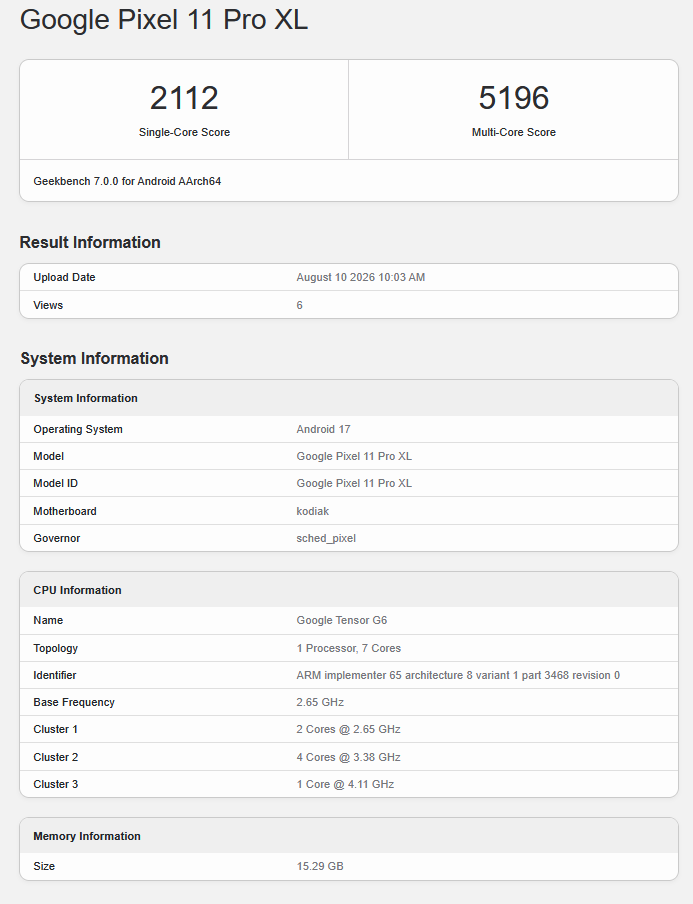

Google Tensor G6 Geekbench listing

As Geekbench 7 results are not comparable with Geekbench 6 scores, we have to rely on data that might not represent real-world performance of the concerned chips. Compared with those reference figures, the Tensor G6 is approximately 7% faster in single-core performance. Multi-core performance, however, goes in the opposite direction, with the Pixel 11 Pro XL result coming in roughly 12% lower than the Tensor G5 reference. The apparent regression may partly be explained by Google's unusual CPU configuration. The Tensor G5 has eight CPU cores, while Geekbench detects only seven on the Tensor G6. Therefore, Google appears to be trading some multi-core performance for higher peak clock speeds.

The raw Geekbench metadata also appears to confirm a new Imagination Technologies GPU for the Tensor G6. The benchmark identifies the GPU as 'PowerVR C-Series CXTP-48-1536 MC1', replacing the PowerVR D-Series DXT-48-1536 found in the Tensor G5. As always, pre-release benchmark results should be treated cautiously. This is currently just one Pixel 11 Pro XL submission, while the Tensor G5 comparison is based on reference results supplied by Primate Labs and not real-world data.

Source(s)​

Geekbench
 

hellhole

Master Member
Joined
May 25, 2001
Messages
3,909
Reaction score
586
If you want the ultimate camera phone then you get Vivo ultra phone.
For others, they are not going to make meaningful difference. It's just side hopping for you.
true that... but i worked with the os for vivo... not quite like it...maybe i am so used to the samsung and pixel style..
 

halocast

Great Supremacy Member
Joined
Feb 19, 2005
Messages
58,524
Reaction score
1,762

Google Pixel 11 Pro XL Geekbench 7 result offers early look at Tensor G6 performance​


A fresh Pixel 11 Pro XL Geekbench 7 listing offers an early look at Tensor G6 CPU performance. The new Google SoC comes with an unusual seven-core configuration, which, in turn, affects multi-core performance.

Google's upcoming Pixel 11 Pro XL has appeared on Geekbench 7 with what appears to be the Tensor G6 running at its full clock speed. While the new chip posts a respectable single-core improvement over internal Tensor G5 reference data supplied to Notebookcheck, its unusual seven-core configuration appears to take a toll on multi-core performance.

The Pixel 11 Pro XL scores 2,112 points in Geekbench 7 single-core and 5,196 points in multi-core. More interestingly, the test identifies the Tensor G6 as a seven-core processor with an unusual three-cluster configuration. There are two cores running at up to 2.65 GHz, four at up to 3.38 GHz, and a single prime core clocked at a rather lofty 4.11 GHz. Exactly which Arm Cortex/Lumex IP each core uses is unknown. Now, a seven-core CPU in an SoC is not exactly uncommon, with both Qualcomm and MediaTek adopting the stragegy. However, lower-binned parts usually surface after their full-bodied counterparts.

The listing also shows 16 GB of memory, along with Android 17 and the Kodiak motherboard identifier, something we spotted earlier this year. While public Geekbench 7 data is still relatively sparse, Notebookcheck received reference results directly from Primate Labs around the launch of Geekbench 7. In that dataset, a Tensor G5-powered Pixel 10 averaged 1,973 points in single-core and 5,872 points in multi-core, based on two samples.


Google Tensor G6 Geekbench listing

As Geekbench 7 results are not comparable with Geekbench 6 scores, we have to rely on data that might not represent real-world performance of the concerned chips. Compared with those reference figures, the Tensor G6 is approximately 7% faster in single-core performance. Multi-core performance, however, goes in the opposite direction, with the Pixel 11 Pro XL result coming in roughly 12% lower than the Tensor G5 reference. The apparent regression may partly be explained by Google's unusual CPU configuration. The Tensor G5 has eight CPU cores, while Geekbench detects only seven on the Tensor G6. Therefore, Google appears to be trading some multi-core performance for higher peak clock speeds.

The raw Geekbench metadata also appears to confirm a new Imagination Technologies GPU for the Tensor G6. The benchmark identifies the GPU as 'PowerVR C-Series CXTP-48-1536 MC1', replacing the PowerVR D-Series DXT-48-1536 found in the Tensor G5. As always, pre-release benchmark results should be treated cautiously. This is currently just one Pixel 11 Pro XL submission, while the Tensor G5 comparison is based on reference results supplied by Primate Labs and not real-world data.

Source(s)​

Geekbench

Not promising :o will the battery get better this time? :o
 

KeYoKe

High Supremacy Member
Joined
Jul 14, 2005
Messages
37,890
Reaction score
9,984

Google Pixel 11 Pro XL Geekbench 7 result offers early look at Tensor G6 performance​


A fresh Pixel 11 Pro XL Geekbench 7 listing offers an early look at Tensor G6 CPU performance. The new Google SoC comes with an unusual seven-core configuration, which, in turn, affects multi-core performance.

Google's upcoming Pixel 11 Pro XL has appeared on Geekbench 7 with what appears to be the Tensor G6 running at its full clock speed. While the new chip posts a respectable single-core improvement over internal Tensor G5 reference data supplied to Notebookcheck, its unusual seven-core configuration appears to take a toll on multi-core performance.

The Pixel 11 Pro XL scores 2,112 points in Geekbench 7 single-core and 5,196 points in multi-core. More interestingly, the test identifies the Tensor G6 as a seven-core processor with an unusual three-cluster configuration. There are two cores running at up to 2.65 GHz, four at up to 3.38 GHz, and a single prime core clocked at a rather lofty 4.11 GHz. Exactly which Arm Cortex/Lumex IP each core uses is unknown. Now, a seven-core CPU in an SoC is not exactly uncommon, with both Qualcomm and MediaTek adopting the stragegy. However, lower-binned parts usually surface after their full-bodied counterparts.

The listing also shows 16 GB of memory, along with Android 17 and the Kodiak motherboard identifier, something we spotted earlier this year. While public Geekbench 7 data is still relatively sparse, Notebookcheck received reference results directly from Primate Labs around the launch of Geekbench 7. In that dataset, a Tensor G5-powered Pixel 10 averaged 1,973 points in single-core and 5,872 points in multi-core, based on two samples.


Google Tensor G6 Geekbench listing

As Geekbench 7 results are not comparable with Geekbench 6 scores, we have to rely on data that might not represent real-world performance of the concerned chips. Compared with those reference figures, the Tensor G6 is approximately 7% faster in single-core performance. Multi-core performance, however, goes in the opposite direction, with the Pixel 11 Pro XL result coming in roughly 12% lower than the Tensor G5 reference. The apparent regression may partly be explained by Google's unusual CPU configuration. The Tensor G5 has eight CPU cores, while Geekbench detects only seven on the Tensor G6. Therefore, Google appears to be trading some multi-core performance for higher peak clock speeds.

The raw Geekbench metadata also appears to confirm a new Imagination Technologies GPU for the Tensor G6. The benchmark identifies the GPU as 'PowerVR C-Series CXTP-48-1536 MC1', replacing the PowerVR D-Series DXT-48-1536 found in the Tensor G5. As always, pre-release benchmark results should be treated cautiously. This is currently just one Pixel 11 Pro XL submission, while the Tensor G5 comparison is based on reference results supplied by Primate Labs and not real-world data.

Source(s)​

Geekbench
This score is a joke in 2026.

Paying 1.7k on a phone with such performance where exynos and snapdragon is scoring 10000 points and above :s13:

there is this much optimization can be done with software

and still shiny sides with matte backs.... sorry, will skip pixel. based on past experience, micro scratches will appear on shiny sides which will trigger the OCD out of me
 

limmk

High Supremacy Member
Joined
Jul 5, 2001
Messages
43,433
Reaction score
8,370
This score is a joke in 2026.

Paying 1.7k on a phone with such performance where exynos and snapdragon is scoring 10000 points and above :s13:

there is this much optimization can be done with software

and still shiny sides with matte backs.... sorry, will skip pixel. based on past experience, micro scratches will appear on shiny sides which will trigger the OCD out of me
Google is making it harder to justify the price when the competition is pushing much higher performance
 

KeYoKe

High Supremacy Member
Joined
Jul 14, 2005
Messages
37,890
Reaction score
9,984
Google is making it harder to justify the price when the competition is pushing much higher performance
precisely. dont tell me BS like tensor is built to handle AI loads in mind

as if snapdragon chips or even exynos cant handle it well
 

limmk

High Supremacy Member
Joined
Jul 5, 2001
Messages
43,433
Reaction score
8,370
why would Google so uninspiring copy apple (Apple Intelligence) and say: Gemini Intelligence.

It's making me think that Gemini not so intelligent and reuse what Apple did
Maybe not copying lah 😂 AI already = Artificial Intelligence, so Apple uses Apple Intelligence, Google just replaces “Artificial” with Gemini. sounds more professional than “Gemini AI” also 😆
 

limmk

High Supremacy Member
Joined
Jul 5, 2001
Messages
43,433
Reaction score
8,370
precisely. dont tell me BS like tensor is built to handle AI loads in mind

as if snapdragon chips or even exynos cant handle it well
The whole “Tensor is designed for AI, therefore it’s better at AI” argument is getting old. “Built for AI” doesn’t mean Snapdragon/Exynos can’t handle AI. it’s more about optimisation than marketing labels
 

halocast

Great Supremacy Member
Joined
Feb 19, 2005
Messages
58,524
Reaction score
1,762
This score is a joke in 2026.

Paying 1.7k on a phone with such performance where exynos and snapdragon is scoring 10000 points and above :s13:

there is this much optimization can be done with software

and still shiny sides with matte backs.... sorry, will skip pixel. based on past experience, micro scratches will appear on shiny sides which will trigger the OCD out of me

Seriously... the current leadership for phone is cmi, how are they fugging up so badly. :o
Software and hardware they had already 5 gens to get it right.
Just using AI to justify their premium.... o_O
The pixel pro xl black seems to be matte version :s12: Can see in the video.
 
Important Forum Advisory Note
This forum is moderated by volunteer moderators who will react only to members' feedback on posts. Moderators are not employees or representatives of HWZ Forums. Forum members and moderators are responsible for their own posts. Please refer to our Community Guidelines and Standards and Terms and Conditions for more information.
Top

