
Yes.Hi, my 4a kept prompting me to restart and install the latest system update. I have disabled auto updates under developer options. if my phone accidentally got restarted, will it still proceed with the system update?
You are using an out of date browser. It may not display this or other websites correctly.
You should upgrade or use an alternative browser.
You should upgrade or use an alternative browser.
Google Pixel 4a
- Thread starter limmk
- Start date
More options
Who Replied?thanks for the replyYes.

- Joined
- Jul 5, 2001
- Messages
- 44,943
- Reaction score
- 8,518
TL;DR
There’s been a lot of talk lately regarding Google’s Battery Performance Program for the Pixel 4a, which, among other things, includes a software update that has a huge impact on its battery life. Many users now consider the phone unusable and are rightfully mad at Google, which hasn’t done a great job communicating why it was suddenly rolling out such an update six years after the device’s release.
A few days ago, a post by Hector Martin (known for his work on Asahi Linux, which brings Linux to newer Macs) shed some light on the update. But we still have loads of unanswered questions, so I decided to investigate it myself and dig deeper into the kernel update.
Google
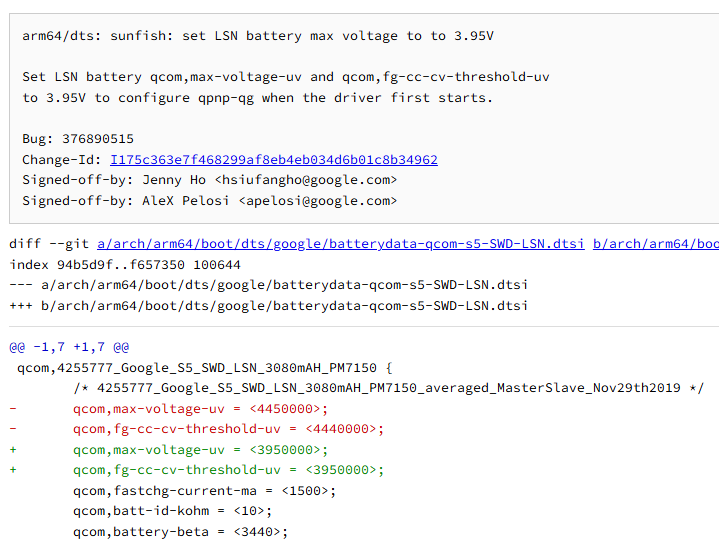
The post revealed that Google has reduced the maximum voltage of the LSN batteries down to 3.95 V, from the original 4.45 V. However, this fact is worthy of greater explanation. At a very high level, battery charging works by pushing more electrons into the cell, raising the internal voltage. Using the stored charge basically works in reverse, using the electrons to power whatever components require it and thereby slowly dropping the voltage.
At first glance, this might not seem too bad — shaving 0.5 V off 4.45 V is a mere 11%, but that’s not the end of the story. Lithium-ion batteries, like the one used in the Pixel 4a, are only really unusable in a range of voltages. The bottom limit of that range is called “cutoff voltage.” In the case of the Pixel 4a, this value is 3.3 V.
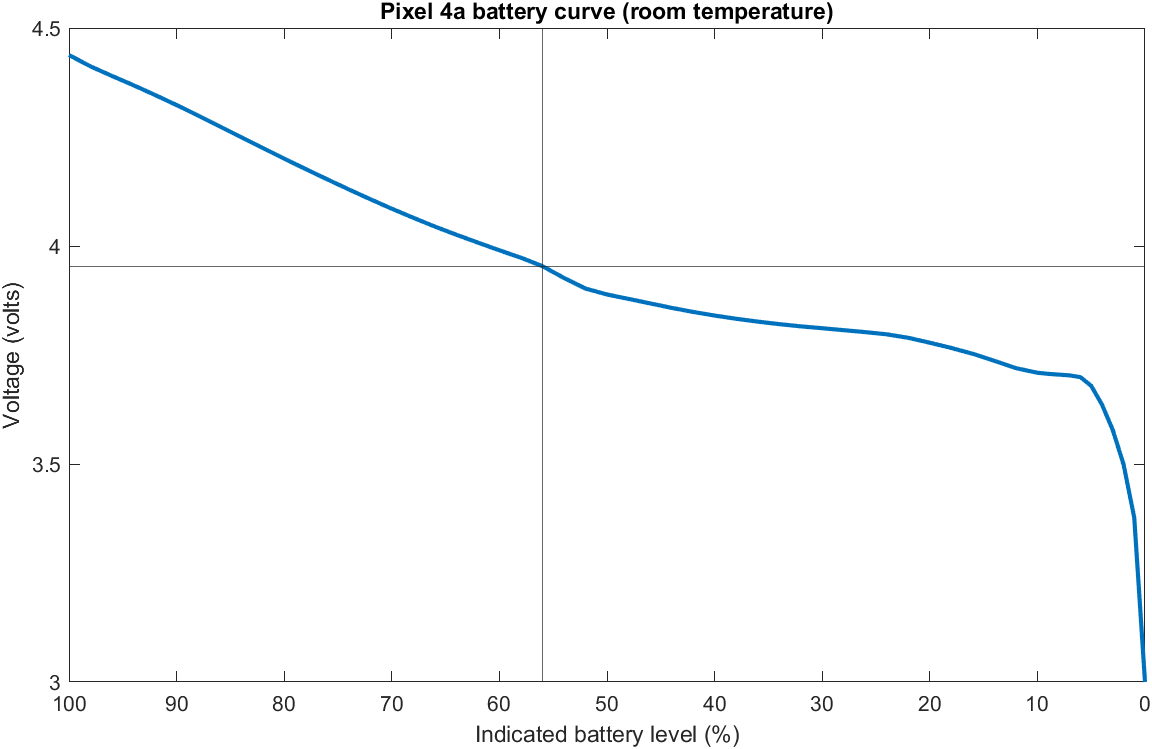
Doing some simple math, we can see that the usable battery range after the update has dropped from 1.15 V to 0.65 V, a 43% drop! This, however, still isn’t the full picture, as batteries are not really linear as you can see above, but we can just check the original voltage-to-percentage curve from the software to see what 3.95 V corresponds to. As it turns out, that value corresponds to 56% of the charge before the update (which is also marked on the image above)!
Google
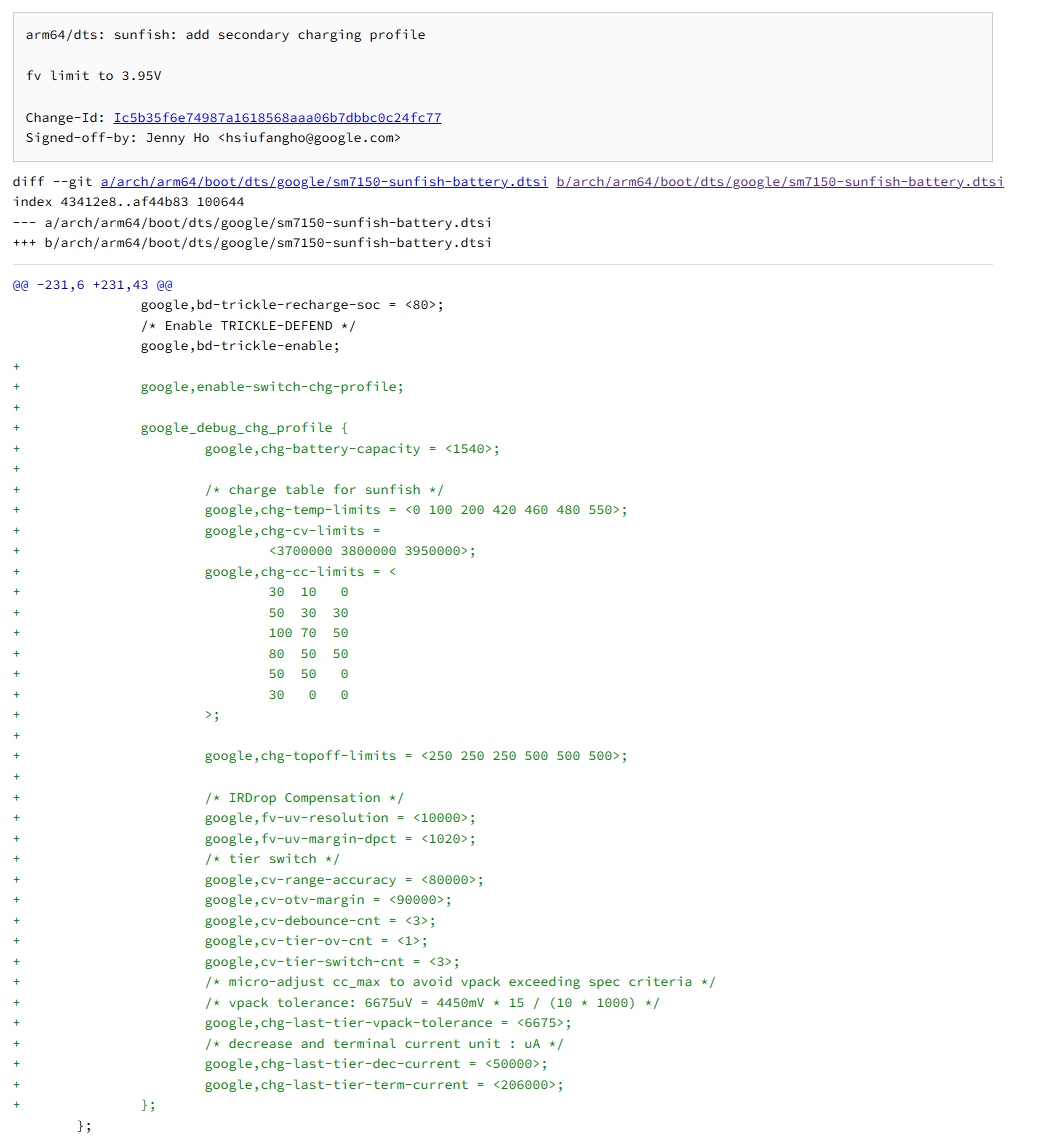
The kernel patch Google applied also changes the charging profile on affected units. While Hector’s post mentions the value Google used for capacity — 1,540 mAh — I wouldn’t necessarily trust it to be entirely accurate, as all the changes in the update seem extremely rushed, and this value is exclusively used to calculate charging speeds anyway.
The more important thing here is the charging speed reduction. Li-ion batteries are usually charged at a current defined by a “C” value. For example, 1C charging on a 5,000mAh battery would mean 5,000mA of current flowing into the battery.
Google’s original charging profile allowed up to 1C of current (depending on the conditions), which would be 3,080mA. After the change, this value is halved to 1,540 mA, which directly translates to the same charging speed decrease (now 0.5C).
Google
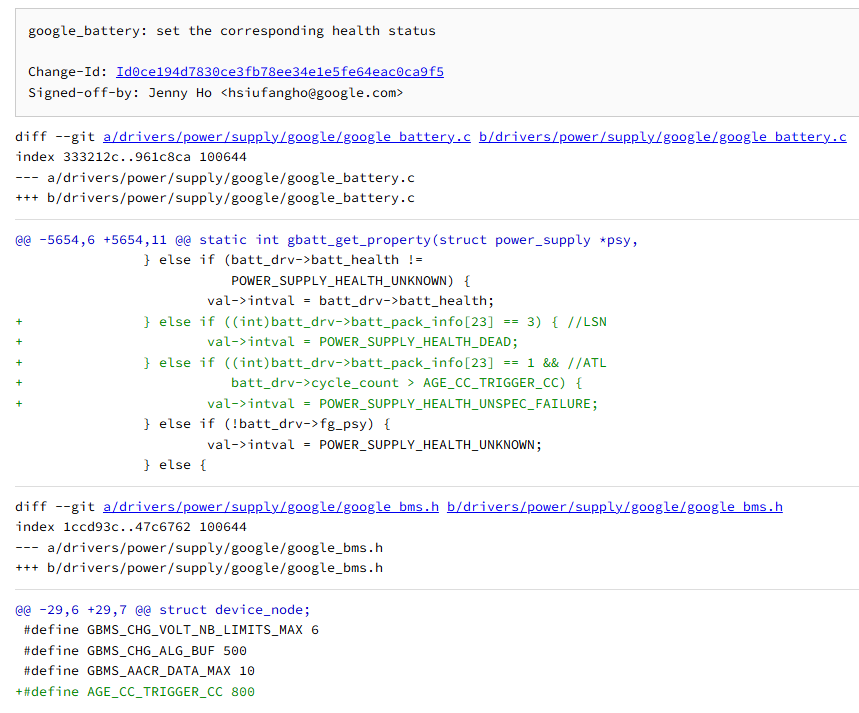
Interestingly, Google also added a check for ATL cells — if they exceed 800 cycles, a health issue will be reported (and indicated in Android as a generic notification), but it won’t trigger the same mitigations.
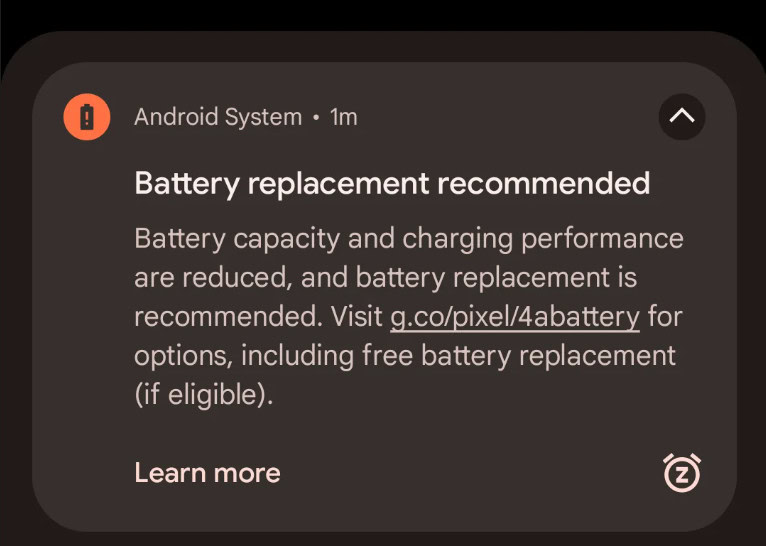
While the update does not make any other changes to the battery on the kernel level, there is more going on on the Android side. The most obvious is that the user is notified about the replacement program with a notification and a tip in settings. Additionally, while charging, the battery icon is replaced by one with an exclamation mark.
As in turns out, the source code of the Android part of this special build has been uploaded, so it’s easy to find other things that changed. A quick look at all the commits shows they all have one thing in common — they do more than their titles suggest, and the context they provide for the changes is minimal.
There are two other major functional changes for the affected devices. First, the battery charge ETA is disabled, which seems to be because the AI models used to power the feature were never updated for the new reduced capacity. Not only that, but Adaptive Charging, the feature meant to extend the life of batteries by learning your habits and slowing down charging when possible, is also disabled for a similar reason.
Other than that, Google seems to have blocked the “show percentage in status bar” option at the settings level, but this doesn’t stop users who already had it on from using it. The intention might have been to hide the incorrect percentage on affected devices, but as with the other changes, the underlying charging curves were never properly updated.
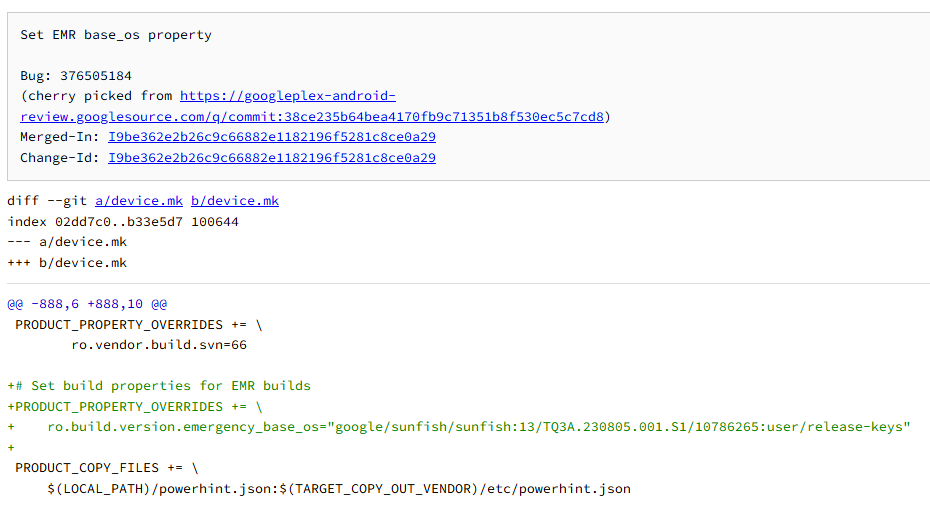
Google
We already know what changes were included in the update, but there’s still more context to be uncovered. As it turns out, the build was marked as an Emergency Maintenance Release (EMR) — a special type of build that doesn’t have to go through all the usual certification steps.
Google has also built the kernel without its usual automation — the whole process was done on a developer’s machine. This is also likely the reason the kernel source has only been released almost a month after the update went live.
Interested in the unusual circumstances of this build, I reached out to a source inside Google. Unfortunately, even the bug tracker entry that was mentioned in the open-source changes in this build has no details filled in besides the title “sunfish [the codename for the Pixel 4a] sunset EMR”.
There’s no way to know exactly what caused Google to release such an overly cautious and rushed update, but we can certainly speculate.
Google is making Pixel 4a phones containing batteries with cells from Lishen basically unusable, and it seems pretty unlikely it would do something like this for a device that was already dead without a really important reason. The clearly rushed nature of the update, plus the fact it’s an EMR, shows Google was rushing to get it out of the door as soon as possible. This definitely suggests there is some deeper reason behind the whole program, and given that Google has also removed all the previous builds from its site, it seems like it might have been a safety issue that triggered the response.
I doubt we’ll ever get an official answer as to what happened — it’s simply not in Google’s best interest to say more than necessary — but it’s pretty evident it’s not nothing, and Google didn’t simply kill the Pixel 4a for no reason.
- The Google Pixel 4a battery update does even more than we thought, reducing capacity by around 44% and halving the maximum charging speed on affected devices.
- The update also disables features like Adaptive Charging and charging time ETAs.
- Google made the update an Emergency Maintenance Release (EMR), which means it’s been trying to release it as quickly as possible.
There’s been a lot of talk lately regarding Google’s Battery Performance Program for the Pixel 4a, which, among other things, includes a software update that has a huge impact on its battery life. Many users now consider the phone unusable and are rightfully mad at Google, which hasn’t done a great job communicating why it was suddenly rolling out such an update six years after the device’s release.
A few days ago, a post by Hector Martin (known for his work on Asahi Linux, which brings Linux to newer Macs) shed some light on the update. But we still have loads of unanswered questions, so I decided to investigate it myself and dig deeper into the kernel update.
Exploring the fixes
As revealed in Hector’s post, the Pixel 4a has two different battery variants. While both of them share the same exact specs and are even manufactured by the same company, Sunwooda Electric, they have battery cells (the thing that actually stores the charge) from different vendors. The cells that are affected by Google’s update are from Lishen (LSN), while the good ones are from Amperex Technology Limited (ATL).
The post revealed that Google has reduced the maximum voltage of the LSN batteries down to 3.95 V, from the original 4.45 V. However, this fact is worthy of greater explanation. At a very high level, battery charging works by pushing more electrons into the cell, raising the internal voltage. Using the stored charge basically works in reverse, using the electrons to power whatever components require it and thereby slowly dropping the voltage.
Shaving 0.5V off the max battery voltage results in a 44% drop in usable charge!
At first glance, this might not seem too bad — shaving 0.5 V off 4.45 V is a mere 11%, but that’s not the end of the story. Lithium-ion batteries, like the one used in the Pixel 4a, are only really unusable in a range of voltages. The bottom limit of that range is called “cutoff voltage.” In the case of the Pixel 4a, this value is 3.3 V.
Doing some simple math, we can see that the usable battery range after the update has dropped from 1.15 V to 0.65 V, a 43% drop! This, however, still isn’t the full picture, as batteries are not really linear as you can see above, but we can just check the original voltage-to-percentage curve from the software to see what 3.95 V corresponds to. As it turns out, that value corresponds to 56% of the charge before the update (which is also marked on the image above)!
The kernel patch Google applied also changes the charging profile on affected units. While Hector’s post mentions the value Google used for capacity — 1,540 mAh — I wouldn’t necessarily trust it to be entirely accurate, as all the changes in the update seem extremely rushed, and this value is exclusively used to calculate charging speeds anyway.
The more important thing here is the charging speed reduction. Li-ion batteries are usually charged at a current defined by a “C” value. For example, 1C charging on a 5,000mAh battery would mean 5,000mA of current flowing into the battery.
Google’s original charging profile allowed up to 1C of current (depending on the conditions), which would be 3,080mA. After the change, this value is halved to 1,540 mA, which directly translates to the same charging speed decrease (now 0.5C).
Interestingly, Google also added a check for ATL cells — if they exceed 800 cycles, a health issue will be reported (and indicated in Android as a generic notification), but it won’t trigger the same mitigations.
Everything else that changed
While the update does not make any other changes to the battery on the kernel level, there is more going on on the Android side. The most obvious is that the user is notified about the replacement program with a notification and a tip in settings. Additionally, while charging, the battery icon is replaced by one with an exclamation mark.
As in turns out, the source code of the Android part of this special build has been uploaded, so it’s easy to find other things that changed. A quick look at all the commits shows they all have one thing in common — they do more than their titles suggest, and the context they provide for the changes is minimal.
The Pixel 4a update also disables the charging ETA and Adaptive Charging capabilities.
There are two other major functional changes for the affected devices. First, the battery charge ETA is disabled, which seems to be because the AI models used to power the feature were never updated for the new reduced capacity. Not only that, but Adaptive Charging, the feature meant to extend the life of batteries by learning your habits and slowing down charging when possible, is also disabled for a similar reason.
Other than that, Google seems to have blocked the “show percentage in status bar” option at the settings level, but this doesn’t stop users who already had it on from using it. The intention might have been to hide the incorrect percentage on affected devices, but as with the other changes, the underlying charging curves were never properly updated.
Piecing it all together
We already know what changes were included in the update, but there’s still more context to be uncovered. As it turns out, the build was marked as an Emergency Maintenance Release (EMR) — a special type of build that doesn’t have to go through all the usual certification steps.
Google has also built the kernel without its usual automation — the whole process was done on a developer’s machine. This is also likely the reason the kernel source has only been released almost a month after the update went live.
Interested in the unusual circumstances of this build, I reached out to a source inside Google. Unfortunately, even the bug tracker entry that was mentioned in the open-source changes in this build has no details filled in besides the title “sunfish [the codename for the Pixel 4a] sunset EMR”.
So, what happened?
There’s no way to know exactly what caused Google to release such an overly cautious and rushed update, but we can certainly speculate.
Google is making Pixel 4a phones containing batteries with cells from Lishen basically unusable, and it seems pretty unlikely it would do something like this for a device that was already dead without a really important reason. The clearly rushed nature of the update, plus the fact it’s an EMR, shows Google was rushing to get it out of the door as soon as possible. This definitely suggests there is some deeper reason behind the whole program, and given that Google has also removed all the previous builds from its site, it seems like it might have been a safety issue that triggered the response.
I doubt we’ll ever get an official answer as to what happened — it’s simply not in Google’s best interest to say more than necessary — but it’s pretty evident it’s not nothing, and Google didn’t simply kill the Pixel 4a for no reason.
Sorry if this is a stupid question, my Pixel 4a was powered off during the time the new system update was pushed. If this update is installed with all the features disabled (Adaptive Charging and charging time ETAs), does replacing a new battery helps to restore these features? Or they are permanently disabled for good?
- Joined
- Jul 5, 2001
- Messages
- 44,943
- Reaction score
- 8,518
TL;DR
The Pixel 4a had a great run as a legendary budget Android smartphone of its era, but it met a rather cruel end. Google recently rolled out the Pixel 4a Battery Performance Program update that massively downgraded the battery experience, practically killing the device for people still using it. Now, the Pixel 4a is being recalled in Australia, and we finally have more information on what went wrong. Unsurprisingly, the cause appears to be battery overheating risks.
The wording is quite vague, and reading just the announcement post wouldn’t give you any clue about what is happening.
When users received the update, they were shocked to find that their phone lasted for just a few minutes before its battery drained out, which was somewhat underplayed in the announcement post. Google even removed all older software updates for the device from its website, a rare move from the company.
The announcement post also lacked technical details or addressed the actual problem with the Pixel 4a’s battery. We eventually discovered that Google reduced the maximum voltage of batteries supplied by battery vendor Lishen (LSN) from 4.45V to 3.95V. This may not seem much on the surface, but the update essentially translates into a 56% drop in charging capacity! The update also showed signs of being rushed out the gate as soon as Google could do it.
This is the first time we’re getting to the actual reason for the Pixel 4a’s Battery Performance Program update. Google’s original announcement post does not mention any “overheating” risks. It doesn’t even mention the word “heat” outside of generic advice to users not to heat their batteries as a means of disposal.
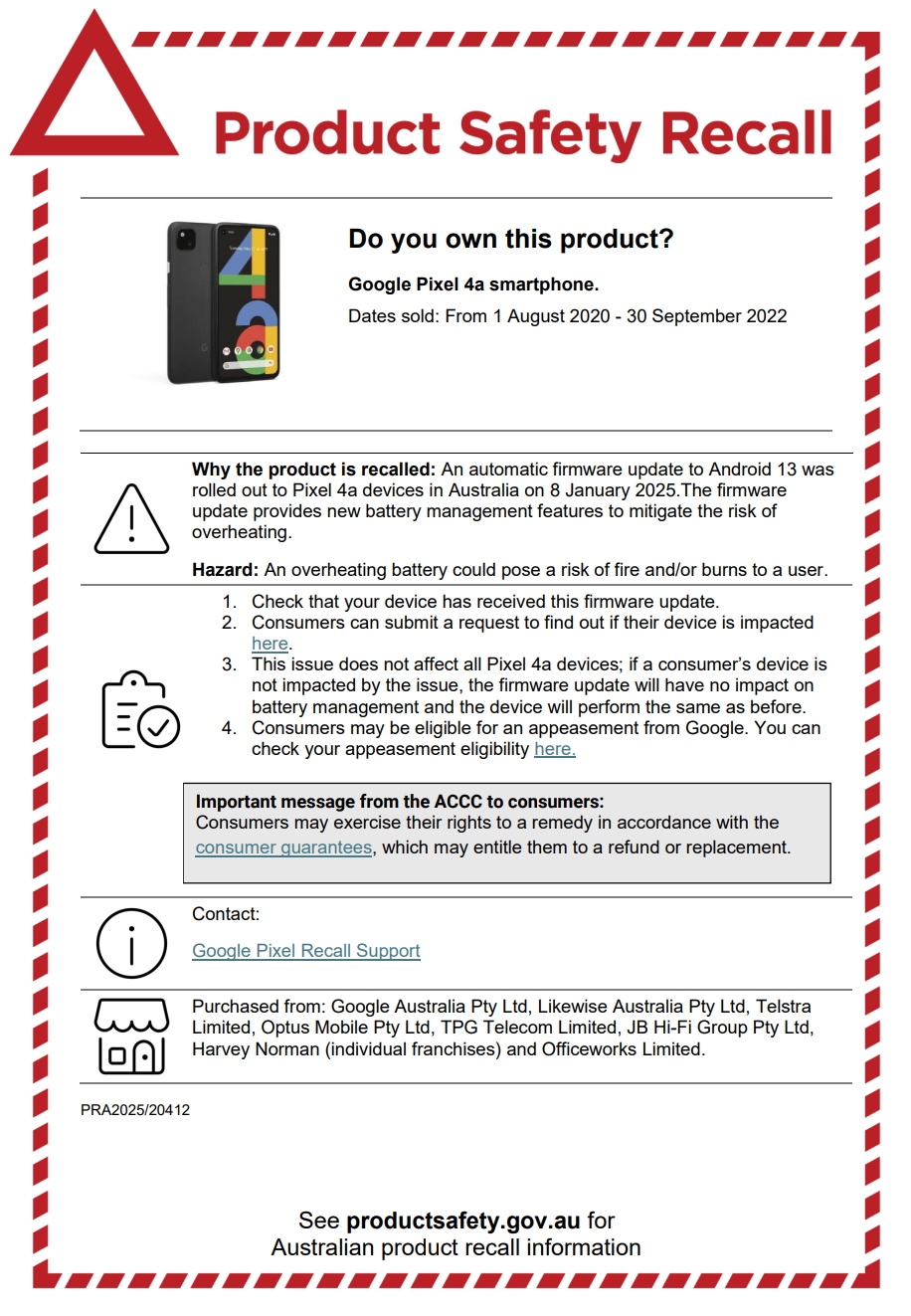
ACCC
The recall notice urges consumers to check if their device has received the firmware update. It also reiterates that consumers can submit a request to find out if their device is impacted and if they are eligible for an appeasement from Google. It notes that not all Pixel 4a devices are affected, which was known previously.
We’ve reached out again to Google for a statement on the Pixel 4a’s battery overheating risks. We’ll keep you updated when we learn more.
- Australia’s regulatory agency has recalled the Pixel 4a over a battery overheating risk.
- This is the first time we’re learning why Google rushed out the Pixel 4a’s Battery Performance Program update, as the company chose to remain vague in its announcement post.
The Pixel 4a had a great run as a legendary budget Android smartphone of its era, but it met a rather cruel end. Google recently rolled out the Pixel 4a Battery Performance Program update that massively downgraded the battery experience, practically killing the device for people still using it. Now, the Pixel 4a is being recalled in Australia, and we finally have more information on what went wrong. Unsurprisingly, the cause appears to be battery overheating risks.
The Pixel 4’a “update of death”
Google pitched the Pixel 4a’s Battery Performance Program update as one that brought over new battery management features to “improve the stability of your battery’s performance.”For some devices (“Impacted Devices”), the update includes new battery management features to improve the stability of your battery’s performance, so the battery may last for shorter periods between charges. Users of Impacted Devices may also notice other changes, like reduced charging performance or changes to how the battery-level indicator on your phone shows your battery capacity.
The wording is quite vague, and reading just the announcement post wouldn’t give you any clue about what is happening.
When users received the update, they were shocked to find that their phone lasted for just a few minutes before its battery drained out, which was somewhat underplayed in the announcement post. Google even removed all older software updates for the device from its website, a rare move from the company.
The announcement post also lacked technical details or addressed the actual problem with the Pixel 4a’s battery. We eventually discovered that Google reduced the maximum voltage of batteries supplied by battery vendor Lishen (LSN) from 4.45V to 3.95V. This may not seem much on the surface, but the update essentially translates into a 56% drop in charging capacity! The update also showed signs of being rushed out the gate as soon as Google could do it.
Australia issues recall notice for the Pixel 4a
So, what happened? Google still hasn’t shared further details. However, the Australian Competition & Consumer Commission has now issued a recall for the Pixel 4a. The recall notice mentions the following details:An automatic firmware update to Android 13 was rolled out to Pixel 4a devices in Australia on 8 January 2025. The firmware update provides new battery management features to mitigate the risk of overheating.
An overheating battery could pose a risk of fire and/or burns to a user.
This is the first time we’re getting to the actual reason for the Pixel 4a’s Battery Performance Program update. Google’s original announcement post does not mention any “overheating” risks. It doesn’t even mention the word “heat” outside of generic advice to users not to heat their batteries as a means of disposal.
ACCC
The recall notice urges consumers to check if their device has received the firmware update. It also reiterates that consumers can submit a request to find out if their device is impacted and if they are eligible for an appeasement from Google. It notes that not all Pixel 4a devices are affected, which was known previously.
We’ve reached out again to Google for a statement on the Pixel 4a’s battery overheating risks. We’ll keep you updated when we learn more.
- Joined
- Jul 5, 2001
- Messages
- 44,943
- Reaction score
- 8,518
Post in thread 'Google Pixel 6a' https://forums.hardwarezone.com.sg/threads/google-pixel-6a.6593459/post-156506752
- Joined
- Jul 5, 2001
- Messages
- 44,943
- Reaction score
- 8,518
In January, Google released a battery update for the Pixel 4a. This firmware installs automatically, and since the company removed the previous versions, there was no way to revert back. However, some users had managed to avoid this update. Now, Google has started to forcibly install the update on devices that had previously avoided it, without users’ permission.
Google’s dark history with batteries has resurfaced once again. Serious issues, such as some Pixel 6a models melting while charging, have raised questions in the past. A significant development has now emerged regarding the battery update released for the Pixel 4a models at the beginning of the year, which sparked widespread criticism.
Google makes Pixel 4a’s battery update mandatory
Google discovered that Pixel 4a models needed an update to improve battery performance. The company released a battery-focused update in January to address this issue. It also promised free battery replacements and various other solutions to users who installed the update at the time.Most users grabbed the update, expecting it to improve battery performance. However, the results showed us exactly the opposite. Following the patch, many users reported that their Pixel 4a’s battery performance worsened even more. Some even reported that their devices lasted only a few hours on a single charge and took much longer to recharge.
Because the update was installed automatically and the brand removed older software builds, users had no way to revert. Fortunately, some users managed to avoid the patch at the time.
A development has occurred in the last 48 hours that is causing considerable distress to users. The workarounds that worked for a while have now lost their effectiveness, and Google has begun forcing devices to install the battery patch.
There have been numerous posts on forums like Reddit about how even methods like developer options to block automatic updates are not working and how patches are being forced onto users without their control.
So why does Google do this?
While it’s annoying that Google installed the update without users’ consent, there’s a strong reason behind it. The company’s insistence on pushing out this version is allegedly due to concerns about battery overheating and catching fire.It seems legit for the brand to make a similar decision for the Pixel 4a models, especially given the meltdown issues experienced with the Pixel 6a. However, users believe there’s been a serious lack of communication here. Finally, whether forced or not, users will be able to take advantage of Google’s free battery replacements and other solutions.
Hi guys, are you still able to use your 4a non 5g? My phone unable to receive and make calls (I think it happened after the 3g network shut down). Only way to use the phone is by wifi connection, but it means it's useless outside of work/ home.
- Joined
- Jul 5, 2001
- Messages
- 44,943
- Reaction score
- 8,518
Go to Settings > Apps and check if Carrier Services is enabledHi guys, are you still able to use your 4a non 5g? My phone unable to receive and make calls (I think it happened after the 3g network shut down). Only way to use the phone is by wifi connection, but it means it's useless outside of work/ home.


dragonhole
Master Member
- Joined
- Jul 13, 2000
- Messages
- 3,281
- Reaction score
- 294
Flash to custom rom lineage, battery life is back to normal.
Important Forum Advisory Note
This forum is moderated by volunteer moderators who will react only to members' feedback on posts. Moderators are not employees or representatives of HWZ Forums. Forum members and moderators are responsible for their own posts.
Please refer to our Community Guidelines and Standards and Terms and Conditions for more information.
