

You are using an out of date browser. It may not display this or other websites correctly.
You should upgrade or use an alternative browser.
You should upgrade or use an alternative browser.
Math Experts - How do you solve these questions?
- Thread starter CCCustom
- Start date
More options
Who Replied?

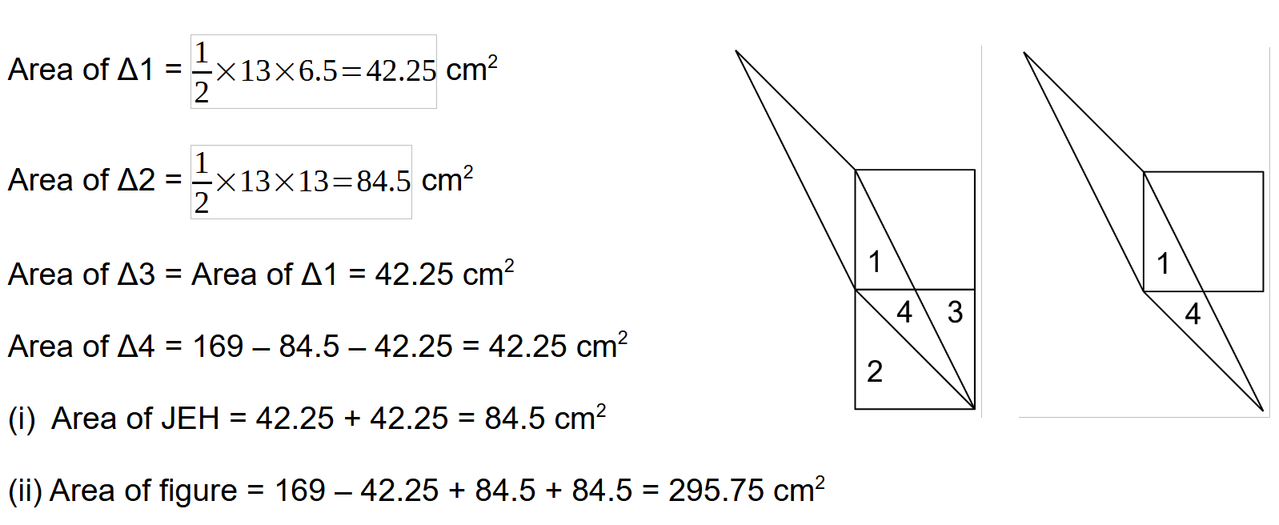
What is the best way to explain how to solve these 2 questions to a primary school kid?1.84.5
2. 295.75

EdenHazard
High Supremacy Member
- Joined
- May 28, 2012
- Messages
- 47,025
- Reaction score
- 13,188
Use AI la.

Mystyque
Greater Supremacy Member
- Joined
- Jan 27, 2001
- Messages
- 94,088
- Reaction score
- 12,683
Q1.
JEH = 1/2 x base x H
= 1/2 x 13 x 13 = 84.5
Q2.
area = square + 2xJEH - EHK
= 169+169- (13x6.5/2)
= 295.75
Hmm, why is the Height of JEH 13cm?
ZesiMuerte
Master Member
- Joined
- Jan 26, 2019
- Messages
- 2,907
- Reaction score
- 1,836
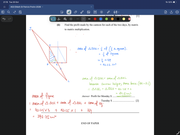
Ignore the irrelevant qn. Was helping a Sec4
Anyway if teaching primary sch students, they must know EHK is 1/4 of the square by cutting it like how I cut it.

randyap
Arch-Supremacy Member
- Joined
- Nov 30, 2002
- Messages
- 17,819
- Reaction score
- 10,235
you see ELH base is 13 and the height is HG.Hmm, why is the Height of JEH 13cm?
HK = KG means K is at the exact midpoint of HG.What is the best way to explain how to solve these 2 questions to a primary school kid?
HG is 13 cm, so HK and KG are each 6.5 cm.
EK = KL means KL is extending exactly the same length out. Resulting in GL being also 13 cm. And part of an identical square below EFHG. This new square is made up of HGL, and a new point that we shall call M for simplicity. So the new square is HGLM.
Understand the above part first.
We want to find the area of the triangle JEH. Since JEH is identical to ELH, we just need to find the area of ELH.
The new square HGLM is made up of 3 triangles.
ELH + 2 right angle triangles, namely GKL and HLM. The area of ELH is therefore, area of the square HGLM minus the 2 right angle triangles in the new square plus the right angle triangle EHK inside the original square.
Alternatively, conside the 2 squares as a rectangle that is 13x26 cm.
For Q2, area of the entire figure is the square, plus the 2 identical triangles, minus the overlapping right angle triangle EHK.
Last edited:
randyap
Arch-Supremacy Member
- Joined
- Nov 30, 2002
- Messages
- 17,819
- Reaction score
- 10,235
This part is the main challenge of the question. once this part can understand the rest is a piece of cake.EK = KL means KL is extending exactly the same length out. Resulting in GL being also 13 cm. And part of an identical square below EFHG. This new square is made up of HGL, and a new poiny that we shall call M for simplicity. So the new square is HGLM.
Understand the above part first.
randyap
Arch-Supremacy Member
- Joined
- Nov 30, 2002
- Messages
- 17,819
- Reaction score
- 10,235

It is understood square’s area 169 = 13 * 13 so it’s fine to leave the pencil markings here.
Question 1: Find the area of triangle JEH
Question 2: Find the area of the figure
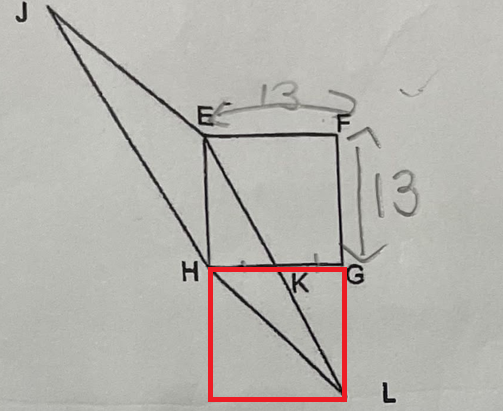
Once you add the red square, it is very easy liao.
Someone told my kid that each triangle is 84.5 because EHK = 1/2 * 13 * 6.5 = 42.25 and HKL = EHK so 42.25 * 2 = 84.5 … I was hoping to get a clearer explanation for this.HK = KG means K is at the exact midpoint of HG.
HG is 13 cm, so HK and KG are each 6.5 cm.
EK = KL means KL is extending exactly the same length out. Resulting in GL being also 13 cm. And part of an identical square below EFHG. This new square is made up of HGL, and a new point that we shall call M for simplicity. So the new square is HGLM.
Understand the above part first.
We want to find the area of the triangle JEH. Since JEH is identical to ELH, we just need to find the area of ELH.
The new square HGLM is made up of 3 triangles.
ELH + 2 right angle triangles, namely GKL and HLM. The area of ELH is therefore, area of the square HGLM minus the 2 right angle triangles in the new square plus the right angle triangle EHK inside the original square.
Alternatively, conside the 2 squares as a rectangle that is 13x26 cm.
For Q2, area of the entire figure is the square, plus the 2 identical triangles, minus the overlapping right angle triangle EHK.
randyap
Arch-Supremacy Member
- Joined
- Nov 30, 2002
- Messages
- 17,819
- Reaction score
- 10,235
Your friend is right, just that he can't convince you why HKL should be equal EHK.Someone told my kid that each triangle is 84.5 because EHK = 1/2 * 13 * 6.5 = 42.25 and HKL = EHK so 42.25 * 2 = 84.5 … I was hoping to get a clearer explanation for this.
ZesiMuerte
Master Member
- Joined
- Jan 26, 2019
- Messages
- 2,907
- Reaction score
- 1,836
EHK = 1/2 * 6.5 * 13Someone told my kid that each triangle is 84.5 because EHK = 1/2 * 13 * 6.5 = 42.25 and HKL = EHK so 42.25 * 2 = 84.5 … I was hoping to get a clearer explanation for this.
because area of triangle.
In my diagram, I draw in green line the height of the triangle EHL
Notice that tri EHL = tri EHK + tri HKL
if you use EK as base of EHK
and KL as base of HKL you will notice that both triangle share the same height (labelled in green) and same base because EK = KL
Same base same height
Hence area of tri EHK = tri HKL
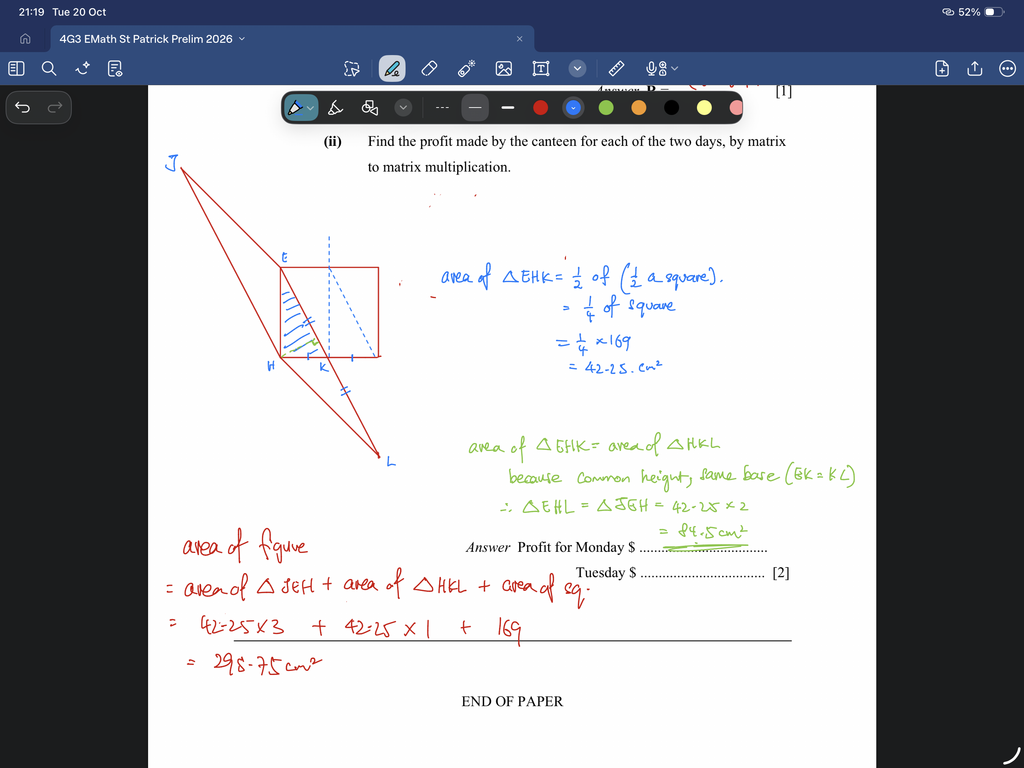
Common height, common base.
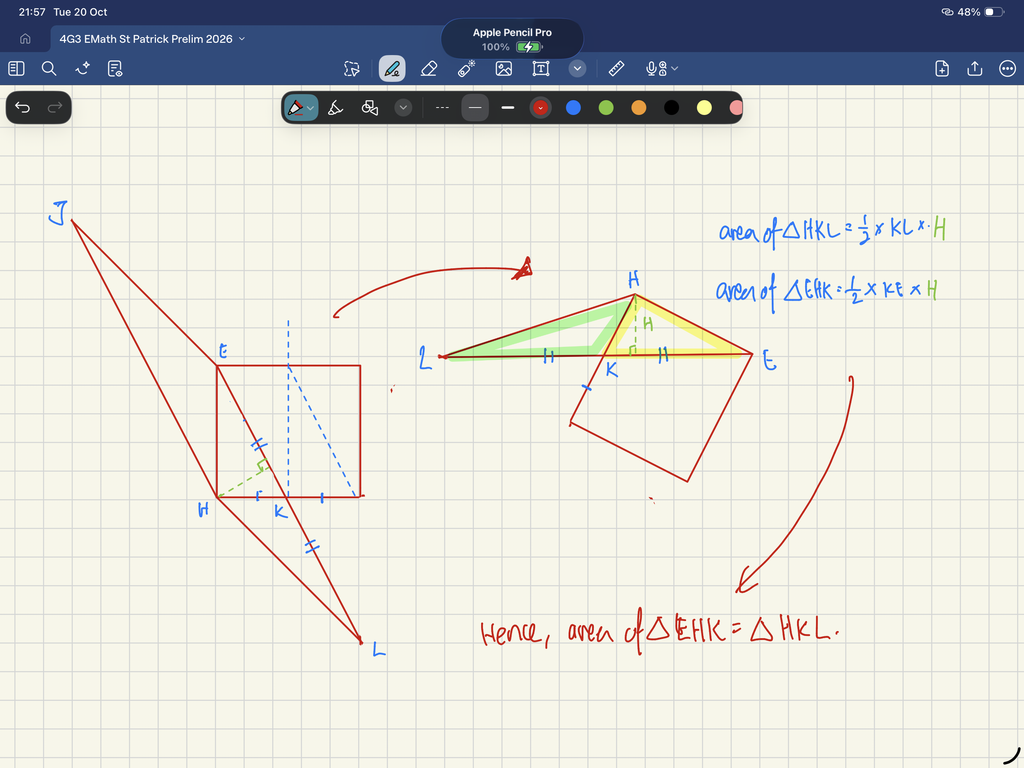
The drawing of another square from randyap can also work. Same logic, common base (HK = KG) common height (EH = LG)
Last edited:
Someone told my kid that each triangle is 84.5 because EHK = 1/2 * 13 * 6.5 = 42.25 and HKL = EHK so 42.25 * 2 = 84.5 … I was hoping to get a clearer explanation for this.
Does my explanation plus the pic that randyap drew with the square make it clearer now?
Your friend is right, just that he can't convince you why HKL should be equal EHK.
Exactly what randyap says. Your friend needs to explain to your kid how to work out why HKL is equal to EHK. Cannot simply infer without steps. Even if we have already done before and knows this, still must show teacher.
The teacher marking the question will also need to know how you kid arrived at this conclusion.
ZesiMuerte
Master Member
- Joined
- Jan 26, 2019
- Messages
- 2,907
- Reaction score
- 1,836
For primary sch students, they cannot use congruency and similarity.If the concept of similar triangles can make things easier to understand, you can extend the EH down to a point X where EX makes a right angle with X. EHK and EXL will be similar triangles.
What this question is testing the P5/P6 kid, is whether he/she understand:
(1) common base common height
(2) the square can be split into 4 equals triangle.
Got it. I was not aware of the context.For primary sch students, they cannot use congruency and similarity.
What this question is testing the P5/P6 kid, is whether he/she understand:
(1) common base common height
(2) the square can be split into 4 equals triangle.

Important Forum Advisory Note
This forum is moderated by volunteer moderators who will react only to members' feedback on posts. Moderators are not employees or representatives of HWZ Forums. Forum members and moderators are responsible for their own posts.
Please refer to our Community Guidelines and Standards and Terms and Conditions for more information.
