
Mindef's Group Term Life

luvpraline

Senior Member
Joined
Nov 21, 2005
Messages
858
Reaction score
65
Hi, would like to check with the gurus here, I've done some reading up here and came across Mindef's Group Term life being recommended for its low cost.

After reading the product summary, is it correct that:

1) For NSMen, latest age to buy this policy is 40 (for non-officers)?

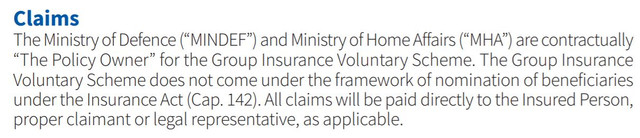
2) I saw this para under "Claims" and do not understand what it means.
Does it mean that we can't nominate a beneficiary when we buy this policy? That the payout will go according to a will or intestacy laws?


3) Do we pay more if we purchase it through an Aviva agent versus buying online?

4) Lastly, is there any other term plan to recommend besides this Mindef one for the budget conscious?

Thank you for any advice!
 

tangent314

Moderator
Moderator
Joined
Jul 26, 2002
Messages
5,136
Reaction score
224
40 for non-officers, 50 for officers
My understanding is that the executor makes the claim and the money goes into the estate to be distributed in accordance with the will
You cannot purchase this through agents, it must be done through MINDEF
Look for Direct Purchase Term Life insurance on http://comparefirst.sg
 

luvpraline

Senior Member
Joined
Nov 21, 2005
Messages
858
Reaction score
65
40 for non-officers, 50 for officers
My understanding is that the executor makes the claim and the money goes into the estate to be distributed in accordance with the will
You cannot purchase this through agents, it must be done through MINDEF
Look for Direct Purchase Term Life insurance on http://comparefirst.sg

Thank you again, tangent314! You're helpful as always :)

I did a search for Direct Purchase Term Life insurance on comparefirst. Max coverage is 400k and the cheapest plan costs $27. For this amount can get close to $700k for Mindef's. So looks like Mindef's is the most value for money, but the drawback is cannot nominate beneficiaries and this might drag out the claim process?
 

xtwis7

Arch-Supremacy Member
Joined
Oct 13, 2006
Messages
21,848
Reaction score
597
Yes you are right. Group policies cannot be nominated so any claims payout will follow the intestate law which would take at least 3-6 months for non-complicated cases.

Thank you again, tangent314! You're helpful as always :)

I did a search for Direct Purchase Term Life insurance on comparefirst. Max coverage is 400k and the cheapest plan costs $27. For this amount can get close to $700k for Mindef's. So looks like Mindef's is the most value for money, but the drawback is cannot nominate beneficiaries and this might drag out the claim process?
 

MichealScott

Supremacy Member
Joined
Feb 25, 2019
Messages
7,758
Reaction score
1,245
Yes you are right. Group policies cannot be nominated so any claims payout will follow the intestate law which would take at least 3-6 months for non-complicated cases.
So if kenna CI, takes 3-6mths to get the money for treatment????

Sent from Stamford Bridge using GAGT
 

BBCWatcher

Arch-Supremacy Member
Joined
Jun 15, 2010
Messages
24,185
Reaction score
5,360
Group policies cannot be nominated so any claims payout will follow the intestate law which would take at least 3-6 months for non-complicated cases.
It’s always advisable to make a will. OCBC offers a free online will generator for simple situations, and most are.

If you’re concerned about payout delays then just make sure all adults in the household can access to the household’s emergency reserve funds if need be.

So if kenna CI, takes 3-6mths to get the money for treatment????
No, for at least two reasons:

1. Your medical insurance covers hospitalization and related care. Remember that? CI covers...well, it’s weird.

2. You’re still alive if you need medical care for an illness.

You do have Disability Income Insurance prioritized over CI insurance, right?
 

luvpraline

Senior Member
Joined
Nov 21, 2005
Messages
858
Reaction score
65
It’s always advisable to make a will. OCBC offers a free online will generator for simple situations, and most are.

If you’re concerned about payout delays then just make sure all adults in the household can access to the household’s emergency reserve funds if need be.


No, for at least two reasons:

1. Your medical insurance covers hospitalization and related care. Remember that? CI covers...well, it’s weird.

2. You’re still alive if you need medical care for an illness.

You do have Disability Income Insurance prioritized over CI insurance, right?

Hi BBCWatcher, thanks for sharing about the free will generator :) Can the executor be one of the beneficiaries?

For Disability Income Insurance, is there coverage if the insured is unable to work at the same job, BUT he's still able to work for a lower income?

In terms of priority for insurance, would it be Hospitalization, followed by Term, and then disability income if budget allows?

Thank you!
 
Last edited:

BBCWatcher

Arch-Supremacy Member
Joined
Jun 15, 2010
Messages
24,185
Reaction score
5,360
Can the executor be one of the beneficiaries?
Yes, that's allowed.

For Disability Income Insurance, is there coverage if the insured is unable to work at the same job, BUT he's still able to work for a lower income?
For DII sold in Singapore typically there's some "same job" disability coverage but with a time limit. For return to work in a different job, DII policies in Singapore tend to "top up" income to the sum assured.

Check the specific policy letter, though. There is a bit of variation between the four policies available from the three carriers in Singapore. As long as the "different job" terms are reasonable, I don't think there's any problem with that. It's quite common for non-disabled people to switch professions over the course of working career anyway.

In terms of priority for insurance, would it be Hospitalization, followed by Term, and then disability income if budget allows?
Life insurance of any sort isn't required unless and until you have at least one genuine dependent and cannot self-insure. So I'd say that term life insurance is the lowest priority since most (young) adults start working before they have dependents.

If you're a Singaporean citizen then you're required to have MediShield Life and enjoy the highest subsidizes, so you already have some baseline hospitalization insurance. Plus Medifund if push comes to shove.

Thus I'd vote for DII among those three, actually. For citizens anyway.
 

luvpraline

Senior Member
Joined
Nov 21, 2005
Messages
858
Reaction score
65
Life insurance of any sort isn't required unless and until you have at least one genuine dependent and cannot self-insure. So I'd say that term life insurance is the lowest priority since most (young) adults start working before they have dependents.

If you're a Singaporean citizen then you're required to have MediShield Life and enjoy the highest subsidizes, so you already have some baseline hospitalization insurance. Plus Medifund if push comes to shove.

Thus I'd vote for DII among those three, actually. For citizens anyway.

Thanks for sharing :) If someone has at least one dependent, and hospitalization insurance, would it then be a priority to get term first to protect the dependent's standard of living, and also in case one gets TPD?
 

BBCWatcher

Arch-Supremacy Member
Joined
Jun 15, 2010
Messages
24,185
Reaction score
5,360
Thanks for sharing :) If someone has at least one dependent, and hospitalization insurance, would it then be a priority to get term first to protect the dependent's standard of living, and also in case one gets TPD?
They're both important in this case, but from what I've been able to determine you're about 3 times more likely to become disabled (and unable to earn an income) than to die before age 65. And the disability scenario is more expensive than death, because you're still alive and still require food, clothing, etc. On top of all that, your accumulated CPF assets are released to your nominee(s) when you die, but they aren't if you're "merely" disabled. DII is almost always going to pay full benefits to term if you're eligible to make a TPD claim, whereas the reverse isn't true very often at all.

If considering the first sum assured dollar, I'd say DII wins this comparison in terms of priority. But if you're comparing the first term life insurance dollar of coverage versus the Nth dollar of DII coverage, at some point the first dollar of term life insurance becomes a higher priority.
 

luvpraline

Senior Member
Joined
Nov 21, 2005
Messages
858
Reaction score
65
They're both important in this case, but from what I've been able to determine you're about 3 times more likely to become disabled (and unable to earn an income) than to die before age 65. And the disability scenario is more expensive than death, because you're still alive and still require food, clothing, etc. On top of all that, your accumulated CPF assets are released to your nominee(s) when you die, but they aren't if you're "merely" disabled. DII is almost always going to pay full benefits to term if you're eligible to make a TPD claim, whereas the reverse isn't true very often at all.

If considering the first sum assured dollar, I'd say DII wins this comparison in terms of priority. But if you're comparing the first term life insurance dollar of coverage versus the Nth dollar of DII coverage, at some point the first dollar of term life insurance becomes a higher priority.

Hmm if the insured becomes disabled and totally unable to work, term insurance would also pay out right? At least for this Mindef one.

Do you mean that DII would be more useful for those cases where the DII payout added up over the years could be higher than what one could get from a term insurance lump sum payout?
 

BBCWatcher

Arch-Supremacy Member
Joined
Jun 15, 2010
Messages
24,185
Reaction score
5,360
Hmm if the insured becomes disabled and totally unable to work, term insurance would also pay out right?
No, not often. Disability Income Insurance pays benefits as long as the policyholder is unable to work no matter what the reason, with only a few exclusions (e.g. going off to fight in a civil war somewhere and getting injured). Total and Permanent Disability (TPD) insurance only pays a benefit if you suffer a very grave disability, and it's probably not going to be adequate compared to a loss of lifetime employment income.

Do you mean that DII would be more useful for those cases where the DII payout added up over the years could be higher than what one could get from a term insurance lump sum payout?
That's part of it, but it's also suffering the loss and qualifying for a payout. TPD is very hard to claim.

OK, what about Critical Illness and Personal Accident insurance? Yes, hypothetically you could buy those, but the major criticism I have is that they're not "all risks" policies. You have to experience a specific condition from the list. Also, they're not tied to an actual loss but rather a situation, which may or may not be an actual loss -- but you have to pay the premium for both the actual loss and situation scenarios. And the payout is typically grossly inadequate if you do experience a loss of lifetime employment income. Thus, in terms of prioritization, I rank DII quite high. So does this blogger, and I fundamentally agree with the logic.
 
Last edited:

luvpraline

Senior Member
Joined
Nov 21, 2005
Messages
858
Reaction score
65
No, not often. Disability Income Insurance pays benefits as long as the policyholder is unable to work no matter what the reason, with only a few exclusions (e.g. going off to fight in a civil war somewhere and getting injured). Total and Permanent Disability (TPD) insurance only pays a benefit if you suffer a very grave disability, and it's probably not going to be adequate compared to a loss of lifetime employment income.


That's part of it, but it's also suffering the loss and qualifying for a payout. TPD is very hard to claim.

OK, what about Critical Illness and Personal Accident insurance? Yes, hypothetically you could buy those, but the major criticism I have is that they're not "all risks" policies. You have to experience a specific condition from the list. Also, they're not tied to an actual loss but rather a situation, which may or may not be an actual loss -- but you have to pay the premium for both the actual loss and situation scenarios. And the payout is typically grossly inadequate if you do experience a loss of lifetime employment income. Thus, in terms of prioritization, I rank DII quite high. So does this blogger, and I fundamentally agree with the logic.

Thank you BBCWatcher! I've read the article you shared and done some reading up on my own. I see the importance of DII, as I've also seen some relatives who had to quit working early due to conditions like vertigo. I'm looking to get the DII rider for Mindef for a family member. Looking through the website and product summary, there're a few clauses that I'd appreciate if you could shed some light on:

1) There's a footnote at Mindef/Aviva's website that says:
Disability means such a state of incapacity that the Insured Person is (i) totally unable, by reason of illness or accident, to follow his own occupation for twenty-four (24) months and thereafter any other occupation to which he is suited by reason of training, education or experience; and (ii) not following any occupation.

Source: https://www.aviva.com.sg/en/mindef-and-mha/disability-income/

I'm confused by this 24 months and what this means. The deferred period is 6 months. Does it mean that the insured needs a doctor to certify that he's unable to work for 24 months? Sounds weird...


2) There's Limitation clause under the product summary that says:
Limitations
In the event that a Disability claim arises under this Policy and the Disability Benefit
together with:
(a) The monthly benefit payable under any other insurance against Disability
(whether provided by private insurers or the state)
including Workmen’s
Compensation insurance; and
(b) Any continuing monthly salary, monthly commission or other monthly income
derived by the Insured Person from the occupation in which the Insured Person
was engaged immediately prior to the commencement of Disability
exceed fiy percent (50%) of the Pre-Disability Basic Salary of the Insured Person the
Disability Benefit will be reduced by the amount of the excess. No premium paid shall
be refunded, as a result of the application of this clause. For the avoidance of doubt,
any other form of compensation whether payable monthly or otherwise, shall not
apply to the limitation in this clause.

For (a) above, does it mean that if his salary is 5000, and Mindef/Aviva covers him for 2500, and he buys 1000 from another insurer, Mindef/Aviva will only pay out 1500?

- And is this Pre-Disability Basic Salary the one declared at point of buying with Mindef or the actual salary at point of disability which may be higher?


For (b) above, does it mean that if the insured were to be on paid hospitalization leave, the deferred period would only commence after the hospitalization leave?

Thank you!
 

BBCWatcher

Arch-Supremacy Member
Joined
Jun 15, 2010
Messages
24,185
Reaction score
5,360
I'm confused by this 24 months and what this means. The deferred period is 6 months. Does it mean that the insured needs a doctor to certify that he's unable to work for 24 months? Sounds weird...
No, it’s merely a policy term that distinguishes between “own occupation” and “any occupation.” During the first 24 months of disability you’re qualified for benefits if you are unable to work in your own profession. Thereafter, if the disability continues, you can receive benefits if you’re unable to work in any profession. That doesn’t mean you must work as a welder if you’re able but were never trained to be a welder. But if you’re able to provide customer service over the telephone, and your own profession was a field support technician (visiting customer sites), then this clause is probably limiting benefits to 18 months (24 months minus the 6 month waiting period). Which is quite fair, of course, because nobody is guaranteed a specific profession. People change professions all the time. The carrier sets an upper bound here.

For (a) above, does it mean that if his salary is 5000, and Mindef/Aviva covers him for 2500, and he buys 1000 from another insurer, Mindef/Aviva will only pay out 1500?
That appears to be the case, yes. One shortcoming of this particular policy is the 50% benefit cap. However, it’s term to age 70, which is unique.

- And is this Pre-Disability Basic Salary the one declared at point of buying with Mindef or the actual salary at point of disability which may be higher?
Actual.

For (b) above, does it mean that if the insured were to be on paid hospitalization leave, the deferred period would only commence after the hospitalization leave?
Check the waiting period language specifically to determine when it starts. But the policy definitely won’t pay benefits if you haven’t suffered a big enough, actual income loss. “Any continuing monthly salary” includes paid medical leave. The basic deal here is that you haven’t experienced a loss of income from work until you’ve lost actual income. If your employer wants to pay you your salary for the rest of your life even if you stopped working, that’s fine (better than fine), but then you haven’t experienced a claimable loss.

True story: one of my relatives died suddenly, way too early. His employer had absolutely no obligation to send continuing monthly paychecks to his widow, but they did: 12 extra.
 

luvpraline

Senior Member
Joined
Nov 21, 2005
Messages
858
Reaction score
65
But if you’re able to provide customer service over the telephone, and your own profession was a field support technician (visiting customer sites), then this clause is probably limiting benefits to 18 months (24 months minus the 6 month waiting period).

Thanks BBCWatcher! In the example cited above, does it mean that it's up to the insurer to decide if we're able to take on a related job? For eg, they might limit the benefits to 18 months if their appointed doc assesses that someone is able to take on work from home jobs in customer service, even though in reality that person may not be able to find such a job (possibly due to other non-health related reasons, such as age/poor job market)?

Check the waiting period language specifically to determine when it starts. But the policy definitely won’t pay benefits if you haven’t suffered a big enough, actual income loss. “Any continuing monthly salary” includes paid medical leave. The basic deal here is that you haven’t experienced a loss of income from work until you’ve lost actual income. If your employer wants to pay you your salary for the rest of your life even if you stopped working, that’s fine (better than fine), but then you haven’t experienced a claimable loss.

True story: one of my relatives died suddenly, way too early. His employer had absolutely no obligation to send continuing monthly paychecks to his widow, but they did: 12 extra.

Under deferred period, the policy wording says:

Period of 6 months beginning from the first day of
any continuous period of Disability

In the case of your relative, if he were to have bought this DII, does that mean that he could only file for a claim after 12 months + 6 months of deferred period?

Speaking of this, I'm reminded that my family member's employer provides a group term payout of 18 months' salary. It's not stated whether it's in lump sum or installments but probably lump sum since it's group term. Would this also mean the DII won't pay out benefits till after 18 months + deferred period?
 

BBCWatcher

Arch-Supremacy Member
Joined
Jun 15, 2010
Messages
24,185
Reaction score
5,360
In the example cited above, does it mean that it's up to the insurer to decide if we're able to take on a related job? For eg, they might limit the benefits to 18 months if their appointed doc assesses that someone is able to take on work from home jobs in customer service, even though in reality that person may not be able to find such a job (possibly due to other non-health related reasons, such as age/poor job market)?
This isn’t unemployment insurance, but I don’t think it would be reasonable — and I don’t think a judge would find it reasonable, if it got that far — to define long-term disability quite that narrowly. It’s reasonable to assume that employers expect employees to be able to commute to workplaces, at least sometimes.

That said, all DII policies pay less than prior wages, so it’s in your financial interest to try to find paid work if able.

In the case of your relative, if he were to have bought this DII, does that mean that he could only file for a claim after 12 months + 6 months of deferred period?
That relative died, but his employer continued paying his salary for 12 additional months. There was no disability claim available, but there could have been a life insurance claim.

As I read the policy language, the 6 month waiting period starts when the disability starts (and is continuous). If an employer continues paying salary, then there won’t be a DII payout, but the 6 month waiting period clock continues to run.

Some employers offer disability coverage as an employment perk. For example, if you have an employer that offers 6 months paid short-term disability and 24 months paid long-term disability, then your DII payments would kick in starting with the 31st month of disability.

Speaking of this, I'm reminded that my family member's employer provides a group term payout of 18 months' salary. It's not stated whether it's in lump sum or installments but probably lump sum since it's group term. Would this also mean the DII won't pay out benefits till after 18 months + deferred period?
No, I think the waiting period runs concurrently with the employer’s coverage. Check the policy language again, but that’s how I interpret it.
 
Important Forum Advisory Note
This forum is moderated by volunteer moderators who will react only to members' feedback on posts. Moderators are not employees or representatives of HWZ Forums. Forum members and moderators are responsible for their own posts. Please refer to our Community Guidelines and Standards and Terms and Conditions for more information.
Top