
JuniorLion
Supremacy Member
- Joined
- May 15, 2017
- Messages
- 8,585
- Reaction score
- 294
It's an exchange traded fund..
That's ETF not ETFS.
It's an exchange traded fund..

Yes. It’s the only CPF LIFE payout plan that offers some protection against inflation, which makes it the best longevity insurance, which makes it the winner by default.Is the new CPF LIFE escalating plan worth it?
Who cares? At what age are you guaranteed to die?At what age would it break even assuming I start at 65?
That’s a little light, in my view. I think you can raise that to 30% if you like, so that you have a 30-70 split (approximately) in retirement. You could make that happen naturally once you retire by spending first from the bond/bond-like portion of your assets. The endowment plan seems like the most obvious first source of spending funds, if that works.Currently have ~25% in stocks and stocks-like. This is assuming that the current balance in endowment plan & sum in CPF is included as part of the not stocks and stocks-like portion. Plan to retire in the next 2-3 years.

Is the new CPF LIFE escalating plan worth it? At what age would it break even assuming I start at 65?
Thanks for the advice.Yes. It’s the only CPF LIFE payout plan that offers some protection against inflation, which makes it the best longevity insurance, which makes it the winner by default.
Who cares? At what age are you guaranteed to die?
CPF LIFE is not a casino, MCKawe. Your other wealth can play those games, if you wish. CPF LIFE is insurance, specifically sovereign longevity insurance. It defends you against the slight (or possibly greater) risk of outliving your savings — insurance against living “too long.” And it’s the AAA-rated government doing the defending, which is really special.
All you need to decide is how much more minimum income, if any, would you you need above the Basic Retirement Sum-level CPF LIFE, and (I’d recommend) assuming payouts start at age 70 on the Escalating Plan, if/when you outlive your savings. If CPF LIFE becomes your sole source of income, could you get by on $800/month (current dollars at payout starting date, increased 2%/year in ancipation of inflation), for example? Or $950? Or $1080? Pick that number (or more) — that’s your only decision to make. It’s truly that easy.
That’s a little light, in my view. I think you can raise that to 30% if you like, so that you have a 30-70 split (approximately) in retirement. You could make that happen naturally once you retire by spending first from the bond/bond-like portion of your assets. The endowment plan seems like the most obvious first source of spending funds, if that works.
Do you have any nominees for a bond/bond-like vehicle that beats liquid cash in your CPF Retirement Account in terms of risk and yield? I certainly don't.If I increase my stocks & stocks-like portfolio to 30%, can I leave the rest of my cash into RA until needed? Or is there a logically better place to park them?
Do you have any nominees for a bond/bond-like vehicle that beats liquid cash in your CPF Retirement Account in terms of risk and yield? I certainly don't.
RA top-ups must be paid out via CPF LIFE. Perhaps it’d be nice if you could tuck away funds in your RA as an interesting high interest savings account, but it doesn’t work that way I’m afraid.Assuming at age 55, i top up my RA to the maximum, which is ERS, and leave it there earning interest till the payout age of 70. I assume it would be better to opt into the CPF LIFE Additional Annuity?
RA top-ups must be paid out via CPF LIFE. Perhaps it’d be nice if you could tuck away funds in your RA as an interesting high interest savings account, but it doesn’t work that way I’m afraid.

Is the new CPF LIFE escalating plan worth it? At what age would it break even assuming I start at 65?
Yes. It’s the only CPF LIFE payout plan that offers some protection against inflation, which makes it the best longevity insurance, which makes it the winner by default.
Who cares? At what age are you guaranteed to die?
CPF LIFE is not a casino
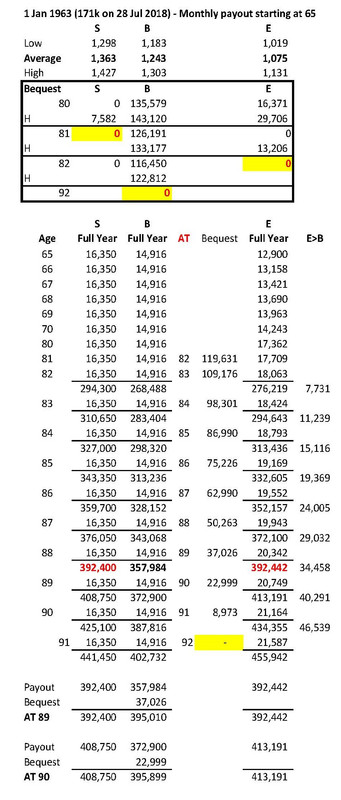
CPF Life is indeed a bet and all are forced to choose one or the other and some win some lose, though more lose than gain as the system must err on the safe side.
See my worksheet and place you bet.
The calculation does not factor time value of money.
Note the bequest is -
0 before 81 S (Standard)
0 before 82 E (Escalating)
0 before 92 B (Basic)
If you certain to live beyond 90, ERS is best, but if you uplorry before 87, ERS is the worst of the 3 plans.
Let's use some sample numbers to illustrate your idea. Let's suppose you have $185,000 in your Special Account and $140,000 in your Ordinary Account. The Full Retirement Sum is $171,000 in 2018, and you turn age 55 in 2018.
OK then, let's go....
There are currently no fixed deposits available through the CPF Investment Scheme, so that won't work.
One year T-Bills are issued every quarter. That's probably your best bet, and I'd recommend placing an order no later than the penultimate auction before turning age 55, just in case your bid doesn't go through and you need to try again at the next auction.
I looked through the unit trusts to see if there's a unicorn (a unit trust with reasonable costs, and in particular no sales or redemption charge), and I couldn't find one.
So let's suppose you buy a one year T-Bill roughly 6 months before you turn age 55. The CPFIS-SA allows you to invest up to $145,000 in this example, so that's what you do (buy a $145,000 T-Bill). At age 55 your Retirement Account is created, and the $40,000 from the Special Account plus $131,000 from your Ordinary Account is swept into your Retirement Account. About 6 months later your T-Bill matures, and the proceeds go back to your Special Account. You're left with:
Retirement Account: $171,000
Special Account: $145,000
Ordinary Account: $9,000
So what are we missing? This seems like a really lovely hack, Icebeng. I like it! Yes, you lose some interest, but then you gain Special Account interest. As long as you're not withdrawing funds until age 57 or later, this hack looks like it works well.
One variation is you sell the T-Bill on the secondary market if you get a good price, and the proceeds go back into your Special Account that much earlier. That might work even better depending on what price the primary dealer will give you.
But you see, i understood the view of BBCW. The point of CPF LIFE is for you to have enough money for your daily expenses and any other costs until the day you die. Once you die, you technically give no f**ks(until the time where your brain can be implanted into a robot).
Why 87 btw. I am using the CPF Life Payout Calculator@CPF website, and it seems like the payout breaks-even at 78 y/o with higher bequest than Standard Plan. Is there a factor that is different/not included?
Which plan are you betting on - S, B or E?
What breakeven is there to talk about?
To calculate, breakeven, you need use prevailing CPF rates on RA and all 3 plans got different breakeven points, but certainly from 78 that you have in mind.
Escalating vs Standard. When escalating payout is more than standard.
Derp, I think i see what you meant. The total amount given out by E + amount left in RA would be more than S from 87 onward right?
I think it's a good idea to pass on as much of your CPF monies to your nominee(due to the attractive interest rate) but that is assuming you have a strong income pillar from somewhere else that you can draw your monthly spending from right?
Firstly, you need to be aware that there is zero bequest for S and E from age 81 and 82 respectively. The bequest on the left of E is for B.
Yes from 87 onwards E is better than S. See bottom of the table, E is better than B from 89.
The bet is how long one is expected to live. I guess most will still go the safe way by choosing B.
Nonetheless, wouldn't it be better to go for ERS instead of FRS? Since it's hard to match the constant minimum 4% interest rate earned in a relatively safe environment.
Also, based on Singstat data from 2017, average life expectancy of residents at age 65 now is 84.1 for males and 87.5 for females. 10 years down the road though, i expect this to increase by at least a year...
The maximum ERS is 150% of the FRS, and this figure increases every year. I believe you’ve got the correct figure for 2018.Is the maximum amount in the RA $256,500 from OA,SA and top-up at 55+?
I’m not following you. If you zoom to ERS level, that determines your payouts. All you’d do is choose your payout plan just before your 70th birthday in this example — I’d pick the Escalating Plan — and that’s that.Assuming one maxed out RA@55 and opt for a 70 y/o payout. Since the $256,500 + interest earned till 70 would be used for the payouts from 70 onward. Then, how would one be eligible for the CPF LIFE Additional Annuity?
The maximum ERS is 150% of the FRS, and this figure increases every year. I believe you’ve got the correct figure for 2018.
Apparently, from age 55, you can add a small top-up to your RA every January 1 when the BRS/FRS/ERS increase, even if you’ve hit the ERS previously. And you can do that for about 10 or 15 years. So ERS on your 55th birthday plus January top-ups to the new ERS would be the absolute maximum CPF LIFE participation level.
I’m not following you. If you zoom to ERS level, that determines your payouts. All you’d do is choose your payout plan just before your 70th birthday in this example — I’d pick the Escalating Plan — and that’s that.
I agree with you and disagree with Henrylbh about bequests. You cannot use CPF LIFE to guarantee a bequest, not directly. None of the CPF LIFE payout plans guarantee a bequest — not even close. (All stand a high chance of yielding zero bequest.) However, you can better assure that your other assets will turn into a bequest if you maximize the longevity insurance characteristics of CPF LIFE. That means three things: (a) funding RA to a level that provides at least a sufficient CPF LIFE income stream for your purposes; (b) deferring CPF LIFE payouts to age 70; (c) choosing the Escalating Plan, to combat possible inflation. That’s the safe and the smart play, even if you are trying to assure a particular (or higher) bequest. Anything else means you’re playing the “bequest lottery,” which is not safe if you’re trying to assure a bequest.
There is another part of CPF that can act as a nearly 100% guaranteed bequest. That’s your Medisave Account. It earns 4% interest, which is very attractive. And it’s restricted to medical spending (and some medical insurance). So what you can do with a bequest aim is to keep topping up your Medisave Account within any/every month that there’s a Medisave deduction. You can top up to the Basic Healthcare Sum (BHS) in your Medisave Account. The BHS for you is the BHS figure at your age 65. (Once you hit your 65th birthday the BHS is not increased for you.)
Medisave is not quite a 100% guaranteed bequest when used this way, because there’s the possibility that you’ll need to spend some Medisave funds for late-in-life qualified medical expenses. But it’s a much better assured bequest bet than any of the CPF LIFE payout plans, and you do want to keep it full (if you can) because of the attractive interest. Upon your demise your Medisave balance is paid to your nominated CPF heir, in cash I’d suggest. (The Enhanced Nomination Scheme is occasionally useful, but cash is better if your nominee is at least somewhat responsible.)
All CPF LIFE payout plans are assured for life. To provide that assurance, they must all fall to zero residual at some point. With all of them the residual falls, and with all of them there is a significant chance of zero bequest. The only difference between plans in terms of residual is how quickly and when they fall to zero, but they all do that. None of them assure a bequest; none of them even come close to assuring a bequest. They are all “bequest lotteries.”But doesn't the bequest be approximately following the [compounded interest rate + principal sum - payouts]? What would cause the bequest to deviate significantly from that?
You’ve got the mechanics a little off, I think, but let’s leave that aside. No, it’s not better to “skimp” on CPF LIFE. Ideally you want CPF LIFE to provide enough to live on, because that defends your bequest (and your lifestyle while living, more importantly). Or at least you want to aim closer to that.Also, there's another option i would like you to advise on. Assuming i have a property pledge(property bought partially using CPF), i can opt for a BRS($88,500 as of 2018). Since i can top-up my SA to FRS($171,000), if 55 this year, $88,500 will be moved to RA while the remaining left in SA would still compound annually at 4% & the BRS would hit the 4-6% interest rate in the RA. The amount in SA, OA and MA would be a guaranteed bequest. Wouldn't it be better to just CPF LIFE using BRS with the Basic Plan?
Correct.In the event of my death, my children(nominee and next owner of house) do not have to refund CPF for the sale of the house right?
But doesn't the bequest be approximately following the [compounded interest rate + principal sum - payouts]? What would cause the bequest to deviate significantly from that?
Also, there's another option i would like you to advise on. Assuming i have a property pledge(property bought partially using CPF), i can opt for a BRS($88,500 as of 2018). Since i can top-up my SA to FRS($171,000), if 55 this year, $88,500 will be moved to RA while the remaining left in SA would still compound annually at 4% & the BRS would hit the 4-6% interest rate in the RA. The amount in SA, OA and MA would be a guaranteed bequest. If cash is needed, same day withdrawals can be made too. So, wouldn't it be better to just CPF LIFE using BRS with the Basic Plan? In the event of my death, my children(nominee and next owner of house) do not have to refund CPF for the sale of the house right?
The freed up cash from supposedly topping up to ERS from FRS can be used to purchase SSBs. The interest earned(10 years from now till 65) + cash on hand & emergency fund + withdrawal from OA first as and when needed then SA + dividends/sale from the 30% stocks can last me till payout from 65 or 70. I would lose the extra 1.5% interest(4% compared to the 2.5%ish in SSB till maturity) in the RA but would be more liquid for the impending recession. If it happens within the next 10 years, capital gain can last me till death and holdings would pass on to my children. Thoughts?
