Official Shiny Things thread Episode V, The Empire Strikes Back

highsulphur

Greater Supremacy Member
Joined
Aug 16, 2011
Messages
75,926
Reaction score
38,927
Did you manage to do the transfer smoothly between FSMOne and SCB? I'm also thinking doing something similar, but in reverse. Buy $200k of MBH at FSMOne, then transfer to SCB, rather than buying MBH directly from SCB.
Yes was very smooth to transfer from fsmone to scb. Fee was 10.90
 

iceblendedchoc

Arch-Supremacy Member
Joined
Nov 22, 2016
Messages
22,032
Reaction score
9,143
Hello, this thread has been incredibly useful for a beginner investor like me looking for something simple so thank you all. Today, I have a different question to ask.

I am 34 and not looking to start a family. I stay with my parents whom I have a very good relationship with. I was thus wondering if it is a good idea to get e.g. a 3 room resale when I hit 35 to rent out after the MOP?
you can also rent out one spare room when you are in your MOP
 

Shiny Things

Supremacy Member
Joined
Dec 13, 2009
Messages
9,569
Reaction score
781
Hi everyone, hope all is well. Despite the topsy turvy market that has been on us since the new US administration, I think I am doing OK, but would like some thoughts on the following:
Yeah, things are, shall we say, interesting over here. Can y'all believe it's only been eight weeks since the Rose Garden press conference? "Why are you tariffing penguins?" was less than two months ago!

I've been diligently DCAing into IWDA/ES3 at the 70/30 ratio for a while now, but I was thinking if I should ease off on IWDA and shift my DCAing into VWRA instead. While I do think US dominance is here to stay, I grow increasingly uncomfortable that the US stock performance (which contributes to just under 70% of IWDA, compared to 60% for VWRA) is subject to the whims of an erratic US president. In summary: So my thoughts are that my 70% international component should be a combination of IWDA/VWRA (leave IWDA in place while buying VWRA from now on), while my 30% remains ES3.

Let's start with where that difference comes from: the difference is basically that VWRA's index includes emerging markets, while IWDA's doesn't. (If you look at VWRA's geography list, you'll see China, India, Taiwan, and South Korea—making up about 8.5% of the fund between the four of them.)

Does that make a difference? Yes, it does, but it's not a huge difference, and it's not something that you need to invest a lot of time and brain-damage to have an opinion on. In short: IWDA and VWRA follow each other pretty much tick-for-tick, as you'd expect when their portfolios are 90% identical (and the other 10% is pretty highly correlated as well).

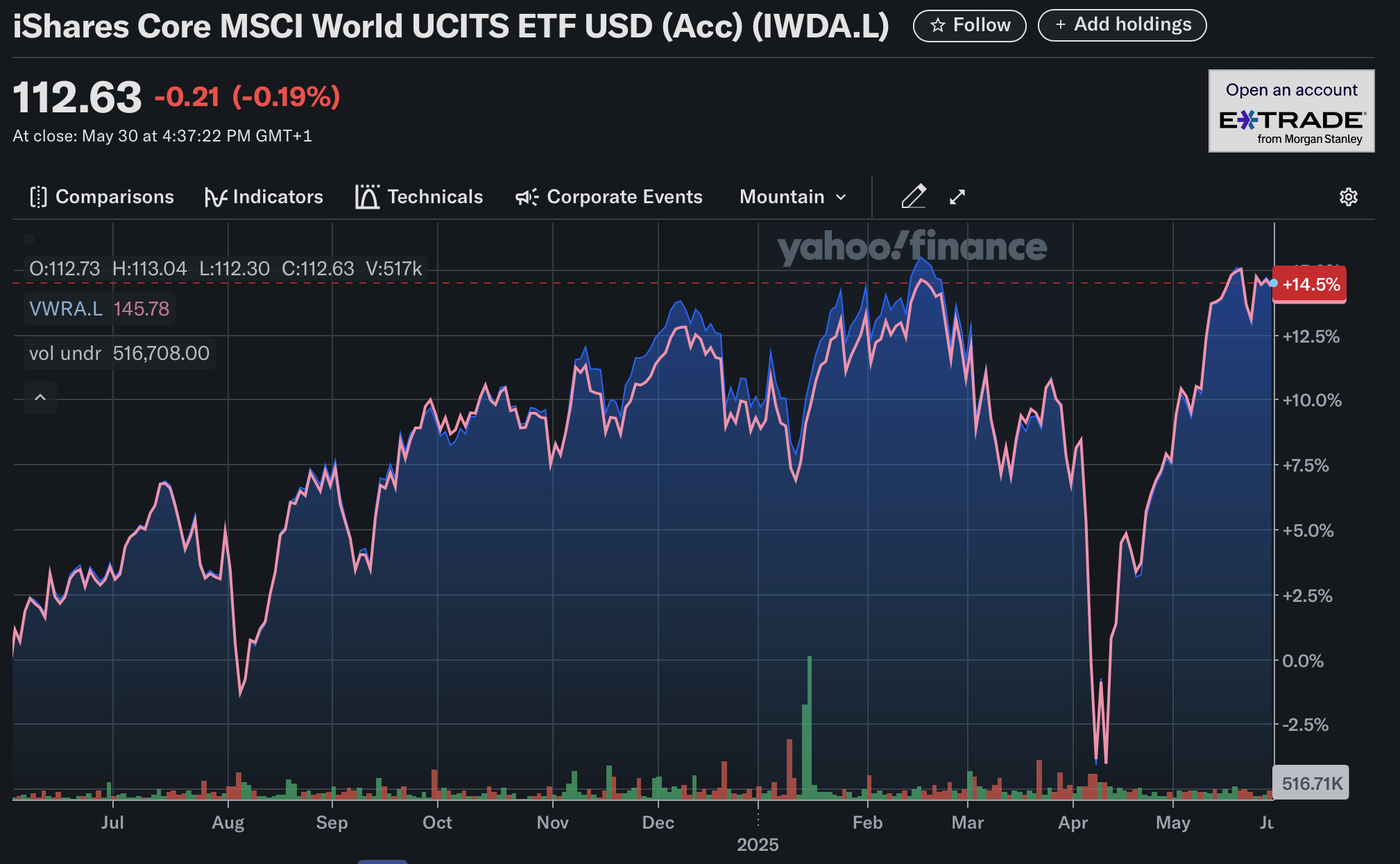
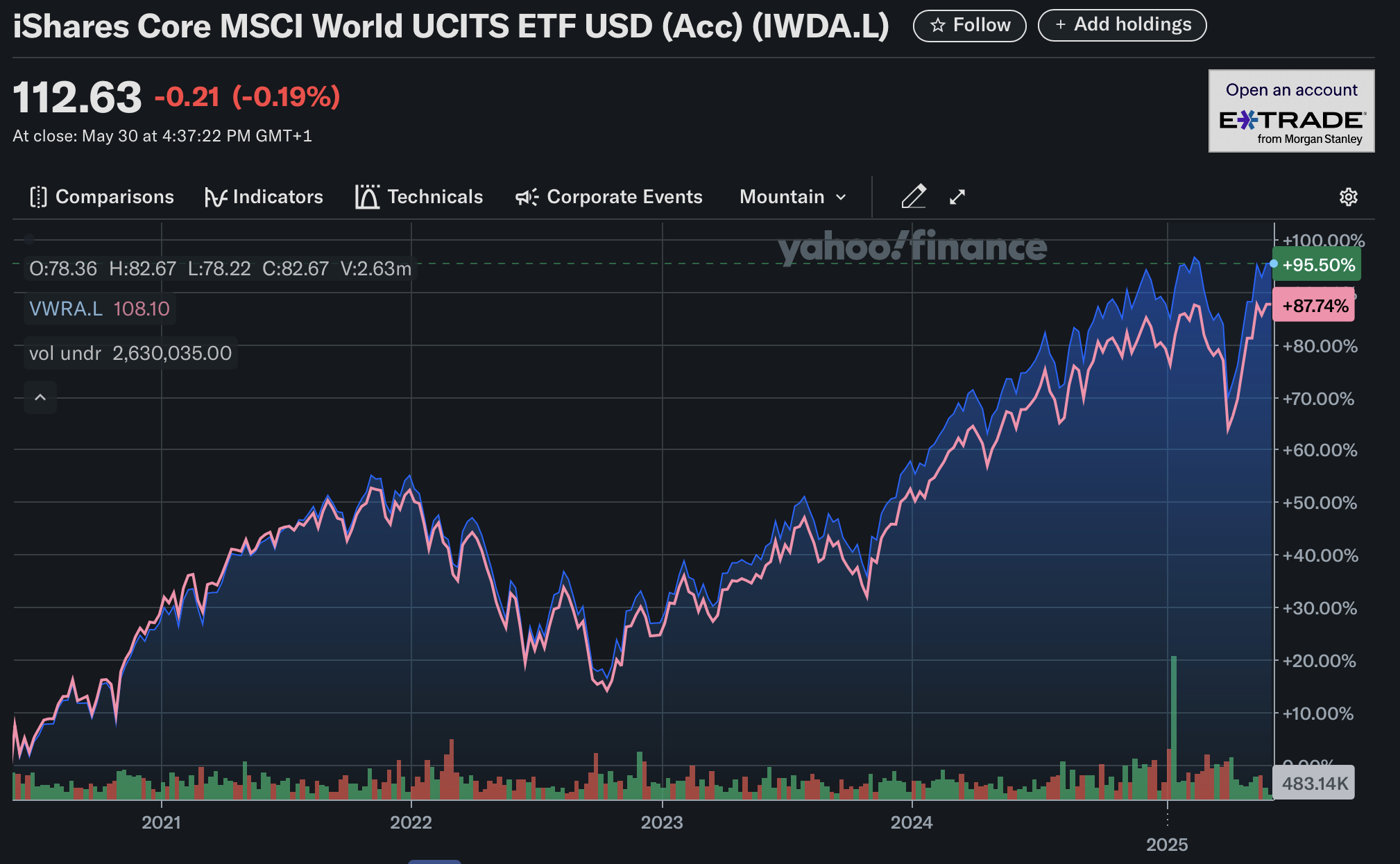
Over very long terms—more than a year—they can drift apart a little, because of differing performance in that remaining 10% of the portfolio. Here's a fun quiz: knowing what you know about the difference between IWDA and VWRA's portfolio (VWRA has more emergings, IWDA has more USA), which one would you guess has done better over the last year? How about the last five years?

Take a guess before you scroll down...

iwda-vwra-1y.png


iwda-vwra-5y.png


And there you go. (In both of these charts, IWDA is the blue line; VWRA is the pink line.)

Over the last five years, IWDA (with its heavier weight in the go-go US equity market) has outperformed VWRA (with its heavier weight in emergings) by about 0.8% per year. This doesn't mean IWDA is a better fund, though: it just means that IWDA has been a little heavier-weighted in a market that's performed better. And over one year, they've gone basically tick-for-tick.

The question is, what will happen in the future? Will IWDA or VWRA be a better investment? I don't know—if I knew, I'd be writing this from a beach in the Caymans.

I will say that overweighting emergings—specifically China—has been a terrible trade for the last few years, and it's been a predictably terrible trade: anyone could've seen this coming. The Chinese government has been explicitly sitting on top of equity markets for years, trying to rebuild banks' capital buffers and local governments' balance sheets at the expense of shareholder profits.

But markets move in cycles. If you were around long enough ago, you'll remember the 2000–2007 period, when the US was uninvestible and emerging markets were the only place to be; or even the mid-90s. And right now, developed markets ex-US have beaten the S&P 500 by ~10% so far this year. (This is why broad diversification is good!)

On the whole, though: both IWDA and VWRA are great ETFs—low cost, broadly diversified, all the things you'd want in a key part of your portfolio. Either is fine.

 

CrashWire

Supremacy Member
Joined
Nov 28, 2000
Messages
5,789
Reaction score
738
But markets move in cycles. If you were around long enough ago, you'll remember the 2000–2007 period, when the US was uninvestible and emerging markets were the only place to be; or even the mid-90s. And right now, developed markets ex-US have beaten the S&P 500 by ~10% so far this year. (This is why broad diversification is good!)
Where were people putting their money in 2000-2007, if not the US?
 

Shiny Things

Supremacy Member
Joined
Dec 13, 2009
Messages
9,569
Reaction score
781
Where were people putting their money in 2000-2007, if not the US?
Emerging-market equities and commodities, mostly. (Also - a lot of AUD! I had a lot of Aussie corporates buying AUD calls the whole way up to hedge their overseas earnings, which turned out to be a very smart move.)

I've only got data from mid-2003 onward, because that's when the EEM ETF launched; but if you measure from April '03 to 22 June '07 (the day two Bear Stearns structured-credit funds exploded and really kicked off the GFC), SPY gained 66% in four years (which is pretty good, that's 13%/year!) but EEM nearly quadrupled over the same time period.

Commodities had an absolute blinder of a run as well; gold more than doubled from 2001 to 2007 (from 260 to 660-ish).
 

Slavor

Senior Member
Joined
Jul 26, 2011
Messages
747
Reaction score
36
Yeah, things are, shall we say, interesting over here. Can y'all believe it's only been eight weeks since the Rose Garden press conference? "Why are you tariffing penguins?" was less than two months ago!


Let's start with where that difference comes from: the difference is basically that VWRA's index includes emerging markets, while IWDA's doesn't. (If you look at VWRA's geography list, you'll see China, India, Taiwan, and South Korea—making up about 8.5% of the fund between the four of them.)

Does that make a difference? Yes, it does, but it's not a huge difference, and it's not something that you need to invest a lot of time and brain-damage to have an opinion on. In short: IWDA and VWRA follow each other pretty much tick-for-tick, as you'd expect when their portfolios are 90% identical (and the other 10% is pretty highly correlated as well).

Over very long terms—more than a year—they can drift apart a little, because of differing performance in that remaining 10% of the portfolio. Here's a fun quiz: knowing what you know about the difference between IWDA and VWRA's portfolio (VWRA has more emergings, IWDA has more USA), which one would you guess has done better over the last year? How about the last five years?

Take a guess before you scroll down...

iwda-vwra-1y.png


iwda-vwra-5y.png


And there you go. (In both of these charts, IWDA is the blue line; VWRA is the pink line.)

Over the last five years, IWDA (with its heavier weight in the go-go US equity market) has outperformed VWRA (with its heavier weight in emergings) by about 0.8% per year. This doesn't mean IWDA is a better fund, though: it just means that IWDA has been a little heavier-weighted in a market that's performed better. And over one year, they've gone basically tick-for-tick.

The question is, what will happen in the future? Will IWDA or VWRA be a better investment? I don't know—if I knew, I'd be writing this from a beach in the Caymans.

I will say that overweighting emergings—specifically China—has been a terrible trade for the last few years, and it's been a predictably terrible trade: anyone could've seen this coming. The Chinese government has been explicitly sitting on top of equity markets for years, trying to rebuild banks' capital buffers and local governments' balance sheets at the expense of shareholder profits.

But markets move in cycles. If you were around long enough ago, you'll remember the 2000–2007 period, when the US was uninvestible and emerging markets were the only place to be; or even the mid-90s. And right now, developed markets ex-US have beaten the S&P 500 by ~10% so far this year. (This is why broad diversification is good!)

On the whole, though: both IWDA and VWRA are great ETFs—low cost, broadly diversified, all the things you'd want in a key part of your portfolio. Either is fine.
Thanks again for your detailed reply! I wasn't confident of emerging markets (and still don't), but at the rate the US is going it might join them too (I kid but you know what I mean). So out of sheer laziness and inertia I'll probably stick with IWDA then.

I do sincerely hope the US wakes up and course corrects in a few years - many people's retirements are depending on it :sleep:
 

marcoyeo

Supremacy Member
Joined
Mar 25, 2001
Messages
6,606
Reaction score
41
Would anyone go with SWRD/IWDA + EIMI better choice than VWRA? And rebalance SWRD/IWDA & EIMI as the year goes on.
 

peachmouse

Member
Joined
Oct 21, 2007
Messages
169
Reaction score
56
Would anyone go with SWRD/IWDA + EIMI better choice than VWRA? And rebalance SWRD/IWDA & EIMI as the year goes on.
If I use ETFs and I want to reduce US exposure from its default 60+% in VWRA, I will use a mixture of CSUS + XUSE + EIMI
CSUS - ishare MSCI USA UCITS ETF
XUSE - ishare MSCI World ex-USA UCITS ETF
EIMI - ishare Core MSCI EM IMI UCITS ETF

Compared to historical valuations, US and AC World equties are pricey.
 

marcoyeo

Supremacy Member
Joined
Mar 25, 2001
Messages
6,606
Reaction score
41
Why do manually what's available automatically?
I am looking into cost effective than VWRA, yet have some control over the Developed World and EM allocation.
If I use ETFs and I want to reduce US exposure from its default 60+% in VWRA, I will use a mixture of CSUS + XUSE + EIMI
CSUS - ishare MSCI USA UCITS ETF
XUSE - ishare MSCI World ex-USA UCITS ETF
EIMI - ishare Core MSCI EM IMI UCITS ETF

Compared to historical valuations, US and AC World equties are pricey.

Thank you for your suggestion, I will look into these. MSCI World (70% US) and All Country World (63% US) are heavily concentrated on US.
 

BBCWatcher

Arch-Supremacy Member
Joined
Jun 15, 2010
Messages
23,224
Reaction score
4,711
I am looking into cost effective than VWRA, yet have some control over the Developed World and EM allocation.
If by "control" you mean "you want to raise the portion invested in (so-called) emerging market stocks," why not VWRA+EIMI?

....But honestly I don't know why so many people have such firm predictions that they want to make their investing lives more complicated (and a bit more expensive too; these funds aren't commission free). I don't know what the future will hold, but I know a global stock index fund should do at least a reasonably good job navigating the future.
 

Shiny Things

Supremacy Member
Joined
Dec 13, 2009
Messages
9,569
Reaction score
781
Compared to historical valuations, US and AC World equties are pricey.

So one thing to note is that the "AC World" index is about 64% US equities - which is what we were discussing upthread. So if US equities are trading on the high end of their historic P/E range, it'd be surprising if the ACWI wasn't doing the same.

I think all this chart is saying - even though this Zaccardi dude is trying to make it say something else - is that US equities have had quite a good run lately.
 

singaporean11

Senior Member
Joined
Sep 21, 2024
Messages
855
Reaction score
360
Would anyone go with SWRD/IWDA + EIMI better choice than VWRA? And rebalance SWRD/IWDA & EIMI as the year goes on.
To me,
SWRD/IWDA + EIMI is definitely better choice than VWRA as you have flexibility to arbitrage And rebalance SWRD/IWDA & EIMI as the year goes on.

Better option may be CSPX (US only) + CSX5 (Europe ex-UK) + ISF (UK only) + EIMI.
 

DevilPlate

Arch-Supremacy Member
Joined
Nov 22, 2020
Messages
12,197
Reaction score
5,139
To me,
SWRD/IWDA + EIMI is definitely better choice than VWRA as you have flexibility to arbitrage And rebalance SWRD/IWDA & EIMI as the year goes on.

Better option may be CSPX (US only) + CSX5 (Europe ex-UK) + ISF (UK only) + EIMI.
hmmm i have VWRA+EQQU+EIMI (vy small portion)

*Thinking of selling EIMI and all pump into BTC :s13:
 

unculturedf

Junior Member
Joined
Dec 2, 2022
Messages
42
Reaction score
5
Importantly, this part is dollar cost averaging too — Singapore dollar cost averaging. The security might be quoted in U.S. dollars for convenience as so many things are — oil, gold, wheat, Picasso paintings, Ariana Grande vinyl records. But you’re Singapore dollar cost averaging into the investment, and that’s powerful.
Am I right to say this only happens if we DCA a fixed SGD amount instead of USD amount into the investment every interval?
 

BBCWatcher

Arch-Supremacy Member
Joined
Jun 15, 2010
Messages
23,224
Reaction score
4,711
Am I right to say this only happens if we DCA a fixed SGD amount instead of USD amount into the investment every interval?
If it’s a fixed Singapore dollar amount that you buy every month then you’re Singapore dollar cost averaging. If it’s a fixed U.S. dollar amount, U.S. dollar cost averaging.
 

highsulphur

Greater Supremacy Member
Joined
Aug 16, 2011
Messages
75,926
Reaction score
38,927
If it’s a fixed Singapore dollar amount that you buy every month then you’re Singapore dollar cost averaging. If it’s a fixed U.S. dollar amount, U.S. dollar cost averaging.
IBKR only allows DCA based on usd amount and not sgd amount. At least this is the case for me for ibkr. Not sure if it's the same for ibsg
 

unculturedf

Junior Member
Joined
Dec 2, 2022
Messages
42
Reaction score
5
I am on IBSG and it's the same as well.
Seems like there's no convenient way to incorporate SGD DCA
 

BBCWatcher

Arch-Supremacy Member
Joined
Jun 15, 2010
Messages
23,224
Reaction score
4,711
IBKR only allows DCA based on usd amount and not sgd amount. At least this is the case for me for ibkr. Not sure if it's the same for ibsg
I am on IBSG and it's the same as well.
Seems like there's no convenient way to incorporate SGD DCA
Let’s suppose you deposit S$10,000 per month into your Interactive Brokers account (this first part can be automatic), convert it at market rate to some variable number of U.S. dollars, then convert that variable number of U.S. dollars (plus any residual U.S. dollars from the prior month) into some variable number of shares of VWRA or ISAC (as examples).(*) That’s Singapore dollar cost averaging!

(*) If you can buy fractional shares, even better, but that’s not a requirement.
 
Important Forum Advisory Note
This forum is moderated by volunteer moderators who will react only to members' feedback on posts. Moderators are not employees or representatives of HWZ. Forum members and moderators are responsible for their own posts.

Please refer to our Community Guidelines and Standards, Terms of Service and Member T&Cs for more information.
Top