Official Shiny Things thread—Part III

Status
Not open for further replies.

311290

Senior Member
Joined
Nov 10, 2007
Messages
1,871
Reaction score
0
Now it's charging at 1.8725%

Found another fund that's charging at this. Is this more acceptable? Haven take a look at the performance as it's just launch this month.

Management Fee
Not exceeding 2.68% (currently charged at 0.749%)
Trustee Fee
Not exceeding 0.11% (currently charged at 0.0214%)
Registrar Fee
Not exceeding 0.11% (currently charged at 0.06527%)
Other Fee
Actual expenses

OH MY GOD

That is honestly bordering on unethical, those are hedge-fund-level fees. Run, don't walk, in the other direction.
 

FnangB

Junior Member
Joined
Sep 9, 2019
Messages
10
Reaction score
0
Bonjour Shiny,

I'm still silently lurking this thread (like many I guess) ;)

I have a question regarding non-SGD bonds (plan to retire in Europe)

Last time you suggested a mix of IEAC with HIGH
But then I saw other of your replies saying:


ShinyThings said:
My usual go-to is LQDA, listed in London
—it’s US-dollar-denominated investment-grade corporate bonds.(I’m not a fan of owning bonds in other currencies—EUR, JPY, etc—
because interest rates are so low that I don’t think they adequately compensate for the FX risk. If you do want those zero-interest EUR and JPY corps, though, CORP, listed in London, is the default.)

ShinyThings said:
For my consulting clients who need a "non-SGD bonds" slug, I usually recommend mostly USD bonds;

I'm very reluctant to allocate to EUR, JPY, or CHF (and now AUD!) bonds that yield three-fifths of diddly squat;

the yields on those bonds aren't adequate compensation for the currency risk.I usually lean toward high-grade corporate bonds for the entirety of the fixed-income allocation.
I think the yield pickup over govvy bonds for the extra credit risk is worth it. This'd point you toward something like LQDA

If I go on something like LQDA I'll be full USD so I guess high Fx risk right ?
However would it be still worth it as seeing how youdepict the EUR fund as terrible (and I'm planning for long term ?)

Thanks
 

Shiny Things

Supremacy Member
Joined
Dec 13, 2009
Messages
9,605
Reaction score
854
Hi, please help me clarify what does Joshua mean by "no USD component in global stocks and global bonds".

That’s a typo unfortunately - it should read “no local-currency component”.

Hi! Hope someone can help me out.

1. Is there any reason to use fixed fees when using interactive brokers for IWDA?

Nope. IBKR’s fee structure can be a bit complicated sometimes, but tiered is almost always cheaper for most investors in UK ETFs.
2. Also, are we able to switch between fixed and tiered fee structure instantly? Or does it take awhile to be processed before being applied to the account?

It takes a day or so.

Now it's charging at 1.8725%

Found another fund that's charging at this. Is this more acceptable? Haven take a look at the performance as it's just launch this month.

Management Fee
Not exceeding 2.68% (currently charged at 0.749%)
Trustee Fee
Not exceeding 0.11% (currently charged at 0.0214%)
Registrar Fee
Not exceeding 0.11% (currently charged at 0.06527%)
Other Fee
Actual expenses

The amounts funds charge varies by asset class. A fee that’s reasonable for high-yield bonds, for example, might be utterly unreasonable for large-cap equities.

Still, no matter what fund you’re looking at, 75bps management fee is an awful lot for a unit trust. That’ll pay for a lot of Ferraris for the portfolio manager.

Bonjour Shiny,

I'm still silently lurking this thread (like many I guess) ;)

I have a question regarding non-SGD bonds (plan to retire in Europe)
[…]
If I go on something like LQDA I'll be full USD so I guess high Fx risk right ?
However would it be still worth it as seeing how youdepict the EUR fund as terrible (and I'm planning for long term ?)

Thanks

On the one hand, yeah, Eurozone bonds have a pretty dismal yield. That said, if you’re planning to retire in Europe, you won’t really mind: European inflation and interest rates are going to stay low for a long time unless something very substantial changes in the Eurozone economy. So you won’t be earning much on your bonds, but neither will anyone else.

I don’t like EUR, CHF, and JPY bonds for people who don’t have to own them; but in your case, it makes sense to own them.
 
Last edited:

lupster

Master Member
Joined
Feb 26, 2010
Messages
3,330
Reaction score
1,626
Nope. IBKR’s fee structure can be a bit complicated sometimes, but tiered is almost always cheaper for most investors in UK ETFs.

Thanks Shiny!

Has IBKR changed the fees recently? I can't really tell when it is cheaper to use fixed. Or am I looking at the wrong table for tiered fees?

Fixed:
XtgZtrc.jpg


Tiered:
J6BE5XB.jpg
 

Kinderino

Junior Member
Joined
Jan 20, 2020
Messages
29
Reaction score
0
XIRR Calculations

Hello, I'm interested to track my portfolio returns using XIRR calculations but I need some help as I cannot wrap my head around the cashflows that should be considered.

I've read up a couple of sources about this and the general consensus is that we should treat the portfolio as a blackbox, i.e. exclude reinvested dividends for XIRR calculations.

However, I'm thinking if it makes sense to include the sale of stocks and dividends paid out (in both cases the proceeds get reinvested, but with a delay)?

I could ignore the above as part of the XIRR calculations, but are there any exceptions to take note off? Example, if Stock A is sold on 30 Dec 2019 and was only reinvested on 15 Jan 2020, then I suppose it should be treated as a 'withdrawal' when calculating the returns for 31 Dec 2019?

Thanks in advance for your expert knowledge.
 

tangent314

Moderator
Moderator
Joined
Jul 26, 2002
Messages
5,136
Reaction score
224
You can if you want absolute accuracy in your XIRR calculations, but in reality the difference is negligible, so it's probably not worth the effort.
 

Kinderino

Junior Member
Joined
Jan 20, 2020
Messages
29
Reaction score
0
You can if you want absolute accuracy in your XIRR calculations, but in reality the difference is negligible, so it's probably not worth the effort.

Hi Tangent, thanks for sharing your thoughts.

I have done a comparison with and without dividends and noticed that with dividends, XIRR performance is better. To put it simply, some argue that by including dividends (as part of calculations) it ignores the fact that the dividends are not earning any interest during the period that it is not invested. So, XIRR should be closer to the (lower) performance returns calculated without dividends accounted for.

Maybe there's no right or wrong way, but I wanted to find out more about the logical reasoning behind including or excluding such cashflows.
 
Last edited:

limster

Arch-Supremacy Member
Joined
Oct 31, 2000
Messages
13,105
Reaction score
4,076
Thanks Shiny!

Has IBKR changed the fees recently? I can't really tell when it is cheaper to use fixed. Or am I looking at the wrong table for tiered fees?

Fixed:
XtgZtrc.jpg


Tiered:
J6BE5XB.jpg


one says US$1.70 minimum max US$39, the other says US$5 minimum but no maximum.

to find out which is cheaper, use maths?
 

WoShiPro

Supremacy Member
Joined
May 6, 2008
Messages
5,592
Reaction score
223
Anyone invested in small cap etf? IJR?

Currently I'm only invested in SGX(90%) and IWDA(10%). Looking to diversify my portfolio once my SGX portfolio reach my TP and buying few etf instead of relying on iwda alone .

Long term aiming 80% global 20% SGX with no bonds. Emergency funds aka savings earning 1-2% will act as my bonds portfolio.
 
Last edited:

ranchfarm

Member
Joined
Apr 5, 2012
Messages
364
Reaction score
24
Anyone invested in small cap etf? IJR?

Currently I'm only invested in SGX(90%) and IWDA(10%). Looking to diversify my portfolio once my SGX portfolio reach my TP and buying few etf instead of relying on iwda alone .

Long term aiming 80% global 20% SGX with no bonds. Emergency funds aka savings earning 1-2% will act as my bonds portfolio.
I'm currently all in VWRA but I'm thinking 72% VWRA, 18% WSML, 10% ABF and MBH (buying whatever is cheap). Then as I pass a certain age I'll slowly move into ES3 and also increase bond allocation.
 

Shiny Things

Supremacy Member
Joined
Dec 13, 2009
Messages
9,605
Reaction score
854
Anyone invested in small cap etf? IJR?

Currently I'm only invested in SGX(90%) and IWDA(10%). Looking to diversify my portfolio once my SGX portfolio reach my TP and buying few etf instead of relying on iwda alone .

A couple of points there:
1) You're a Singaporean investor; there isn't really a good reason for you to buy US small-caps. 2) You'll also get hit by the dividend tax on the divs from IJR.
3) Small-caps are, by definition, a small part of the market. Even if you wanted to have a market-weight exposure to them, they'd be like 1-2% of your portfolio.

Long term aiming 80% global 20% SGX with no bonds. Emergency funds aka savings earning 1-2% will act as my bonds portfolio.

That seems quite aggressive and I don't think it's a great idea. Emergency funds are not the same as a bond allocation within your broader portfolio: a bond allocation is something you rebalance in and out of, but emergency funds are money that you don't touch unless you need it.
 

WoShiPro

Supremacy Member
Joined
May 6, 2008
Messages
5,592
Reaction score
223
A couple of points there:
1) You're a Singaporean investor; there isn't really a good reason for you to buy US small-caps. 2) You'll also get hit by the dividend tax on the divs from IJR.
3) Small-caps are, by definition, a small part of the market. Even if you wanted to have a market-weight exposure to them, they'd be like 1-2% of your portfolio.


That seems quite aggressive and I don't think it's a great idea. Emergency funds are not the same as a bond allocation within your broader portfolio: a bond allocation is something you rebalance in and out of, but emergency funds are money that you don't touch unless you need it.

Thanks. Are there any accumulating etf listed on LSE for value/small-cap.
 

applecore7

Junior Member
Joined
Sep 12, 2014
Messages
79
Reaction score
0
I see most people are using IWDA for the global portion. Why not something else like CSPX or VT?

Genuinely curious as I'm new!
 
Last edited:

lupster

Master Member
Joined
Feb 26, 2010
Messages
3,330
Reaction score
1,626
one says US$1.70 minimum max US$39, the other says US$5 minimum but no maximum.

to find out which is cheaper, use maths?

Am I looking at the correct table for tiered fees though? If yes, tiered is always cheaper, not just usually cheaper.
 

Shiny Things

Supremacy Member
Joined
Dec 13, 2009
Messages
9,605
Reaction score
854
Thanks. Are there any accumulating etf listed on LSE for value/small-cap.

I think you might be missing the point; you don't need a dedicated allocation to small-caps, or to factors (whether those are value, momentum, quality, whatever).

Small-caps are, by their name, a small percentage of the market, and IWDA already has an allocation to global smallcaps anyway. If you're overweighting small-caps or value because you genuinely think the decade-long underperformance in small-cap value is about to turn around, that's a pretty ambitious bet...!

I see most people are using IWDA for the global portion. Why not something else like CSPX or VT?

Genuinely curious as I'm new!

This is a totally fair question, with a three-part answer:

1) Why a "global stocks" ETF, instead of a specific country?
Getting exposure to a lot of stock markets all around the world is a good thing. The US stock market has been a surprisingly strong performer over the last ten years; but from 2004-2007, emerging-market stocks were absolutely on fire, and nobody wanted to own US stocks.

You also want diversification between sectors. Tech (the infamous FAANG stocks) has been red-hot for the last few years, but commodity stocks were hot in 2009-2011 thanks to the gold boom; banks were hot in the 2000s...

Basically you don't want to focus on whatever the current hot sector or country is, because then you'll miss the moment when the new hot sector or country starts to emerge.

2) Why not a US-listed ETF like VT?
For Singaporean investors (or basically any non-US-tax-resident), US-listed ETFs have an expensive slug of dividend withholding tax: 30% of the dividends get withheld by the US tax office.
If you own exactly the same stocks through an Irish-domiciled, UK-listed ETF, though, you can take advantage of the tax treaty between the UK and Ireland. That reduces the tax rate on dividends from US-listed stocks from 30% to 15%, which is quite literally free money. Free money!

3) Why IWDA instead of other Irish-listed global-stocks ETFs like VWRA or VWRD?
This one is a bit more line-ball. I prefer "accumulating" ETFs (ETFs that reinvest dividends) to "distributing" ETFs (ETFs that pay out dividends), and when I wrote the most recent edition of Rich by Retirement (in early 2019), IWDA was the only Irish global-stocks ETF that checked all of my boxes (low fees, liquid, big asset base).

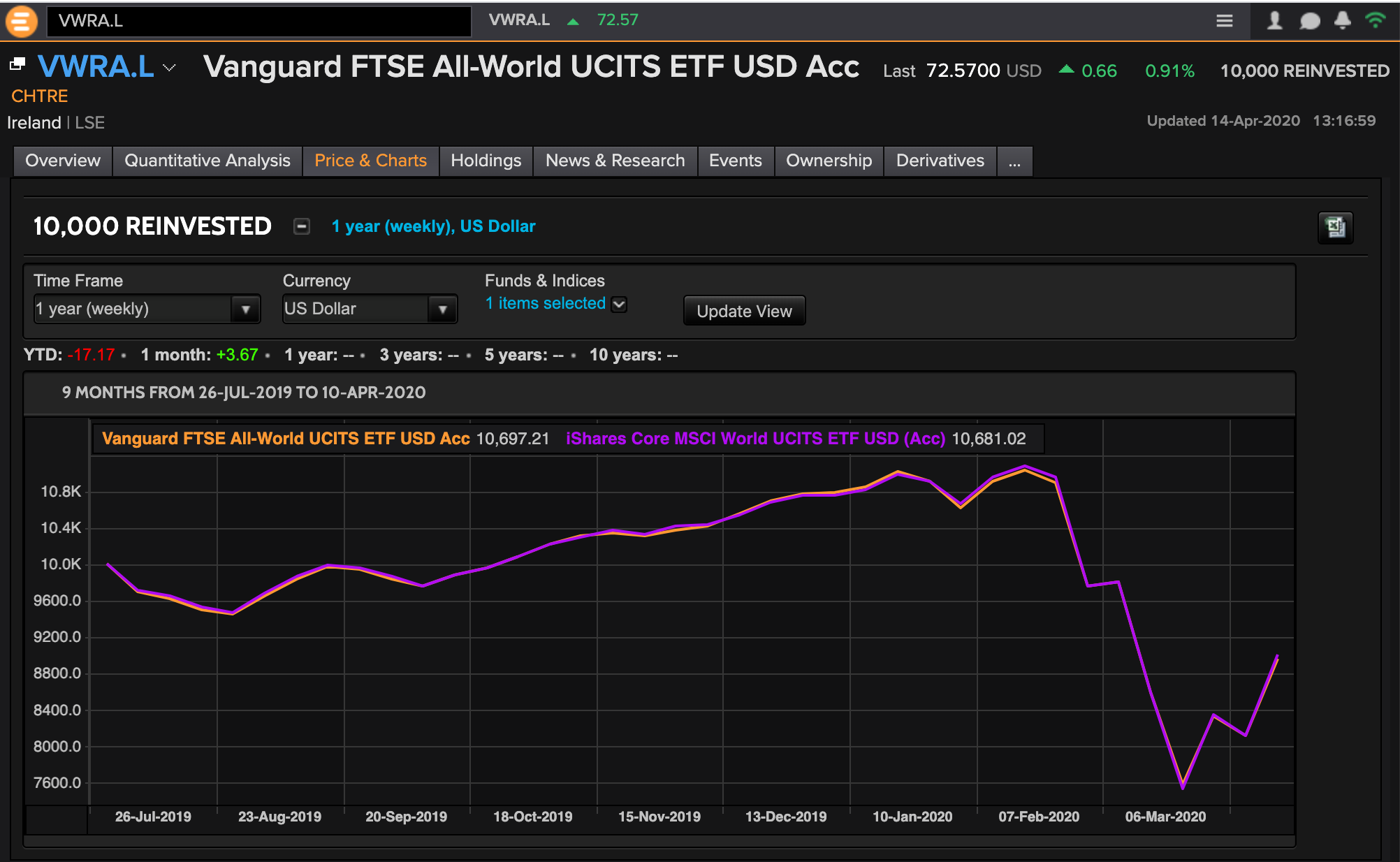
VWRA emerged late last year, and is very good as well. The only difference between IWDA and VWRA is that IWDA is 100% in developed-market stocks, while VWRA is 90% in developed markets and 10% in emerging markets. In practice, the two ETFs track almost tick-for-tick, so it doesn't actually matter that much.

IWDAvsVWRA.png


---

So IWDA checks all the boxes for "a good global equities fund for Singaporean investors". It's easy to buy and sell; it has low fees; it's broadly diversified and has low turnover; it minimises your dividend taxes... it does everything you'd want it to.

 
Last edited:

WoShiPro

Supremacy Member
Joined
May 6, 2008
Messages
5,592
Reaction score
223
I think you might be missing the point; you don't need a dedicated allocation to small-caps, or to factors (whether those are value, momentum, quality, whatever).

Small-caps are, by their name, a small percentage of the market, and IWDA already has an allocation to global smallcaps anyway. If you're overweighting small-caps or value because you genuinely think the decade-long underperformance in small-cap value is about to turn around, that's a pretty ambitious bet...!

Thanks what about emerging market exposure? Most recommended EIMI but vanguard VWO returns seem better as it exclude South Korea.

I can't seem to find VWO Irish Domiciled etf or is there any?
 

cassowary18

Senior Member
Joined
Jul 17, 2018
Messages
1,819
Reaction score
201
Thanks what about emerging market exposure? Most recommended EIMI but vanguard VWO returns seem better as it exclude South Korea.

I can't seem to find VWO Irish Domiciled etf or is there any?

VWO Irish equivalent is VFEA (accumulating) or VDEM (distributing).

However you got to be careful:
IWDA and EIMI track MSCI indices
The Vanguard funds track FTSE indices

There are some differences in index composition between the MSCI and FTSE indices. If you get IWDA, pair with EIMI. If you want Vanguard funds, get VWRA/VWRD (for a single fund) or VHVE and VFEA (accumulating funds) or VDEV and VDEM (for distributing funds).
 

WoShiPro

Supremacy Member
Joined
May 6, 2008
Messages
5,592
Reaction score
223
VWO Irish equivalent is VFEA (accumulating) or VDEM (distributing).

However you got to be careful:
IWDA and EIMI track MSCI indices
The Vanguard funds track FTSE indices

There are some differences in index composition between the MSCI and FTSE indices. If you get IWDA, pair with EIMI. If you want Vanguard funds, get VWRA/VWRD (for a single fund) or VHVE and VFEA (accumulating funds) or VDEV and VDEM (for distributing funds).

Yes it's VFEA.

thanks it seem that VFEA has very low volume.. I'm better off with EIMI to avoid the large bid/ask spread.
 
Status
Not open for further replies.
Important Forum Advisory Note
This forum is moderated by volunteer moderators who will react only to members' feedback on posts. Moderators are not employees or representatives of HWZ Forums. Forum members and moderators are responsible for their own posts. Please refer to our Community Guidelines and Standards and Terms and Conditions for more information.
Top