Property News!

jq75

Honorary Member
Joined
Dec 5, 2000
Messages
142,972
Reaction score
4,972
April 9, 2008
$516M DEAL
Tulip Garden owners call off collective sale

OWNERS at Tulip Garden have called off the $516 million collective sale of their 164-unit Holland Road condo, but they will keep the $25.8 million deposit.

Mr Ow Yong Thian Soo of Lee & Lee, who is representing the owners, told The Straits Times yesterday that a notice rescinding the sale was given to the intended buyer - a consortium led by Bravo Building Construction.

The owners also told Bravo that they would retain the 5 per cent deposit, a right allowed under the sale and purchase agreement.

They decided to cancel the sale after Bravo missed Monday's deadline - which had already been extended from last month - to pay a further 5 per cent of the purchase price. The developer wanted even more time to pay and complete the sale.

The deposit will now be distributed proportionally. Owners who were due to receive $2.5 million to $4.2 million from the sale will now get 5 per cent of these sums once the estate pays expenses of possibly $1 million or more. These include half the conveyancing fees, half the fees of consultants Savills Singapore, plus litigation and administration costs.

Bravo bought Tulip Garden last July and was due to complete the sale late next month. It also has unfinished business at Pender Court, where it missed the $80 million collective sale completion date but has an extension until later this month.
 

jq75

Honorary Member
Joined
Dec 5, 2000
Messages
142,972
Reaction score
4,972
April 9, 2008
Fewer home loans taken up as property market cools further
Mortgage default rate also falls but some banks see refinancing deals rise

By Grace Ng
THE number of home loans taken up has fallen sharply in recent months as the property market continues to contract.

Only 4,200 new home loans were approved in January, up about 13 per cent on the 3,722 in December but down 21 per cent from the peak of 5,319 last August.

The Credit Bureau of Singapore figures also show that 2,544 second mortgages were taken up in January, a 31 per cent drop from the high of 3,698, also last August.

'We expect the growth in new mortgages to slow further this year,' said Credit Bureau general manager Mark Rowley.

Inquiries for new home loans have also dropped, down to 8,923 in February, the lowest since April 2006.

Mr Gregory Chan, OCBC Bank's head of consumer secured lending, said: 'We have observed that property buyers are becoming more cautious in their purchase decisions.'

United Overseas Bank's (UOB's) head of loans, Mr Kevin Lam, said that 'in line with property sales transactions, our loan applications were slower in January and February' but there was 'a pick-up in market activity at the end of March'.

His counterpart at HSBC Singapore, Ms Alice Chia, said the bank has 'seen a reduction in applications for new home loans, which is reflective of sentiment towards the property market'.

But she pointed to one area where banks are getting increased business - more people are re-mortgaging their home to take advantage of the declining interest rate environment.

'We have seen an increase in the number of refinancing applications over recent months,' she said.

Maybank and OCBC have also encountered more home owners looking to refinance.

Ms Helen Neo, Maybank's head of consumer banking in Singapore, said it launched financing packages in February 'catering to customers seeking refinancing' and has received 'an encouraging response'.

However, Standard Chartered and UOB said they have not seen a significant increase in customers wanting to refinance.

The Credit Bureau figures also revealed certain more positive aspects of the mortgage market.

The number of delinquent account holders has fallen to 4,636, or just 1.63 per cent of total mortgage holders - the lowest in two years.

This allays concerns raised during the speculative frenzy last year that some buyers would overstretch by taking on loans they could not afford.

Mr Rowley said the lower delinquency rate is 'a good sign' that Singapore customers are creditworthy, even as loan amounts have risen steadily.

The increase in the number of home owners with significantly larger mortgages has also been striking.

There were 7,404 home owners with outstanding balances on their mortgages of over $1 million in January. This was an 81 per cent jump over February last year. This segment makes up almost 3 per cent of the total number of mortgage holders in Singapore.
 

jq75

Honorary Member
Joined
Dec 5, 2000
Messages
142,972
Reaction score
4,972
Private home sales leapt 80% in March from February

15 April 2008 2010 hrs


SINGAPORE: There are signs the property market in Singapore might be making an about-turn following its muted start to the year.

Figures released by the Urban Redevelopment Authority (URA) show that the number of private homes sold in March leapt 80 per cent from the month before, signalling improved buyer sentiment.

And developers were even more positive. They launched more than 600 units for sale in March - about 85 per cent more than the month before, and the highest in seven months.

Analysts said they expect to see more units being placed on sale in the months to come.

Donald Han, Managing Director of Cushman & Wakefield, Singapore, said: “Moving forward we expect more launches taking place in the second quarter of this year. While there are generally not a slew of new launches, a lot of developers have re-launched their projects. Re-launched in the sense (they) have started to price properties at more realistic levels.

“Early part of year, it's not too effective to start pricing there. But now we are well into 2008. There are developers who are certainly using pricing to attract more positive sentiment to lure the buyers out."

Still, developers have some way to go before the property market even begins to resemble that of its heydays last year.

A closer look at the numbers show that most of the increase in sales came from the high-end market where sales jumped 80 per cent, compared to a 31 per cent hop in suburban region sales.

For now, it seems that mass market buyers will still be holding back in hope of better deals to come.

Analysts are also quick to note that the ratio of launches to sales in March still remain at February levels at 47.5 per cent to 46.4 per cent.

Nicholas Mak, Director of Knight Frank, said: "At first glance, it seems like sales figures in March have improved over February. The numbers moved back to about the same level as in January or December. But on closer analysis we find that the take-up has weakened. Typically about 70 to 90 per cent of units launched are sold. Right now that figure has fallen to about 50 per cent, same as February."

But overall, analysts said the private home market data for March should still put a smile on the faces of those in the industry, given the current economic climate due to the bad news from the US and its ensuing ripple effect worldwide. - CNA/vm
 

jq75

Honorary Member
Joined
Dec 5, 2000
Messages
142,972
Reaction score
4,972
Still home for 8 more months

En bloc firm offers Leedon Heights residents leaseback deal


Wednesday • April 16, 2008

Tan Hui Leng
huileng@mediacorp.com.sg

RESIDENTS of Leedon Heights came home to a pleasant surprise last week — the chance to stay on in their apartments until the end of January next year, instead of having to move out by June.

Following appeals from residents and home-owners, the buyer of the en bloc site, GuocoLand, extended a leaseback deal to them.

In a notice dated April 10, the company offered a short-term lease, subject to a minimum of three months, up until Jan 31, 2009.

The 48,525-sq-m, 23-year-old condominium off Holland Road and Farrer Road was to have been vacated by June 2.

But as the showflats for the development will be built off-site — though still on the sprawling land — developer Rivaldo Investments, a Guocoland subsidiary, agreed to the lease arrangement.

Leedon Heights made news last April when GuocoLand paid $835 million — a record price then — for the site.

Following Channel NewsAsia's report in January that Guocoland was considering a leaseback deal, many residents apparently responded positively.

One of them who affirmed his interest was retail banking consultant Richard Hartung, who has been living at Leedon Heights since 1994.

But last month, he said, he got a letter from the developer saying that the offer would not be made.

On the latest good news, Mr Hartung said: "We would have loved to stay longer but we have already made new housing arrangements."

Although unusual, leaseback deals are not unheard of.

Property analysts whom Today spoke to said the current slowdown in the property market is allowing developers to kick back their heels and bide time on their next hot project.

Said Mr Colin Tan, Chesterton's head of research and consultancy: "Developers may feel their developments can fetch better prices if they ride out the current cycle. Because they are in no hurry, they may offer a lease back to residents and collect rent at the same time."

Knight Frank's director of consultancy and research Nicholas Mak cautioned that in the offering of such a scheme, there had to be a substantial number of residents interested in renting, as the cost of maintaining the property is high.

Even so, developers would have much to gain in the future with the offering of such goodwill.

"The former owners of these units could be future buyers of the developer's new project or of their inventory stock," said Mr Mak.
 

jq75

Honorary Member
Joined
Dec 5, 2000
Messages
142,972
Reaction score
4,972
Sharp drop in Q1 new home sales

But don't expect prices to fall, say analysts


Friday • April 18, 2008

Tan Hui Leng
huileng@mediacorp.com.sg

IN another sign of a lull in the private residential property market, developers managed to sell only 795 new homes in the first three months of this year — a hefty 46 per cent decline from the fourth quarter of last year.

"This was the second lowest quarter of developer sales since the Sars-stricken quarter" in the first three months of 2003, said DTZ Research in the real estate consultancy's first-quarter Singapore Property Market Report released yesterday.

"Developers and buyers are taking a wait-and-see attitude and some are holding back launches," said DTZ in the report.

According to the Urban Redevelopment Authority (URA), developers launched 1,395 units in the first quarter this year, 291 fewer than the 1,686 in the previous quarter.

But even with the dwindling activity in the first quarter, most developers — especially the larger ones — are in no hurry to cut prices. "Developers were still able to put up with lacklustre sales, bolstered by the revenue surge during the past two years," noted DTZ.

The bigger and more established developers are likely to hold out until the market regains its firm footing — unless a darker cloud of prolonged gloom descends in the form of a deepening United States sub-prime mortgage crisis or regional uncertainties, said Mr Donald Han, managing director of real estate firm Cushman and Wakefield.

Currently, a generally optimistic outlook for Singapore's economy continues to prop up the property market. In fact, larger developers may even hold out for as long as two years until the Temporary Occupation Permits are obtained for their projects.

And even then, they may choose to rent out instead of selling the new apartments. Indeed, monthly rents of prime apartments have risen between 2.1 and 2.5 per cent quarter-on-quarter, noted the DTZ report.

However, some smaller developers subject to tighter bank credit, may yield to pressure to cut prices.

"Some developers may have taken out loans pegged to higher interest rates so they may price their property lower to clear stock," said Mr Han.

Earlier this month, estimates from the URA showed that the rise in home prices had been moderating, with prices up 4.2 per cent in the first three months, down from the 6.8 per cent growth in the previous quarter. Overall, there were only about 2,000 private residential transactions in January and February this year, down sharply from the 5,200 deals recorded over the same period last year.

The number of private home transactions has fallen in part due to the cooling of en bloc sales, which stood at a "standstill" in the first quarter, noted real estate firm Colliers International. There was just one collective deal — that of Ban Guan Park at Holland Road with a price tag of $31.1 million.

At the peak of en bloc fever in the second quarter of last year, there were 41 collective sales worth a total of about $6.5 billion, which supplied the market with potential buyers.

While the residential sector is cooling down, other segments of the property market such as office, industrial and retail are going strong. This has kept overall property investment sales at $8.4 billion in the first quarter this year, just 1 per cent above the previous quarter, according to the DTZ report.
 

jq75

Honorary Member
Joined
Dec 5, 2000
Messages
142,972
Reaction score
4,972
April 21, 2008
S'pore luxury home prices surge 31%
WHEN it comes to luxury homes in prime locations, Singapore had the eighth-most expensive properties in the world last year, ahead of cities such as Tokyo, Hong Kong and Paris.
Average prices of top-end properties in the Republic rose by 31 per cent to £1,197 (S$3,232) per sq ft (psf), the sixth-biggest price jump globally, according to a survey by Knight Frank and Citi Private Bank.

Their 2008 Annual Wealth Report found that the prices of luxury homes around the world increased, on average, by 11 per cent last year.

The sub-prime credit crisis led to 'falling prices, restricted financing and declines in sale volumes', which spread from the United States to Europe, but the report also noted the emergence of a new breed of super rich.

'Commodity price rises have brought wealth and created a significant number of additional new high net worth individuals in countries that benefit from a high level of natural resources - Brazil, Canada, Australia and Russia, which each added more than 8,500 additional wealthy residents in 2007.'

Rising affluence has also generated another market for second homes and holiday homes, said the report.

'We have yet to see the full impact on demand for property from the rising mass affluent population of central and eastern Europe, let alone from China, India, South Korea and other Asian economies,' it said, adding that 'the boom in second home ownership over the past decade will be nothing compared with the growth we will see over the next decade'.

The highest price growth was achieved by prime residential properties in Cortina D' Ampezzo in Italy (61 per cent), St Jean Cap Ferrat in France (50 per cent) and Antigua (40 per cent) .

Mr Liam Bailey, Knight Frank's head of residential research and author of the report, said prices grew strongly in the emerging economies, especially China and central and eastern Europe.

A second area of strong growth was in the global financial centres and second-home hot spots in France, Italy and the Caribbean, he added.

'Overall in 2007, capital growth in prime residential properties has been strongest in the main global financial centres and those with benign tax jurisdictions,' he added.

Five of the top 10 locations fell into this category, with London outperforming all other centres. It had 29 per cent growth and prices averaged £3,025 psf. Prices of properties valued over £10 million there grew by 37 per cent.

Monaco, in Europe, was second priciest at £2,877 psf and St Jean Cap Ferrat was third at £2,860 psf.
 

jq75

Honorary Member
Joined
Dec 5, 2000
Messages
142,972
Reaction score
4,972
April 23, 2008
Deferred payment scheme: Up to 4,200 homes may be dumped
No URA figure on units sold but experts say 30% could be offloaded


ST8626343862634301_01_0001.jpg


By Jessica Cheam
THE hugely popular deferred payment scheme (DPS) - scrapped last year - may now be a thing of the past, but what sort of shadow will it cast on the Singapore property market going forward?
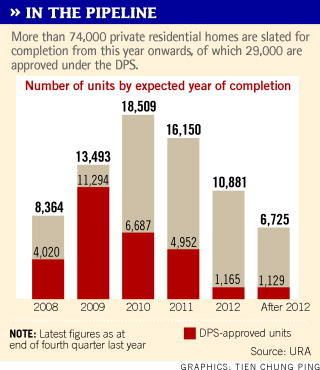
This has been the question on market watchers' lips since the Urban Redevelopment Authority (URA) revealed last week that as many as 29,250 homes offered under the DPS, including 5,760 unsold units as at the end of last month, will be completed from this year to 2013.

The concern is that speculators who bought homes under the DPS could dump their units at below-market prices, and this could drastically drag down overall sentiment.

But just how many units are at risk of being sold, and how big will the impact be?

The URA said while it has the number of units approved under DPS, it does not have data on how many units were actually sold under the scheme.

But four property experts The Straits Times spoke to estimated that up to 30 per cent of homes sold under the scheme last year could be held by speculators who may offload homes as the completion date nears. This translates to roughly 4,200 homes, going by a back-of-the-envelope calculation.

That is because out of the 23,490 units approved under the DPS and sold, only about 50 to 60 per cent - or roughly 14,000 - are likely to have been sold under the DPS, say property consultants and agency bosses from Knight Frank, Savills Singapore, HSR Property Group and PropNex.

The remaining 40 to 50 per cent were not bought under the DPS. Either developers did not eventually offer it, or buyers chose to pay via progressive payments, because buying a home with DPS usually means a further 2 to 3 per cent added to the price.

Next, property experts estimated that of the 14,000 or so homes sold under the DPS, about 20 to 30 per cent were probably sold to short-term investors or speculators.

This means that as a group, speculators could be holding on to as many as 4,200 units.

Why are speculators prone to selling their units as they near completion?

The DPS allowed buyers to pay just 10 or 20 per cent of the sale price upon purchase, with the rest due only when the unit received its temporary occupation permit (TOP) on completion.

Speculators would, therefore, typically opt for the DPS and hope to sell their units for a profit before the TOP. Any later and they would have to pay up for their homes by arranging for bank loans or other means of financing.

Industry experts were, however, divided on the impact these 4,200 homes would have on the market.

Some maintained that panic selling is not likely, given Singapore's strong economic outlook, which is backed by upcoming mega projects such as the integrated resorts and the 2010 Youth Olympics.

Mr Eric Cheng, HSR's executive director, noted that homes set to be completed this year and next are less likely to be sold indiscriminately, since their owners are probably sitting on healthy gains.

But those who bought at the peak of last year's buying frenzy, from April till October, are most likely to be at risk. These homes are likely to be completed after 2010.

Mr Ku Swee Yong, Savills' director of business development and marketing, said the sell-off will likely be staggered, because investors have different levels of holding power.

Also, investors have bigger coffers compared to the last property peak in 1996, he added.

But he warned that if too many units in a single large project get dumped at below-

market prices, overall market sentiment may be hit.

Mr Colin Tan, Chesterton International's head (research and consultancy), thinks that the potential risk created by the DPS is relatively high.

He added that data on homes sold under the DPS should be collected and made public, so investors know 'what they're getting themselves into'.

The DPS was scrapped abruptly last October after a decade-long run to remove excessive speculation and ensure financial prudence in the property market.
 

jq75

Honorary Member
Joined
Dec 5, 2000
Messages
142,972
Reaction score
4,972
April 23, 2008
Flaw in en-bloc mediation process
IN A collective property sale, minority objectors create uncertainty, resulting in hardship for the 80 per cent majority owners, as follows:


They cannot commit to a new home and property prices may rise against them;

They may commit to a new home but are unable to get the sales proceeds to pay for the new property;

They lose interest on the sales proceeds (which may be a substantial amount) while the minority holds out; and

They are unable to rent at market rates because of the long sale process.
To add insult to injury, under the mediation process, minority objectors are legally allowed to negotiate with buyers for higher compensation, which can run into millions of dollars.

When successful, such payments to minority objectors are kept 'strictly confidential'.

As the law should be equal for all Singaporeans, the authorities should remove this legal loophole by abolishing the mediation process. Objectors should object on the grounds of whether the sale process is fair, transparent and handled in good faith. There must be transparency in the legal system.


Ong Boot Lian (Mdm)


--------------------------------------------------------------------------------


'I think 99 per cent, as she suggested, is too high. Perhaps 90 per cent is more reasonable.'
MR WILLIAM TAY, responding to Ms Susan Prior's suggestion to increase the percentage required before a collective property sale can be approved. The current rate is 80 per cent
 

jq75

Honorary Member
Joined
Dec 5, 2000
Messages
142,972
Reaction score
4,972
April 22, 2008
Buyers, sellers call off collective sale of Finland Gardens
Both sides decide to let deal die; developer said to be bearing most of legal costs

By Joyce Teo
ANOTHER collective sale has fallen through. This time, however, there were smiles all around - a reflection of how sharply sentiment has changed in the property market.
Both the majority sellers at Finland Gardens in Siglap and the intended buyer, Sing Holdings, agreed yesterday it would be best to just let the deal die. And the minority sellers, who were against it from Day One, were thrilled.

The sellers rung the death knell when they halted a High Court appeal yesterday.

They went to court last year to overturn a Strata Titles Board (STB) decision made in November last year.

The STB had thrown out the $49.5 million sale, ruling the deal lacked 80 per cent approval and that the price had not been obtained in good faith.

Sing Holdings initially backed the court appeal but withdrew yesterday its application to intervene in the appeal.

Managing director Lee Sze Hao said Sing Holdings told the sellers late last week that Sing Holdings no longer wanted them to continue with the appeal.

'The key determining reason for us is the uncertainty of the timing of the sale and market conditions,' said Mr Lee.

He added that the sale had dragged on for a long time and, considering market uncertainties ahead, it did not make sense to continue waiting.

The Sing Holdings statement said it considered uncertainties over the time needed to procure the order for the sale and market conditions, coupled with the rising costs of construction.

The sellers from 40 units met on Saturday. 'We agreed to the buyer's request to call off the deal amicably,' sales committee chairman Song Koon Poh told The Straits Times. 'Current market prices for our estate are still favourable... and the long waiting time has worn everyone down.

'We don't know how long this will drag on. Assuming the appeal is successful, we will need three months for final completion and another six months to vacate.'

The developer is said to be bearing most of the legal costs.

The minority owners, who fought hard against the sale and won the STB decision last year, were happy that it was over.

The deal for the freehold estate, with 48 units of walk-up flats, is now off. The move comes amid a flat market for private homes, with both buyers and sellers now cautious.

Sing Holdings bought the 98,309 sq ft Finland Gardens for $504 per sq ft on the land area in November 2006, just before prices surged in the first half of last year.

When the estate was launched for sale in July 2006, the owners were hoping for between $50 million and $55 million.

Meanwhile, Sing Holdings has completed the purchase of two collective sale sites - Bellerive and Hillcourt Apartments. Both are at the demolition stage.

joyceteo@sph.com.sg
 

jq75

Honorary Member
Joined
Dec 5, 2000
Messages
142,972
Reaction score
4,972
April 25, 2008
FEES UNPAID FOR 10 YEARS, OWNERS UNCONTACTABLE, SO...
Condo unit to be auctioned off to recover money owed

By Joyce Teo
AN UNUSUAL auction of an apartment worth over $1 million is scheduled for next week - after the mysterious disappearance of the owners.
The three-bedroom unit at King's Mansion off Tanjong Katong Road has been vacant for more than 10 years.

Repeated attempts by the condo's management corporation (MC) to get in touch with the owners and their lawyers have failed.

The four owners, all foreigners, owe possibly $30,000 or more in maintenance fees.

So the MC is taking the rare step of putting the flat up for sale to recover the money without the owners' cooperation. The auction is set for next Wednesday.

Little information is available about the owners but it is believed they are Malaysians.

Although MCs are legally able to seize the property of debtor owners, such action is rare as few want to take action against their neighbours, property consultants say.

But this case is unusual as the owners have been absent from the freehold unit for so long - even ignoring the recent property boom.

The guide price for the 1,604 sq ft high-floor unit is about $1.1million to $1.2 million, said auctioneer Mary Sai of Knight Frank, which is conducting the auction. She said numerous attempts by the MC to get in touch with the owners and their lawyers had failed.

It is not known how much is owed by the owners as the MC has refused to comment.

But based on the condo's current fees, it could be up to $35,000 over 10 years - not counting interest.

MCs are permitted to lodge a charge against an owner's property if contributions are unpaid for more than 30 days after they have served a written notice of demand, said lawyer Vijai Parwani. They then have the authority to sell the property as if they were a registered mortgagee, he said.

If the owner wants to sell his property, he would not be able to complete the sale until the debt is settled.

MCs can also go to court or the Small Claims Tribunal to recover outstanding contributions. If owners still refuse to pay, the MCs can get a writ to seize and sell some household items to pay the debt, he said.

If the debt exceeds $10,000, the MC can apply to make the owner a bankrupt.

No matter what, seizing a defaulter's property for sale is absolutely the 'last resort', said Mr Raymond Choo, executive director of Chesterton International's property, assets and facilities management department.

It is a 'tedious and costly' process, he said.

It involves upfront costs, getting a resolution for the sale, doing a property valuation and engaging an auctioneer.

'There are other ways you can use before you resort to the power of sale,' he said.

Property consultants say they have not heard of any such cases recently as owners usually appear when threatened with a sale.

Ms Sai says the MC of Pandan Valley tried to put a unit up for auction a few months ago, but the owner appeared and paid up before the sale could happen.
 

jq75

Honorary Member
Joined
Dec 5, 2000
Messages
142,972
Reaction score
4,972
Cracks forming
Water Seeping
Paint peeling


Court awards condo owners more than $200,000 after 6-year battle. But it's not over...
WATER from the common roof had seeped into the walls of the two condominium units.
By Arul John

25 April 2008
WATER from the common roof had seeped into the walls of the two condominium units.

The paint was peeling, the walls were stained and cracks were appearing.

The damage in one unit was so bad that the tenant ended her rental agreement and moved out.

A married couple who own the two apartments at Harbour View Towers took the management corporation (MC) to court when the problem persisted after their complaints.

Mr Cheng Fu Zay and Madam Lai Foong Har sued for damages such as loss of rental income, surveyors and valuers' fees and assessment costs.

After a six-year tug-of-war, the couple were awarded more than $200,000 in damages last week.

The couple's units - one on the 29th storey and another on the 30th in the same block - were rented out.

The couple discovered that water had seeped into the walls of both apartments because the common roof was poorly waterproofed, court documents stated, but it is not known when they discovered them.

The waterproofing contractor, Scott Vickers Engineering (SV), had given a 10-year warranty on the common roof. The condo was built in 1994.

COUPLE FILED CLAIM

Mr Cheng and Madam Lai filed a claim against the MC in March 2002 - two years before the waterproofing warranty expired.

They wanted the MC to waterproof the roof again and claimed damages.

At first, both sides tried mediation. But after 1 1/2 years, they were still in a deadlock.

In July 2005, the case ended up in the Subordinate Courts, with the waterproofing contractor named as a third party.

Both the MC and the waterproofing contractor admitted that the couple were liable to claim.

The MC then sued SV to re-waterproof the roof, which the latter finally did in November that year.

In April last year, the court ordered the MC to pay the couple damages of more than $300,000, which included loss of rental income of more than $200,000.

MC APPEALED

But the MC felt it should not have to pay and appealed.

Mr Cheng and Madam Lai also appealed to the Subordinate Courts for a higher amount for their 29th-storey unit, for which they were originally awarded about $125,500.

The judge dismissed their appeal and ruled that they were not entitled to claim for loss of rental income.

The MC was ordered to pay them only about $16,000 for both units combined, excluding interest.

COUPLE APPEALED

The MC agreed to pay this amount, but the couple appealed to the High Court last September.

They wanted to reclaim the earlier award of close to $100,000 for the loss of rental income for their 30th-storey unit, where the tenant moved out because of its condition.

They also wanted an extra of some $430,000 for the loss of rental income for the other unit, repair costs to both units, surveyors' and valuers' fees and interest.

Last week, the High Court ruled that the couple's claim for loss of rental income was reasonable.

Justice Woo Bih Li said that the damage made the 30-storey unit 'uninhabitable'.

The leakage had caused the staining, peeling, cracking and discolouration of the walls in three bedrooms, the living and dining rooms and the common toilet.

So much so the tenant was forced to terminate her rental agreement in January 2003. She had earlier sent two letters of complaint to the MC.

For the 29th-storey unit, the water that leaked into it had stained and discoloured the ceiling board and walls in one bedroom, and also damaged its doorframe.

But, Justice Woo added, the damage in this unit was not as bad. It was still in liveable condition and the tenant ended his tenancy because he had been posted overseas.

Justice Woo also noted that since the MC had re-waterproofed the common roof in November 2005, the earlier award for loss of rental income should be reduced.

The owners had earlier claimed they did not know about the re-waterproofing work until April 2006. So they did not rent out the units until after August that year as a water-flooding test had to be conducted first before the units could be rented out.

Justice Woo eventually awarded the couple about $170,000 for loss of rental income, about $14,000 for repair costs and surveyors' and valuers' fees, and $70,000 in assessment costs and interests.

On the MC's argument that the couple should not be compensated for loss of rental income, Justice Woo said the issue was whether the units could have been rented to paying tenants and if the owners could have got a rental sum at the full market rate.

He said: 'The MC had only itself to blame. It knew about the water seepage problem and that its own expert(s)... had recommended that the common roof be re-waterproofed.'

Instead, the MC had relied on its contractor and the warranty conditions to take remedial action, but there were delays.

MC APPEALING

The MC is appealing against the decision.

Mr Cheng and Madam Lai declined comment when contacted by The NewPaper.
 

jq75

Honorary Member
Joined
Dec 5, 2000
Messages
142,972
Reaction score
4,972
April 25, 2008
Home prices rise more slowly in quiet market
By Fiona Chan
THE property market may have gone quiet, but home prices continued their steady climb in the first three months of this year, albeit at a much weaker pace.

Private home prices rose 3.7 per cent between January and March, down from 6.8 per cent growth in the previous three months.

It was also notably lower than the 4.2 per cent rise that had been predicted early this month, based on transactions in the first 10 weeks.

This suggests that prices may have started to decline last month, dragging down the whole quarter's growth.

Experts suggested that private home prices could be holding partly because developers are putting off project launches, creating a perceived lack of supply of new homes.

Developers had 10,239 new units ready for sale in the first quarter that were not launched - that is a three-year high and 3,000 more than in the previous quarter.

The number of units actually launched in the quarter - 1,343 - was the lowest in almost four years.

Almost half of these unlaunched units were in the core central region, comprising the prime Districts 9 to 11, the Marina Bay area and Sentosa.

The rest was evenly divided between the city-fringe and suburban regions.

Mr Ku Swee Yong, director of business development and marketing at Savills Singapore, said developers may not be delaying launches to deliberately prop up prices but rather to wait out the weak market sentiment and uncertain global outlook.

Whatever the reason, the lack of launches has forced homebuyers to turn to the secondary market, where they bought 2,304 units in the quarter - three times more than what they bought directly from developers.

This shows there is still an underlying demand for homes, and may have helped sustain prices at current levels, analysts said.

The slowdown affected private homes in all areas, from prime to suburban regions. Each region saw prices rise only 3 to 4 per cent, from 7 to 8 per cent the previous quarter.

Sub-sales - this is when a person buys an uncompleted home and then sells it again before it is built - made up a tenth of all sales.

In the case of public housing, resale prices rose 3.7 per cent in the first quarter, down from 5.7 per cent previously. But sales dropped 6 per cent to 6,360 transactions.

Apart from housing, the sluggish market also depressed growth in the prices and rentals of all types of properties, with office prices logging the biggest slowdown.

They rose only 1.1 per cent in the first quarter compared with 8 per cent in the previous three months.

This could be because buyers of office properties tend to be institutional and foreign investors, who have been harder hit by the global credit crisis, said Mr Chua.

But office rentals stayed strong, as businesses continued to expand and space remained tight.
 

jq75

Honorary Member
Joined
Dec 5, 2000
Messages
142,972
Reaction score
4,972
April 26, 2008
Home prices rise more slowly in quiet market
Lower-than-forecast 3.7% growth could signal start of decline


weakergrowth.jpg


By Fiona Chan
THE property market may have gone quiet, but home prices continued their steady climb in the first three months of this year, albeit at a much weaker pace.
Private home prices rose 3.7 per cent between January and March, down from the 6.8 per cent growth in the previous three months.

It was also notably lower than the 4.2 per cent rise that had been predicted early this month, based on sales in the first 10 weeks.

This suggests prices may have started declining last month, dragging down the whole quarter.

'Price growth is starting to weaken severely and the volume of transactions has halved,' said Mr Chua Yang Liang, Jones Lang LaSalle's head of South-east Asia research.

'The rate of increase in coming quarters is likely to be even slower and prices may peak in the third or fourth quarter.'

Observers have suggested that private home prices could be holding partly because developers are putting off project launches, thus curbing the supply of new homes.

Developers had 10,239 new units ready for sale in the first quarter that were not launched - that is a three-year high and 3,000 more than in the previous quarter.

The number of units actually launched in the quarter - 1,343 - was the lowest in almost four years.

'There's a lot of supply but it hasn't been released into the market yet, and that could be one reason why prices are still growing,' said Mr Nicholas Mak, director of research and consultancy at property firm Knight Frank.

Almost half of these unlaunched units were in the core central region, comprising the prime districts 9 to 11, the Marina Bay area and Sentosa. The rest were evenly divided between the city-fringe and suburban regions.

Mr Ku Swee Yong of Savills Singapore said developers may not be delaying launches to deliberately prop up prices but, rather, to wait out the weak market sentiment and uncertain global outlook.

Whatever the reason, the lack of launches has forced buyers to turn to the secondary market, where they bought 2,304 homes in the quarter - three times what they bought directly from developers.

This shows there is still an underlying demand for homes, and may also have helped sustain prices at current levels, analysts said.

The slowdown affected private homes in all areas, from prime to suburban regions. Each region saw prices rise only 3 to 4 per cent, from 7 to 8 per cent the previous quarter.

Sub-sales - this is when a person buys an uncompleted home and then sells it again before it is built - made up a tenth of all sales.

In the case of public housing, resale prices rose 3.7 per cent in the first quarter, down from 5.7 per cent previously. But sales dropped 6 per cent to 6,360 transactions.

The median cash-over-valuation amount - the portion of a flat's price that buyers have to pay in cash - dipped slightly to $21,000. This shows that buyers are starting to resist having to fork out too much cash for HDB flats, especially since valuations have climbed recently.

All other types of properties also saw lower growth, with office prices logging the biggest slowdown. They rose only 1.1 per cent in the first quarter, down from 8 per cent in the previous three months.

But office rentals stayed strong, as businesses continued to expand and space remained tight.
 

jq75

Honorary Member
Joined
Dec 5, 2000
Messages
142,972
Reaction score
4,972
April 26, 2008
Developers hold off launches in quiet market
Number of private flats that have not been launched hits three-year high

By Joyce Teo
DEVELOPERS are so gun-shy of the quiet property market that they are continuing to hold off launching units, creating fears of a supply glut and possible price slump.
The pool of unsold, uncompleted private flats that can be launched for immediate sale rose by more than 3,000 units in the first quarter of this year.

This brings the number of such units to 10,239, a three-year high, according to Urban Redevelopment Authority figures released yesterday.

Of the 10,239 unlaunched flats, 4,824 units were in the core central region, which includes districts 9, 10 and 11. These are areas with high-end properties - the very sort facing lacklustre demand now.

Things are even worse in the rest of the central region, where the number of unlaunched units rose by 77 per cent to 2,934 in the first three months.

High-end projects that have not been launched include Marina Bay Suites, Sentosa Quayside and Nassim Park Residences.

CBRE Research expects more suburban launches this quarter as developers focus on mass market projects.

Developers on the whole remain wary of new launches, said Dr Chua Yang Liang, Jones Lang LaSalle's head of research for South-east Asia.

But there was significant growth in suburban areas, where 813 units - or 60.5 per cent of total launches - were released in the first quarter. Yet demand was weak.

'This could result in a supply overhang that may encourage a more conservative approach by developers in the next quarter,' said Dr Chua.

The industry uses launches to sell units to generate cash flow. Big developers have the resources to hold on for years if the market is flat, but smaller firms may be under pressure to sell at lower prices.

Mr Nicholas Mak, Knight Frank's director of research and consultancy, said that if sales volume remains thin, more small developers will likely cut prices of their projects to improve cash flow, but the impact of their action may be lost on the market because of their size.

But big-name developers able to launch units may not do so until the United States sub-prime crisis eases, said Mr Ku Swee Yong from Savills Singapore.

Major developers such as Wheelock Properties, Far East Organization, City Developments and Keppel Land have, in the past, been willing to hold back their launches for several years, he added.

Take Far East. It topped up the lease of its 99-year leasehold property, Orchard Scotts, while it delayed the launch several years ago.

While the quarter was flat, there was naturally some sales activity. Developers sold 762 new homes in the first quarter, but that was one of the smallest numbers in 12 years.

By the end of the first quarter, there were 2,526 flats that had been launched but remained unsold. These could include units launched several months ago.

In the pipeline are another 29,920 units that have yet to obtain a sales licence

The vacancy rate of private homes has also been rising steadily since the second quarter of last year, when it was at a low of 4.9 per cent. It hit 6.3 per cent in the first quarter.

Developers sell about 8,000 homes a year. If their inventory of unsold private homes exceeds 17,000, it could indicate a supply glut, said Mr Mak.

We are not anywhere near that point, he added. But it is now a stand-off. Buyers are waiting for prices to fall while sellers are waiting for buyers to return.

But Mr Ku said that unless developers flood the market, which they are not expected to, the significant increase in stock is not a real concern.
 

jq75

Honorary Member
Joined
Dec 5, 2000
Messages
142,972
Reaction score
4,972
April 27, 2008
Goodbye, en bloc sales
By Teo Cheng Wee

Pender Court. Finland Gardens. Tulip Garden. Makeway View. These were all attempts to sell an estate en bloc which fell through, all within this month.
But even as the en bloc fever cools, not all the affected residents are getting hot under the collar. Many told The Sunday Times that they were disappointed to miss out on a good price, but were happy to stay put.

It was reported last Friday that the sale of Pender Court, off West Coast Highway, had fallen through. Others reported include Finland Gardens in Siglap on Tuesday; Tulip Garden in Holland Road on April 9; and Makeway View in the Newton area on April 1.

Italian expatriate Lucia Omodei, 43, who has lived at Tulip Garden for six years, said: 'We looked elsewhere in case we had to move out, but we didn't find anything this ideal. Besides, we would miss our neighbours.'

A fellow resident, music teacher Y.C. Lee, 75, saw the bright side in the 'consolation hongbao' he received, a $120,000 payout which was his share of the $25 million deposit that the buyer forfeited.

The unhappy ones are most likely those who had bought another house and now face financing issues.

The Sunday Times spoke to residents in some of the failed en bloc estates to find out how their lives have been affected.
 

jq75

Honorary Member
Joined
Dec 5, 2000
Messages
142,972
Reaction score
4,972
April 27, 2008
property
What if my condo's en bloc sale fails?


Defaulting parties stand to lose their deposits and can be sued for non-completion of the sale; it's also risky to buy a new home before a collective deal is closed
By Joyce Teo
Some owners of condominium units may still be keen on selling en bloc, but developers' interest in collective sale sites has more or less dried up.
No residential sites have been sold en bloc in recent months. And given the market uncertainty these days, completion may not be a given for sites that have been sold.

Several collective sales have fallen through, with a few - Tulip Garden, Makeway View, Finland Gardens and Pender Court - already axed, regardless of whether approval from the Strata Titles Board (STB) was obtained.

A collective sale requires an 80 per cent minimum consent from owners before it can be sold. Unless there is unanimous consent, owners will have to get an order from the STB for the sale after they find a buyer.

After getting the order, they will have to wait for the buyer to complete the sale, which is when they will get their sale proceeds.

They have six months after the sale completion date to move out of the property.


The Sunday Times takes a look at what happens if your collective sale deal falls through.


If the STB throws out your sale

The onus is on the majority owners - those who have signed off on the sale - to obtain the STB order.

'If they do their part and get the STB order, they are not in breach of contract,' said Credo Real Estate's managing director, Mr Karamjit Singh.

If they cannot get the STB order, they have failed to fulfil their part of the sale agreement with the buyer. The buyer can thus take back his 5 per cent deposit, a sum he had to pay when he inked the deal.

Most sale and purchase agreements have a standard provision that stipulates that if the purchase fails to be completed, the deposit or option money will be forfeited.

The buyer can also ask the majority owners to appeal against the STB decision in the High Court, said Mr Singh.

If they are not satisfied with the High Court decision, they can proceed to the next and last level, the Court of Appeal.

This is where the Airview Towers case went. The Court of Appeal overturned the High Court's decision to reject the sale, putting the case back in the STB's court.

In another collective sale, that of Finland Gardens, the buyer and sellers decided to withdraw their case in the High Court and terminate their agreement.

But as the sale had been thrown out by the STB, the developer remained entitled to keep its deposit.

It was a unique situation, and both sides negotiated on the terms, with the developer agreeing to bear most of the costs such as the litigator's fees and advertisement costs.


If the buyer defaults on the deal

Whether owners can or cannot get back some money depends on which party is the one which has not fulfilled the contract.

Last year, developers were frantically buying sites and pushing to complete them.

But as the market slowed this year, it has so far seen a buyer, Bravo Building Construction, let go of three collective sale deals - Tulip Garden, Makeway View and Pender Court.

As it was the buyer that did not fulfil its part of the agreement to buy Tulip Garden for $516 million, it had to forfeit its 5 per cent deposit of $25.8 million.

The same developer also did not go ahead with the purchase of Makeway View and had to forfeit its option deposit of 1 per cent.

Owners from the 48-unit Pender Court got to keep the buyer's 10 per cent deposit of $8 million, as well as a $4 million payment for granting a deadline extension. They had negotiated for an additional payment of $4 million to extend the deadline as the buyer had missed the completion deadline.

'If the buyers default, sellers can sue them if the sale and purchase agreement does not contain a clause that limits the buyer's liability to forfeiture of the deposit,' said Mr Henry Heng, a director from law firm Tan Peng Chin LLC.

Or they could sell to another buyer and then go after the original buyer for the losses incurred, if any, again provided the agreement does not have the above clause.

While going after the buyer may sound logical to some, it depends on whether the company has enough funds to pay up, property consultants said.

Few would consider it as developers usually create shell companies for their property purchases, said DTZ executive director, consulting & research, Mrs Ong Choon Fah.


If you have committed to a property purchase

Last year, many owners bought replacement properties way before their collective sales were completed, in an attempt to beat the rising market.

This can get tricky. If the collective sale fails, the owners are basically left to their own devices. The risk is certainly much greater if the owners are dependent on the sale proceeds to finance their new property.

'It's a commercial risk, which is why property consultants and lawyers always advise owners not to take the risk,' said Mr Singh.

All collective sellers have a six-month rent-free period after the completion of their collective sales, during which they can safely source for a property.

While it is uncommon, an owner could try to negotiate a deal with the seller of the new property where it becomes a done deal only if his estate's collective sale is completed, said Mr Singh. The other party may agree if he is offered a higher price, he said.
 

jq75

Honorary Member
Joined
Dec 5, 2000
Messages
142,972
Reaction score
4,972
April 27, 2008
FINANCIAL QUOTIENT
When do I have to pay stamp duty?

Where do you see this?

Mostly when you sign a sale & purchase agreement, an option to purchase or a tenancy agreement.
What does it mean?

Stamp duty is a tax you pay for the stamping of documents relating to properties and shares, for instance, leases or mortgages.

Property buyers are required to pay stamp duty based on the transacted price of the property or its market value, whichever is higher. The duty must be paid within 14 days of the date of execution if the document is signed in Singapore.

Why is it important?

Stamp duty is a substantial payment that buyers have to consider before they buy a property.

Penalties are imposed on you if the documents are stamped late or if the duty is underpaid. Also, the court considers only stamped documents as evidence.

So you want to use the term. Just say...

'If I get a stamp duty rebate, I can get that cabinet I always wanted.'
 

jq75

Honorary Member
Joined
Dec 5, 2000
Messages
142,972
Reaction score
4,972
Dignity, please

Replace 'majority wins' rule with consensus-seeking in the en bloc process


Monday • April 28, 2008

Letter from Jeannette Chong Aruldoss

As a citizen of a progressive and global nation, I thought no one would be allowed to sell property that was not legally theirs, until my estate came under threat of an en bloc sale. En bloc laws, extant since 1999, empower and facilitate my neighbours to sell my home against my will and even without my signature.

Although the Singapore Constitution contains no specific clause assuring protection of one's property rights, it is natural for a citizen of any country to expect their government to safeguard his or her property, along with his or her life and liberty.

Lately, the public has witnessed minority owners going to great lengths to defend their homes from en bloc sales. Perhaps their determination is an expression of an individual's inborn unwillingness to be forced to give up what is rightfully his.

Pre-1999, compulsory land acquisition was done only by the Government for public purposes. In an en bloc sale, the need to optimise land use in land-scarce Singapore is the justification for denying one's property rights.

But commercial interests may be served more than any. Increasingly, redeveloped estates are offering luxury condos that few Singaporeans can afford. Developers seem to be the real winners.

If indeed en bloc laws are meeting their policy objectives, then they do so at an incalculable social price. When 100 per cent consent was done away with, the stage was set for the current controversies — the spate of court cases, misbehaviour at general meetings, breakdowns of relationships between neighbours — all of which surely outweigh the benefits of an en bloc.

Pitting neighbours against each other to win a majority percentage to their side is a perverse application of the democratic process.

With news that en bloc laws will be reviewed, I appeal to the Ministry of Law to take this opportunity to consider replacing the antagonistic "majority wins" rule with a consensus-seeking process.

Currently, owners' concerns are largely sidelined if they comprise the minority. The Strata Titles Board steps in as mediator-arbitrator only after a buyer is found.

Instead, the en bloc process could begin with platforms for owners to voice their concerns, define common goals, identify problems, with extended use of mediation, negotiation and arbitration to resolve disagreements, all before finding a buyer.

The community-focussed, consensus-seeking approach may take longer, but the end result will be more satisfactory and dignified for all parties concerned, and certainly less traumatic.

This letter was also signed by 13 others.
 

jq75

Honorary Member
Joined
Dec 5, 2000
Messages
142,972
Reaction score
4,972
For his daughters, he fought en bloc battle alone

Weekend • April 26, 2008

Ansley Ng
ansley@mediacorp.com.sg

IT HAS been his home for about 30 years, one he bought with his late parents. His two daughters attend school close by and they have pleaded with him not to sell the apartment.

His is a familiar dilemma for minority dissenters caught up in en bloc deals across Singapore. Some have, like him, fought determinedly to cling to their homes.

But in one respect, 52-year-old business consultant Ken Lee has gone where none has yet.

Single-handedly, he has taken his case against the $202-million sale of Airview Towers to the authorities and won it twice. Each time, the father of two, who has had no legal training, represented himself.

Then on Thursday came a reversal of fortune that left him bewildered.

After both the Strata Titles Board (STB) and the High Court threw out the sale of the drab, 100-unit estate on River Valley Road — on a technicality — the Court of Appeal overturned the lower court's decision and threw the case back to the STB.

He has also been ordered to pay his opponents' legal costs for the STB, High Court and Court of Appeal hearings. Today understands this amount, to be decided in court, could be anywhere from $150,000 to $300,000.

"I am confused and disappointed, but I will take it in my stride," Mr Lee told Today.

During an hour-long chat on Friday at a cafe, Mr Lee — who was initially reluctant to be interviewed — seemed guarded and declined to be photographed.

Mr Lee, who travels frequently for work, had bought the apartment at Airview Towers some three decades ago. He now lives there with wife and two daughters, who are in Secondary 1 and 4.

He told Today his decision to fight the en bloc sale was partly about fulfilling a vow to his children.

"They said: 'Papa, if you sign, we'll throw rotten tomatoes at you.' They know I am keeping my promise to them," he said. "For me, it's a home. I lived there with my parents for a long time before they passed on."

A pragmatist, he had originally decided that if 80 per cent of the owners agreed to the sale, he "wouldn't go against it, since that is the law".

And so sure was he that this consent would be obtained that he shopped around for a new home and bought a "replacement unit" in April last year, which he renovated. He is now leasing out the new place.

So, why did he lodge an objection? Because he felt the proper application process "had not been followed" (see box).

Why not rally the other minority dissenters behind his cause?

"I don't rope people. If they come and support, I am thankful," he said.

Mr Lee said he has not decided if he would engage a lawyer for the next STB hearing, saying that it would add to his legal costs should he lose again.

So far, he says, he has experienced no animosity from the other residents, many of whom — like Mr Lee — have already bought new homes.

Many neighbours are still friendly, he said, although there were a few "unhappy that their plans were not working out".

Had the sale gone according to plan, they should all have moved out this month.

Said Mr Lee: "If they had done everything properly, this is the time everyone would be shaking hands and saying their goodbyes."

THE Airview SAGA

Last July, Mr Lee filed an objection to the sale, saying due process was not followed.

The sale committee had applied for the estate to go en bloc after the legal quota of 80 per cent of signatures was attained. Listed property player Bukit Sembawang, which won the site tender, was planning a 36-storey condominium project.

But then Mr Lee found that two of the units had changed hands during the one-year period given for residents' assent to be garnered – and the new owners had not signed the collective sale agreement in time.

The STB voided the en bloc application as the two new owners could not be included in the consensus that had expired; their consent was needed for the sale to proceed. The majority owners appealed, but the High Court dismissed their case on the same grounds.

On Thursday, the Court of Appeal overturned that decision – ruling that the order of sale would apply as long as 80 per cent of signatures in assent were garnered within 12 months. This is to avoid the deal being complicated should owners change their minds and transfer ownership.

The plaintiffs are represented by Senior Counsel Harry Elias, Foo Soon Yien and Toh Wei Yi of Harry Elias Partnership.
 

jq75

Honorary Member
Joined
Dec 5, 2000
Messages
142,972
Reaction score
4,972
April 25, 2008
FEES UNPAID FOR 10 YEARS, OWNERS UNCONTACTABLE, SO...
Condo unit to be auctioned off to recover money owed

By Joyce Teo
AN UNUSUAL auction of an apartment worth over $1 million is scheduled for next week - after the mysterious disappearance of the owners.
The three-bedroom unit at King's Mansion off Tanjong Katong Road has been vacant for more than 10 years.

Repeated attempts by the condo's management corporation (MC) to get in touch with the owners and their lawyers have failed.

The four owners, all foreigners, owe possibly $30,000 or more in maintenance fees.

So the MC is taking the rare step of putting the flat up for sale to recover the money without the owners' cooperation. The auction is set for next Wednesday.

Little information is available about the owners but it is believed they are Malaysians.

Although MCs are legally able to seize the property of debtor owners, such action is rare as few want to take action against their neighbours, property consultants say.

But this case is unusual as the owners have been absent from the freehold unit for so long - even ignoring the recent property boom.

The guide price for the 1,604 sq ft high-floor unit is about $1.1million to $1.2 million, said auctioneer Mary Sai of Knight Frank, which is conducting the auction. She said numerous attempts by the MC to get in touch with the owners and their lawyers had failed.

It is not known how much is owed by the owners as the MC has refused to comment.

But based on the condo's current fees, it could be up to $35,000 over 10 years - not counting interest.

MCs are permitted to lodge a charge against an owner's property if contributions are unpaid for more than 30 days after they have served a written notice of demand, said lawyer Vijai Parwani. They then have the authority to sell the property as if they were a registered mortgagee, he said.

If the owner wants to sell his property, he would not be able to complete the sale until the debt is settled.

MCs can also go to court or the Small Claims Tribunal to recover outstanding contributions. If owners still refuse to pay, the MCs can get a writ to seize and sell some household items to pay the debt, he said.

If the debt exceeds $10,000, the MC can apply to make the owner a bankrupt.

No matter what, seizing a defaulter's property for sale is absolutely the 'last resort', said Mr Raymond Choo, executive director of Chesterton International's property, assets and facilities management department.

It is a 'tedious and costly' process, he said.

It involves upfront costs, getting a resolution for the sale, doing a property valuation and engaging an auctioneer.

'There are other ways you can use before you resort to the power of sale,' he said.

Property consultants say they have not heard of any such cases recently as owners usually appear when threatened with a sale.

Ms Sai says the MC of Pandan Valley tried to put a unit up for auction a few months ago, but the owner appeared and paid up before the sale could happen.


May 3, 2008
Missing owners' condo unit sold for $1.6m
By Joyce Teo
AN UNUSUAL auction of an apartment at King's Mansion off Tanjong Katong Road has attracted strong bidding - driving up the sale price to $1.59 million, well above expectations.
The condominium's management corporation had taken the rare step of selling the three-bedroom property after the owners had disappeared for more than a decade.

The auction, conducted on Wednesday, came after the foreign owners had failed to pay property fees, which could have run up to $30,000 or more.

The management corporation had tried repeatedly to get in touch with the four owners and their lawyers - but to no avail.

The sale price was considered fairly strong in a generally weak auction market, analysts said.

The starting bid for the freehold 1,604 sq ft high-floor unit was $1.18 million, which was within the guide price of $1.1 million to $1.2 million.

Five bidders chased the price up, with a local businessman succeeding in buying the unit at $1.59 million, said Knight Frank's auctioneer, Ms Mary Sai.

This price works out to about $991 per sq ft (psf), considerably higher than the starting bid of $735 psf.

A somewhat larger unit at King's Mansion, at 1,808 sq ft, sold for $1,106 psf a few months back, according to a caveat lodged in February.

After deducting fees and other expenses, such as costs associated with arranging this week's auction, the management corporation is expected to keep the rest of the money in a trust for the owners.

Mystery surrounds why the owners departed the scene and why they have failed to make themselves known despite publicity prior to the auction.

If they ever do reappear to claim the balance of the sale proceeds, it is likely they will make a tidy profit.
 
Important Forum Advisory Note
This forum is moderated by volunteer moderators who will react only to members' feedback on posts. Moderators are not employees or representatives of HWZ Forums. Forum members and moderators are responsible for their own posts. Please refer to our Community Guidelines and Standards and Terms and Conditions for more information.
Top