
Property News!

jq75

Honorary Member
Joined
Dec 5, 2000
Messages
142,973
Reaction score
4,972
Jan 20, 2009
Home prices still falling, study shows
condo.jpg


By Joyce Teo
HOME prices here largely continued to be eroded at the end of last year, according to early indications.
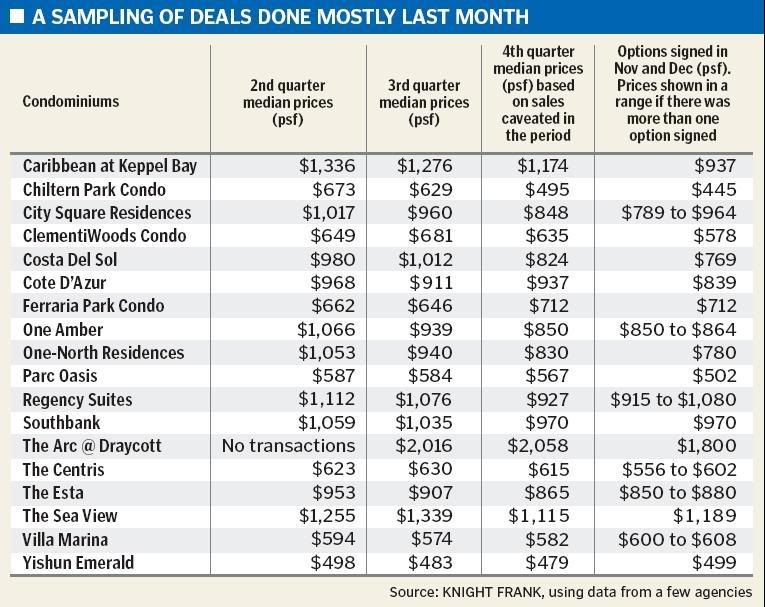
A Knight Frank study of a sampling of property options signed mostly last month showed that the prices of many condominiums fell in a quiet month.

In developments which had registered more than one recent sale, prices fell by 4.6 per cent to 10.9 per cent, it said. However, prices of a few developments remained steady or even rose.

Knight Frank compared individual options of a development with median prices of caveats lodged in the previous three quarters. There may be a time lag for caveats lodged, as lodging a caveat is voluntary, it said.

The consultancy was unable to identify a general trend by locality or wider region as the number of options was limited. Also, the characteristics of a particular unit, such as which floor it is on, can influence prices.

At the 910-unit City Square Residences near Farrer Park MRT station, for instance, prices of recent options signed ranged from lower to largely flat from the third quarter at $789 to $964 per sq ft. While its prices have gradually come down from the second quarter, they were way above the April 2005 soft launch price of $560 psf on average.

Overall, home prices are expected to weaken further in the next three to six months, with a bigger plunge in prices of high-end projects than mass market ones, said Knight Frank director of research and consultancy Nicholas Mak. 'There is a fair bit of latent demand, but these buyers are all waiting to come in at the bottom.'

Individual sellers in the resale market are likely to drop their prices at a faster rate than developers in the primary market, he said.

Home prices will likely continue to fall gradually for a few months, but there is a difference between the previous downturns and this one, said Chesterton Suntec International head of research and consultancy Colin Tan. 'Usually, when prices go down, sales will go up. But now, prices have started to come down, but sales have not improved.'

One possible reason for the low volume is that some investors cannot afford to sell now, said Mr Tan.

If they were to sell low now, they would have to top up their loan in cash, he said, and cash is a scarce commodity in a credit crunch.

The slower the prices come down, the longer the property market recovery will take, said Mr Tan.
 
Last edited:

jq75

Honorary Member
Joined
Dec 5, 2000
Messages
142,973
Reaction score
4,972
Jan 21, 2009
Couple sue realty firm
By Selina Lum
WHEN a married couple sold their downtown apartment for $688,000 in 2007, they thought it was the best deal they were going find.
But soon after they granted the buyer the right to purchase the property, the two-bedroom Keng Cheow Street apartment was re-sold for $945,000.

It was only later that Mr Yuen Chow Hin and Madam Wong Wai Fan found out about the second deal.

They also learnt that the woman who bought their flat - and flipped it for a healthy profit - was married to the boss of their real estate agent.

The couple cried foul, and are now suing ERA Realty Network in the High Court, seeking $257,000 - the difference between the two sale prices - and the return of about $7,3oo in commission.

They allege the company did not try their best to find buyers and made a 'secret profit' off the deal.

ERA disputes that and says the couple have no basis to sue them since the agent was not an employee but an independent contractor.

On Wednesday, the trial entered its third day, with ERA senior vice-president Marcus Chu taking the stand.
 

jq75

Honorary Member
Joined
Dec 5, 2000
Messages
142,973
Reaction score
4,972
Jan 21, 2009
Couple sue realty firm
By Selina Lum
WHEN a married couple sold their downtown apartment for $688,000 in 2007, they thought it was the best deal they were going find.
But soon after they granted the buyer the right to purchase the property, the two-bedroom Keng Cheow Street apartment was re-sold for $945,000.

It was only later that Mr Yuen Chow Hin and Madam Wong Wai Fan found out about the second deal.

They also learnt that the woman who bought their flat - and flipped it for a healthy profit - was married to the boss of their real estate agent.

The couple cried foul, and are now suing ERA Realty Network in the High Court, seeking $257,000 - the difference between the two sale prices - and the return of about $7,3oo in commission.

They allege the company did not try their best to find buyers and made a 'secret profit' off the deal.

ERA disputes that and says the couple have no basis to sue them since the agent was not an employee but an independent contractor.

On Wednesday, the trial entered its third day, with ERA senior vice-president Marcus Chu taking the stand.
 

jq75

Honorary Member
Joined
Dec 5, 2000
Messages
142,973
Reaction score
4,972
Jan 21, 2009
Couple sue realty firm
By Selina Lum
WHEN a married couple sold their downtown apartment for $688,000 in 2007, they thought it was the best deal they were going find.
But soon after they granted the buyer the right to purchase the property, the two-bedroom Keng Cheow Street apartment was re-sold for $945,000.

It was only later that Mr Yuen Chow Hin and Madam Wong Wai Fan found out about the second deal.

They also learnt that the woman who bought their flat - and flipped it for a healthy profit - was married to the boss of their real estate agent.

The couple cried foul, and are now suing ERA Realty Network in the High Court, seeking $257,000 - the difference between the two sale prices - and the return of about $7,3oo in commission.

They allege the company did not try their best to find buyers and made a 'secret profit' off the deal.

ERA disputes that and says the couple have no basis to sue them since the agent was not an employee but an independent contractor.

On Wednesday, the trial entered its third day, with ERA senior vice-president Marcus Chu taking the stand.


Jan 22, 2009
Couple sue agency after buyer flips flat for profit
By Selina Lum


ST_IMAGES_SEERA22C.jpg


WHEN a married couple sold their downtown apartment for $688,000 in 2007, they thought it was the best deal they were going to find.
But soon after they granted the buyer the right to purchase the property, the two-bedroom Keng Cheow Street apartment was re-sold for $945,000.

It was only later that Mr Yuen Chow Hin and Madam Wong Wai Fan found out about the second deal.

They also learnt that the woman who bought their flat - and flipped it for a healthy profit - was married to the boss of their real estate agent.

The couple cried foul, and are now suing ERA Realty Network in the High Court, seeking $257,000 - the difference between the two sale prices - and the return of about $7,300 in commission.

They allege the company did not try its best to find buyers and made a 'secret profit' off the deal.

ERA disputes that and says the couple have no basis to sue it since the agent was not an employee but an independent contractor.

Yesterday, the hearing entered its third day, with ERA senior vice-president Marcus Chu taking the stand.

He denied that the agency earned any secret profits and said that the real estate agent, Mr Jeremy Ang, did nothing wrong.

Mr Chu said ERA agents are required to disclose the identity of the buyer only if that person is the agent or a member of his immediate family.

This was echoed by Mr Ang, who also took the stand.

Mr Yuen, 50, and Madam Wong, 48, hired Mr Ang to sell their apartment at The Riverside Piazza in June 2007. He told them he would advertise the property.

In early July, an offer came for $650,000. After negotiations, the couple granted the buyer, Madam Natassha Sadiq, an option - dated July 12 - to buy the flat for $688,000.

Meanwhile, Madam Natassha's husband - Mr Ang's boss - placed advertisements in the papers to sell the property for his wife.

On July 14, a buyer responded to an ad which asked for $945,106. Four days later, Madam Natassha granted the new buyer an option to buy the flat for $945,000.

Both deals eventually went through.

Mr Yuen and Madam Wong found out about the re-sale only after the Central Provident Fund Board asked them about the disparity between the selling price and the valuation submitted by the new buyer's banker.

Their lawyer, Ms Gan Kam Yuin, argued that ERA made little effort to get the best possible price for the flat.

She questioned why Mr Ang did not place newspaper ads for the couple. Mr Ang said calling up his regular clients, who included Madam Natassha, constituted 'advertising'.

Ms Gan argued that the firm had placed itself in a position of conflict of interest.

But Mr Ang said there was no conflict because the buyer was not himself nor his wife.

Madam Natassha and her husband, Mr Mike Parikh from ERA, are expected to testify today.
 

neolife

Junior Member
Joined
Mar 15, 2005
Messages
70
Reaction score
0
Any one know which show flats are open over the CNY period? Looking at Lavendar area or Amber Road area
 

satayxp

Banned
Joined
May 10, 2004
Messages
151,822
Reaction score
5,156
Jan 13, 2009
Pay-interest-only deal for cash-short home owners
DBS scheme eases borrowers' burden for six to 18 months

By Goh Eng Yeow
HOME owners with mortgages at DBS Bank can ease some of their financial burden by opting to pay only the interest on their loans for periods of up to 18 months.
The bank sees the scheme as a way of helping cash-strapped borrowers who are worried about their ability to repay their mortgages amid the deepening economic gloom.

The scheme could potentially benefit 'tens of thousands' of borrowers with home loans at DBS.

It can mean an immediate reduction in the monthly amount a borrower must fork out as a key portion of the payment - the loan principal - can be set aside.

Take a 25-year home loan of $500,000 pegged at an interest rate of 3.5 per cent.

A borrower will have to pay $2,504 a month - covering both interest and principal.

But by opting to pay the interest only, his monthly payment drops to $1,439, putting an extra $1,065 into his pocket.


So even if a working couple loses one income, which is a growing threat in the downturn, they can likely keep paying their mortgage - and keep their home.

They can also pay the monthly instalment using Central Provident Fund cash if they are only servicing the interest on the loan.

They can resume monthly payments on the principal portion of their loan when their cash flow situation improves.

The periods for paying interest only can extend from a minimum of six months to 18 months.

'The last thing we want to do is to foreclose on people's homes. Come and talk to us early if you have any financial problems,' said Mr Koh Kar Siong, head of consumer deposits and secured lending at the bank, yesterday.

Homeowner Rose Tan, 40, who has a DBS mortgage on her condominium flat, welcomed the move: 'This is a friendly gesture from DBS. At least, I know they won't treat me like a leper if I approach them for help in lowering my housing instalment.'

The flip side is that paying interest-only means you are not paying off any of the loan itself so you will have fallen behind.

DBS is the largest bank here and a key player in the private housing loans market. It is also a big lender to HDB flat-owners through its POSB network.

It has 'tens of thousands' of mortgage borrowers.

To get the go-ahead, a borrower must give the bank an update of details such as employment and other financial commitments.

The scheme is applicable to cash-strapped borrowers as well as those in the pink of financial health.

DBS will advise them within a week if their applications to pay interest-only on their loans has been approved.

Mr Koh said the updates are needed to enable DBS to fulfil its fiduciary duty and ensure that borrowers have the means to repay their loans eventually.

Besides offering interest-only instalments, DBS is extending an option to allow home owners to extend the tenure of their loans, which will lower their monthly instalments.

Mr Koh said there has not been any sharp rise in the number of borrowers asking DBS to alter their loan repayment terms but banks are unlikely to be immune to the economic slowdown.

'About 90 per cent of our home loans are taken up by borrowers who occupy their properties. We want to help them to tide over this difficult period,' he said.

DBS' move has stirred hopes among traders and home owners that by acting in such a pro-active manner, there will be fewer foreclosures and this will help the wobbly property market to get back on its feet eventually.

Banks such as MayBank and OCBC Bank told The Straits Times that they preferred to take a case-by-case approach to assist home owners who have taken up loans with them.

Mr Gregory Chan, OCBC's head of secured lending, said: 'In the event that our customers' needs change during the duration of their loans, we are open to reviewing their financial positions and borrowing limits, and advising them accordingly.'

so as long as the borrower cannot repay can jus keep paying interests? :s22:
 

jq75

Honorary Member
Joined
Dec 5, 2000
Messages
142,973
Reaction score
4,972
Jan 22, 2009
Couple sue agency after buyer flips flat for profit
By Selina Lum


ST_IMAGES_SEERA22C.jpg


WHEN a married couple sold their downtown apartment for $688,000 in 2007, they thought it was the best deal they were going to find.
But soon after they granted the buyer the right to purchase the property, the two-bedroom Keng Cheow Street apartment was re-sold for $945,000.

It was only later that Mr Yuen Chow Hin and Madam Wong Wai Fan found out about the second deal.

They also learnt that the woman who bought their flat - and flipped it for a healthy profit - was married to the boss of their real estate agent.

The couple cried foul, and are now suing ERA Realty Network in the High Court, seeking $257,000 - the difference between the two sale prices - and the return of about $7,300 in commission.

They allege the company did not try its best to find buyers and made a 'secret profit' off the deal.

ERA disputes that and says the couple have no basis to sue it since the agent was not an employee but an independent contractor.

Yesterday, the hearing entered its third day, with ERA senior vice-president Marcus Chu taking the stand.

He denied that the agency earned any secret profits and said that the real estate agent, Mr Jeremy Ang, did nothing wrong.

Mr Chu said ERA agents are required to disclose the identity of the buyer only if that person is the agent or a member of his immediate family.

This was echoed by Mr Ang, who also took the stand.

Mr Yuen, 50, and Madam Wong, 48, hired Mr Ang to sell their apartment at The Riverside Piazza in June 2007. He told them he would advertise the property.

In early July, an offer came for $650,000. After negotiations, the couple granted the buyer, Madam Natassha Sadiq, an option - dated July 12 - to buy the flat for $688,000.

Meanwhile, Madam Natassha's husband - Mr Ang's boss - placed advertisements in the papers to sell the property for his wife.

On July 14, a buyer responded to an ad which asked for $945,106. Four days later, Madam Natassha granted the new buyer an option to buy the flat for $945,000.

Both deals eventually went through.

Mr Yuen and Madam Wong found out about the re-sale only after the Central Provident Fund Board asked them about the disparity between the selling price and the valuation submitted by the new buyer's banker.

Their lawyer, Ms Gan Kam Yuin, argued that ERA made little effort to get the best possible price for the flat.

She questioned why Mr Ang did not place newspaper ads for the couple. Mr Ang said calling up his regular clients, who included Madam Natassha, constituted 'advertising'.

Ms Gan argued that the firm had placed itself in a position of conflict of interest.

But Mr Ang said there was no conflict because the buyer was not himself nor his wife.

Madam Natassha and her husband, Mr Mike Parikh from ERA, are expected to testify today.

Jan 23, 2009
No secret buyer or profit, says property exec's wife
By Selina Lum

ST_IMAGES_SEERA23.jpg


THE wife of a senior property agent who bought an apartment through her husband's subordinate, then quickly sold it for a $257,000 profit, yesterday refuted claims that she had made a 'secret profit' from the deal.
Madam Natassha Sadiq, 40, told the High Court her purchase of the downtown flat from Mr Yuen Chow Hin and Madam Wong Wai Fan was done on a 'willing buyer and willing seller' basis.

Mr Yuen, 50, and Madam Wong, 48, have sued ERA Realty Network to seek profits from the sale and the return of about $7,300 in commission.

They claim their agent did little to market the flat to other buyers, and was in a clear conflict of interest when he sold the unit to his boss' wife.

In a testimony echoed by her husband, Mr Mike Parikh, Madam Sadiq said there was no secret buyer in waiting when she bought the two-bedroom Keng Cheow Street apartment in mid-2007. Mr Parikh is a senior group division director of ERA.

Madam Sadiq said that in early July last year, her husband told her about The Riverside Piazza unit being marketed by his subordinate, Mr Jeremy Ang.

She made an offer of $685,000 as her identity card number started with '685'. She said: 'I know it sounds a bit crazy, but it's from my IC number.'

The price was eventually agreed at $688,000. Madam Sadiq said she was granted the right to buy the flat on July 5 last year, but the couple disputed this date as the option was dated July 12.

Madam Sadiq said she then decided to try to sell the apartment as property prices were then 'roaring'. Two days later, on July 7, the unit was on the market again. This time, it sold for about $945,000.

'At the time, the market was bullish, and we decided to put up this price. We happened to make a bit of a profit,' Madam Sadiq said.

Mr Parikh, 44, took the stand after his wife. He said the first sale to his wife and her subsequent resale were separate transactions. He said his subordinate, Mr Ang, called him up on July 5 to tell him that the sale to Madam Sadiq was a 'done deal'.

The next day, Mr Parikh placed advertisements in The Straits Times for July 7 and July 9. When there was no response, he changed the text, adding 'en bloc potential' in a third ad on July 14.

He admitted that he had not actually heard of any plans to sell units at The Riverside Piazza collectively. 'It's just a common term that agents use because there were a lot of en blocs going on. The possibility is always there,' he explained.

On the same day that he placed the third ad, an interested buyer responded. Four days later, Madam Sadiq granted him an option to buy at $945,000.

It was only later that Mr Yuen and Madam Wong found out about the resale.


ABOUT THE CASE

MR YUEN Chow Hin and Madam Wong Wai Fan have sued property agency ERA Realty Network for breach of contract and misrepresentation.

In July 2007, the couple, through ERA agent Jeremy Ang, sold their apartment for $688,000.

Unknown to them, the buyer, Madam Natassha Sadiq, was the wife of Mr Ang's boss. Soon after she was granted the right to buy the property, Madam Sadiq flipped the flat for $945,000.

Mr Yuen and Madam Wong are now seeking from ERA the price difference of $257,000 and the return of about $7,300 in commission.

They claim the agency did not try its best to find more offers and allege that there was conflict of interest.

ERA says it is not liable for the actions of its agents, who are independent contractors. In any case, says the agency, Mr Ang has not breached its code of conduct.

Lawyers for both sides are to make closing arguments next Thursday.
 

jq75

Honorary Member
Joined
Dec 5, 2000
Messages
142,973
Reaction score
4,972
Jan 24, 2009
Property price slump worsens
Private home prices fall 6.1%; more new projects delayed

By Joyce Teo

THE property slump gathered pace on two fronts late last year with rents moderating and private home prices registering their biggest quarterly fall in a decade.
Developers also continued to delay the completion of new flats as well as office projects as the recession tightened its grip.

Prices slumped 6.1 per cent in the last three months of last year, according to the Urban Redevelopment Authority (URA) yesterday, higher than the earlier estimate of 5.7 per cent.

The slump follows a 2.4 per cent fall in the third quarter, which was the first decline in over four years.

Private home prices - which started last year on an uptrend even as sales fell dramatically - dropped 4.7 per cent over the whole of the 12 months. It was a striking contrast to 2007 when prices surged a whopping 31.2 per cent.

The declines will likely continue this year with some consultants estimating that falls of 10 to 20 per cent are possible.

In the fourth quarter, homes in prime districts fell the most - by 6.5 per cent - while suburban home prices dropped 5.9 per cent.

The slump in suburban home prices reflects waning buying interest for mass-market property, said Knight Frank's director of research and consultancy, Mr Nicholas Mak.

This segment was initially expected to hold up better than the high-end segment last year but the mood has become so cautious that some homeseekers are buying HDB resale flats instead, he said.

Rents are feeling the pain as well. Private home rents fell 5.3 per cent in the fourth quarter after a marginal 0.9 per cent decline in the third quarter.

Non-landed homes in prime districts recorded the largest drop of 6.1 per cent with mass-market homes down 4.3 per cent. Overall, private home rents rose 2 per cent last year.

Sales are on the slide as well. A total of 7,701 resale homes were transacted last year, down from 20,980 in 2007 while sub-sales, an indicator of speculative activity, fell to 1,628 units last year, down from 4,097 in 2007.

New home sales went into freefall last year, with a record low of only 4,264 changing hands, down from 14,811 in 2007.

Price declines should be accompanied by increased buying volumes, said Chesterton Suntec International's head of research and consultancy, Mr Colin Tan.

But one reason that is not happening now is that prices have not fallen low enough. To generate demand, the price drops have to be bigger than seen in previous downturns as this is the worst downturn ever, he said.

To add to the gloom, there is also a standstill in the investment market due to the tight credit situation facing developers. 'Those who want to capitalise on the lower prices today still find it hard to do so,' said a market watcher.

The two parallel markets give rise to a divergence in the price expectations of buyers and sellers, he said.

The market will take several quarters to find its new footing with at least some price convergence between buyers and sellers, he added.

This quarter is likely to be a slow period due to the cautious sentiment, poor economic conditions and interruptions by the Chinese New Year celebrations, said CBRE Research.

While the market is expected to stay tentative, the continued price falls should kick-start some sales, especially in mid-tier and mass-market projects, said its executive director, Mr Li Hiaw Ho.

There is no lack of supply, even as developers pushed back the completion of more projects to beyond 2011.

The URA now expects 7,012 private homes to be completed next year, down from an earlier estimate of 8,538. The number for 2011 has been revised to 13,686, down from a forecast of 16,145.

Meanwhile, rentals of office space, shops and industrial properties all fell in the fourth quarter, as leasing interest softened in light of the economic climate.

Further drops in rentals are expected, experts said.
 

jq75

Honorary Member
Joined
Dec 5, 2000
Messages
142,973
Reaction score
4,972
Jan 25, 2009
Carrots galore for home buyers
Developers, agents offer perks like cash hongbao, stamp duty waivers

By Nur Dianah Suhaimi
With the property market currently at a standstill, developers and agents are dangling carrots with the hope that buyers will bite.
Cash hongbao, stamp duty waivers and outright discounts of as much as 50 per cent have all been rolled out to entice home buyers.

Some agents have also resorted to tricks such as advertising an unusually low price for a unit, just to get home buyers to call.

And this could be just the tip of the iceberg, said property experts. In past recessions, developers have been known to offer free cars with certificates of entitlement, years of maintenance fee waivers and free interior decoration services.

No other sweetener interests buyers more than price discounts, according to property agents.

As buyers adopt a wait-and-see attitude towards buying property, an increasing number of developments have slashed their prices - some by as much as 50 per cent.

AG Capital's The Aristo@Amber for example, has had its prices cut from about $1,700 per sq ft (psf) last July to $900 psf last month.

At City Square Residences in Kitchener Road by City Developments, prices have fallen from a high of over $1,000 psf last year to less than $800 psf for some units recently.

Developers are also giving non-official discounts to buyers who bother to haggle.

Businessman Derrick Wong, 44, who has been shopping for an apartment, said he was offered discounts ranging from 6 to 10 per cent even before he asked.

'These developers seem really desperate to sell. A year ago, when the property market was booming, getting a 3 per cent discount was unimaginable,' he said.

The most common sweetener offered by property developers, it seems, is a stamp duty waiver.

Of the 10 new property developments The Sunday Times checked with, eight cited waiving stamp duty fees as a perk for buyers.

Stamp duty is a tax on commercial and legal documents that buyers have to pay. It is about 3 per cent of the transacted price of a property.

It may not sound like a lot, but stamp duty fees for a $1 million property can come up to $30,000. Buyers can pay the amount by cash or from their Central Provident Fund monies.

Other developers are luring home seekers with cash giveaways.

Far East Organization, for example, is giving out $12,888 hongbao to the first eight buyers of the Lakeshore and Hillview Regency condominiums starting today.

Agents marketing its Waterfront Waves condominium in Bedok Reservoir also recently text-messaged their clients informing them of hongbao giveaways of up to $12,888 for those who buy now.

But developers say the hongbao are not bait.

'The hongbao are meant to add to the good cheer of the season, rather than a sweetener per se,' said a Far East Organization spokesman.

Still, agents are so keen to sell that some even offer to open showflats at night and during the Chinese New Year public holiday specially for busy potential buyers.

One agent who is marketing a new apartment project in the east said that he would open showflats for clients as late as 10pm.

'Most of our clients are professionals who work until very late. Some even work on weekends. So we try to accommodate their schedules as much as we can,' he said.

Stories of agents using dirty tricks have also surfaced.

Engineer Aloysius Tan spotted an online advertisement for a two-bedroom Bayshore apartment selling for $680,000. But when he called the agent, he was told that the price is actually $1.2 million.

The agent then tried to push to him the other apartments she was selling that fell within his $700,000 budget.

Said Mr Tan, 29: 'I don't understand how the agent could have got the price wrong in the ad, unless she had the intention to deceive in the first place.'

Other home shoppers say agents would entice them to visit showflats with the promise of discounts, although they would not say how much.

Said housewife Rina Mohamed, 37: 'The agents will make us go down to the showflat and then we find out they are offering just $1,000 to $2,000 worth of discounts. What a waste of time.'

In the East Coast and Telok Kurau area, where more than 15 new residential developments will be ready in the next few years, competition is especially stiff among property agents.

Some have resorted to bad-mouthing their competitors to buyers and are all too happy to list the inferior qualities of the other developments.

Said Mrs S. Goh, 32, a teacher: 'Sometimes, I find agents tend to focus more on the negative points of other developments instead of marketing their own projects.'
 

ckchia88

Senior Member
Joined
Dec 28, 2003
Messages
760
Reaction score
5
Channel NewsAsia - 1 hour 34 minutes agoSINGAPORE:

Here’s good news if you are looking for a place to rent. Property developers are renting out en bloc units at half the usual price.

ADVERTISEMENT

Many new property projects have been put on hold due to the economic uncertainty.

In the meantime, developers are renting out the existing units, acquired over the last two years, to cover their costs.

Mark Teo, ERA’s senior group division director (real estate), said: "These holding costs are tremendous, because projects like these, some of them are worth a few hundred million to maybe close to a billion dollars.

"So they would just have to perhaps rent them out to collect as much as they can in terms of rental."

But to do so, some developers may have to do some touch—up work.

Mr Teo said: "These so—called en bloc projects, they’re pretty old, perhaps more than 20 or 30 years old and coupled with the fact that usually the owners did not do too much to maintain the houses, so the conditions of these en bloc developments are actually quite poor.

"So in order to be able to attract tenants, developers may have to repaint or do some maintenance to the houses.

"On top of these, generally the rental would have to be lower. I’ve seen some of these asking for even 50% below the usual rents."

Analysts say that given the right price and location, some developers can expect to see all the units they hold fully rented out.

But most developers are generally satisfied with just renting out at least one third of the entire project.

And it will be a tenants’ market with overall rents expected to fall, as some 30,000 brand new units will come onstream over the next two years.

Analysts say that most of these have been bought by investors intending to rent them out.

— CNA/ir
 

jq75

Honorary Member
Joined
Dec 5, 2000
Messages
142,973
Reaction score
4,972
Feb 3, 2009
No steep rental cuts
By Joyce Teo
THE head of a developers' association yesterday urged commercial tenants here not to expect steep rental cuts from their landlords.
Some tenants at retail outlets are asking for cuts of up to 40 per cent amid a spending slump.

But Mr Simon Cheong, president of the Real Estate Developers Association of Singapore (Redas), has asked tenants to be reasonable in their demands.

He was speaking at a Chinese New Year lo-hei lunch held at The Ritz-Carlton Millenia Singapore hotel.

He said many Redas members have already said that they intend to pass on a 40 per cent property tax rebate to their tenants.

This rebate to owners of commercial and industrial properties is part of the Government's $20.5 billion resilience package unveiled in the Budget.

Mr Chia Ngiang Hong, group general manager of City Developments - which owns malls such as Chinatown Point and Palais Renaissance - said the company will soon decide on how much savings to pass on to their tenants.

'We only ask that tenants be reasonable,' said Mr Cheong. Requests for a large sudden reduction in rentals are 'neither realistic nor sustainable for building owners in the long run', he said.

Developers say the total savings that will result from the tax rebate are far less than the 40 per cent cuts being sought.

CapitaMall Trust, which has noted a weakening in discretionary spending late last year, has said it is passing on all its $41.5 million tax rebate to tenants, which could translate into a 4 per cent rent cut.

'The retailers will always ask for more (cuts) but as I have explained, the average portfolio increase (in annual base rent for the past six years) is only 3 per cent,' CapitaLand president and chief executive Liew Mun Leong told reporters.

'If you are asking for a 30 to 40 per cent cut...you are not being realistic...It cannot be that you can survive, I cannot survive. It's not balanced,' he said.

'We spent $600 million on the malls in the past six years. Every year, I spend $100 million on improving the malls but the service level is what will generate better sales...The Government must train our service staff,' he added.

Mr Cheong said that last year had been worse than anticipated. He said Redas understands that retaining jobs is a key objective of the Budget.

'Without jobs, not only will our malls be affected but there will also be less income to service loans to buy our houses.'

Frasers Centrepoint chief executive Lim Ee Seng yesterday said that, for a start, the company will pass on all its tax savings to tenants.

There is currently no need for the company to offer any additional rent reductions but it will review the situation should the need arise, he added.

Analysts say landlords are in an awkward position this downturn. Existing tenants have asked for rental rebates to cope with the tough times. Industry sources say tenants signing up to lease space at yet-to-open malls are busy renegotiating their rents. Already, some potential tenants have pulled out of these malls, fearing a lack of business due to the weak economic climate, they add.
 

jq75

Honorary Member
Joined
Dec 5, 2000
Messages
142,973
Reaction score
4,972
Feb 3, 2009
Final bid to stop enbloc sale
By Jessica Cheam
THE appeal - and last ditch attempt - by 10 minority owners of former HUDC estate Gillman Heights to stop its collective sale was heard by the Court of Appeal on Tuesday.
This is the last recourse for the owners, who have fought the $548 million sale to the bitter end since it was approved by the Strata Titles Board (STB) in 2007.

Minority owners of the 607-unit, 99-year leasehold estate at Alexandra Road appealed STB's decision in the High Court, but this was dismissed by Justice Choo Han Teck last June.

Senior Counsel Michael Hwang, engaged by Tan Tan Chin Hoe & Co to act for the 10 owners, argued that before amendments last year to laws governing collective sales, former HUDC estates had not been intended by Parliament to be covered by these laws.

Another point of contention was the date used to calculate the age of the development, to determine if the estate needed 80 or 90 per cent consent for an en bloc sale.

Currently, an application for an en bloc sale can be made if there is consent from the owners holding at least 80 per cent of share value if the development is more than 10 years old, and 90 per cent if the development is less than 10 years old.

Mr Hwang argued that since Gillman Heights only got its certificate of statutory completion in 2002, it needed 90 per cent.

Currently, about 87 per cent of owners have signed the collective sale agreement.

Senior Counsel Andre Yeap of Rajah & Tann, who was acting for the purchasers - CapitaLand, Hotel Properties and two private funds - said, however, that it was obvious the age of the development was older than that since it was completed in 1984-1985.

The public gallery was packed with residents at the Tuesday morning hearing at the Court of Appeal.

The three judges who presided over the hearing - Chief Justice Chan Sek Keong, Judge of Appeal Andrew Phang and V K Rajah - said they would reserve judgement until 4.30pm on Wednesday.
 

jq75

Honorary Member
Joined
Dec 5, 2000
Messages
142,973
Reaction score
4,972
Feb 4, 2009
Court hears two collective sale
HORIZON TOWERS: 2-year battle to kill deal will end on Friday

By Joyce Teo
ONE of the most protracted en-bloc sale disputes in years entered its final act yesterday when dissenters of the Horizon Towers deal opened their last-ditch court bid to kill the deal.
The four owners want the Court of Appeal to throw out a decision handed down last July that backed the $500 million sale of the property to Hotel Properties (HPL) and its partners, Morgan Stanley Real Estate and Qatar Investment Authority.

Objectors have been fighting for two years to have the deal overturned - a battle that has ridden right through the market slump, its boom and now back into the downcycle.

Their key objection is the loss of their homes, particularly at what they see as a giveaway price and by a process they feel was badly handled.

Owner Rudy Darmawan, who is representing himself in court, told the judges: 'I am here because I want to protect my home.'

Retiree Vincent Wong, 65, said: 'We are not here to profit...We are really fighting for our homes.'

The saga began in January 2007 when the majority owners accepted a price of just under $850 per sq ft (psf) of gross floor area for the 99-year leasehold estate in Leonie Hill. The 199 apartment owners would each have pocketed about $2.3 million while the 11 penthouse owners would have received at least $4 million each.

But when the property market began climbing after the deal was signed, many owners believed their $500 million reserve price was too low.

A series of court challenges culminated last July when the High Court dismissed a contention by sale objectors that the deal had been done in bad faith.

Yesterday, the objectors again argued that point during a hearing involving Senior Counsel. They said a higher offer of $510 million from Hong Kong firm Vineyard Holdings was not taken seriously.

About 50 people, including residents and HPL executive director Christopher Lim, were in the gallery.

The court will hand down its judgment on Friday.

HPL has just obtained provisional permission to turn the Horizon Towers site into 253 flats and eight detached houses.

So far, its sale price has held up. Credo Real Estate executive director Tan Hong Boon believes the $500 million price tag remains reasonable - at least as far as the buyer is concerned.

'They can break even at $1,300 to $1,400 psf and are still able to make a profit when the market recovers,' he said.


Feb 4, 2009
Court hears two collective sale
GILLMAN HEIGHTS: Final bid by 10 owners to end transaction

By Jessica Cheam
A LAST-DITCH attempt by 10 minority owners of units in former HUDC estate Gillman Heights to stop its collective sale was heard by the Court of Appeal yesterday.
This appeal is the last recourse for the owners who have fought the $548 million sale at every turn since it was approved by the Strata Titles Board (STB) in 2007. Some owners had appealed against STB's decision previously in the High Court, but this was dismissed by Justice Choo Han Teck last June.

The fate of the 607-unit, 99-year leasehold estate at Alexandra Road will be sealed today, as the judges are due to make a ruling at 4.30pm.

Senior Counsel Michael Hwang, engaged by law firm Tan Chin Hoe & Co to act for the 10 minority owners, argued yesterday that collective sale laws introduced in 1999 by Parliament had not been intended to cover HUDC estates.

Another point of contention at the hearing was the date used to calculate the age of the development. This determines if the estate needed an 80 or 90 per cent level of consent to be sold en bloc.

Currently, 80 per cent is needed if the development is more than 10 years old, 90 per cent if it is less than that.

Mr Hwang argued in the packed courtroom that because Gillman Heights obtained its certificate of statutory completion only in 2002, it needed 90 per cent. Currently, about 87.54 per cent of owners have signed the collective sale agreement.

Representing the majority owners, Mr Quek Mong Hua of Lee & Lee said, however, that it was an 'indisputable fact' that Gillman Heights was completed in 1984, making it more than 22 years old in 2007.

Senior Counsel Andre Yeap of Rajah & Tann, acting for the purchasers - CapitaLand, Hotel Properties and two private funds - argued that as homes in HUDC estates, upon privatisation, become strata-titled units, they are covered by the 1999 laws on collective sales.

Analysts that The Straits Times spoke to said the $548 million price tag is 'more attractive now than before' given the current market situation.

Owners stand to reap about $870,000 to $950,000 per unit from the sale. Chesterton Suntec International's Mr Colin Tan said that the current market favours the sellers, while buyers CapitaLand might have to put redevelopment plans on hold.

For some owners at the estate, however, it was never a question of money. One said at the earlier High Court hearing: 'The price was never our problem...You can't find another place like this.'
 

jq75

Honorary Member
Joined
Dec 5, 2000
Messages
142,973
Reaction score
4,972
Feb 4, 2009
Gillman's verdict postponed
THE fate of Gillman Heights condominium will remain undecided for a few days more.
The Supreme Court said on Wednesday that the verdict on the appeal will now be known on Monday at 10.30am.

The Court of Appeal heard the appeal of 10 minority owners of the former HUDC estate on Tuesday and was originally meant to deliver a verdict at 4.30pm on Wednesday.

This appeal is the last recourse for the owners who have fought the $548 million sale at every turn since it was approved by the Strata Titles Board (STB) in 2007.

Some owners had appealed against STB's decision previously in the High Court, but this was dismissed by Justice Choo Han Teck last June.
 

jq75

Honorary Member
Joined
Dec 5, 2000
Messages
142,973
Reaction score
4,972
Jan 23, 2009
No secret buyer or profit, says property exec's wife
By Selina Lum

ST_IMAGES_SEERA23.jpg


THE wife of a senior property agent who bought an apartment through her husband's subordinate, then quickly sold it for a $257,000 profit, yesterday refuted claims that she had made a 'secret profit' from the deal.
Madam Natassha Sadiq, 40, told the High Court her purchase of the downtown flat from Mr Yuen Chow Hin and Madam Wong Wai Fan was done on a 'willing buyer and willing seller' basis.

Mr Yuen, 50, and Madam Wong, 48, have sued ERA Realty Network to seek profits from the sale and the return of about $7,300 in commission.

They claim their agent did little to market the flat to other buyers, and was in a clear conflict of interest when he sold the unit to his boss' wife.

In a testimony echoed by her husband, Mr Mike Parikh, Madam Sadiq said there was no secret buyer in waiting when she bought the two-bedroom Keng Cheow Street apartment in mid-2007. Mr Parikh is a senior group division director of ERA.

Madam Sadiq said that in early July last year, her husband told her about The Riverside Piazza unit being marketed by his subordinate, Mr Jeremy Ang.

She made an offer of $685,000 as her identity card number started with '685'. She said: 'I know it sounds a bit crazy, but it's from my IC number.'

The price was eventually agreed at $688,000. Madam Sadiq said she was granted the right to buy the flat on July 5 last year, but the couple disputed this date as the option was dated July 12.

Madam Sadiq said she then decided to try to sell the apartment as property prices were then 'roaring'. Two days later, on July 7, the unit was on the market again. This time, it sold for about $945,000.

'At the time, the market was bullish, and we decided to put up this price. We happened to make a bit of a profit,' Madam Sadiq said.

Mr Parikh, 44, took the stand after his wife. He said the first sale to his wife and her subsequent resale were separate transactions. He said his subordinate, Mr Ang, called him up on July 5 to tell him that the sale to Madam Sadiq was a 'done deal'.

The next day, Mr Parikh placed advertisements in The Straits Times for July 7 and July 9. When there was no response, he changed the text, adding 'en bloc potential' in a third ad on July 14.

He admitted that he had not actually heard of any plans to sell units at The Riverside Piazza collectively. 'It's just a common term that agents use because there were a lot of en blocs going on. The possibility is always there,' he explained.

On the same day that he placed the third ad, an interested buyer responded. Four days later, Madam Sadiq granted him an option to buy at $945,000.

It was only later that Mr Yuen and Madam Wong found out about the resale.


ABOUT THE CASE

MR YUEN Chow Hin and Madam Wong Wai Fan have sued property agency ERA Realty Network for breach of contract and misrepresentation.

In July 2007, the couple, through ERA agent Jeremy Ang, sold their apartment for $688,000.

Unknown to them, the buyer, Madam Natassha Sadiq, was the wife of Mr Ang's boss. Soon after she was granted the right to buy the property, Madam Sadiq flipped the flat for $945,000.

Mr Yuen and Madam Wong are now seeking from ERA the price difference of $257,000 and the return of about $7,300 in commission.

They claim the agency did not try its best to find more offers and allege that there was conflict of interest.

ERA says it is not liable for the actions of its agents, who are independent contractors. In any case, says the agency, Mr Ang has not breached its code of conduct.

Lawyers for both sides are to make closing arguments next Thursday.


Feb 5, 2009
ERA ordered to pay $257k
By Selina Lum
REAL estate agency ERA has been ordered by the High Court to cough up $257,000 and other expenses to a married couple whose property agent had acted in conflict of interest.

Mr Yuen Chow Hin and Madam Wong Wai Fan engaged ERA agent Jeremy Ang to sell their downtown apartment in mid-2007.

But soon after soon after the couple granted Madam Natassha Sadiq the right to purchase the property for $688,000, the two-bedroom apartment at The Riverside Piazza was resold for $945,000.

It was only later that the couple found about the second deal and that the woman who bought their flat, then flipped it for a profit, was married to the boss of their housing agent.

The couple sued ERA Realty Network in the High Court seeking $257,000 - the difference between the two sale prices.

On Thursday, Justice Choo Han Teck ruled in favour of the couple and found that the conduct of the agent Jeremy Ang and his boss, Mike Parikh, amounted to breach of duty and fraud.

The two men were "ethically wrong and in breach of contract by reason of creating a conflict of interest between their client and themselves", said the judge.

When a property agent is engaged to sell or buy property, he has a responsibility to act in the interests of the person who hired him - not his own, or his friends', or his relatives' or his boss', said the judge.
 

jq75

Honorary Member
Joined
Dec 5, 2000
Messages
142,973
Reaction score
4,972
Feb 6, 2009
ERA told to return $257,000 to couple
Judge slams unethical agents who 'flip' properties for profit

By Selina Lum
A HIGH Court judge yesterday criticised the unethical behaviour of two ERA Realty Network agents and ordered the return of $257,000 to a couple who used the agency to sell their apartment.
Mr Yuen Chow Hin, an IT company vice-president, and his wife, Madam Wong Wai Fan, a housewife, had let go of their two-bedroom downtown flat at $688,000. They took their ERA agent's word that this was the best price they could get.

What they did not know was that the buyer of their Riverside Piazza unit was the wife of their agent's boss, and that she re-sold it almost immediately for $945,000, making a hefty profit.

Yesterday, Justice Choo Han Teck ruled in favour of the Yuens, who had sued ERA for the 'secret profit' made in the second deal.

Justice Choo found that the conduct of agent Jeremy Ang and his boss, Mr Mike Parikh, senior group division director at ERA, amounted to breach of duty and fraud.

He also had a stern reminder for the industry of its ethical responsibilities, as it had emerged in court that such practices were common.

The judge concluded that it was Mr Parikh who wanted to buy the flat in order to make a quick profit during the property boom.

To distance himself from the deal, he used his wife, Madam Natassha Sadiq, as the buyer and Mr Ang as the seller's agent, the judge found.

Mr Ang was the link but Mr Parikh was the person behind the scheme, and his position made his subordinate's breach of contract even more reprehensible.

The misconduct was of such magnitude that the judge said he felt bound to make the reasons clear in his judgment so that no property agent could now claim ignorance.

When a property agent is engaged to sell or buy property, he has a responsibility to act in the interests of the person who appointed him - not his own, or his friends', or his relatives' or his boss', said the judge.

'This responsibility that the agent bears is the foundation of the ethical rules and contractual principles that prohibit an agent from acting in conflict of interests and reaping secret profits for himself or his friends.'

Madam Sadiq was a party to the plan carried out by her husband and Mr Ang.

'The result of the concerted efforts of Jeremy, Mike and Natassha resulted in the plaintiffs selling their flat for less than what they might have had they been properly and honestly advised,' said the judge.

Justice Choo rejected the testimony of ERA's top brass - president Jack Chua and senior vice-president Marcus Chu - that the two men had done nothing wrong.

The judge said it was clear why they thought so - Mr Chu admitted in court that he and others in the company, as well as agents in other companies, had done the same thing.

Justice Choo also rejected arguments by ERA that it was not liable for the actions of its agents, who are 'independent contractors'.

The option form had ERA's logo printed on it; the commission agreement was between Madam Wong and ERA; and the newspaper advertisements sought to persuade the public that they would have the backing of the company and its network by engaging an ERA agent.

It was also ERA - not Mr Ang - which took the couple to the Small Claims Tribunal when they refused to pay the commission on the sale.


Yesterday, a relieved Madam Wong said: 'Naturally, I'm very happy. I respect the decision of the court.'

In a statement, ERA president Jack Chua said: 'ERA intends to appeal the court decision that finds our company liable as we did not benefit from the transaction.'

Mr Jeff Foo, president of the Institute of Estate Agents, would only say the case could have been prevented if real estate agencies and their agents are licensed.

He said: 'In this way, the industry will be regulated and everybody can be held responsible and accountable for their actions.'

The institute has a code of conduct and ethics for members.

Mr Ang is not a member of IEA.

madamsadiq.jpg


ERA Senior agent Mike Parikh got his wife Madam Sadiq (above) to buy a flat sold by his subordinate Mr Ang (below). The flat was resold for a hefty profit within weeks. -- PHOTOS: ST FILE, LIANHE ZAOBAO

mrang.jpg


WHO'S WHO:

The plaintiffs: Mr Yuen Chow Hin, 50, and his wife, Madam Wong Wai Fan, 48.
The agent: Mr Jeremy Ang, 40, who was hired by ERA senior director Mike Parikh after he was retrenched in 1999.
The boss and his wife: ERA senior group division director Mike Parikh, 44, and his wife, Madam Natassha Sadiq, 40.


WHAT HAPPENED

June 2007: The Yuens appoint Mr Ang to sell their Riverside Piazza apartment.
The agent says the market value is between $650,000 and $700,000, and says a 'regular client' is interested in buying the property. No valuation is done and Mr Ang omits to mention that the interested buyer is his boss' wife.

Mr Ang does not advertise the property for sale.

July 7 and July 9: Mr Parikh advertises the property for sale on behalf of his wife, Madam Sadiq, before she has an option to buy.
July 12: The Yuens give Madam Sadiq an option to buy for $688,000.
July 14: Mr Parikh places a third ad, setting the price at $945,106 and saying the property has en bloc potential. A buyer responds, and Mr Parikh handles the deal.
July 18: Madam Sadiq grants the buyer an option to buy at $945,000.
July 25: The new buyer exercises the option.
July 26: Madam Sadiq exercises her option from the Yuens.
October 2007: The couple discover the flat was resold after the CPF Board asks why they sold well below the valuation obtained by the new buyer.
Dec 19, 2007: The couple find out that Madam Sadiq is married to Mr Ang's team leader, Mr Mike Parikh.

justicecht.jpg

WHAT THE JUDGE SAID: Justice Choo Han Teck said that Mr Parikh and Mr Ang were ethically wrong and in breach of contract by creating a conflict of interest between their client and themselves.

ARRANGEMENTS BASED ON DECEPTION

'Jeremy's duty to act honestly required him to disclose his boss' interest in the sale and purchase. The arrangements made and carried out by him in collaboration with Mike and his wife Natassha depended on deception.'

- Justice Choo

MANY OWNERS, BUYERS AT RISK

'Mike has 200 agents working for him and we do not know how many agents the defendant has, nor how many housing agents there are in all. This kind of misconduct is never easy to discover because it is carried out in stealth and in breach of trust and far too many homeowners and potential purchasers are at risk. The defendant and its two agents have done a grave disservice to the honourable and honest members in their rank.'

- Justice Choo
 

jq75

Honorary Member
Joined
Dec 5, 2000
Messages
142,973
Reaction score
4,972
Feb 6, 2009
Property agents exit in droves but...
No dearth of recruits though; housewives and those fearful of losing jobs queueing up

By Joyce Teo
THOUSANDS of property agents have fled the industry over the past year amid the real estate slump but the tight job market here has forced new recruits to try their hand despite the lean pickings.
The number of people attending recruitment courses - anyone from housewives to sacked bankers have turned up - has leapt in recent months and property agencies believe the trend will continue.

But the loss of personnel has been dramatic, with industry experts estimating that around 8,000 to 10,000 have quit in the past 12 months, leaving about 18,000 to 20,000 active agents.

More are expected to drop out as the property market worsens but the extent of the fall is being offset by new recruits.

'In the trough of the property cycle, the attrition rate is higher but the bulk of those who exit are 'opportunist agents' who came in during the peak,' said Dr Tan Tee Khoon, head of KF Property Network, a Knight Frank subsidiary.

During the 2007 property boom, many people jumped into the market, hoping to make a quick buck as property agents.

Agencies were swamped with hopefuls from all corners of the economy, with new hires that included retirees, administrative staff, teachers, white- collar professionals and accountants.

Some property firms doubled their number of new hires from a year earlier.

'It was the all-time peak when the market was at its crazy stage. We used to have 200 people joining our courses every month,' said PropNex chief executive Mohd Ismail.

PropNex now has 4,000 active agents - defined as one who has closed at least one deal in the past year - after it terminated nearly 3,900 inactive agents over the past year.

Major agencies regularly axe agents who have not been active in 12 months.

ERA Asia-Pacific, with 2,500 active agents, had record recruitment in 2007.

'We had 300 people on average a month (in training courses) but now we get 150 to 180 a month; back to normal,' said associate director Eugene Lim.

While many more agents may drop out or be axed if they cannot seal deals, new ones will arrive.

'This market is really challenging but there's new blood...You don't need an educational background to get in,' said HSR Property Group executive director Eric Cheng. HSR has about 8,500 agents, with just over half who are active.

There is no fixed commission rate, though sellers may now pay 2 per cent, which works out to $10,000 for a $500,000 home.

The larger agencies - HSR, PropNex, ERA, Dennis Wee Group - all reported increased interest in recent recruitment drives and training courses which cost several hundred dollars.

A recent course attendee, who wanted to be known only as Kelvin, told The Straits Times: 'I am in the manufacturing line. The market is pretty bad so I feel this is the right time to join the industry and learn so that I am ready when the market recovers.'

He did not want to give his surname as he is still in his full-time job.

'As unemployment increases, we notice that more people are taking an interest in our free recruitment seminars,' said Mr Lim.

'We also have agents from other small companies joining us since a year ago. These are the five-man, 10-man shows.'

Mr Chris Koh, director of Dennis Wee Properties, said his recent training courses attracted housewives who were worried that their husbands may lose their jobs.

'This time round, we are seeing a lot of people who are preparing for the worst. In the 1997 downturn, many who joined us had already been retrenched,' said Mr Koh.

HSR's Mr Cheng said several people who attended its course have not joined the industry. 'Some people want a stand-by job in case they lose their jobs,' he said.

C&H Realty managing director Albert Lu added: 'During downturns, we usually see people who are retrenched come in and join us on a full-time basis.'

In recent days, he has recruited three agents. One was once a top performer at the agency who has made a comeback as his brother's transport business has turned 'very bad'.

The second agent was a small-time businessman in the construction field while the third was a retrenched banker.

C&H Realty has about 1,000 agents.

Agencies said the one good thing about a down cycle is the high chance of recruiting serious agents who will work hard and stay on in the industry.
 

jq75

Honorary Member
Joined
Dec 5, 2000
Messages
142,973
Reaction score
4,972
Feb 6, 2009
ERA to appeal court order
Judge slams unethical agents who 'flip' properties for profit

By Selina Lum
ERA Realty Network, which was ordered by the High Court on Thursday to return $257,000 to a couple, has said it intends to appeal the court decision.

In a statement to the media, its president Jack Chua said: 'ERA intends to appeal the court decision that finds our company liable as we did not benefit from the transaction.'

Two ERA agents were slammed by High Court Judge Choo Han Teck for their unethical behaviour in the transaction of a two-bedroom downtown flat.

Mr Yuen Chow Hin, an IT company vice-president, and his wife, Madam Wong Wai Fan, a housewife, had let go of their two-bedroom downtown flat at $688,000. They took their ERA agent's word that this was the best price they could get.

What they did not know was that the buyer of their Riverside Piazza unit was the wife of their agent's boss, and that she re-sold it almost immediately for $945,000, making a hefty profit.

On Thursday, Justice Choo ruled in favour of the Yuens, who had sued ERA for the 'secret profit' made in the second deal.

The judge found that the conduct of agent Jeremy Ang and his boss, Mr Mike Parikh, senior group division director at ERA, amounted to breach of duty and fraud. He also had a stern reminder for the industry of its ethical responsibilities, as it had emerged in court that such practices were common.

The judge concluded that it was Mr Parikh who wanted to buy the flat in order to make a quick profit during the property boom. To distance himself from the deal, he used his wife, Madam Natassha Sadiq, as the buyer and Mr Ang as the seller's agent, the judge found.

Mr Ang was the link but Mr Parikh was the person behind the scheme, and his position made his subordinate's breach of contract even more reprehensible. The misconduct was of such magnitude that the judge said he felt bound to make the reasons clear in his judgment so that no property agent could now claim ignorance.

'When a property agent is engaged to sell or buy property, he has a responsibility to act in the interests of the person who appointed him - not his own, or his friends', or his relatives' or his boss', said the judge. 'This responsibility that the agent bears is the foundation of the ethical rules and contractual principles that prohibit an agent from acting in conflict of interests and reaping secret profits for himself or his friends.'
 

jq75

Honorary Member
Joined
Dec 5, 2000
Messages
142,973
Reaction score
4,972
Feb 7, 2009
Urgent: Laws to tighten property brokerage trade
IT HAS taken a High Court judgment to amplify an alarm that something is rotten in the real estate business. Justice Choo Han Teck said this week in a civil action, over which he found for the plaintiffs against ERA Realty Network, that property agents owed their primary duty of care to their client, not to themselves or to third parties related to them. It is an indictment of the trade and a comment on the shambles of its self-policing, that a judge needed to remind practitioners of what is commonsensical, so as to avoid conflicts of interest.
What ought to follow the development is a policy review by the Inland Revenue Authority, which licenses real estate agencies but, oddly, not individual agents. The objective should be legislation to professionalise the practice and subject violators to statutory penalties in the form of fines, suspension or a permanent ban. The only way ethical conduct can be entrenched is to require people wanting to be property brokers to pass a common national-level written test to obtain a licence. Practitioners will be subject to a professional code, with obligations, responsibilities and forms of censure spelt out.

Just now, the trade is a jumble of in-house courses, half-hearted tests that no one takes seriously, and non-existent censure for such common infractions as misleading clients, abetting payment of kickbacks and gross misconduct, as in the case Justice Choo heard. An agent sacked for questionable practices can work for another firm. And anybody can be an agent. During the last boom in 2007, numbers swelled to about 30,000. Complaints to the consumers' association against shoddy service peaked that year, no surprise as brokerages and agents were in a race to make easy money. Many were nomads, who shipped out as soon as deals thinned.

It is partly the absence of a professional compliance code that has rendered the vocation vulnerable to abuse. It is an abysmal state of affairs that agents can work unregulated in a sector whose value to the economy is reckoned in the billions of dollars. It need scarcely be said that home ownership also defines Singaporeanness, a bedrock value of citizenship.

Until the vocation is tightened and even after, consumers have also a duty to themselves to not rely on an agent completely. In the case before Justice Choo, the plaintiffs, Mr and Mrs Yuen Chow Hin, could have saved themselves grief if they had obtained an independent valuation of the flat they were selling. Their agent not only gave them a low, false value but also did not advertise the flat for sale. The shabbiness could not have happened if there was an enforceable compliance code.
 
Last edited:

jq75

Honorary Member
Joined
Dec 5, 2000
Messages
142,973
Reaction score
4,972
Feb 8, 2009
ERA COURT CASE
'Flipping' property for a quick profit
Agents speak out on how common practice is, and conditions for an ethical transaction
By Shuli Sudderuddin , Fiona Chan
A couple flipped when they found out that the flat they sold through a property agent had been 'flipped' by his boss' wife.
She quickly resold it - for a big profit.

The couple went to court, and last week a judge decided the agent was unethical, and ordered the firm he worked for to pay the sum of the profit to the couple.

What exactly is 'flipping of property' and - given that there are claims it is a common practice - when is it unethical?

Last week's case sheds some light.

'Flipping' takes place when someone - usually a speculator or even an agent - buys a property and resells it quickly to make a quick buck.

The court heard that Mr Yuen Chow Hin, an IT company vice-president, and his wife, Madam Wong Wai Fan, a housewife, had sold their two-bedroom downtown flat for $688,000.

Their ERA Realty Network agent had told them this was the best price they could get. But they later checked and were shocked to learn that the buyer of their Riverside Piazza unit had immediately re-sold the flat for $945,000.

There was another shock: The first buyer was the wife of their property agent's boss.

The judge, deciding that the agent and his boss had not acted in the Yuens' interest, ordered ERA to return them $257,000.

The Sunday Times spoke to six real estate agencies. Most said the verdict was fair.

Said Mr Steven Tan, executive director of property firm OrangeTee: 'I think the verdict is correct. The moment we decide to let agents represent us, we have to be accountable for their mistakes.'

Agencies agreed that cases similar to the Yuens' are uncommon. But they were divided over how common flipping is among agents.

'I don't think it's widespread... As agents, we are trained and we have a code of conduct and ethics,' said Mr Ho Tian Lam, DTZ's chief executive officer.

Some agencies disallow flipping. At C&H Group, when agents join the company, they must sign an agreement with a clause that they must not act as an agent to buy a property under their own name or a nominee's name, like a wife or a friend.

Other industry players say flipping by property agents is not uncommon but is usually done in an 'ethical' manner.

Mr Mohamed Ismail, chief executive of PropNex, said flipping usually happens in a buoyant market.

'It is not wrong for an agent in a good, speculative market to take a risk by buying property from a client and then selling it,' he said.

But two conditions have to be fulfilled for it to be an ethical transaction, he said.

First, the agent must be transparent to the seller about who the buyer is.

Secondly, if the agent buys the flat, he must buy it at a reasonable price from the seller and he cannot make a 'secret profit' by underpaying the seller.

Said a property agent who wanted to be known only as Ms J. Tan: 'We are human and we buy property too. If we are interested in buying it ourselves, we have to make it known and not keep the owner in the dark.'

Ms Ivy Lee, chief executive officer of Ivy Lee Realty, said that if the agent pays the clients the price of their choice, it is acceptable.

But she added this proviso: 'The agent should make the seller aware of the prices involved relative to the value of the property.'

How did the Yuens smell a rat?

The discrepancy was spotted when the Central Provident Fund (CPF) Board asked why they sold the flat well below the valuation obtained by the new buyer.

Said a CPF Board spokesman of its procedure: 'When a member sells his property, he is required to refund the full CPF principal withdrawn and accrued interest.

'If he is unable to do so, because he has to pay the bank first or the sale price is not sufficient to cover the required refund, CPF Board will ask for a valuation report to check that the property is sold at market value.'

There are also agencies which, on their own initiative, take steps to protect clients in the event of a breach by their agents.

Mr Ismail said PropNex ensures that all staff are covered with professional indemnity insurance so clients can make a claim if the agent is professionally negligent.

HSR Property Group is also going to introduce professional indemnity insurance covering each agent for $400,000.

A spokesman said it plans to launch it in phases soon.

Also, there are agents who eschew any form of flipping, which they see as unethical.

Said Mr Jeffrey Sim, a property agent with DTZ: 'If there's an opportunity to flip properties, sellers would jump on it. It's only human to do that, but I wouldn't do it because I don't want to take this risk and tarnish my name.'

ABOUT THIS CASE
Mr Yuen Chow Hin, an IT company vice-president, and his wife, Madam Wong Wai Fan, a housewife, sold their two-bedroom Riverside Piazza apartment for $688,000 in 2007.
They let it go at this sum as their ERA Realty Network agent Jeremy Ang said that this was the best price they could get.

Unknown to them, the buyer of the unit turned out to be Madam Natassha Sadiq, the wife of Mr Ang's boss, Mr Mike Parikh. She quickly resold it for $945,000.

The Yuens sued ERA for the 'secret profit' made in the second deal.

Last Thursday, a High Court judge found that the conduct of Mr Ang and Mr Parikh amounted to breach of duty and fraud, and ordered ERA to return $257,000 to the couple.

He also had a stern reminder for the industry of its ethical responsibilities.

'If I'm interested in buying a client's property, I will always ask his permission. I tell him I'm the one buying it and I will match the price that he is asking for. Often, clients are happy to get the price they ask for and they don't care who buys it. You have to be upfront about it, declare yourself and explain the prices involved.'
MS IVY LEE, chief executive officer of Ivy Lee Realty
'Last year, the market was very hot so there were a lot of speculators, and a lot of agents earned money from flipping. Such cases do happen, but I will not do this. I feel that there will be a conflict of interests. If I were the seller, I would trust the agent to sell the property at the best price. There is no way to safeguard against people who may cheat clients when they flip property.'
MR MUHAMAD SALLEH, property agent from HSR Property Group


Feb 8, 2009
License all agents, say experts
By Mavis Toh
The Consumers Association of Singapore wants an accreditation scheme to be put in place for the property industry.
Its executive director, Mr Seah Seng Choon, said that he has been in talks with various government agencies over the last six months to work on this.

'The industry is very disorganised and it is really in need of proper regulation to ensure that buyers' and sellers' interests are protected,' he said yesterday.

The accreditation scheme should hold companies responsible for their agents' conduct. 'Currently, many say that the agents are their associates and they are not responsible for their conduct. The scheme will put the agents' conduct under their purview so they can't deny responsibility.'

He hopes to put the scheme in place after talks with the Inland Revenue Authority of Singapore (Iras), the Housing Board, the Institute of Estate Agents (IEA) and the Singapore Accredited Estate Agencies (SAEA) are completed.

The number of complaints against property agents has been on the rise. Consumers lodged 1,113 complaints related to the property industry in 2007, up from 991 in 2006 and 672 the year before.

Currently, anyone who wants to broker a property deal need only join one of about 1,700 agencies here. No minimum qualifications are needed.

Although agencies may have some form of in-house training, some agents broker deals before they complete the course.

At present, only agencies are licensed by the Iras. Agents operating under them are not. There are an estimated 30,000 agents in the industry.

Mr Jeff Foo, president of the IEA, wants individual agents to be licensed so that they are accountable for their actions.

Errant agents fired from an agency can now simply 'waltz into another licensed agency to continue his bad practice', he said.

'It's time for a top-down approach to legislate agents so that the market will correct itself. If not, there will still be cowboys.'

Mr Seah agrees that agents should be licensed, and urged the Iras to issue individual licences.

Besides also calling for the licensing of individual agents, the SAEA wants the Common Examination for Salesperson (CES) to be made a compulsory entry qualification.

Currently, agencies have their own in-house training courses. SAEA also conducts a Common Examination for House Agents and the CES for interested agents.

But industry experts said the problem is that there are too many schemes and none is mandatory.

The IEA also has a central register that displays on its website the names of more than 20,000 agents. This allows the public to verify if someone is employed by an agency he claims to represent.

The registry also alerts bosses if an agent is working for more than one company and if he had been blacklisted before.

But it is not compulsory for agents to sign up with the registry. Said Mr Peter Koh, chairman of the SAEA: 'At this point we need the authorities to come in. If they don't, it's hard for the industry to self-regulate.'
 
Important Forum Advisory Note
This forum is moderated by volunteer moderators who will react only to members' feedback on posts. Moderators are not employees or representatives of HWZ Forums. Forum members and moderators are responsible for their own posts. Please refer to our Community Guidelines and Standards and Terms and Conditions for more information.
Top