Property News!

jq75

Honorary Member
Joined
Dec 5, 2000
Messages
142,968
Reaction score
4,972
July 20, 2007
FARRER ROAD SITE
Tulip Garden sold en bloc for $516m


THE 164-unit Tulip Garden estate in Farrer Road has been sold en bloc for $516 million, reaping owners anything from $2.5 million to $4.2 million each.
However, the price paid by Bravo Building Construction is below the $633 million - that is $1,250 per sq ft (psf) of potential gross floor area - asked for by the owners when the freehold estate went on sale by tender in late May.

Bravo's price values the sprawling 316,709 sq ft estate at $1,018 psf and there is no development charge payable. That is still well up on the indicative price of only $900 psf placed on the estate when an expression of interest was called for at the start of the year.

The smallest units are 1,700 sq ft - these owners will get about $2.5 million - while the largest go up to 3,400 sq ft. Owners of these will get $4.2 million. Records show that a 2,659 sq ft unit sold for $3.4 million, or $1,278.7 psf, in June. But late last year, a 2,583 sq ft unit sold for $1.975 million, or $765 psf.

Bravo Building Construction bought Pender Court in West Coast earlier this month for $80 million. Its development projects include the 35-unit Sims Dorado in Geylang.

Tulip Garden is in a hot spot for potential collective sale properties. It is a road away from Leedon Heights, which GuocoLand bought in April for $835 million, or about $1,062 psf. The leasehold Farrer Court, sold en bloc late last month, is a stone's throw away.
 

jq75

Honorary Member
Joined
Dec 5, 2000
Messages
142,968
Reaction score
4,972
July 20, 2007
Developers unfazed by rise in property fee
Experts raise concern that Govt may take further steps to cool real estate boom

By Fiona Chan
PROPERTY players have shrugged off the sharp increases in development charges that came out of the blue on Wednesday.
They say the impact of the hikes will be minimal, as development charges - which developers pay to enhance a site's use - comprise only a small proportion of total development costs.

However, experts fear the move foreshadows further steps by the Government to cool the sizzling property market, which they say could result in a market correction.

The anxiety stems from the Government's unexpected move to raise development charges on Wednesday by 40 per cent.

These fees are payable if developers want to intensify the use of a site, for instance, by building a bigger project. However, fees paid to top up a site's lease back to 99 years will not be affected.

Wednesday's announcement caught the market off-guard and prompted a knee-jerk selldown of property stocks.

But major developers were unfazed yesterday. Keppel Land said its land bank has already been fully paid for and so will not be affected by the changes.

City Developments said the hikes would have an 'insignificant impact' on its existing projects.

'However, we will take this increase into consideration for future acquisitions,' a spokesman added.

Even CapitaLand took the changes in its stride, even though its recent buys of Gillman Heights off Alexandra Road and Farrer Court in Farrer Road will be among those hardest hit by the hikes.

'These are large and branded residential developments for which we have factored in a conservative estimate of the development charge and other such business costs,' CapitaLand said.

It added that it expected the hikes to raise total development costs by between 1 per cent and 3 per cent for these two estates.

Farrer Court, the largest collective sale in Singapore, will see its development charge rise by about $110 million, or 6 per cent of the land price, said Credo Real Estate, which marketed the site.

But Credo executive director Tan Hong Boon noted that this increase was unusually high and that development charges actually do not apply to many estates.

These include Grangeford Apartments in Leonie Hill, whose residents are in collective sale talks, and Pacific Mansion in River Valley, which is seeking a record price in a tender that closes next Thursday.

'Yes, the hikes will affect some potential collective sale sites, and owners may have to expect lower prices,' said Mr Tan.

He cited an example. 'If owners wanted $100 million for an estate that comes with a $20 million development charge, then the developer would be prepared to pay $120 million. But now, the charge will rise to $28 million, so owners should expect to get only $92 million instead of $100 million.'

However, Mr Tan estimated that there is 'still $7 billion to $10 billion worth of properties that have collective sale potential'.

He and other property consultants are more worried about the motivation behind the hikes than their actual impact.

'A lot of people wonder if it's the start of the Government trying to impose some order into the market,' said Mr Lui Seng Fatt, regional director and head of investments at Jones Lang LaSalle.

'They're waiting to see what's coming next.'

Another consultant said: 'The actual change itself is not hugely significant.

'Then the question is, why introduce it at all? It's a wake-up call, maybe, that the Government can take action.'
 

jq75

Honorary Member
Joined
Dec 5, 2000
Messages
142,968
Reaction score
4,972
Why was market spooked?

Property analysts say announcement affected listed developers, so it should have been re-timed

Weekend • July 21, 2007

Sheralyn Tay
sheralyn@mediacorp.com.sg

PROPERTY stocks rebounded slightly on Friday after being spooked two days ago by the Government's surprise announcement that it was raising development charges by 20 percentage points with immediate effect.

The Wednesday announcement — made in the afternoon and seen then as a clear signal that the Government was out to cool the red-hot property market — led the Singapore Properties Equities Index to drop 2.7 per cent and the ST Index to lose 1.8 per cent at the close of trading that day.

Now that the dust has settled — with dealers saying that property stocks have regained their bearings — one question has emerged: Why did the Government announce such a shocker before the market closed?

The last time such a "shocking announcement" had unleashed havoc on the stock market was in 1996 when the tax in capital gains — also issued to curb skyrocketing property prices — was implemented, recalled Mr Eugene Lim, assistant vice-president at ERA Singapore.

He was one of the many property analysts Today spoke to who voiced surprise at the timing of the announcement. Mr Lim said: "These announcements make quite a big impact on listed developers, so by right, they should wait till the market closes."

The increase in development charges — from 50 per cent back to the pre-1985 rate of 70 per cent — is widely viewed by analysts as an attempt to slow down the en bloc frenzy as it will now be more expensive for developers to buy land. While he acknowledged that it was not the first time that the Government had released statistics before the market closed, Mr Lim felt none of those announcements were as big as Wednesday's. "It is quite unlike our Government" not to see the impact of such an announcement on the stock market, he added.

Other analysts felt that it was possible that the Government did not expect the fallout to be quite so big.

Mr Colin Tan, director and head of consultancy & research at Chesterton International, said: "Perhaps, the Urban Redevelopment Authority (URA) thought the market was primed for such a policy announcement … (Or) They must have thought it wasn't so sensitive because it's nothing new, as they were just reinstating an old policy (of raising the development charges back to an old, higher rate). "

But in hindsight, perhaps the announcement could have waited till later in the day, Mr Tan added, to give investors a chance to digest the news.

In any case, Mr Donald Han, managing director at Cushman & Wakefield Singapore, said: "The official line was not directed at cooling the market, but adjusting it to be more equitable, so I think Government didn't think it was a critical announcement (that) would make much impact." But it did have a great impact on the stock market, said analysts. "The hours of panic might have been because investors thought it was a sign of tougher measures to come," said Mr Han.

Economist Chua Hak Bin, however, was among the analysts who did not attach much weight to the timing of the announcement as monetary policies are also released in the morning, at 8am. While he noted that the Government emphasised that the move was not a cooling measure, "it does raise the possibility that the Government is watching the property market closely and more measures are likely".

In response to Today's queries, the Ministry of National Development said the announcement — issued at 12.30pm during the mid-day market recess and posted on both the MND and URA websites — was "consistent" with their practice of issuing other announcements like the Government Land Sales (GLS) programme.
 

jq75

Honorary Member
Joined
Dec 5, 2000
Messages
142,968
Reaction score
4,972
July 22, 2007
En bloc frenzy not behind rise in devt charge

THE Minister for National Development, Mr Mah Bow Tan, explained on Sunday that the Government's recent move to raise development charges was not a reaction to the current collective sale frenzy.
Rather, the move was because the 'property market is now booming' and it was 'timely to return' to the position before 1985 when the market went down and there was a recession.

The Government announced the increase, from 50 per cent to 70 per cent of the rise in value, on Wednesday.

Mr Mah called it 'a sharing of the gains and of the increase in value of the land as a result of the Government?s planning approval'.

Some of the increase in revenue will be used to provide infrastructure such as roads, rail and power.

Mr Mah was speaking to reporters after an event for at-risk youths organised by the north-east mosque cluster in Tampines on Sunday morning.

Though the move could affect some collective sale developments, he felt the overall impact was likely to be minimal.

He assured the public that the Government was closely monitoring the property market and the balance between supply and demand.

If supply falls short, it will step up its land sales programme.

On rising rental rates, he said there had been reports of reasonable prices still being asked in good areas.

The high prices, he said, were generally due to people focusing on particular properties.
 

jq75

Honorary Member
Joined
Dec 5, 2000
Messages
142,968
Reaction score
4,972
Rise in land development charge will allow fair sharing of property gains

22 July 2007 2106 hrs

SINGAPORE : The primary intention of the land development charge increase is not to slow down the frenzied property market.

National Development Minister Mah Bow Tan says the aim is to facilitate a fair sharing of the enhancement in the value of the land.

Last Wednesday, the government announced an increase in the land development charge from 50 to 70 per cent.

Experts were split, with some saying it would slow down the en bloc sales frenzy as developers would have to fork out more for land.

This would in turn stem rising rental costs as fewer redevelopments mean fewer apartments torn down.

But others said the bullish market sentiments would override that.

Weighing in, the National Development Minister says the impact on en bloc sales will be minimal and underlines the rationale behind the charge.

He says: "The development charge is to take some of that increase in value to go and improve the infrastructure. Roads, rail, power, whatever. Because you know when you increase the plot ratio - build more flats, build to a higher level - you need to provide the infrastructure. So that's what the development charge is. You could say it's a tax on the increase in the value as a result of government action."

So depending on the stipulated land use, some projects may not be affected.

Mr Mah says: "When you look at the different en bloc sales you'll realise that some en bloc sales actually do not incur development charge at all, partly because they are actually able already to develop up to a higher intensity. So, the government doesn't have to go in and change the planning parameters."

He notes that a recession in 1985 led to the downward revision of the land development charge.

But now that the property market has more than recovered, it is time to reinstate things.

Mr Mah says: "It's what we feel to be a fair share of the enhancement of the value of the land. So that's why during this time, the market is healthy, we decided it's timely for us to go back to the original."

He says the current squeeze will only last a short while as he expects ample supply to come in over the next 2 or 3 years in various categories.

And to further ensure smooth functioning of the market, there should be comprehensive information sharing by analysts and developers.

He says: "This is not just government coming out with such information. I think developers and analysts should also make it a point when they put out information that they should put it out based on facts, not based on speculation. And if they do publish information based on their own analysis of the situation, I think it's important for them to upfront say so, so that people know."

"It's not just the government agencies putting out information. It's very important to make sure that you keep publishing out this information so everybody knows, so they don't get spooked, panicked by one particular headline, one report in the papers about record prices here or record rentals there."

In all, Mr Mah says the property market will continue to be monitored with sustainable growth in mind, and more land will be released through the government land sales programme if necessary
 

jq75

Honorary Member
Joined
Dec 5, 2000
Messages
142,968
Reaction score
4,972
July 23, 2007
En-bloc sales: Raise percentage of willing subsidiary proprietors from 80% to 90%

YOUR article, 'Property charge hike may cool en bloc fever' (ST, July 19), surmises/analyses that 'the buoyant en bloc market could be an immediate casualty' in reaction to the Government's surprise announcement to raise 'development charges' from the previous 50 per cent to 70 per cent.
If the avowed objective of the Government is indeed to defuse such an over-heated market, this move by itself may not be quite enough.

In practically every proposal for an en-bloc sale, there have been small pockets of 'subsidiary proprietors' (SP) who, for whatever personal reasons, have held out against signing the collective agreements, and have had to be legally forced into doing so for the sale to go through.

The present requirement is for 80 per cent approval by share-value, and so if 20 per cent are opposed, the en-bloc sale is blocked.

A senior SPH journalist who was forced into giving up his apartment lamented in an article that he had to move out of his comfort-zone, and many others who have had to be relocated after an en-bloc sale have similarly expressed their unhappiness with their new surroundings.

If the Government is really committed in its attempts, a simple, and viable, suggestion is to raise the percentage of willing SPs to 90 per cent, from the present 80 per cent.

In the stock market, a listed company can continue to retain its listing status as long as there is a 10 per cent of minority shareholders..

There could be said to be an analogy of sorts in the case of en bloc apartment sales.

Narayana Narayana
 

jq75

Honorary Member
Joined
Dec 5, 2000
Messages
142,968
Reaction score
4,972
July 23, 2007
Property fever: Be contented and live with what you have

I REFER to the article, 'Sub-sales of private homes hit 10-year high' (ST, July 14).
The common topics among Singaporeans now are the sizzling property prices and the rocketing stock market. It also shows that we are buyers of sentiment and also perhaps followers of the market.

Many who purchase properties or stocks last year must be sitting on hefty profits as prices are on the upward trend. Those who buy in middle of this year have a narrower profit margin and perhaps a much riskier portfolio as compared to those who bought last year.

Personally, I sold off my leasehold property late last year and somehow regretted it as I could have held on for a better price if I sell this year. Nevertheless, I bought another property at a reasonable price and felt better knowing that when you sell high you also buy high and this could negate your profits anytime.

Those who sold off their property on an en-bloc basis need to scout around for a property that is affordable and within their budget. I have a feeling that they are the ones chasing up the property prices, as flushed with cash from their en-bloc sales, they are the ones now anxiously looking for a new place. They somehow have a bigger headache of looking for a place now due to the skyrocketing property price and the heavy demand due to the number of property en-bloc sales. Singaporeans who put off their property purchase all along may also now begin to hunt for property, contributing to the tight supply.

A friend of mine commented that he is envious of the many millionaires that resulted from the dozens of en-bloc sales that is ongoing since late last year. Some may even retire earlier or go for their dream holiday with so much cash on hand.

I told him that money earned from such transactions are often difficult to hold on to as, firstly, they will buy another property that may also be around the same price range or even higher unless they are willing to downgrade and, secondly, money that is acquired easily seem to be let off easier too. My advice to en-bloc benefactors is to approach financial advisers for sound financial investment planning and to save up for their retirement, which many Singaporeans fail to do.

Another concern of en-bloc sales is that it actually benefits only a small section of the population and out of which a high percentage could also be foreigners.

As a large majority of property owners live in public housing, they could never be benefactors of such dream transactions. This also perpetuates the discontentment among the poor and sandwiched middle class who struggle in our ever rising living standard.

Many will feel that the booming economy only benefits the rich and upper middle class. Their salaries remain stagnant or rise moderately, never keeping pace with the living cost or their liabilities.

The much debated wage rift is also another major concern as the higher wage earners seem to pull away from the rest who continue to struggle, leaving nothing much behind for retirement planning. The top 20 per cent income earners earn at least 10 times more than the bottom 20 per cent wage earners, creating a substantial wage gap which can only fuel discontentment.

My advice to Singaporeans is to live simply and be contented with what you have. Never cast an envious eye on those who have much more financially as I always believe that wealth can never buy happiness.

I personally have a few wealthy friends who say that to them their wealth is never a major contributor to their happiness quotient but that strong family bonding, good health and job satisfaction are the main reasons for living a satisfied life.

For me, it is better to have some savings and live happily surrounded by supportive family members and friends than having a big fat account and not able to enjoy life due to poor health or a disintegrated family.

Gilbert Goh Keow Wah
 

jq75

Honorary Member
Joined
Dec 5, 2000
Messages
142,968
Reaction score
4,972
July 25, 2007
Market nervous over possible steps to cool property sector
Hike in devt charge has industry players speculating about further measures


By Joyce Teo

PossibleCurbs.jpg


THE surprise hike in the development charge (DC) last week has left some property investors frantically trying to interpret the signals the Government might be sending the market.

The uncertainty has led to a 4.2 per cent dip in property stock prices since they hit a peak a month ago.

While the Government stated that the move last week was not a cooling measure, it was seen by many in real estate circles as a sign that it could hit the brakes if it felt the need.

Experts say it will not come to that but there is talk about what other moves the Government could take if it does opt to step in. These measures essentially fall into two categories - those that hit demand or supply.

National Development Minister Mah Bow Tan tackled the supply side of the equation on Sunday when he assured the public that when supply falls short, land sales will be stepped up.

Some see the 40 per cent DC hike as a supply-side measure in that it could slow collective sales. But supply-side measures could take years to work. 'And if you don't do it properly, you might kill the market down the road,' said one expert.

Moves to hit demand can take effect far quicker, as the anti-speculation curbs imposed in 1996 attest. But these hit the market so hard it took years for it to recover.

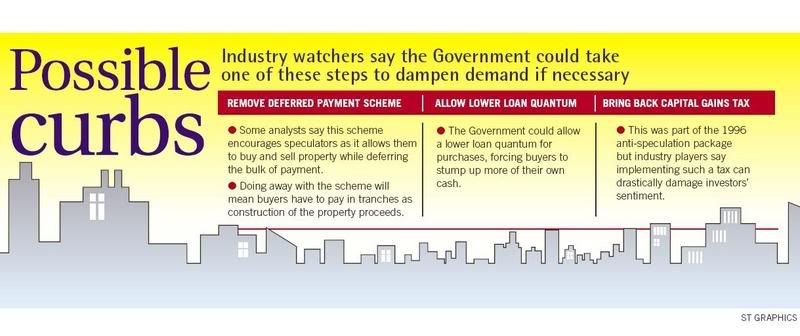
One idea at the top of some lists is the axing of the deferred payment scheme, which would hit speculators.

Some experts believe the scheme encourages speculators - which in turn helps to push prices up - as it lets them buy and sell without investing much equity. Deferred payment allows buyers to put off paying the bulk of the purchase until the property is ready for occupation a few years down the road.

Doing away with the scheme will mean buyers have to pay in tranches as construction of the property proceeds.

The Government could also allow a lower loan quantum for purchases, forcing buyers to stump up more of their own cash.

Since July 2005, buyers have been able to borrow up to 90 per cent of a property's value instead of just 80 per cent previously.

Banks could also be encouraged to reduce their exposure to property. Some said the capital gains tax, which was part of the 1996 anti-speculation package, may be revived.

'The chances of implementing a capital gains tax is very low at this point because there are other measures the Government can use,' said Mr Nicholas Mak of property consultancy Knight Frank.

'Also, implementing such a tax can damage investors' sentiment very drastically.'

Although these ideas have been bandied about in the industry, the real unknown is the trigger point that forces the Government's hand.

Some say it will be when business costs get out of control. Others say there is a magic number the Government is watching for when it comes to the level of speculation or price increases.

'Where it sees excessive price movements or unnatural markets being created, then it will act,' said JP Morgan analyst Christopher Gee.

The concern is that excessive speculation leads to distorted prices, said Citigroup economist Chua Hak Bin. Citigroup expects the residential supply crunch to worsen despite government assurances that supply remains sufficient over the next few years.

OCBC analyst Winston Liew anticipates the Government coming up with more soft measures, such as removing the deferred payment scheme.

Knight Frank's Mr Mak said the Government may not need to impose drastic measures at all, but if people believe it might get tough, that may be enough to keep things in check. 'Sometimes, the fear of death is worse than death itself.'
 

jq75

Honorary Member
Joined
Dec 5, 2000
Messages
142,968
Reaction score
4,972
July 25, 2007
SURGING PRICES
Govt to ensure property market not overly bullish

THE Government will not intervene in private transactions concluded at sky-high prices, but it does want to ensure that there is no unwarranted 'exuberance' in the market, Minister of State for National Development Grace Fu said yesterday.

Her comments came about a week after the Government's surprise move to raise the development charge that developers pay to enhance a site.

Some property analysts worry that the hike will raise developers' land acquisition costs and affect the market for collective sales.

National Development Minister Mah Bow Tan said over the weekend, however, that the move was not a reaction to the collective sale fever.

Yesterday, Ms Fu said in response to a question on whether cooling measures lie ahead: 'The Government is not doing anything to dampen the market. We just want to make sure there's no exuberance that's not warranted.'

The Government's objective, she added, is to make sure there is sufficient information for people to make informed decisions. 'In a rising market, what you are going to pay is more than what has been transacted in the past. The economy is doing well, so expect the market to trend up. That is the right direction. As the Government, we should not be unduly worried about the trend,'she said.
 

jq75

Honorary Member
Joined
Dec 5, 2000
Messages
142,968
Reaction score
4,972
MAS closely monitoring property prices, inflation to stay tame

25 July 2007 1807 hrs (SST)

SINGAPORE : The Monetary Authority of Singapore (MAS) has said it is expecting overall inflation to remain tame this year, but it is nonetheless concerned about the impact of rising property prices.

Giving its annual review on Tuesday, the central bank said it was closely monitoring rising property prices, after inflation hit a one-year high in June.

MAS said it would keep to its policy of allowing a modest and gradual appreciation of the Singapore dollar.

It added that it was keeping to its full year economic growth forecast of 5-7% for 2007.

That's more conservative than the 8% expansion now forecast by most private sector economists, after better-than-expected numbers for the first half.

The Singapore economy grew 7.3% in the first half, powered by ongoing expansion in the transport engineering, biomedical manufacturing and services sectors.

"We could repeat the 7.9% growth that we registered in 2006, based on the healthy data reports for the first two quarters of the year. The construction, services and other manufacturing sectors were holding up. In the second half, the tech sector should be less of a drag," said economist David Cohen at Action Economics.

In its annual review, the MAS reported positive growth in the financial services sector.

The total market capitalisation of equities listed in Singapore rose 69% from 2005 to reach S$720 billion.

MAS also noted that Singapore is now the largest REIT market in Asia ex-Japan, with 16 listed REITS and a market cap of over S$27 billion.

But inflation continues to be a key concern for MAS. It noted that business costs like wages and rentals have risen rapidly recently.

CPI is expected to pick up in the second half, with the GST hike in July and some price increases in food and transport.

The central bank expects CPI for the full year to come in at the upper end of its forecast range of 0.5-1.5%. It foresees inflation creeping up by 1-2% next year.

It is also keeping a close eye on rising property prices.

Heng Swee Keat, MD of MAS, said: "Impact of the rise in property prices and CPI - the first round effect is small. We'll watch the second round, to see if high prices will pass through to inflation as rental costs get passed on into prices of goods and services.

"On the financial stability front, the banking sector's exposure to property and construction sectors, as well as housing loans, is significant."

The central bank is maintaining its policy of allowing a modest and gradual appreciation of the Singapore dollar.

The Singapore dollar is now hovering at 10-year highs against the greenback.
 

jq75

Honorary Member
Joined
Dec 5, 2000
Messages
142,968
Reaction score
4,972
Singapore property prices up sharply in Q2

27 July 2007 1303 hrs

SINGAPORE - Singapore's residential, commercial and industrial property prices rose sharply in the second quarter, figures showed Friday, in further evidence of the city-state's accelerating real estate boom.

Prices of residential property, including houses, apartments and condominiums, were up 8.3 percent compared with a 4.8 percent rise in the three months to March, the Urban Redevelopment Authority (URA) said.

Office prices rose 8.9 percent compared with 4.3 percent in the first quarter, while shop prices spiked to 4.6 percent from 1.7 percent, said the URA, which is responsible for land use planning in the island nation.

Prices of industrial property jumped 8.2 percent after 3.7 percent, it said.

Meanwhile, HDB's Resale Price Index grew by 3.0% in the second quarter over the previous quarter, with price increases across most flat types and towns.

Residential rents increased 10.4 percent during the quarter, up from a 7.6 percent gain in the previous quarter, while retail rents shot up 7.1 percent from 1.4 percent.

Office rents increased by 11 percent after a 10.4 percent rise in the previous quarter, with industrial rents up 7.7 percent after 4.5 percent, the URA said.

Helping to fuel the rental boom is a huge influx of foreigners as the government seeks to recruit more skilled professionals to augment the local workforce.
 

jq75

Honorary Member
Joined
Dec 5, 2000
Messages
142,968
Reaction score
4,972
Government releasing more quarterly data on rental rates

27 July 2007 1435 hrs

SINGAPORE : The Government has pushed out even more information on the property market to give a clearer idea of where prices may be headed.

It is now providing figures for rental and vacancy rates for shops and offices, as well as the rentals commanded by both private homes and HDB flats.

The additional figures were included with the URA and HDB's quarterly updates.

Private home prices were seen rising 8.3 percent in the three months to June, while resale HDB flats prices were up 3 percent.

The move is seen as a bid to calm down a frenzied property market by providing more transparency, and ease concerns of escalating business costs in the form of rentals.

The new set of figures includes median rentals of offices, split up into two categories: one for newer, better quality buildings in the prime districts, and another for the remainder.

Retail space has also been sub-divided into three parts: the Orchard area, the rest of the city area, and space outside the city.

For private apartments, the URA is also providing median rental rates for all developments where at least 10 units were leased out in the last quarter.

On HDB's part, it will now report on the number of sublets it approves for each new quarter, and provide the median rents achieved for each town and flat type.

The data will be updated on the last Friday of every quarter.
 

jq75

Honorary Member
Joined
Dec 5, 2000
Messages
142,968
Reaction score
4,972
July 28, 2007
Private homes: Rents up 10.4% in 2nd quarter
Big hike due to slew of collective sales, but still 21% lower than 1996 high


NLProperties.jpg


By Fiona Chan
ALL private home owners have good reason to celebrate these days, but landlords should really pop the champagne - while their tenants should drown their sorrows.

Rents rose at an unprecedented rate in the April to June period, outpacing home prices which were far from sluggish.

Official figures showed yesterday that rents jumped 10.4 per cent in the quarter, trumping the 7.6 per cent rise in the first three months of the year. They are now 31.2 per cent higher than a year ago.

This is the highest quarterly and yearly growth since the Government made rental data public, said property firm Knight Frank. It is also the first time private home rents have shown double-digit growth in a quarter, it added.

Rents this year have gone up 18.7 per cent, compared to only 14.1 per cent in the whole of last year, added consultancy ** Richard Ellis.

More important, rents rose across the board, according to new Urban Redevelopment Authority (URA) figures yesterday.

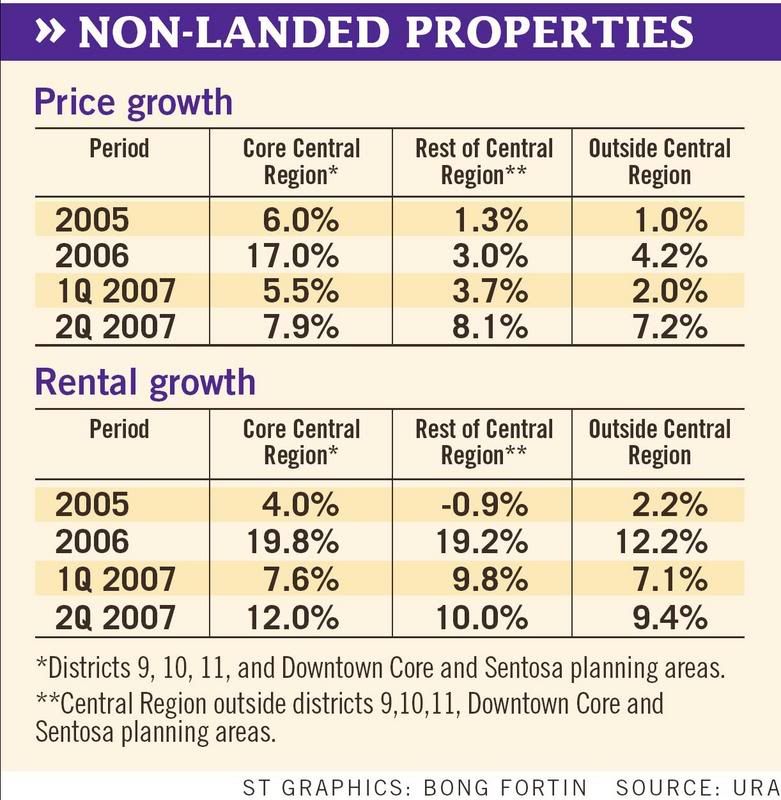
Although the core central region still led the pack with a 12 per cent jump over the first quarter, the rest of Singapore was not far behind.

Rents in the city fringe areas went up 10 per cent while those in suburban districts were just behind with a 9.4 per cent rise.

Knight Frank's latest data shows that homes in the East Coast, Thomson and Bishan areas saw rents rise by 10 to 12 per cent, matching the pace in the prime districts.

But while landlords enjoy the bubbly, their tenants are far from happy with surging rents becoming a source of concern among foreign companies bringing in growing numbers of expats.

To help tenants get a better idea of the market, the Government yesterday released data on median home rentals, breaking it down for the first time by project.

This allows potential tenants to compare median rentals - that is, the level at which half the rentals are higher and the other half lower - of individual condominiums.

The figures showed that The Pier at Robertson, for instance, commands a median monthly rental of $6.30 per sq ft (psf), or $3,150 for a 500 sq ft unit. At the other end of the spectrum, Neptune Court has median monthly rentals of $1.56 psf, or $1,560 for a 1,000 sq ft apartment.

This new data is available on the URA website. The agency also took pains to point out that while median rents overall rose to $2.17 psf per month, there were 'a significant number of properties which were rented out at below $1.50 psf per month'.

Also, while rents are soaring, they are still some 21 per cent lower than the 1996 high, said Knight Frank.

The key reason for the rental rebound is the slew of collective sales, said experts. And as more and bigger estates are torn down, rents can be expected to surge further as displaced owners and tenants look for hew homes.

Similarly, private home prices are set for a good run.

They jumped 8.3 per cent in the second quarter to hit a level not seen since 1997. But what raised eyebrows was that prices of non-landed homes in the city-fringe areas outpaced those in red-hot prime districts.

Even in suburban areas, prices climbed 7.2 per cent - well above the 2 per cent rise in the previous quarter.

Perhaps most significantly, prices of completed homes rose more than those of uncompleted ones for the first time in at least two years.

This is a sign that the strong price rebound is due to genuine buying demand, said property consultants. Traditionally, prices of uncompleted homes tend to lead price increases because more people want to buy new homes.
 

jq75

Honorary Member
Joined
Dec 5, 2000
Messages
142,968
Reaction score
4,972
July 29, 2007
Rents here too high? Not so, say expats
Though rents are rising, expats say housing here is more affordable than in many major cities
By Melissa Sim
SINGAPORE and Hong Kong are keen competitors in most things but when it comes to rent, there is only one winner.

Ask Mr Jason Longley, the regional manager of an insurance company. A year ago, he was paying $8,500 a month to rent a 900 sq ft apartment in Hong Kong's prime Peak area.

Now he rents a 1,400 sq ft flat at Leonie Hill off Grange Road for just $5,500.

Mr Longley, 35, said Singapore's cheaper rent was a key factor in his decision to relocate: 'I definitely saw rent as a huge expense in Hong Kong.'

It also helps put into perspective the growing complaints about rising rents.

Urban Redevelopment Authority figures out last Friday showed that residential rents rose 10.4 per cent in the April to June quarter and are up 31.2 per cent over the past 12 months.

But expats and agents told The Sunday Times that Singapore rents are still cheaper than in cities such as Hong Kong, Tokyo, London and New York.

A new survey by ECA International, a human resource consultancy, showed that rents here were 45 per cent less than the average price in Tokyo and 40 per cent less than in Hong Kong.

Singapore was the eighth most expensive place to rent a three-bedroom flat in Asia and 15th most expensive in the world - below Hong Kong, Tokyo, New York and London.

Investment banker Timothy Rice, who moved here last August, can testify to that.

Mr Rice, 27, pays $1,400 for a 350 sq ft studio in Kelantan Lane, near Bugis Junction. He said such a flat in an equivalent London location would still cost about the same figure - but in pounds. That is about $4,300.

Mr Masamitsu Kawasumi, 44, chief bank representative of the Development Bank of Japan, arrived here last month and was struck by the rental gap between Tokyo and Singapore.

Tokyo's hip Roppongi area, with its many clubs and restaurants, has rents of about $13 per sq ft. Orchard Road's $6 psf seems like a bargain.

Mr Thomas Preben Hansen, 32, chief executive of a listed marine firm, has lived in Shanghai and London: 'Rents had become very cheap since 1997, and still have some catching up to do.'

He anticipated the rent squeeze and so bought a flat in Ewe Boon Road, off Bukit Timah Road, when he arrived in May.

A rental squeeze is exactly what Ms Isabelle Scali, 30, is bracing herself for. The public relations manager thinks Singapore is relatively more costly than London.

She pays $1,800 - nearly half of her salary - for a 1,200 sq ft flat at Sunshine Plaza off Prinsep Street.

In London, she said she spent just a third of her salary on a 700 sq ft studio flat in Balham, southwest London.

Ms Scali, who has signed a two-year lease, said rental costs will determine if she stays in Singapore.

Mr Rajesh Malkani, 43, who lived in Hong Kong for 13 years before moving here in 2005, said: 'I don't expect Singapore's prices to reach Hong Kong levels because there is still land here. But I do expect them to go up.'

Mr Malkani, the global head of sales and business development at Standard Chartered, rents a 4,000 sq ft bungalow in Sunset Place. He would not reveal his rent but said it would get only half the space in Discovery Bay, which he feels is a comparable site in Hong Kong.

Given the decade-long property slump here, Mr Simon Smith, a senior director at Savills Asia Pacific, thinks rents will keep rising for the next one to three years.

But Mr Rice is not complaining: 'Compared to Hong Kong, New York, London - Singapore is still cheap,' he said.
 

jq75

Honorary Member
Joined
Dec 5, 2000
Messages
142,968
Reaction score
4,972
July 30, 2007
Govt to take a more 'hands-off' approach to property market
By Imelda Saad
THE Government will depend on 'non-interventionist measures' to cool the red hot property market.

National Development Minister Mah Bow Tan said the Government's twin approach is to give out more information and push up supply.

Speaking to the media just three days after the release of Singapore's first comprehensive data on housing prices, Mr Mah also said 'there's no reason to be alarmed.'

Referring to sub-sale figures, he said: 'If you look at the numbers, it's quite a distance away from what we have in the mid 90s, particularly in 1996.'

The minister also declined to say if the government will introduce more measures to cool the property sector.

'I think we try to avoid interfering in the market if we can and that's the reason why we continue to depend on broad dissemination of information even sometimes persuading various parties to come up with more accurate information and then collating them and getting URA and HDB to push out this info in a very timely and very comprehensive manner,' he said.

Mr Mah added long term measures are already in place.

There will be sufficient supply to meet housing demands over the next three to five years.

In June, the Ministry of National Development (MND) announced the biggest Government Land Sales (GLS) Programme with enough land for about 8,000 private homes.

Another 56,182 housing units are in the pipeline. Of which 30,158 units have not been sold. These units are expected to be ready between the end of this year and 2010

'The long term measures are very well in hand and we know that there's going to be enough supply in the next 3 to 5 years. I think that's a fact and nobody disputes that. It's really what happens in the short term.

'I think there's a lot of excitement and maybe a little bit of panic in the short term - maybe next month, 6 months, one year', said Mr Mah.

This is where measures like releasing vacated flats under the Selective En Bloc Redevelopment Scheme or Sers will help.

120 such flats in Tiong Bahru will be released for short term rental.

The flats, which are built in the 50s, will be spruced up by the Managing Agents, tasked with renting out the flat.

'The Managing Agent will do some renovations, touch up, repairs and do some short term rental for one or two years. It's not going to make a big dent in the market but it will test the market,' Mr Mah explained.

If response to these flats is good, up to 5,000 more units can be added to the supply over the next there years.

Mr Mah said he's confident that by pushing out information and increasing housing supply, property prices will be moderated.

He said the latest data released last Friday showed that although prices have gone up across the board, rates remain 'affordable'.

'The government will keep an eye on the situation to make sure we remain competitive,' he said.
 

jq75

Honorary Member
Joined
Dec 5, 2000
Messages
142,968
Reaction score
4,972
July 31, 2007
Two River Valley condos fail to get asking prices
Pacific Mansions sought $2,400 psf; Rivershire asked for $2,200 psf

By Joyce Teo
RECENT high-profile collective sales of Pacific Mansions and Rivershire have both failed to attract bids from developers willing to match the prices being sought by owners at the two River Valley condominiums.

Marketing consultants of both sites, however, are understood to be negotiating with 'interested parties' to see if they can at least achieve the reserve price - ranging from 10 per cent to 20 per cent below the asking price.

Asking prices at the two condominiums were optimistically priced at the very top end of market levels.

The current collective sale record stands at $2,338 per sq ft (psf) of potential gross floor area at The Ardmore in the prestigious Ardmore area.

Owners at the 45-year-old Pacific Mansions in River Valley Close, however, asked for even more - about $2,400 psf of potential gross floor area. This placed its total price at $1.18 billion.

Although the property market is booming, the perception is that the asking price for Pacific Mansions is high and unachievable for now, said a source.

Rivershire in the Leonie Hill area was put up for sale in late June at $348 million, or a hefty $2,200 psf of potential gross floor area.

The recent hike in development charge has no impact on the sites, as no such charge is payable for both sites.

There is talk that the Pacific Mansions' tender had attracted a few expressions of interest but no firm bids.

Mr Steven Ming, director of investment sales at Savills Singapore, which is marketing Pacific Mansions, only said: 'We have received interest, and we are in discussions with the interested parties.'

Knight Frank, which is marketing Rivershire, is also believed to be in talks with keen parties.

Nearby, owners of the 99-year leasehold Grangeford Apartments, who had asked for $2,016 psf of potential gross floor area, also failed to get what they had asked for.

The best they got was an offer from Overseas Union Enterprise - believed to be around $1,820 psf - subject to approval by owners controlling 80 per cent of the property's share values.

The deal is likely to be sealed soon. ** Richard Ellis, which is marketing the site, said it is waiting for lawyers to confirm the approval level.

The absence of finalised deals for these condos has not stopped others from hitting the market at relatively high prices.

These include Trendale Tower in the Cairnhill Road area, which was relaunched for sale in late July at $2,477 psf of potential gross area. Its earlier asking price in May, when it was put up for sale via an expression of interest exercise, was at $2,200 psf of gross floor area.

Recently, City Towers in Bukit Timah Road was also relaunched for sale at a revised asking price of $2,100 psf of potential gross floor area.

Property consultants say the residential market is still rosy, though some collective sales may stall as the owners' asking prices are far beyond what the market is currently willing to pay.

'It really depends on the site's potential,' said one.
 

jq75

Honorary Member
Joined
Dec 5, 2000
Messages
142,968
Reaction score
4,972
jq75 said:
July 20, 2007
Horizon Towers minority owners bid to delay hearing fails

In yet another twist to the controversy over the sale of the Horizon Towers condominium, a High Court bid by minority owners for more time to present their case to the Strata Titles Board has failed.
The minority owners, who object to the sale, wanted a judicial review of the Board's decision not to postpone a hearing.

They will now have to present their case next week instead of in September as they wanted.

The $500 million deal for the two blocks at Leonie Hill, which was struck on Feb 12, has to be finalised by Aug 11. If the High Court had ruled in favour of the minority owners, the deal would have been effectively scuttled.

The 99-year leasehold property has been pledged to be sold enbloc to HPL, Morgan Stanley Real Estate and the Qatar Investment Authority, the investment arm of the Gulf Arab state of Qatar.

The deal was backed by 84 per cent of the owners. This is above the 80 per cent requirement, but it still needs the approval of the Strata Titles Board. Previously, the Board set the hearing for September, but later moved it forward.

Through lawyers from Tan Kok Quan Partnership and Harry Elias Partnership, the minority owners argued that they needed more time to prepare their objections to the deal.

They therefore sought leave from the High Court for a judicial review of the Board's decision to bring the hearing forward.

But according to court documents filed by the purchasers, the the deal would have been scuttled if the objectors request had been granted.

The purchasers, who were represented by Senior Counsel K Shanmugam, argued that if this happened,the majority owners who consented to the sale would be unwilling to extend the deadline for the en-bloc deal.


Aug 4, 2007
Strata Titles Board rules in favour of minority owners
No go for Horizon Towers en bloc sale
Move taken because the correct sale procedures were not followed, says STB

By Fiona Chan & K.C. Vijayan
THE Strata Titles Board (STB) axed the contentious collective sale of Horizon Towers yesterday after months of bitter wrangling between neighbours and lawyers.

The surprise move - it is the first such decision in seven years - cheered the condominium's unhappy sellers, who have been complaining about a neighbouring estate fetching a higher price due to the property boom.

But it was technicalities, not money or the validity of the minority owners' claim, that finally decided the case.

The STB told a room packed with residents, lawyers and onlookers that the sale was stopped because correct procedures were not followed.

The decision, after a week-long hearing, was the latest step in a battle watched closely by collective sale parties and property owners elsewhere amid the escalating en-bloc frenzy and rising unhappiness among minority owners forced to sell.

Horizon Towers was pledged to be sold to developer Hotel Properties (HPL) and a Middle Eastern fund in January for $500 million. At the time, it was the biggest collective sale in dollar terms.

But The Grangeford next door went en bloc a few months later at a far higher asking price per square foot (psf). It was eventually sold on Thursday, just two days ago - for double the Horizon Towers' psf price.

The Grangeford asking price prompted unhappy Horizon Towers residents to band together to reverse their sale, in the process inspiring a growing group of minority owners in other condos disgruntled with the record wave of collective sales.

Even those who signed the original Horizon sales deal ended up backing the minority owners in their bid to unwind the sale.

Some residents cheered the decision. One who declined to be named but had signed the sale deal said: 'It's good we've brought things back to square one. This time around, hopefully, we can get a fairer deal relative to what's going on in the market.'

But this may not be the end of the road yet.

HPL said in a statement yesterday that it is now 'considering the STB's decision and reserves all its rights', including against the sales committee and the owners who signed the sale agreement.

Property watchers called the STB's decision 'significant'.

'On the basis of price, I felt the sale would go through,' said Mr Jeremy Lake, executive director of investment properties at ** Richard Ellis. 'Clearly, people will now look carefully at STB's reasons to ensure that other projects don't repeat them.'

Horizon Towers is not the first condo to have its collective sale bid turned down.

In 2000, Mandalay Court and Grenville Condominium faced similar rejections, also on technicalities. But in both cases, the majority owners ironed out the glitches and succeeded on the second try.

But Horizon Towers may not be so lucky. The deadline for owners to obtain the sale order is next Saturday, and without the order or an extension of the deadline, the deal will be off.

While the STB said the rejection was based on technicalities, it did not specify which ones. But sources told The Straits Times that cases of irregularities were presented by the objecting lawyers.

These included a notice put up on July 11 last year saying that owners with 80.81 per cent of share values in Horizon Towers had signed the sale agreement. A sale needs 80 per cent consensus. But only 79 per cent had agreed to the sale at that time, lawyers said.
 

jq75

Honorary Member
Joined
Dec 5, 2000
Messages
142,968
Reaction score
4,972
Aug 1, 2007
More appropriate for a judge to take charge of the Strata Titles Board
RECENTLY the Government sought the views of the public (twice) through its Working Committee (WC) to give clarity/equity to en-bloc sales (EBS).

There are also a number of court cases on EBS.

The Strata Titles Board (STB) members who rule on EBS matters are volunteers. I think it is appropriate that a judge take charge of the STB to give confidence, guidance and consistency in STB's rulings.

One thorny/disturbing issue is the Apportionment of Price in an EBS.

The Singapore Institute of Surveyors (SIV) recommends three methods and/or a combination of the three.

The prevailing method is to use a combination of the shares value (SV) and built-in area (PSF) methods.

This is generally acceptable when the types and sizes of the properties are uniform. However, injustices happen when various types of properties and different sizes are involved and, worse still, disproportionate SV.

The Commissioner of Land, in apportioning SV in the early days, obviously had in mind maintenance charges and matters pertaining to the common property and voting rights in condo living and not EBS. Hence the use of SV apportionment is called into question when it is used for EBS price apportionment.

It is misconceived and misplaced .

By way of illustration, is it not absurd that by using the SV method - even on a 50 per cent (or higher) apportionment - a townhouse more than four times the size of a studio flat is given only 5 SV and the studio 3?

This leads to great conflict and unhappiness especially when the majority insists SV be the major component in price apportionment. An oppression of the minority arises needing the court's intervention.

Is it not the market's norm that property is sold and bought on PSF basis?

Have you ever seen property bought and sold or advertised on SV basis?

Does it not make more sense and would it not create less conflict if the PSF method were to be used for the built-in area and the SV method, if at all applicable, be confined to the common area?

It does not hold water to argue that a smaller area commands a higher value; in fact, a quick glance at the property ads will show that the opposite is equally true.

Also, would it not be ideal that EBS be handled by an independent (non-resident) official sales tribunal (if feasible) to do away with all the vested and conflict of interests of the sale committees and also to ensure fairness and transparency?

There should also be a qualified tribunal to look into apportionment of price issues and make fair and equitable rulings and not leave it to estate agents and sales committees members to decide.

They are hardly qualified or impartial enough to make price apportionment decisions.

Richard Chia Chee Keong
 

jq75

Honorary Member
Joined
Dec 5, 2000
Messages
142,968
Reaction score
4,972
Aug 1, 2007
En-bloc sales: Beware the great fallacy

THE recent en-bloc fever that has swept Singapore by storm has affected both supporters of en-bloc sales and those who are against in a rather significant manner.

On paper, it seems that any person who disposes of his older property in an en-bloc sale gets a significant amount of cash which is able to tide them through the years to come.

These packages seem attractive but, on a deeper analysis of the wonderful gift that this en-bloc fervour brings, it turns out to look more like a Trojan horse.

Firstly, many of these properties that are involved in an en-bloc sale are 20-30 years old. For an average Singaporean to buy his first private property, he may need to work for an average of 10 years before he is able to afford the first downpayment of his property, his dream home.

Considering the time in which an average Singaporean takes to pay for his housing, it takes around 20 years to achieve that aim. By then, this average Singaporean will be close to retirement and waiting to enjoy life. However, if his property undergoes the en-bloc process, he loses his roof and he does not have the means to earn the cash needed to get a new property of substantial size.

But wait, some people will say, we are getting millions from the en-bloc sale. Surely we can make use of this cash to get a better property.

Once again, this is great fallacy.

Firstly, the cash does not come immediately, so you will not get the property that you have been eyeing for at the current price.

Based on the rising trend of property prices, chances of you getting a similar property to that you have lost is slim.

Furthermore, if a developer is willing to part with billions to purchase your property, wouldn't he charge you more when he rebuilds a new one over your old area?

How can we then purchase a property that is in the same area or of equal standing to that we have lost? This is basic common sense which does not require an economics degree to arrive at.

As the Minister Mentor stated, property and rental prices have to stay competitive in order to attract foreign investments. Collective sales totally contradicts this notion. Furthermore, it has been reported that Singapore's housing prices are among the highest in the world. How is this contributing to our competitiveness?

Well, some people will say, you can downgrade to a HDB flat and enjoy the extra liquidity that comes with an en-bloc sale. True, but how much liquidity do we really get? With the rising prices of HDB flats and hidden costs in the en-bloc package, do we really get what we perceived we could? Furthermore, if one is staying at a good location now, does it warrant to uproot oneself to the suburbs for pittance? I am not so sure.

Lastly, we are talking about going green and conserving the environment nowadays. Does the tearing down of buildings and rebuilding of new ones so frequently serve to protect the land we love and the air we breathe? I am not so sure.

Let not our short-term greed ruin the future of our children. The world is tough enough for them as it is. We need not make it harder.

Lau Cher Chye
 

jq75

Honorary Member
Joined
Dec 5, 2000
Messages
142,968
Reaction score
4,972
Aug 5, 2007
No-go on Horizon Towers sale: Minority victory after long fight
By K.C. Vijayan , Bryna Sim & Melody Zaccheus
WHEN Mr Hendra Gunawan and three of his neighbours tried to engage lawyers to block the collective sale of Horizon Towers, three firms turned them down flat.
All felt they had no case. The last time the Strata Titles Board (STB) ruled in favour of minority owners was seven years ago.

Although more than 80 percent of the owners were reported to have signed the collective-sale agreeement, it still needed the board's approval before the sale could proceed.

But in June, Harry Elias Partnership agreed to represent them, and on Friday, the board ruled in their favour.

The firm's lawyer Philip Fong explained that the deal was thrown out because the application for STB approval did not comply with the law.

'They dismissed the application on this ground alone, and not on the merits of the case.'

For the minority, however, it has been a long fight.

Although 33 owners objected to the sale, only nine turned up to file an official objection with the board in late May.

Besides the four, three owners were represented by Tan Kok Quan Partnership, another by Pang & Co, and the last chose to represent himself.

Mr Gunawan, a 51-year- old businessman, attended all the mediation meetings and hearings since they began late last month.

Now, he is just relieved that he will get to keep his home of seven years.

'We were determined and committed to our cause; the comfort we so enjoyed in this home was at stake.'

The two tower blocks in Leonie Hill were due to be sold for $500 million to Hotel Properties Limited, Morgan Stanley Real Estate and Qatar Investment Authority, the investment arm of the Gulf Arab state of Qatar.

When STB threw out the deal, HPL issued a statement reserving its rights against the majority owners who signed the collective sale agreement and the sales committee of the property.

Lawyers, however, say that the contract to sell was conditional upon STB's approval. That would have protected the majority owners from a breach of a commercial contract.

But the contract may have contained other clauses which enable buyers to examine whether the majority owners had attended properly to technical issues - such as making sure approval papers are in order.

One lawyer who spoke on condition of anonymity said: 'This is a big area, and if the potential loss to the buyer is $500 million, then they might be willing to spend $1 million to test the case in court.'
 
Important Forum Advisory Note
This forum is moderated by volunteer moderators who will react only to members' feedback on posts. Moderators are not employees or representatives of HWZ Forums. Forum members and moderators are responsible for their own posts. Please refer to our Community Guidelines and Standards and Terms and Conditions for more information.
Top