Property News!

jq75

Honorary Member
Joined
Dec 5, 2000
Messages
142,982
Reaction score
4,979
April 10, 2009
Not the end for en bloc sales
Horizon Towers ruling restores care back to selling of homes

By Joyce Teo
THE Horizon Towers ruling has taken the property market by surprise, with some experts saying that the days of the 'en bloc jackpot' are well and truly over.
As it is, the rules around collective sales have already been toughened up. Amendments to the Land Titles (Strata) Act in late 2007 made the sale process more complex, costly and lengthy.

And last Thursday's Court of Appeal ruling shone such a harsh light on the way the estate's sale committee operated that some fear owners will shy away from serving on such bodies because the legal risks are too great.

The Court of Appeal's 117-page judgment, penned by Justice V.K. Rajah, exposed the fact, for example, that the need for an estate's rejuvenation or upgrading had been periodically hijacked by buyers' profit motives.

'The lure of 'windfall profits' has been a siren song for many (especially absent landlords and speculators), to the detriment of those who do not want to lose their homes at any prices,' it said.

It also likened the role of a sale committee to that of a trustee. Thus, even if it is largely made up of home owners wanting to sell, it must still hold 'an even hand' between all parties and take heed of the interests of objectors.

The court also stressed that the committee must not place itself in a position where there may be conflicts of interest - whether existing or 'potential'. It must also 'act conscientiously' to get the best price.

'It is the first time the minority group has won on the basis that the sale was not in good faith, and not on a technicality,' said Mr Philip Fong of Harry Elias Partnership, who represented the objectors.

The judgment has been met by howls of protest from many in the property sector. The fear is that the bar has been set so high that any future deals will be impossible. They say the balance has been shifted too far in favour of en bloc dissenters, such that an en bloc deal becomes vulnerable to even the smallest objections.

'It has become a thankless job, and there are so many restrictions and fiduciary duties. And you have the potential to be sued,' said Mr Shaun Poh, DTZ's senior director for investment advisory services and auction.

These are valid concerns, but the ruling must also be seen in broader terms.

It is a landmark judgment that has helped to level the playing field for minority owners, who have tended to be sidelined in the sale process.

And in the process, it will bring sanity back to a collective sale market that can get out of control easily, as shown by the numerous court cases in the past two years.

To be fair, some ageing residential estates are fast deteriorating, and deserve to be sold en bloc before they turn into urban eyesores.

But in the last property boom, developments that were just over 10 years old - or even newer than that - were also attempting a collective sale.

The pace of destruction was unwarranted, and I think it is a pity the pursuit of money so easily triumphed over the importance of preserving a country's architectural heritage and sense of place - something no amount of money can buy.

For many minority owners, what was also at stake were their own memories and a level of comfort that is not easily replaced. (During the boom, sale proceeds were often insufficient to get a similar replacement home.)

In dynamic Singapore where we are always buffeted by economic and social changes, the familiarity of home is perhaps more important than ever.

Yet minority owners have been pushed aside as sale committees single-mindedly work towards achieving a collective sale and hitting jackpot earnings.

At times, they have been at the complete mercy of indifferent speculators, who go around buying up units in old estates and then agitating for a collective sale.

Covering the boom and bust of the property market in recent years, I have heard many stories about these sales tactics. People have told me how those home owners who oppose collective sales of their estates are routinely banned from owners' meetings. There was one instance of a sale where no minutes of any committee meeting were kept.

Minority owners have had their cars scratched and families threatened.

Some have even hit the headlines by taking irrational action to save their homes. In 2007, one family refused to move out of their Newton area condominium, even as the building was being prepared for demolition.

For these people, the judgment is a welcome step forward in the right direction.

The question, of course, is whether the court has gone too far.

Will this judgment spell the death of all collective sales, and the happy windfall profits often associated with them?

Worse still, does it create the opposite problem - an unhealthy aversion to en bloc deals?

Not necessarily.

The fact remains that if an estate is ripe for renewal, and most of its residents agree, it can - and will - be sold en bloc.

'As long as sale committee members act on behalf of all owners and transparently, it shouldn't be a problem,' said Knight Frank investment sales head Foo Suan Peng.

And herein lies the real significance of the Horizon Towers saga, with all its twists and turns.

It restores the requisite level of care and attention that should be paid when people contemplate selling something they are as emotionally attached to as their homes.

And if society in general eventually learns to be guided by principles other than monetary gains, then it can only be a good thing.
 

jq75

Honorary Member
Joined
Dec 5, 2000
Messages
142,982
Reaction score
4,979
April 15, 2009
Timing's everything for upgraders
HDB residents buying a condo unit have to do their sums carefully

By Jessica Cheam
IN THE midst of Singapore's worst recession, people are still buying property.
Private condominium sales reached a recent high of 1,323 units in February - the highest since the 1,731 units sold in August 2007, which was the peak of the recent property bull run.

And though official figures are not yet available, the buying frenzy seems to have continued into March.

According to a recent report by DTZ Research, seven out of 10 buyers in the first quarter of this year are HDB upgraders.

This is a jump from the 48 per cent registered in the fourth quarter last year, and the highest number since the 86 per cent achieved in the second quarter of 2002.

HDB upgraders are home buyers with HDB addresses looking to move up the property ladder. They typically buy into mass-market condos, usually in the suburbs.

Experts say the recent brisk sales indicate a 'pent-up demand' in the market, especially from buyers who held back during the recent property boom, when prices skyrocketed in 2006 to 2007.

They also point to a unique phenomenon that occurs in a property boom-and -bust cycle where the gap between the price of HDB resale flats and mass market condos has narrowed to an all-time low.

Private property prices fell a quarterly record of 13.8 per cent in the first quarter of this year, compared with the marginal 0.6 per cent drop for HDB resale flats.

This means that HDB flat owners own an asset that has appreciated to more or less record value, at a time when the prices of mid-tier condos have dropped to affordable levels.

Now, the jump from public to private home ownership has always been a tantalising proposition.

But is this really the right time for an HDB upgrader to buy?

The answer, say property experts, depends on two things - when the condo unit the upgrader is buying will be completed, and what view he takes of the Singapore property market over the next couple of years.

Let me explain.

Unlike an investor who is buying for rental yield, the HDB upgrader typically moves out of his HDB flat and into his new condo unit. This means that he sells his flat only when the new condo unit is completed and ready for occupation.

Therefore, it makes the most sense for an upgrader today to buy a completed unit - because he can sell his flat now for a relatively high price and buy the new private condo unit on the cheap.

The problem is that there aren't many completed suburban developments on the market. Most new condos approaching completion today are in the prime districts, which were the focus of the property boom two years ago.

And the handful of suburban developments that are close to completion aren't that attractively priced, so the HDB upgrader isn't getting that good a deal on them.

The fact is: The cheapest suburban condo units today are those being sold 'off plan', meaning that they will be completed only two or three years later.

For HDB upgraders who buy these types of condo units, the fact that they can currently can get a good price for their HDB flats is moot, because they will sell their flats only two or three years down the road.

That brings me to the second point that HDB upgraders must consider before signing on the dotted line.

What will the global economy and the Singapore property market look like in two or three years' time, when these projects are due for completion?

Home buyers today can no longer rely on the now-defunct deferred payment scheme introduced in 1997. This allowed buyers to pay a 10 or 20 per cent downpayment, and defer taking a bank loan until the project was completed.

Developers have replaced this with the 'interest absorption scheme'. Here, the buyer also pays an initial 20 per cent downpayment and defers the rest until the property is completed.

But the big difference now is that the minute buyers commit to a property, they have to take a loan with a bank which the developer has selected. The developer then foots the bill for the buyer in interest payments to the bank during the construction period.

This arrangement carries new risks for the home buyer.

Firstly, if a developer goes under, it will no longer be able to pay the regular interest payments and the bank will go to the buyer for these payments.

This seems quite an unlikely scenario in Singapore as developers who offer this scheme generally have the financial muscle to ride out the tough times. Still, the risk of this happening is higher with smaller developers.

Secondly, the bank reserves the right to revalue a property at any point during the construction, or when the project is completed.

So if the property market heads further south, a bank may revalue properties downwards. This means that it will likely reduce the sum it had earlier agreed to lend to the buyer, who will then have to stump up a hefty sum of cash to make up the difference.

On the one hand, experts say banks are unlikely to revalue properties as long as buyers are able to make the monthly payments. Unlike high-end properties where prices could crash in as little as three months, prices of suburban units are less volatile, say analysts.

But on the other hand, if the market really crashes, HDB upgraders could be hit by a double whammy. They will have to fork out more cash to top up their loans at a time when the values of their resale flats would most likely have crashed along with the general market. And if they back out of buying the new flat, they will lose a 20 per cent deposit.

In the worst-case scenario, they could be saddled with two mortgages for properties, both in negative equity.

Such an optimistic gamble on the future is not for the faint-hearted nor the financially prudent, especially when unemployment is hitting a record high.

But if an HDB upgrader truly has the financial strength to hold on to his properties indefinitely for the long term, it could be a gamble that will pay off when the market finally recovers.

These are sums that one must do carefully, no matter how beautiful and attractive floor plans and showflats now look.
 

jq75

Honorary Member
Joined
Dec 5, 2000
Messages
142,982
Reaction score
4,979
April 16, 2009
Home sales remain strong
More than 1,000 private homes sold for the second month in a row in March

5topsellers.jpg

By Joyce Teo
THE bumper private property sales recorded in February were no fluke.
For a second straight month, home hunters defied the weakening economy to buy more than 1,000 units last month.

Property consultants say buyers are attracted to what they regard as good buys in the moderately priced mass market.

Still, they warn that these strong buying levels are probably not sustainable.

Last month, property developers sold 1,220 new private homes, just shy of the 1,332 units sold in February.

It was the first time in over a year that the market has seen two consecutive months with more than 1,000 units sold. Sales for both months were a stunning contrast to the dismal 108 in January.

Another striking figure: First-quarter new private home sales hit 2,660 units, representing 62 per cent of all new homes sold during the whole of last year.

February sales - boosted mainly by two new launches Alexis and Caspian - were the highest since August 2007.

Figures compiled by the Urban Redevelopment Authority also showed 832 new housing units were launched last month, compared with 1,072 units in February and just 204 units in January.

Most units sold last month were in the mass market, along with a few city-fringe small-format apartments at condominiums such as Domus and The Mercury.

HDB upgraders were the hottest group of buyers. CBRE Research said that last month alone, they bought 550 to 600 units at mass market projects such as Caspian, Double Bay Residences, Kovan Residences, Livia, Mi Casa and The Quartz at median prices of $610 per sq ft (psf) to $740 psf.

A survey of first-quarter caveats lodged for this market segment indicated an average price of $695,000, said CBRE Research executive director Li Hiaw Ho. 'This is probably a good time for HDB home owners to upgrade to private property as the price gap between private properties and HDB resale flats has narrowed.'

Said Colliers International director for research and advisory Tay Huey Ying: 'Developers have lowered their price expectations for new launches and generally cut prices of unsold units. Buyers are biting as there is pent-up demand.'

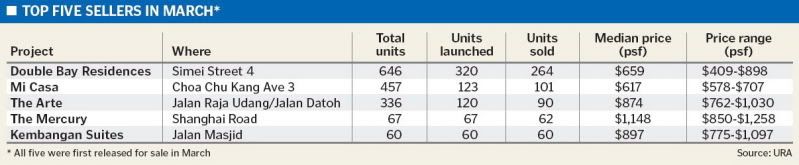
The top three sellers in March were Double Bay Residences, Mi Casa and The Arte. About 85 per cent of units sold last month were priced below $1,000 psf, said PropNex chief executive Mohd Ismail.

The high-end showed some life with 70 units launched and some sales, including one Orchard Scotts unit at $2,220 psf.

But overall, only 100 prime units were launched in the first quarter, or just 4.7 per cent of all units launched, well down from the 39.4 per cent of all units launched in the fourth quarter last year.

Knight Frank director of research and consultancy Nicholas Mak said this was partly due to the retreat of foreigners from the luxury market.

Preliminary data suggests foreign deals stood at 16.8 per cent in the first quarter - a level last seen when Sars badly hit the market in 2003, he said.

Market analysts say it is a good start to the year, but they do not expect the strong buying to continue long-term.

'In the short term, this rate of buying can continue provided developers lower or maintain their prices,' Chesterton Suntec International's research and consultancy head Colin Tan said of March sales.

But in the long term, it is not sustainable, he said. 'The last time the market sold so many new units (14,811 units) was in 2007. That was when the deferred payment scheme was available. And it has since caused indigestion in the top end of the market.'

Unless the Singapore economy and employment market improve significantly this year, only 6,000 to 7,000 new private homes are expected to be sold, said Mr Mak.

He said healthy demand for mass market homes is likely to continue only as long as average HDB resale prices do not fall by more than 7 per cent year on year.

'Many in the mass market segment are buying now and banking on their future earnings to service their loans as they are afraid of missing the boat,' said Mr Mak.


April 16, 2009
HDB prices on their way down
One-third of sales in the first quarter at or below valuation

hdb2.jpg

hdb-3.jpg


By Jessica Cheam
GOOD news for home buyers eyeing the resale flat market: About one-third of HDB sales in the first quarter were struck at or below the flat's valuation price.
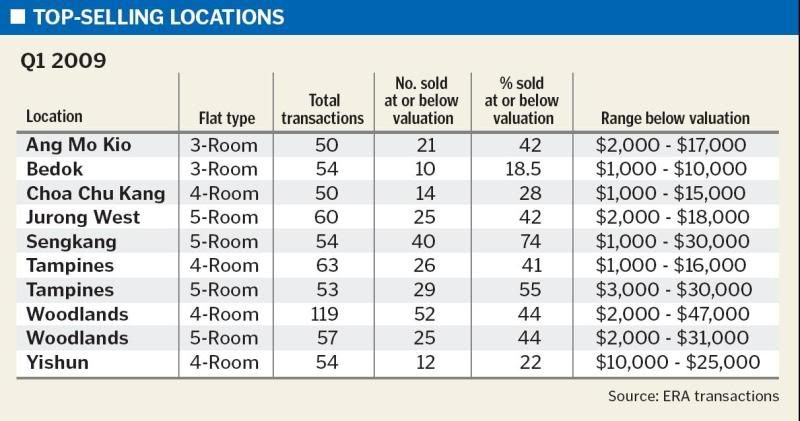
The level in some areas was far higher. In Sengkang, for instance, up to three in four five-room flats sold by ERA Asia Pacific were done at or below valuation.

This means those buyers did not need upfront cash to buy their dream home.

Analysts say the trend indicates HDB flat prices are now coming down at a quicker rate after holding up better than many private residential properties.

In the recent market boom, many sellers sought prices well above valuation - a figure set by an independent valuer.

Buyers can use Central Provident Fund savings to pay for a flat only up to its valuation amount. They must stump up cash for any premium they pay above valuation.

The property agencies surveyed by The Straits Times, HSR Property Group, PropNex, ERA Asia Pacific and C&H Realty - which together account for almost the entire HDB market - said a significant 30 per cent to 40 per cent of first-quarter sales were done at or below valuation.

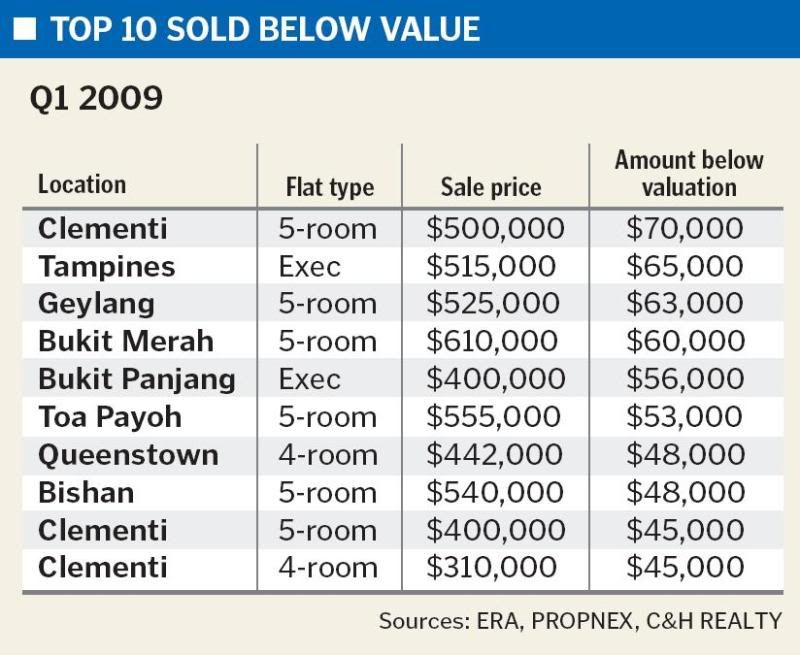
The agencies' data showed prices crumbling for bigger flats such as five-roomers and executive flats. In Clementi, for instance, a five-room flat was sold for $70,000 below valuation at $500,000, while an executive flat in Tampines sold for $65,000 below its valuation at $515,000.

Industry observers say the HDB market, whose price trends typically lag behind those of the private sector, is finally reflecting the weakened economy.

Recent flash estimates showed HDB prices dipped 0.6 per cent in the first three months, compared with the fourth quarter of last year. It is the first fall since 2006.

Demand for resale flats has eased as the recession bites, while the HDB has been ramping up the supply of new flats, said Chesterton Suntec International head of research and consultancy Colin Tan. Home buyers also have more options now as prices of mass market condominiums are more affordable, he added.

ERA associate director Eugene Lim said home hunters were reluctant to pay more than $500,000 for HDB flats.

'The longer these highly priced flats stay on the market, the more over-exposed they become. Consequently, some had to be sold at big discounts due to buyer resistance,' he added.

The balance of power has now clearly shifted from sellers to buyers, with analysts saying this could be the time for buyers to do some bargain-hunting.

ERA's first-quarter data showed that in locations such as Sengkang, a whopping 74 per cent of transactions for five-roomers were done at or below valuation. In Tampines, they accounted for 55 per cent while, at Jurong West, it was 42 per cent.

Even for smaller flat types like three-roomers in Ang Mo Kio and four-roomers at Woodlands, 42 per cent to 44 per cent of sales were at or below valuation.

Experts point out that while more flats are now selling below valuation, this does not mean people are selling at a loss as HDB prices rose a hefty 31.2 per cent in the property boom of the past two years. But first-time buyers, priced out of the resale market during the boom, will now find the flats more affordable.

The current discounts to valuation will eventually diminish when valuations catch up, which usually takes three months, said Knight Frank director of research and consultancy Nicholas Mak.

But there is a possibility of valuations and price falls chasing each other, further eroding prices, he said.
 

jq75

Honorary Member
Joined
Dec 5, 2000
Messages
142,982
Reaction score
4,979
April 17, 2009
Home sales set to rise in 3 to 12 months: CDL
By Jessica Cheam
PROPERTY developer City Developments (CDL) said yesterday that it expects increasing numbers of homebuyers to enter the market in the next three to 12 months.
Its optimism stems from the sale of more than 80 per cent - or 150 units - of its newly-launched development, The Arte at Thomson. CDL has put 180 units of the 336-unit project on sale.

It said The Arte was 'a record breaker of sorts', being one of the few large projects launched in the global economic meltdown 'that has tasted success'.

CDLs' statement comes on the heels of newly released data that showed 1,220 new private homes sold last month, just shy of the 1,332 units sold in February.

This makes two consecutive months with more than 1,000 units sold - the first time it has happened in a year.

First-quarter private home sales have hit 2,660 units - about 62 per cent of all of last year's new home sales.

It has led some to speculate that the market has indeed turned a corner.

CDL said that 'after absorbing news of forecasts of a steep decline in GDP growth for 2009, the upbeat in sales volume could mean that there is greater confidence that a turnaround is in sight - with a steady rise expected in the property market within the next three to 12 months'.

But analysts maintain that this level of buying may not be sustainable.

Knight Frank director of research and consultancy, Mr Nicholas Mak, has estimated that only 6,000 to 7,000 new private homes are expected to be sold this year, unless the Singapore economy and employment market improve significantly.

However, CDL's group general manager, Mr Chia Ngiang Hong, said that recent launches have shown that 'buyers are still willing to spend when they see value and see a good deal'.

Developers, prompted by the challenging economic conditions, have lowered selling prices - by between 5 to 25 per cent - and these factors have contributed to larger transaction volumes, said CDL.
 

jq75

Honorary Member
Joined
Dec 5, 2000
Messages
142,982
Reaction score
4,979
April 18, 2009
Condo units turned hotels
Rental of such rooms may have adverse effect on other residents: URA

By Jessica Lim & Yeo Sam Jo
SOME entrepreneurial owners of condominium units are renting out and marketing their properties as hotel rooms, going against regulations set by the Urban Redevelopment Authority.
The Straits Times knows of at least four condominium developments with units being rented out on a daily basis.

Marketed as 'condotels', 'holiday apartments' or 'hotel-style apartment room accommodation', the rooms are advertised freely on hostel directories online and personal websites.

One website, claiming 'award-winning service', even indicated check-in and check-out times, a $70 key deposit and free wireless Internet.

Advertised as the Soho 188 Condotel, it is actually known as the Soho 188 condominium development in Race Course Road, near Little India.

Other accommodation can be found at Parkview Condotel, officially known as Parkview apartments in Bukit Batok; Braddell Road's Braddell Regalia and Serangoon's Avon Park.

These rooms are being rented out at between $40 and $150 a day and are popular with students, people here for medical treatment and vegetarian business travellers from Bangladesh who want a kitchen to cook their own food.

These lodgers typically rent for a few days, although it can go up to a month.

'For properties approved for residential use, they are intended for long-term residential stay,' said a URA spokesman, adding that the use of such properties for transient accommodation is similar to how hotels operate. 'The leasing of such properties on a daily, weekly or monthly basis is not permitted.'

He added that the URA needs to assess the appropriateness of such accommodation and if it has an adverse impact on neighbouring residents.

Condominium managers agree that this arrangement may spell trouble. 'The concept of a condominium is for home living, not short-term living,' said Avon Park's manager Haroon Aisree, who will be discussing the matter with the property's management.

His worry: Tenants may be irresponsible and not take care of facilities because they have no ownership.

'We definitely have to take a stand and protect the interest of residents,' he said, adding that he did not know such a business was going on.

Owners of these units, like Mr Roger Pay, said they did not know they were doing anything wrong.

The owner of four units at Avon Park started renting out his 20 rooms half a year ago when he 'received calls from people saying they wanted daily or weekly stay'.

The 41-year-old, who told The Straits Times that all but two rooms are currently occupied, charges about $50 to $90 per room each day and has seen 'increased popularity over time'.

It is the same story for a 75-year-old owner who did not want to be named.

He has been renting out units to lodgers who fork out $70 daily. 'I didn't know that it was wrong,' he said. 'If the authorities give me a letter to tell me to stop doing this in black and white, then I will stop.'

Mr Surendra Kumar Sinha, who is in Singapore for colon cancer treatment, rents a room at a condo unit at Soho 188.

He and his wife, both from Bangladesh, pay $130 a night. Depending on how intensive treatment is, his stay could last from two weeks to a month.

'It's rather expensive for us, but it is still cheaper than hotels and other studio apartments,' said the 59-year-old, who arrived in Singapore earlier this month.

For Miss Crystal Deleon, who is on a 13-day trip to visit her Singaporean boyfriend, her condotel room brings many benefits.

'It's cheaper than a hotel and near my boyfriend's house, so he can send me back after work,' said the Philippine national, who pays about $70 daily for a room at Braddell Regalia.

The URA is currently investigating the matter.
 

jq75

Honorary Member
Joined
Dec 5, 2000
Messages
142,982
Reaction score
4,979
April 19, 2009
property
City-fringe units not a sure bet
Fall in prices in first quarter greater than that for properties in city centre, suburbs

By Joyce Teo
Values for city-fringe homes are typically thought to hold up better than those in the suburbs, but the fall in prices in the first quarter means that this belief may no longer hold true, at least temporarily.
These homes are in areas which are not attractive to institutional investors and are also not within the reach of many HDB upgraders.

In view of these dynamics, the question is whether the areas still present good buys.

The city-fringe areas are what the Urban Redevelopment Authority (URA) terms RCR, or rest of central region. They are sandwiched between the core central region (CCR) - which comprises districts 9, 10, 11, Sentosa and the Central Business District - and the outside central region (OCR).

RCR areas include Paya Lebar, Geylang, Amber Road, Lavender, Toa Payoh, Tiong Bahru and Telok Blangah.

URA data shows that last year, prices of non-landed properties in the city centre, city fringe and suburban areas fell by 5.6 per cent, 4.7 per cent and 2.9 per cent, respectively.

But first-quarter flash estimates show that prices of city- fringe flats slipped by 17.2 per cent - more than the 15.2 per cent drop for city centre flats and the 7.5 per cent fall for suburban ones.

Price

The price index reflects the rate of growth for each region, said Ms Jacqueline Wong, head of residential at Jones Lang LaSalle.

That the RCR experienced the steepest first-quarter price drop based on the flash estimates may just imply that the region is undergoing a greater price correction as prices might have been inflated during the property market boom, she said.

In terms of pricing, RCR pales in comparison to CCR as the latter's branding and location are better, she said.

It is thus fair to say that RCR is 'a poorer cousin to CCR', added Ms Wong.

In some parts of the RCR nearer to the city, developers tend to leverage on prime areas when they sell their projects, said Chesterton Suntec International's Mr Colin Tan.

He said: 'It'll be a discount from prime areas rather than a premium over suburban areas.'

But a price correction is happening now in the RCR, as with other areas.

'At the moment, it is probably perceived as overpriced. Investors may want to wait for it to come down to a more realistic level,' said Mr Tan.

Prime beats RCR

In general, where investors are concerned, prime areas are the best, experts said.

'If you can afford it, buy prime. Depending on the type of properties you buy, there is a better chance for capital appreciation when the market recovers,' said Knight Frank's Mr Nicholas Mak.

'If you cannot, buy a property near an MRT station farther away or in the suburbs if your objective is to cash out.'

Mr Tan said a price recovery, when it comes, will be quicker in an established area like Orchard.

The RCR has quite a few new residential areas, so it may take time for the value in these areas to rise, he said.

City centre properties generally enjoy 'unrivalled prestige, exclusivity and locational advantage', and are hence extremely popular with expatriates, particularly those with higher budgets, said Ms Tay Huey Ying, director for research and advisory at Colliers International.

As prices of these properties have eased substantially from their stratospheric levels in 2007, they would certainly be worthwhile investments for those who can afford it, she said.

A mixed bag

Nevertheless, the RCR is not a write-off, experts stressed.

'Properties in RCR will, however, continue to be attractive to those who remain priced out of the high-end market, or those with a lower risk appetite,' said Ms Tay.

'The RCR is definitely an area not to be forgotten,' said Ms Wong.

February and March sales data has proven that RCR projects such as the sold-out Alexis at Alexandra Road and The Arte at Thomson Road are in strong demand, she said.

'In terms of the leasing market, developments in RCR remain popular among tenants as they are more affordable compared to those in prime areas,' said Ms Wong.

The good thing about RCR is that there is a higher probability that the properties are freehold, Mr Mak said.

Condos in the suburbs next to MRT stations tend to be 99-year leasehold properties.

But unlike the case in most suburban estates, not many RCR projects are near MRT stations.

'The RCR is a mixed bag. For instance, there is Tanjong Rhu which is quite popular and not too far north, and there is Geylang, an area that some people will not touch with a 10-foot pole
 

jq75

Honorary Member
Joined
Dec 5, 2000
Messages
142,982
Reaction score
4,979
April 18, 2009
Condo units turned hotels
Rental of such rooms may have adverse effect on other residents: URA

By Jessica Lim & Yeo Sam Jo
SOME entrepreneurial owners of condominium units are renting out and marketing their properties as hotel rooms, going against regulations set by the Urban Redevelopment Authority.
The Straits Times knows of at least four condominium developments with units being rented out on a daily basis.

Marketed as 'condotels', 'holiday apartments' or 'hotel-style apartment room accommodation', the rooms are advertised freely on hostel directories online and personal websites.

One website, claiming 'award-winning service', even indicated check-in and check-out times, a $70 key deposit and free wireless Internet.

Advertised as the Soho 188 Condotel, it is actually known as the Soho 188 condominium development in Race Course Road, near Little India.

Other accommodation can be found at Parkview Condotel, officially known as Parkview apartments in Bukit Batok; Braddell Road's Braddell Regalia and Serangoon's Avon Park.

These rooms are being rented out at between $40 and $150 a day and are popular with students, people here for medical treatment and vegetarian business travellers from Bangladesh who want a kitchen to cook their own food.

These lodgers typically rent for a few days, although it can go up to a month.

'For properties approved for residential use, they are intended for long-term residential stay,' said a URA spokesman, adding that the use of such properties for transient accommodation is similar to how hotels operate. 'The leasing of such properties on a daily, weekly or monthly basis is not permitted.'

He added that the URA needs to assess the appropriateness of such accommodation and if it has an adverse impact on neighbouring residents.

Condominium managers agree that this arrangement may spell trouble. 'The concept of a condominium is for home living, not short-term living,' said Avon Park's manager Haroon Aisree, who will be discussing the matter with the property's management.

His worry: Tenants may be irresponsible and not take care of facilities because they have no ownership.

'We definitely have to take a stand and protect the interest of residents,' he said, adding that he did not know such a business was going on.

Owners of these units, like Mr Roger Pay, said they did not know they were doing anything wrong.

The owner of four units at Avon Park started renting out his 20 rooms half a year ago when he 'received calls from people saying they wanted daily or weekly stay'.

The 41-year-old, who told The Straits Times that all but two rooms are currently occupied, charges about $50 to $90 per room each day and has seen 'increased popularity over time'.

It is the same story for a 75-year-old owner who did not want to be named.

He has been renting out units to lodgers who fork out $70 daily. 'I didn't know that it was wrong,' he said. 'If the authorities give me a letter to tell me to stop doing this in black and white, then I will stop.'

Mr Surendra Kumar Sinha, who is in Singapore for colon cancer treatment, rents a room at a condo unit at Soho 188.

He and his wife, both from Bangladesh, pay $130 a night. Depending on how intensive treatment is, his stay could last from two weeks to a month.

'It's rather expensive for us, but it is still cheaper than hotels and other studio apartments,' said the 59-year-old, who arrived in Singapore earlier this month.

For Miss Crystal Deleon, who is on a 13-day trip to visit her Singaporean boyfriend, her condotel room brings many benefits.

'It's cheaper than a hotel and near my boyfriend's house, so he can send me back after work,' said the Philippine national, who pays about $70 daily for a room at Braddell Regalia.

The URA is currently investigating the matter.


April 20, 2009
Condo units near 'blue zones' may be used for vice activities
IN LAST Saturday's article, 'Condo units turned hotels', it was reported that rooms in at least four condominium developments were being rented out on a daily basis for as little as $40 per day.
Some condo units are near 'blue zones', which are unofficial areas designated for the flesh trade. This will encourage pimps to rent such rooms on a daily basis and sub-let them on an hourly basis to circumvent the prohibition on budget hotels renting out rooms by the hour.

I hope the Urban Redevelopment Authority will take this into consideration when assessing such arrangements.

Chin Kee Thou
 

jq75

Honorary Member
Joined
Dec 5, 2000
Messages
142,982
Reaction score
4,979
April 21, 2009
New showflats pull in crowds
Condo-style flats popular; private homes see encouraging sales

By Joyce Teo
THOUSANDS of people flocked to check out some of the new housing developments on sale over the weekend, scenes more reminiscent of a boom, not a recession.
As one industry watcher told The Straits Times: 'The mass market is still moving. If you price it correctly and reasonably, people will still buy.'

The hottest ticket in town was clearly the Parc Lumiere project, which drew an astonishing 6,500 visitors over the weekend.

Buyers had begun queueing last Friday before its viewing period started on Saturday, with 829 people eventually in the line for flats in the estate, which is being developed under the Design, Build and Sell Scheme (DBSS).

There was no balloting for the project: Just turn up and book.

Developer Sim Lian Group said it has already sold 306 units out of a total of 360. All the four-room flats, priced between $378,000 and $425,000, have been sold.

Only the low-floor five-room flats are left. The five-roomers are priced from $462,000 to $575,000.

'After going through Premiere @ Tampines, we thought we would try another way of selling. When you do it by ballot, a lot of people just try for fun. A lot who were keen didn't get the chance to book,' said Sim Lian executive director Diana Kuik.

But some potential buyers felt the walk-in selection sale method, essentially a first-come, first-served sale, was inconvenient. One said the sale came at too short a notice for him to take leave to queue. A parent said her son had been waiting for the project but was travelling in Europe.

Sim Lian said it has had feedback from happy buyers, including a pair of siblings happy to get a unit next to each other.

The second DBSS project, The Peak @ Toa Payoh, also had a busy weekend with 1,711 applications lodged as of 6pm yesterday for the 1,203 units.

This project by developer Hoi Hup Sunway is being sold by ballot, with applications open until next Tuesday.

About 22,500 people had visited the showflat from last Wednesday until it closed yesterday, said Ms Kellie Liew, executive director of projects at HSR Property Group, the marketing agent for The Peak. More than half of the applicants are interested in the five-room flats, with about 30 per cent looking at the four-roomers, she said.

In the private home market, the freehold The Arte in Jalan Datoh attracted about 1,000 people over the weekend, said developer City Developments (CDL).

The average price at the 336-unit project - which boasts relatively large flats - is $880 psf, with most units going for under $2 million each.

CDL said it sold another 20 units over the weekend for $30 million, bringing total sales to 170.

'The sales volume indicates that buyers have greater confidence in the property market and in the future of their investment,' said CDL group general manager Chia Ngiang Hong.

'This reinforces CDL's view that the current market is now attracting savvy but cautious investors.'

A large number of buyers have private home addresses, he said, with many saying they want to invest in another property or to move into a 'new and upscale residence'. CDL said it has extended the interest absorption scheme to these buyers.

Two other large projects that were launched last month also saw encouraging sales.

A further 22 apartments were sold at the 457-unit Mi Casa condominium in Choa Chu Kang in the past week, bringing total sales to 202 units. Prices hovered around $635 psf.

More than half of the 646 units at Double Bay Residences in Simei have been sold. This was the best-selling project last month, with 264 units being bought.

About 60 per cent of the 68-unit Verdure in Holland Roadhas also been sold since its preview more than a week ago.
 

jq75

Honorary Member
Joined
Dec 5, 2000
Messages
142,982
Reaction score
4,979
April 22, 2009
Neighbours should blow whistle on 'condotels'
LAST Saturday's report, "Condo units turned hotels", highlights a trend that has possibly been prevalent for quite some time.
Over the years, several friends and colleagues have mentioned that neighbouring apartments were being unofficially run as "hotels" or "serviced residences". Some managers chose to look the other way when their attention was drawn to the matter.

A couple of years back, I witnessed this myself. An elderly couple rented the apartment next to mine.

The main and service doors of their apartment were open from early morning till about midnight, and a steady stream of strangers moved in and out with baggage in tow, at all hours of the day and night. I could hear loud conversations and the TV. Huge amounts of laundry were hung out on multiple racks placed in the common lobby.

When I highlighted the goings-on to the manager, he first chose to look the other way, saying the residents possibly had a large, extended family.

Later, after observing matters first-hand, he said he had advised the residents against the practices, but they did not listen to him.

Later, the manager pleaded helplessness and said he had referred the matter to his bosses. No discernible deterrent action was taken in the ensuing years.

Some time back, possibly with the onset of the economic downturn, the residents and their "guests" moved away.

For every "condotel" advertised, scores of others would be operating through informal networks or "word of mouth" publicity.

Aside from observant neighbours, the authorities and the condo management have a major role to play in deterring such practices. But one wonders if they have the will, training or even the necessary "teeth" under the current laws to do so.

Raja Mitra
 

jq75

Honorary Member
Joined
Dec 5, 2000
Messages
142,982
Reaction score
4,979
April 23, 2009
Failed deal nets Horizon Towers owners $1.5m
Sum is interest on deposit; sales panel faces another lawsuit

By K. C. Vijayan
HORIZON Towers owners may reap some $1.5 million from their failed en-bloc deal, which in turn could help pay their legal bills.
The sum represents the interest earned on the $50 million deposit paid by the would-be buyers when the $500 million deal was inked in 2007.

The deposit was paid when the initial option to purchase and sales pacts were signed. The deal was made between the condominium's sales committee on behalf of the majority owners, and property developer HPL and two partners.

The en-bloc deal derailed early this month after a handful of objectors fought all the way to the Court of Appeal, which ruled for them. The $50 million deposit is understood to have been returned to the would-be buyers. But the deal provided for the interest to be given to the sellers, probably including the minority objectors. Not all contracts spell out how to deal with the interest earned on the 10 per cent deposit from the option to purchase and sales agreements, which in this case was substantial, said lawyers.

But today's sales-savvy sellers are likely to insist the interest goes to them if a sales bid falls through, said lawyer Philip Fong. In disbursing the money, the sales committee would have to include the minority objectors, as the the Court of Appeal decision made clear the sale contract applied to all owners, said Mr Fong, a partner of Harry Elias Partnership.

It is not clear how far $1.5 million will offset legal costs, which have not been totalled up. Horizon Tower sales committee member Mamata Kapildave Dave, 40, said yesterday no decision had been made yet on how the 210 owners would deal with the $1.5 million while the court assesses legal fees.

The total costs in the long-standing case would include lawyers' fees for the initial 17-day Strata Titles Board hearings, two High Court appearances and the final Court of Appeal session.

A total of 173 majority owners have already paid some $2.6 million, or $15,000 each, while a group of three minority owners are reported to have coughed up some $1.5 million in lawyers' fees.

Meanwhile, lawyers from Allen & Gledhill, representing the failed buyers, are going to court today about a suit that has been brought against the sales committee. The suit was filed in 2007 and sought a declaration that the sales committee had allegedly not done all it could to make sure the sale went through.

According to court documents filed, the suit also sought damages for alleged breach of contract. It has been in abeyance since February, pending the outcome of the Court of Appeal's judgment, which was delivered earlier this month.

'They can either go ahead with the suit, amend the suit or drop it altogether,' said Ms Mamata.

'We are on the horizon, and there is sunrise and there is sunset.We hope in good faith everything goes right.'

vijayan@sph.com.sg

REALISTIC OUTLOOK

'They can either go ahead with the suit, amend the suit or drop it altogether. We are on the horizon, and there is sunrise and there is sunset. We hope in good faith everything goes right.'

Horizon Towers sales committee member Mamata Kapildave Dave, on an upcoming suit
 

jq75

Honorary Member
Joined
Dec 5, 2000
Messages
142,982
Reaction score
4,979
April 24, 2009
Koh Brothers targets Kovan condo at HDB upgraders
By Joyce Teo
KOH Brothers Group hopes to tempt HDB upgraders with the release of a small Kovan project this weekend while it holds off launching high-end properties until the time is ripe.
The freehold Fiorenza in Florence Road has 28 units and will be priced at $790 per sq ft, or between $749,000 and $1.2 million per unit.

There are two- and three-bedroom units ranging from 840 to 1,442 sq ft in the five-storey block as well as penthouses of 1,378 to 1,851 sq ft each.

In the same area, the 521-unit Kovan Residences, which is nearer the Kovan MRT station than Fiorenza, still has unlaunched units. The 99-year leasehold project went for about $880 psf last year but those levels have since been cut. Last month, 56 units were sold at a median price of $705 psf.

Koh Brothers is offering the interest absorption scheme at a 2 per cent premium for Fiorenza.

Chief executive and managing director Francis Koh said the project would feature a glass jacuzzi imported from Italy on all the balconies. Each unit will also get a multi-room digital music system.

Koh Brothers had planned to release Fiorenza in the second quarter of last year. It was also hoping to launch the high-end Lincoln Suites off Newton Road by early this year, but the market has not been in its favour.

With high-end demand still muted, the launch is unlikely anytime soon.

Mr Koh said the consortium would continue to lease out Lincoln Lodge - which is the site for Lincoln Suites - right into next year. It had, together with Heeton Holdings, KSH Holdings and Lian Beng Group, bought Lincoln Lodge at the height of the property boom in 2007 for $1,449.30 psf per plot ratio.

Koh Brothers has other development projects in the pipeline which it is holding until an appropriate time.

'The market may change very quickly. It can go up quickly, it can also come down quickly,' said Mr Koh
 

jq75

Honorary Member
Joined
Dec 5, 2000
Messages
142,982
Reaction score
4,979
April 25, 2009
Private home prices spiral further downward
The first quarter sees a 14.1% fall; rents continue to slide as well, and at a faster rate

fallinghomeprices.jpg


fallingcovprices.jpg

By Joyce Teo
PRICES of private homes fell off a cliff in the first quarter, continuing a dramatic slide that has now wiped out the gains owners have made since 2007.
Values dived 14.1 per cent in the first three months this year - the biggest fall on record - and followed a 6.1 per cent slide in the last quarter of last year.

Figures from the Urban Redevelopment Authority (URA) yesterday also point to pain in the residential rent market and in the office sector.

But the plight of the private home sector caught most attention. The first-quarter fall was worse than an initial URA estimate of 13.8 per cent, indicating the slide accelerated towards the end of the quarter.

The souring of the market has been fast and furious. Prices had been rising for four years and were still going north until as late as September of last year but then the rot set in.

Price declines have been registered in three consecutive quarters with the fall in the first three months of this year the worst since the URA began keeping data in 1975. Private homes on the city fringes suffered the most, with prices down 17 per cent, compared with 16.2 per cent in the city centre and 7.3 per cent for suburban residences.

The hefty gains over the past two years have been erased, so owners who bought after the first quarter of 2007 could see their home's valuation fall below the purchase price, said Colliers International's director for research and advisory, Ms Tay Huey Ying.

Rents for private homes also kept falling and at a faster rate. They plunged 8.5 per cent in the first quarter compared with a 5.3 per cent decline in the last three months of 2008. Rents of non-landed prime homes fell the most, at 10.3 per cent.

HDB resale flats showed more resilience with prices inching lower by just 0.8 per cent in the first quarter - the first fall since the third quarter of 2006.

But there was a sliver of good news. Sales of new homes in the first quarter were a robust 2,596 units, driven by pent-up demand, price cuts and innovative product packaging, experts said.

The mass market sector was most active with upgraders picking up many units to help lessen the rate of price fall in suburban areas, said Knight Frank consultancy and research director Nicholas Mak. Developer sales in suburban areas reached 1,637 units in the first quarter, almost as many as were sold last year, he said.

But the prime market accounted for only a meagre 9.5 per cent of all developer sales. And sales in the resale and sub-sale markets remained weak.

'Property really depends on the economy, and the economy around the world and in Singapore still looks pretty weak.' National Development Minister Mah Bow Tan told Bloomberg in Vietnam yesterday.

Mr Mak expects private home prices and rents to contract sharply in the first half of the year but the rate of decline will decelerate.

Singapore's office market also took a beating in the first quarter. Rents slid 10.7 per cent, the biggest fall since the first quarter of 1992, while prices fell 12 per cent. Take-up contracted for the second consecutive quarter and for the first time since late 2006, the islandwide vacancy rate hit 10 per cent.
 

jq75

Honorary Member
Joined
Dec 5, 2000
Messages
142,982
Reaction score
4,979
April 25, 2009
HDB resale flat buyers pay less cash upfront
BUYERS of resale HDB flats now tend to need much less cash upfront to secure a home - and those looking at bigger flats may need none at all.
Data released yesterday by the HDB showed first-quarter median cash-over-valuation levels fell substantially to $4,000 in the first quarter, from $15,000 in the previous quarter.

This refers to the sum that flat buyers pay above a valuation set by HDB-appointed private valuers. Buyers can use Central Provident Fund money for any sum up to this level but need cash for any more.

The significant fall is attributable to twin factors - falling resale flat prices in a deteriorating economy and higher valuation levels, after a run-up in prices over the past year or so before recent falls.

HDB resale flats fell 0.8 per cent in the first quarter, just over the initial estimate of 0.6 per cent, after prices peaked late last year. However, resale prices are still at healthy levels, about 2 per cent above the 1996 peak, said Knight Frank's director of consultancy and research Nicholas Mak.

Higher HDB valuations are why resale HDB prices dipped only slightly despite a far lower cash portion, said PropNex chief executive Mohamed Ismail. 'It is evident that public housing remains resilient in this gloomy economy, thanks to continued strong demand for resale flats. The alternatives, Build-To-Order and Design, Build and Sell Scheme projects, are still years away from completion.'

But things may change. 'Generally, though valuations are still high, banks are becoming more conservative and there have been cases where buyers are offered only 70 per cent loans instead of the usual 80 per cent,' said ERA Asia Pacific's associate director, Mr Eugene Lim. That means more higher-value HDB resale flats are now being sold below valuation - in some cases, perhaps, up to $30,000 to $50,000 below, he said.

'For larger flats, the days of transactions with cash-over-valuation are over,' adds Mr Lim.

ERA's first-quarter resale HDB deals show 21 per cent of flats sold below valuation, 19 per cent at valuation. Of the rest, most fetched no more than $15,000 cash, said Mr Lim.

First-quarter median sublet rents were unchanged for the smaller flats, and down $100 to $200 for the four-room and larger flats.

In the first quarter, more people bought smaller three- to four-room flats. Their prices fell a little.

The larger flats saw a slightly bigger price fall of up to 2.8 per cent for executive flats, said Mr Mak. These larger flats will continue to face stronger downward price pressure, property experts said.

They expect increased demand for smaller flats as home buyers exercise prudence. 'In the coming quarters, we are likely to see more and more larger flats sold at or below valuation as the harsh economic conditions hit home,' said Mr Lim.

The good news is that the fall in HDB resale prices is not expected to dent upgrader demand for private homes as the rate at which HDB resale flat prices are falling is still less than that of private homes, Mr Mak said.
 

jq75

Honorary Member
Joined
Dec 5, 2000
Messages
142,982
Reaction score
4,979
April 25, 2009
Property market 'still weak'
HO CHI MINH CITY: Singapore's property market is still 'pretty weak' and the Government will not lift its suspension on land sales to developers until at least June, National Development Minister Mah Bow Tan said yesterday.
The city-state said last October that it will suspend its land sales, putting on hold sites for residential, office and hotel developmentsas the economy deteriorated.

The city's Private home prices fell 14 per cent in the first quarter, the Government said yesterdayy. Rents of offices, retail and industrial properties also retreated.

'At the moment, things are still pretty slow,' Mah said in an interview .'Property really depends on the economy, and the economy around the world and in Singapore still looks pretty weak,' Mr Mah said.

Singapore's economy may contract by as much as 9 per cent this year as the global recession saps demand for the island's exports, the Ministry of Trade and Industry has predicted. The slowdown has pushed residential prices lower for three straight quarters, halting a four-year rally.

'The Government will continue to invest in infrastructure, but the land sales programme will be suspended for the time being,' Mr Mah said. The existingsuspension will last till June and the Government will evaluate and make a decision 'some time in the next month'. he added.

CapitaLand Ltd, Southeast Asia's biggest developer, said first-quarter income slumped 83 percent due to lower sales from development projects and a drop in rents from commercial properties and serviced residences.

Net profit for the three months ended March 31 fell to S$42.9 million ($28.6 million) from S$247.5 million in the same period last year, the Singapore-based company said in a statement to the local exchange today.

Keppel Land Ltd., a developer building Singapore's largest office complex, said today it plans to sell S$712.3 million of stock to existing shareholders to bolster its balance sheet and fund acquisitions.

BLOOMBERG
 

jq75

Honorary Member
Joined
Dec 5, 2000
Messages
142,982
Reaction score
4,979
April 25, 2009
Sentosa Cove homes on schedule

sg-sentosa-srm.jpg


Despite the recession, Sentosa Cove is fast taking shape as a prime residential haven.
Building at the 117ha site is on schedule, although some developers have asked for extensions. A 12-month extension has been granted to one developer.

By the end of the year, 85 per cent of the projects in North Cove will be ready, while the South Cove, where land sales were completed only last year, will be fully developed by 2014.

There are 1,700 residents in Sentosa Cove but this will rise to about 3,000 by the end of the year.
 

jq75

Honorary Member
Joined
Dec 5, 2000
Messages
142,982
Reaction score
4,979
May 2, 2009
What's that condo called again?
The latest condos have fancy names that people cannot pronounce or are misnomers

E10-1.jpg

There is no bay near Double Bay Residences (left) in Simei and the Caspian (picture 2) at Lakeside is not to be confused with the Caspian Sea near Russia. And Arte (picture 3) is the name of the condo in Thomson Road, not some art gallery.
E10-2.jpg

E10-3.jpg


By tay suan chiang
Home buyers may be drooling over the latest stylish new condominiums, but once they move in, they might face a tongue-twisting time.
That is because developers sure have got creative in the latest condo name game.

But it could translate to a word puzzle once hapless home owners move in and give directions to visitors.

Telling a well-travelled friend to 'Take me to the Caspian' might have him wondering why you want to suddenly go around the world to the Caspian Sea in Russia.

But no, you would be meaning Caspian Condominium near Singapore's Lakeside.

And be careful if you ask the friend to 'Come and visit me at Double Bay this afternoon'.

He might assume you have moved to Australia as Double Bay is the name of a famous, ultra-expensive suburb in Sydney.

But you are really closer to home, at Double Bay Residences at Simei on the east coast.

E-mail someone to visit you at The Arte, and your visitor might find that his taxi driver has taken him to an art gallery.

Worse, if you were a smartie and asked for somewhere art-ee, you might find yourself at the MRT.

For the record, the 336-unit The Arte condo in Thomson Road is pronounced as 'art'. The 'e' is silent.

Condo names come and go in waves of fashion, and where once monickers with @ in them or the word One were 'in', the latest trend is for fancy, posh-sounding names.

Developers say a well-chosen name can complement and enhance the development and helps to brand and define its positioning.

A spokesman for City Developments (CDL), developer of The Arte, says 'arte' is Italian for art and that the name is a 'fitting reflection of the unique visual statement that the iconic design of the residence makes, which elevates architectural aesthetics to a work of art'.

However, one potential buyer, housewife Tammy Tan, 37, finds the chi-chi names confusing.

Ms Tan, who viewed The Arte's showflat last month, asks: 'Is it meant to be called 'art' or 'art-ay'?'.

In addition to mispronunciations, there are misnomers.

The latest condominium project to be launched in Simei is Double Bay Residences, which oddly enough is located in an area where not a single bay is in sight.

Developer UOL Group says the 646-unit project was named after Sydney's Double Bay because it has similar attributes.

The Double Bay residential suburb is in the east of Sydney near the city's commercial centre and near Bondi Beach.

UOL says that like the Australian suburb, Double Bay Residences is in the eastern part of Singapore, near the Changi Business Park commercial district and the beach at East Coast Park.

The property developer has other projects with more apt names: Newton Suites in Newton Road and Duchess Residences in Duchess Road.

As for Caspian, a condominium in Boon Lay Way, a spokesman for developer Frasers Centrepoint Homes says the name was inspired by the Caspian Sea.

This is the largest lake in the world, which borders Azerbaijan, Russia, Kazakhstan and Iran.

'It is surrounded by several islands, some of which hold significant geopolitical and economic importance,' says the spokesman.

She adds: 'Our project was similarly named because of its strategic location in the Jurong Lake District, which is an upcoming business, leisure and educational hub that promises home buyers a quality and vibrant lifestyle.'

According to CDL's representative, various factors such as a project's neighbourhood, views and architectural theme are considered in coming up with a name.

The Frasers Centrepoint spokesman says names chosen should be 'tasteful, can be pronounced easily and have no negative societal or religious connotations'.

Still, not everyone is attracted to a project just because of its name.

'The right location, price and size of the apartment are still more important than the name,' says financial consultant Tommy Lim, 35, who is looking for a house.

Big And Cheap Condominium, anyone?
 

jq75

Honorary Member
Joined
Dec 5, 2000
Messages
142,982
Reaction score
4,979
May 5, 2009
Buyer resells 19 of 20 Fernhill units
Chinese firm receives 'pay up' notice from developer MCL Land after missing payments


b18-1.jpg

Concordia had bought all 25 units in The Fernhill in January 2007 under the deferred payment scheme. Last month, it failed to pay in full for 20 units.


By Fiona Chan
A CHINESE investor that failed to pay up for 20 of the apartments it bought at MCL Land's The Fernhill condominium has managed to resell 19 of those units.
Concordia Overseas, controlled by a Hong Kong resident named Chan Ki, was reported to have missed about $30 million in payments that were due when the project was completed recently, according to reports by the Business Times (BT).

Concordia had reportedly bought all 25 units in the freehold condominium, located off Stevens Road, in January 2007 at $1,410 per sq ft (psf). It then resold five units within the year, at an average price of almost $2,200 psf, according to BT.

The apartments were all bought under the deferred payment scheme, which allows a purchaser to pay an upfront deposit for the apartments - in this case 20 per cent - and then defer the rest of the payments until the units are completed.

But when the time came to pay in full for the remaining 20 units, Concordia failed to do so. MCL Land, a subsidiary of Hongkong Land, sent a payment notice last month but did not receive the money.

Under the sale and purchase agreement, MCL Land is now entitled to give 21 days' notice to Concordia to rescind the agreement. If Concordia does not make payment by the end of the 21 days, it will forfeit its 20 per cent deposit and MCL Land can take back the units and resell them.

In a filing to the Singapore Exchange yesterday, MCL Land said the 21-day notice period will start today.

It also said it has been informed by Concordia's lawyers that Concordia has successfully resold 19 units and will complete the sale this month, before the 21-day period expires.

If this happens, the units will not be forfeited and MCL Land will be able to recognise the revenue and profit from these units in its second-quarter results, the developer added.

MCL Land did not book the income from these 20 units when it released its first-quarter results last week. It included profit only from the five units that had been resold in 2007.

The Fernhill deal is being closely watched by the property industry as one of the first major examples of negative fallout from the deferred payment scheme, which was removed in October 2007.

Now that home values are falling, developers who sold projects at the peak of the market are on edge. If an apartment has lost more in value than the initial 20 per cent downpayment, the developer will find itself out of pocket if the buyer walks away from the agreement.
 

jq75

Honorary Member
Joined
Dec 5, 2000
Messages
142,982
Reaction score
4,979
May 7, 2009
URA puts stop to Grangeford 'dorm' flats


b16-4.jpg

Ideal, which is leasing flats at Grangeford, had sub-divided them dormitory-style, so they could be rented to students. It had reportedly found takers for half of the 600 units.


A PLAN to run student dormitory rooms at Grangeford condominium in Leonie Hill is no more.
Master tenant Ideal Accommodation completed sub-dividing 140 apartments into a total of 600 units last month.

But it has been ordered to take down all the partitions by the end of the month.

The Urban Redevelopment Authority (URA) investigated the project after receiving complaints about the plans.

Late last month, URA asked for the condo units to be restored to their original condition, according to a Business Times report. URA declined to comment.

The Business Times also earlier reported that Ideal had found takers for about half of the 600 units - seeking monthly rents of $900 to $1,400 per furnished unit.

Now it may have to terminate the leases and find the takers alternative accommodation. Ideal's founder Tang Yong declined to comment. But The Straits Times understands that Ideal is appealing against the decision.

The condo's owner, Overseas Union Enterprise (OUE), which had signed a two-year lease with Ideal for 170 flats, will have to step in if Ideal fails to act.

OUE had acquired Grangeford in a $625 million collective sale during the property boom in 2007. Because demand is very poor, it is holding back the launch of the project and leasing the units out.

Owners of other apartments and projects are also reportedly carrying similar sub-divisions but on a smaller scale.

The Straits Times understands that the URA is also investigating these cases.
 

jq75

Honorary Member
Joined
Dec 5, 2000
Messages
142,982
Reaction score
4,979
May 8, 2009
People's Park Complex...or Hostel?
Many units renting out bed spaces to workers; URA investigation on


c1-1.jpg

Apartments at the iconic green-and-orange People's Park Complex have apparently been converted into workers' quarters

c1-2.jpg

Double-decker beds are a common sight and some units accommodate as many as 30 people.
By Ang Yiying
APARTMENTS at People's Park Complex in Chinatown are being partitioned to create extra rooms holding bed spaces for foreign workers, and the Urban Redevelopment Authority (URA) is on the case.
The signs of overcrowding are there.

The three lifts serving residents in the iconic green-and-orange building are jam-packed and frequently break down, and long-time residents there say the place has become noisier and dirtier.

They also fear that the partitioning within units and packing in of beds have created fire hazards.

Two URA officers were at the complex on Tuesday, and a URA spokesman said investigations were on.

Private apartments are for residential use and long-term residential stay, so leasing them out on daily, weekly or monthly terms is generally not allowed, URA said.

Also, planning approval is needed for a single residential unit to be broken up into more units.

URA can take action against unauthorised use of residential space.

The Straits Times reported yesterday that the agency had quashed the plan of a master tenant in Leonie Hill's Grangeford condominium to run a student dormitory there.

URA said it is also investigating condo owners elsewhere who are reportedly renting out rooms as hotel rooms.

URA is not the only enforcement agency: The Singapore Civil Defence Force said it issued composition fines to nine units at People's Park Complex this year and 18 units last year for unauthorised conversions of apartments into workers' quarters, flouting fire-safety regulations.

Those that have been caught, however, could just be the tip of the iceberg.

When The Straits Times visited the complex, many of the estimated 288 apartments from the eighth to the 31st floors looked like they were occupied by more people than a typical family unit.

The cues: shoe racks with 15 to 30 pairs of shoes, laundry strung out on window grilles, on racks in the hallway and in staircase landings; kitchens that appeared to have been turned into bedrooms; and notices on doors reminding occupants to keep quiet or to shut the door.

One unlocked regular-size unit of 1,119 sq ft had at least seven rooms. In its original state, a unit that size would have only three bedrooms and a living room.

Tenants in the complex, observed to be mostly Chinese nationals, said they were renting bed spaces for between $180 and $300 a month.

Mr Li Guiquan, 28, a chef, said he has been paying $200 a month for his bed space for more than a year. His bed is one of six in a room with three double-decker beds. He reckoned 30 people occupied the seven or eight rooms in the unit.

He said nonchalantly in Mandarin: 'Perhaps it's just the way it is in Singapore.'

People's Park Complex residents said the conversion into workers' quarters became apparent two years ago.

Long-time resident Beverly Lee, 49, in a letter to this newspaper's Forum page published on Monday, said that, with the alert on for the Influenza A (H1N1) flu, contact tracing would be difficult in such overcrowded conditions.

The complex's management corporation seems to have its hands tied.

Complex manager Wilson Goh said the management corporation managed only the common areas and had no jurisdiction over the apartments.

'What we can do is only to persuade owners to take care of the issue,' he said.

Some residents are resigned.

One resident who has been living there for more than 10 years and who gave his name only as Benny, 58, said: 'There is no use complaining.'

Mr Jeff Teo, 33, who lives beside a unit which he estimates houses up to 20 foreign workers, quipped: 'Right now, you can call it People's Park Hostel.'

To inform URA of unapproved use of residential units, call 6223-4811 or e-mail ura_dcd@ura.gov.sg. To inform SCDF of fire hazards, call 1800-2800-000.
 

jq75

Honorary Member
Joined
Dec 5, 2000
Messages
142,982
Reaction score
4,979
May 22, 2009
Gillman Heights finally sold

sg-gil.jpg

The estate's owners were anxious that buyers got the cold feet, but Ankerite's lawyers Rajah and Tann said the buyers had every intention to complete the sale

By Jessica Cheam
THE protracted and controversial sale of Gillman Heights finally came to an end on Friday, when owners and buyers legally completed the $548 million deal.
Lawyers Lee and Lee, acting for the Alexandra Road estate's sales committee, told The Straits Times on Friday evening that the deal had finally gone through.

This comes after the fate of the estate seemed to hang in the balance when purchasers, Ankerite, led by property developer Capitaland, did not complete the sale by its due date last week on May 15.

The estate's owners were anxious that buyers got the cold feet, but Ankerite's lawyers Rajah and Tann said the buyers had every intention to complete the sale.

Ankerite's lawyers had raised some housekeeping matters regarding the estate's management funds, and wanted to get proof that these matters were resolved before going ahead with the deal.

This puts an end to a saga that lasted more than two years since the sale was first inked in February 2007.
 
Important Forum Advisory Note
This forum is moderated by volunteer moderators who will react only to members' feedback on posts. Moderators are not employees or representatives of HWZ Forums. Forum members and moderators are responsible for their own posts. Please refer to our Community Guidelines and Standards and Terms and Conditions for more information.
Top