
You are using an out of date browser. It may not display this or other websites correctly.
You should upgrade or use an alternative browser.
You should upgrade or use an alternative browser.
*Official* Shiny Things club - Part 2
- Thread starter yukari_san3
- Start date
- Status
- Not open for further replies.
More options
Who Replied?
revhappy
Arch-Supremacy Member
- Joined
- Mar 19, 2012
- Messages
- 12,208
- Reaction score
- 2,662
Futures? Sounds too high risk!
It is no more riskier than the underlying. They are just more efficient for short term punting or hedging.

BBCWatcher
Arch-Supremacy Member
- Joined
- Jun 15, 2010
- Messages
- 23,412
- Reaction score
- 4,901
That is a trade.Just DCA into China ETFs & hold forever for long term growth? Don't need to trade.
How about neither overweighting nor underweighting any country's stock market(s), with the possible exception of your retirement country's stock market(s), especially as you approach retirement?
I could go on and on but this is just a quick overview on PERE. It has close to no bearing on layman real estate investing. The average layman probably invests in a HDB shophouse, or another Condo unit, and that's it. PERE funds buy whole portfolios of office buildings, with a GAV of S$500m each? Very different ballgame.
SpeedingBullet, can I say for the commoners like us, since we can't invest in PERE, the closest investible asset we can get is REIT (Commercial, Industrial, Logistics, Data Center, Retail, Healthcare)?
Not so much of HDB, condo and shop house right ? Because this segment is more towards residential, which is rather unattractive in today's landscape.
BBC, Shinny,
An interesting research for your reference, titled "The Rate of Return on Everything, 1870–2015?"
https://www.frbsf.org/economic-research/files/wp2017-25.pdf
The gist of it is this :
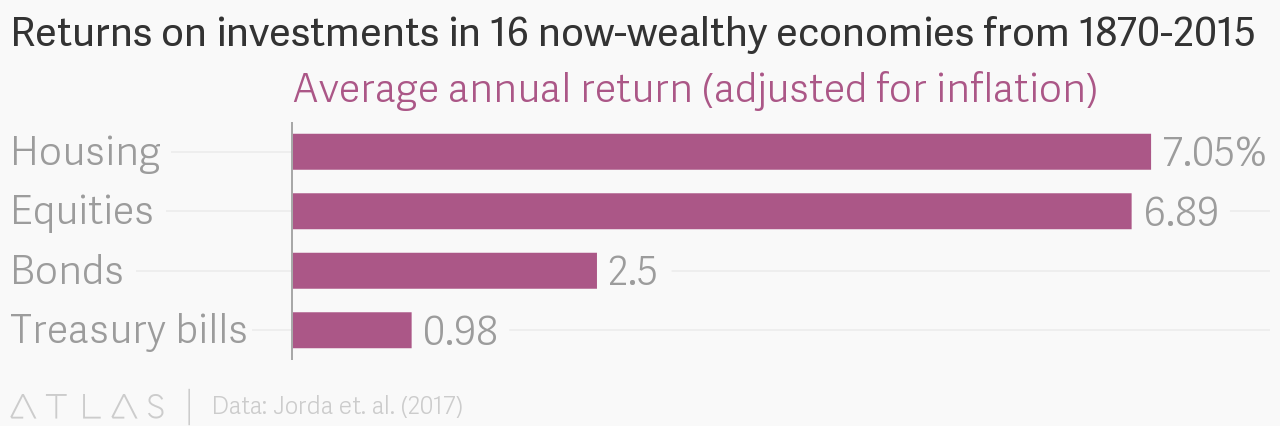
For the past 145 years, "housing" actually outperformed equity, though only slightly.
However, from 1980-2015, equities have, on average, performed significantly better than real estate. Across the 16 countries studied, equities earned an average annual return of 10.7 percent, decisively beating real estate’s stolid 6.4 percent.
I guess your perception of real estate/housing under-performed equity is formed during this period (1980 - 2015) only.
An interesting research for your reference, titled "The Rate of Return on Everything, 1870–2015?"
https://www.frbsf.org/economic-research/files/wp2017-25.pdf
The gist of it is this :
For the past 145 years, "housing" actually outperformed equity, though only slightly.
However, from 1980-2015, equities have, on average, performed significantly better than real estate. Across the 16 countries studied, equities earned an average annual return of 10.7 percent, decisively beating real estate’s stolid 6.4 percent.
I guess your perception of real estate/housing under-performed equity is formed during this period (1980 - 2015) only.

- Joined
- Jul 26, 2002
- Messages
- 5,136
- Reaction score
- 228
SpeedingBullet, can I say for the commoners like us, since we can't invest in PERE, the closest investible asset we can get is REIT (Commercial, Industrial, Logistics, Data Center, Retail, Healthcare)?
There are a few options, like Astrea IV bonds are PE linked. There are some PE ETFs available, though they are not cheap in terms of expense ratio. There are some PE unit trusts around, I think listed on iFast, but I believe they require AI status and/or going through an IFA.
revhappy
Arch-Supremacy Member
- Joined
- Mar 19, 2012
- Messages
- 12,208
- Reaction score
- 2,662
BBC, Shinny,
An interesting research for your reference, titled "The Rate of Return on Everything, 1870–2015?"
https://www.frbsf.org/economic-research/files/wp2017-25.pdf
The gist of it is this :
For the past 145 years, "housing" actually outperformed equity, though only slightly.
However, from 1980-2015, equities have, on average, performed significantly better than real estate. Across the 16 countries studied, equities earned an average annual return of 10.7 percent, decisively beating real estate’s stolid 6.4 percent.
I guess your perception of real estate/housing under-performed equity is formed during this period (1980 - 2015) only.
I don't think they have a perception of underperformance. They just don't want to overweight any one sector. Our lifetime is short compared to that period of study. What if RE underperforms only the next 20 years. Our lifetime is screwed.
I think 1 fully paid up house is must if our asset allocation allows for it. Beyond that I don't think we should overweight RE.
Last edited:
There are a few options, like Astrea IV bonds are PE linked. There are some PE ETFs available, though they are not cheap in terms of expense ratio. There are some PE unit trusts around, I think listed on iFast, but I believe they require AI status and/or going through an IFA.
Before subscribing for Astrea IV i actually went to have a look at whether a local investor investing in PE via SG-unit trust or LSE-listed investment trust would be better.
My impression is that the PE funds linked to Astrea IV appear to be higher quality (and possibly more diversified) than the PE funds otherwise available to local investors through unit trust/investment trust. Another reason why I pressed for as much Astrea IV as possible, and look at its price now!

I don't think they have a perception of underperformance. They just don't want to overweight any one sector. Our lifetime is short compared to that period of study. What if RE underperforms only the next 20 years. Our lifetime is screwed.
I think 1 fully paid up house is must if our asset allocation allows for it. Beyond that I don't think we should overweight RE.
They do have this perception, as they mentioned in some posts.
Showing 20 years of data, is deemed too short by some people, showing 145 years of data is deemed too long, oh well..
Anyway, my proposition is not to overweight on "housing", but rather - considering REIT as a viable component in asset allocation, which both BBC and Shinny agreed, for a more advanced investors, not newbie.
BBCWatcher
Arch-Supremacy Member
- Joined
- Jun 15, 2010
- Messages
- 23,412
- Reaction score
- 4,901
This approach broadly makes sense to me, but I'd like to add a some caveats:I think 1 fully paid up house is must if our asset allocation allows for it. Beyond that I don't think we should overweight RE.
1. Re: "paid up," you shouldn't accelerate repayment of a comparatively low cost mortgage, assuming you are a responsible saver and prudent investor, which you should be. Current mortgage interest rates in Singapore (as I write this) are comparatively low. You will surely be poorer if you pay off a low cost mortgage any faster than required instead of prudently investing the same sums in reliably higher yielding vehicles.
2. Due to the significant transaction costs, you shouldn't buy a home until you're at least reasonably confident you're going to live in it for several years or more.
3. You shouldn't necessarily, or even very often, buy the most expensive home that a mortgage lender will help you to buy. Just because a mortgage lender is willing to take a particular risk (not much -- the loan is secured by the home, and the lender gets the home if you cannot pay) doesn't mean you should.
4. At the same time, if the mortgage lender is willing to lend you money at a comparatively low interest rate, over a long term, and with no prepayment penalty, take the highest loan to value percentage allowed with the longest term allowed at that low interest rate. You can always convert a longer term mortgage to a shorter term mortgage: just accelerate repayment. You cannot do the opposite without refinancing, and then only if allowed/granted.
5. For those who are eligible, HDB BTOs tend to be very good deals, still.
6. There are occasional exceptions to general "rules of thumb." As one example, if you're trying to emigrate to a particular country via a retirement visa program, you might be required to buy a home of a certain minimum value, otherwise you cannot emigrate. In that case it could be prudent to maintain ownership in two homes, at least for some period of time.
Last edited:
Hippocrates
Member
- Joined
- Apr 11, 2005
- Messages
- 375
- Reaction score
- 80
They do have this perception, as they mentioned in some posts.
Showing 20 years of data, is deemed too short by some people, showing 145 years of data is deemed too long, oh well..
Anyway, my proposition is not to overweight on "housing", but rather - considering REIT as a viable component in asset allocation, which both BBC and Shinny agreed, for a more advanced investors, not newbie.
To me, purchasing IWDA means to invest in the economic growth of mankind (with biased towards the developed world in the absence an accompanying emerging world index). However, I couldn't see the logic to single REIT out as a viable component in asset allocation. Depending on investment timeframe studied, many sectors have the potential of outperforming the world index... why would a more advanced investor considers REIT but not other sectors like healthcare, consumer staples, and etc as viable components in asset allocation?

oAkEn86
Senior Member
- Joined
- May 7, 2005
- Messages
- 742
- Reaction score
- 0
Hi all, just to share on how to transfer USD from Singapore account to Interactive Brokers. Think many may know but some like me, may still be clueless.
In short, go DBS, create the eMCA account, deposit in the USD cheque (free; mine was local issued) and then do a bank wire (from IB side) and DBS remit (from DBS side). The remittance was amazingly fast. Less than an hour, think around 30mins and the money is in.
Had taken some screenshots on how to do it -
https://keykeytravels.blogspot.com/2019/04/transferring-usd-from-dbs-multicurrency.html
For sharing if you need it.
Was originally thinking of using usd high account but heard that need to be priority customer or something. Anyone can confirm this?
In short, go DBS, create the eMCA account, deposit in the USD cheque (free; mine was local issued) and then do a bank wire (from IB side) and DBS remit (from DBS side). The remittance was amazingly fast. Less than an hour, think around 30mins and the money is in.
Had taken some screenshots on how to do it -
https://keykeytravels.blogspot.com/2019/04/transferring-usd-from-dbs-multicurrency.html
For sharing if you need it.
Was originally thinking of using usd high account but heard that need to be priority customer or something. Anyone can confirm this?
To me, purchasing IWDA means to invest in the economic growth of mankind (with biased towards the developed world in the absence an accompanying emerging world index). However, I couldn't see the logic to single REIT out as a viable component in asset allocation. Depending on investment timeframe studied, many sectors have the potential of outperforming the world index... why would a more advanced investor considers REIT but not other sectors like healthcare, consumer staples, and etc as viable components in asset allocation?

Couple of reasons:
-REIT is an asset class by itself, while consumer staple and healthcare are common stocks.They are different "pie" in your AA.
-Example that you have quoted are significantly represented in IWDA, e.g consumer staple is 8% and and healthcare is around 12%,wheares real estate is merely 3%. Most of the real estate firms are property developers, so REIT might be less than 1% in IWDA.
-REIT consistently outperformed equity index in any 20 years rolling time frame.
Last edited:

Wishdom
Arch-Supremacy Member
- Joined
- Sep 15, 2014
- Messages
- 16,858
- Reaction score
- 1,066
I'm looking to step up some risk taking on my vwrd. What are some considerable ways to do so?
The finance textbook suggests some level of borrowing. This will allow us to adjust the risk level by varying the composition of borrowing and market portfolio. (borrow to buy more vwrd - is there such a thing as margin on a long term basis?)
How does this apply to real life?
Sent from Ilovennp using GAGT
The finance textbook suggests some level of borrowing. This will allow us to adjust the risk level by varying the composition of borrowing and market portfolio. (borrow to buy more vwrd - is there such a thing as margin on a long term basis?)
How does this apply to real life?
Sent from Ilovennp using GAGT
Last edited:
Shiny Things
Supremacy Member
- Joined
- Dec 13, 2009
- Messages
- 9,580
- Reaction score
- 804
I'm looking to step up some risk taking on my vwrd. What are some considerable ways to do so?
The finance textbook suggests some level of borrowing. This will allow us to adjust the risk level by varying the composition of borrowing and market portfolio. (borrow to buy more vwrd - is there such a thing as margin on a long term basis?)
My first question would be "why"? Leveraging up to buy more VWRD (or buy more anything) is inherently a pretty risky thing to do; are you worried that you won't have enough money when you retire?
If you've got a solid reason for doing it, then, yeah, you're basically just looking to take out a margin loan. There's no active derivatives market in VWRD, so you can't leverage up that way.
There's not really such a thing as long-term margin; margin loans are sort of inherently short-term. The interest rates usually get repriced daily. (That said, if there's an options market in the stock, you can synthesise a long-term fixed-rate "margin loan" by doing a synthetic forward.)
I dug around for MSCI World futures, but couldn't find any that do any meaningful volume.
One thought: BBCWatcher, do you know what the tax treatment's like for non-US investors trading options on US-listed equities, assuming you religiously roll the options positions instead of taking delivery of the stock? I'm wondering if a synthetic forward on VT equity would get Wishdom to the same place as a leveraged position in VWRD without any of the dividend taxes on VT, but also this feels a bit "if it were that easy everyone would do it".
I've got a mate in equity derivatives; I'll check in with him regarding whether derivatives dealers price the full dividend hit into their equity options prices or whether they discount them for tax somehow.
We have more perma bulls than bears when it comes to Chinese stocks. This is true across forums and analyst recommendations. Many fail to realise its not easy to play the "pump and dump" characteristics of the Chinese market. Sentiment changes very rapidly.
I'm, er... not quite sure what this means? Sentiment changes rapidly in every market; did you see how hard-and-fast the US rates market has swung around lately?
Anyway, if you're trying to chuck it around in Chinese onshore equities and you're looking for a trading vehicle rather than a long-term investment vehicle, I'm going to assume you aren't too worried about the A-H premium collapsing on you. In that case, yeah, you can use your CSI-300 ETF of choice, but watch out for that premium.
pmstudent said:BBC, Shinny,
An interesting research for your reference, titled "The Rate of Return on Everything, 1870–2015?"
Thank you!
I'm still not persuaded that there's any particular value in Singaporean investors - especially new investors - to spend the brokerage charges for a REIT allocation over and above the usual three-fund portfolio. (Also, I still find myself skeptical of the worth of piling into S-REITS after fifteen years of outperformance; that smacks of performance-chasing to me, which is always something I try to avoid.)
Maybe we agree to disagree on this one, though I've got no problem with you having a REIT allocation - or, for that matter, larger investors having a small allocation to REITs as part of their portfolio. This is a discussion we've had in the past; I've got no problem with larger investors having a "fun-money" account for active trading, or weird single-name stocks, or whatever they feel the need to trade. Better to scratch that itch with a side account than with your main account.
On that note:
If it is good, it is good for everybody.
Where got good for advanced investor & not newbie such thing?
Hey sugarbun. Firstly, welcome to the thread, but can I ask that you tone your posts down a little? We're not here to argue, and some of your posts come across as a little argumentative.
Anyway, the answer to this is that new investors benefit from two things:
- Keep it simple. Investing can be scary sometimes, especially when you're doing it yourself and doing it for the first time! Keeping the initial portfolio to three funds gives new investors all the benefits of diversification without dumping too much information on them.
- Small allocations mean large brokerage charges. This is why I tell new investors that they don't need an allocation to, say, EIMI or to high-yield bonds. The "normal" allocation to either of those would be about 5% of a diversified portfolio... but in a $10,000 portfolio, that's only $500 of stock. Even if you're only paying $10 brokerage at Stanchart, that puts you 2% behind already... it's like paying a 2% sales charge on an overpriced unit trust.
More generally, small allocations (anything under 5%) don't make any appreciable difference to your portfolio's returns. Any allocation under about 5% is just your fund manager fooling themselves.
If you have a 5% allocation to, say, high-yield bonds, and those high-yield bonds absolutely blow the doors off—let's say they outperform investment-grade by a full two percentage points a year for an entire ten-year economic cycle, which would be huge—that's still only a one-percentage-point gain on your entire portfolio. The rebalancing benefits won't be very big, either, for the same reasons.
Last edited:
BBCWatcher
Arch-Supremacy Member
- Joined
- Jun 15, 2010
- Messages
- 23,412
- Reaction score
- 4,901
That's an awfully thin argument, in my view. Healthcare stocks include pharmaceutical companies, and pharmaceutical companies (the primary ones anyway) are basically drug patent portfolios. Patents are certainly an "asset class." Healthcare stocks also include hospitals, and guess what they typically own? Hospital buildings, which is...real estate.-REIT is an asset class by itself, while consumer staple and healthcare are common stocks.They are different "pie" in your AA.
When you buy an oil company you're basically buying oil still in the ground, an "asset class." When you buy shares of Disney you're basically buying a vast copyright portfolio, an "asset class."
And "so what?" Just because somebody labels something an "asset class" doesn't make it something you ought to overweight or underweight. Horses represent an "asset class," but I don't think you should buy very many of them.
OK, but cannabis growers represent much less than 1% of IWDA. So that's clearly a problem, right? What percentage do you recommend we allocate to cannabis growers since they're so insignificantly represented in IWDA?-Example that you have quoted are significantly represented in IWDA, e.g consumer staple is 8% and and healthcare is around 12%,wheares real estate is merely 3%. Most of the real estate firms are property developers, so REIT might be less than 1% in IWDA.
....I think these are pretty weak arguments. If you feel strongly that you want to increase real estate exposure in your portfolio, then just do it! I wouldn't go overboard, but if real estate is your thing, it can be your thing. The asset class argument doesn't resonate with me at all.
A possibly stronger argument you might make is to take a look at the total market value of the whole planet, divide it up into various constituents -- real estate, cannabis growers, Armenia, whatever -- and then apply "correction" factors to the broadest index fund (with low costs) you can find, probably VWRD actually. But you'll need to be a little more scientific about this. As mentioned, hospital stocks own hospitals, and those are buildings (I'm quite sure). When you look at "real estate" you really have to dig into the actual underlying assets. And you just might find that the total market value of planetary real estate is (let's suppose) 12.8% of planetary wealth, and the total exposure to real estate (underlying and overt) in VWRD is...12.9%. For example. (Fictional numbers here.)
....And did we mention your own home equity counts and, for most people, it's a big percentage of household wealth, already?
....And then you can still decide to allocate whatever percentage you want to cannabis growers or anything else. You're perfectly free to do that! With or without a particular analysis.
Last edited:
Hippocrates
Member
- Joined
- Apr 11, 2005
- Messages
- 375
- Reaction score
- 80
Thanks for the explanations. I've more noob questions on the fundamental knowledge of REIT.
How do you define REIT as a separate asset class? Is it based on arbitrary classification or there are fixed criteria for that (for example, is there a cutoff correlation value for it to be considered different from equity). Would such criteria translate to diversification benefit compared to other sectors?
There are plenty of REIT counters in IWDA, but I couldn't find a single counter for bonds, commodities or precious metal. Is that sufficient to argue that REIT is a subset of common stock and not a unique asset class as far as the two recommendations here are concerned - IWDA and ES3?
I did a quick addition of all REITS in IWDA and it worked out to be ~1.8%. I do not know where to find accurate numbers of of REIT vs total equity market capitalisation, but the following sources could give some hints:
REIT ~US$1.7 trillions (2017, EY's global REIT market report)
Equity ~US$79.225 trillions (2017, World bank data)
So, REIT doesn't seem to be grossly underrepresented in IWDA compared to the economic reality of the world.
'Any' 20-years sound pretty astonishing if it's true. Can you please refer me to the source to examine closer on the distribution of outperformance? I wonder how many data points did they look at to be able to say that it's consistent.
Couple of reasons:
-REIT is an asset class by itself, while consumer staple and healthcare are common stocks.They are different "pie" in your AA.
How do you define REIT as a separate asset class? Is it based on arbitrary classification or there are fixed criteria for that (for example, is there a cutoff correlation value for it to be considered different from equity). Would such criteria translate to diversification benefit compared to other sectors?
There are plenty of REIT counters in IWDA, but I couldn't find a single counter for bonds, commodities or precious metal. Is that sufficient to argue that REIT is a subset of common stock and not a unique asset class as far as the two recommendations here are concerned - IWDA and ES3?
-Example that you have quoted are significantly represented in IWDA, e.g consumer staple is 8% and and healthcare is around 12%,wheares real estate is merely 3%. Most of the real estate firms are property developers, so REIT might be less than 1% in IWDA.
I did a quick addition of all REITS in IWDA and it worked out to be ~1.8%. I do not know where to find accurate numbers of of REIT vs total equity market capitalisation, but the following sources could give some hints:
REIT ~US$1.7 trillions (2017, EY's global REIT market report)
Equity ~US$79.225 trillions (2017, World bank data)
So, REIT doesn't seem to be grossly underrepresented in IWDA compared to the economic reality of the world.
-REIT consistently outperformed equity index in any 20 years rolling time frame.
'Any' 20-years sound pretty astonishing if it's true. Can you please refer me to the source to examine closer on the distribution of outperformance? I wonder how many data points did they look at to be able to say that it's consistent.
BBCWatcher
Arch-Supremacy Member
- Joined
- Jun 15, 2010
- Messages
- 23,412
- Reaction score
- 4,901
While I see where you're going and largely agree with your logic (since I'm making similar arguments), in fairness commodities and precious metals are genuinely represented in IWDA. Oil is a commodity, and oil company stock prices are highly correlated to oil prices. IWDA certainly contains several oil stocks. Likewise, agribusiness share prices are highly correlated to the prices of agricultural commodities (soybeans, wheat, corn, etc.) I'm quite sure the share price of Tyson Foods (TSN on the New York Stock Exchange) is highly sensitive to poultry and poultry feed prices as another example.There are plenty of REIT counters in IWDA, but I couldn't find a single counter for bonds, commodities or precious metal.
As for precious metals, there are mining companies in IWDA, so there you go.
It's of course possible to quibble with the composition of IWDA (or even the broader VWRD) since it's impossible to represent the planet in all its wonderful diversity. But from an investment point of view they're amazingly diverse.

appl888
Supremacy Member
- Joined
- Nov 9, 2017
- Messages
- 7,646
- Reaction score
- 0
Are you writing
A blank verse
Poem?
You don't need
So many
Line breaks.
But BBCW is right. Just because something's a long way below its all-time high doesn't mean it's cheap.
Oh my
I didn’t know
Just happily pressed the return button a few more times
Chinese market way bigger than japan and their population ain’t shrinking
By that “logic,” so is Japan. The Nikkei 225’s peak was hit in 1989. Why don’t you buy stocks listed in Japanese stock markets? Great deal, right? (And for the past quarter century or so.) How about putting at least 50% of your net worth into Japanese stocks?
....Oh, that’s right, you don’t like the current story, the narrative, the mythology about Japan and Japanese stocks.
Don’t try to time markets. Don’t try to play favorites. That’s gambling, usually. Just pick a well diversified portfolio allocation, doggedly save and mechanically invest, and (as Shiny Things suggests) go to the pub. If you ignore this sage advice, at least only ignore it with very small amounts of money strictly after you have become very wealthy.
Nope, I won’t buy anything with jpy
Travel and I would may be change some Yen and that’s it
But Long term, nah
Don’t quite like their low treasury interest rates
That's an awfully thin argument, in my view. Healthcare stocks include pharmaceutical companies, and pharmaceutical companies (the primary ones anyway) are basically drug patent portfolios. Patents are certainly an "asset class." Healthcare stocks also include hospitals, and guess what they typically own? Hospital buildings, which is...real estate.
When you buy an oil company you're basically buying oil still in the ground, an "asset class." When you buy shares of Disney you're basically buying a vast copyright portfolio, an "asset class."
And "so what?" Just because somebody labels something an "asset class" doesn't make it something you ought to overweight or underweight. Horses represent an "asset class," but I don't think you should buy very many of them.
Hmm....that's a logical argument, one has the right to challenge the "asset class" that deemed conventional. Everything can be an asset class by itself.
Burton Malkiel (Random Walk Down wall Street) Asset Allocation Guidelines 2007 looks like this :

The above is the from his book
http://docs.google.com/Doc?id=dg53rhrv_13f4xh2p
More here :
https://www.portfolioeinstein.com/burton-malkiel-portfolio-no-random-returns-here/
For all we know, he maybe as confused as me, defining REIT as an asset class along cash, domestic stock, international stock and bonds.
But I agree with your logic, both oil and Intellectual Property can be a unique asset class that is not correlated with other asset classes.
OK, but cannabis growers represent much less than 1% of IWDA. So that's clearly a problem, right? What percentage do you recommend we allocate to cannabis growers since they're so insignificantly represented in IWDA?
....I think these are pretty weak arguments. If you feel strongly that you want to increase real estate exposure in your portfolio, then just do it! I wouldn't go overboard, but if real estate is your thing, it can be your thing. The asset class argument doesn't resonate with me at all.
A possibly stronger argument you might make is to take a look at the total market value of the whole planet, divide it up into various constituents -- real estate, cannabis growers, Armenia, whatever -- and then apply "correction" factors to the broadest index fund (with low costs) you can find, probably VWRD actually. But you'll need to be a little more scientific about this. As mentioned, hospital stocks own hospitals, and those are buildings (I'm quite sure). When you look at "real estate" you really have to dig into the actual underlying assets. And you just might find that the total market value of planetary real estate is (let's suppose) 12.8% of planetary wealth, and the total exposure to real estate (underlying and overt) in VWRD is...12.9%. For example. (Fictional numbers here.)
....And did we mention your own home equity counts and, for most people, it's a big percentage of household wealth, already?
....And then you can still decide to allocate whatever percentage you want to cannabis growers or anything else. You're perfectly free to do that! With or without a particular analysis.
True, I can't possibly know the actual representation of REIT in real world global economy, therefore could easily over-weighted on that.
Last edited:
- Status
- Not open for further replies.
Important Forum Advisory Note
This forum is moderated by volunteer moderators who will react only to members' feedback on posts. Moderators are not employees or representatives of HWZ Forums. Forum members and moderators are responsible for their own posts.
Please refer to our Community Guidelines and Standards and Terms and Conditions for more information.
