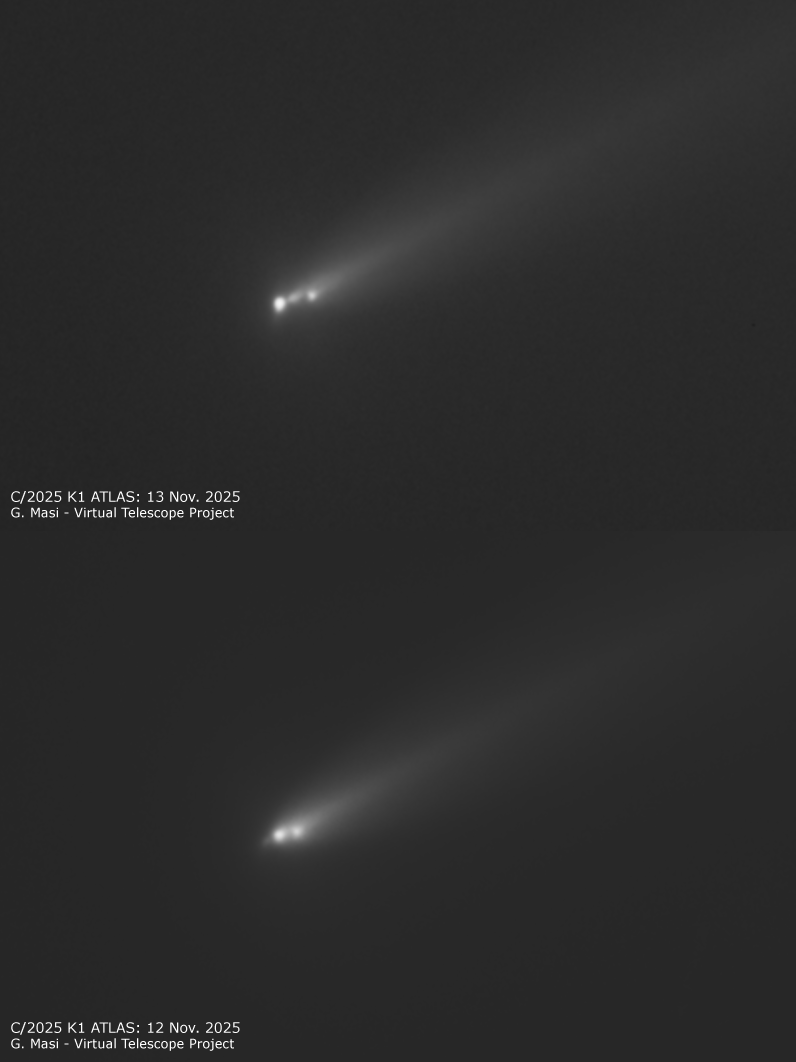
3i/Atlas Update!

Potato_Wedges

Banned
Joined
Jan 31, 2020
Messages
13,550
Reaction score
12,565
All fake news.

Come 2040...your kids will still be paying $millions for BTO & $300,000 COE. Pap still in Power.
NOTHING HAS CHANGED !!!
 

tmkedmw

Banned
Joined
Feb 16, 2013
Messages
34,389
Reaction score
24,575

https://www.space.com/stargazing/interstellar-comet-3i-atlass-tail-is-still-growing-new-image-shows

Interstellar comet 3I/ATLAS's tail is still growing, new image shows​

News
By Samantha Mathewson published 6 hours ago

Interstellar comet 3I/ATLAS exhibits a bright, extended ion tail while releasing gas and dust as it travels through the inner solar system.

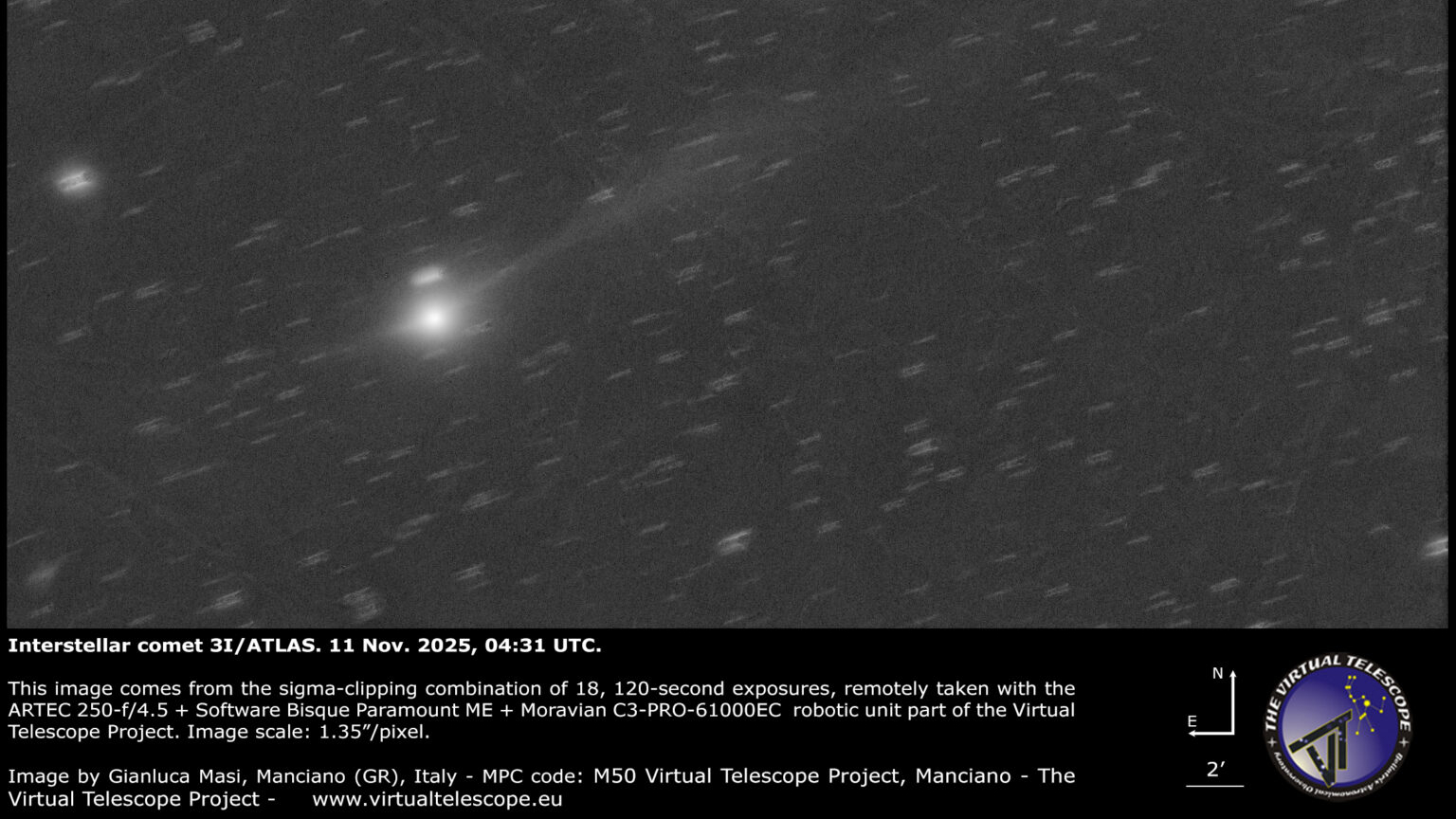
a grayscale image showing a white dot of 3I/ATLAS with a long white tail behind it.

Interstellar comet 3I/ATLAS photographed by the Virtual Telescope Project at 11:31 p.m. EDT on Nov. 10 (0431 GMT Nov. 11), showing a bright nucleus and a sharply defined ion tail. (Image credit: The Virtual Telescope Project)

A stunning new image of interstellar comet 3I/ATLAS (C/2025 N1 ATLAS) reveals the cosmic visitor's ion tail has grown dramatically longer and more structured — a sign of intensifying activity as it continues its journey through the inner solar system.

The image, captured by the Virtual Telescope Project at 11:31 p.m. EDT on Nov. 10 (0431 GMT on Nov. 11), is composed of 18 separate 120-second exposures, remotely taken by robotic telescopes located in Manciano, Italy. Despite the comet being just 14 degrees above the eastern horizon and a bright 61% moon shining about 70 degrees away, a sharply defined, luminous ion tail is seen.

"Exploiting the unusual good weather of this season, we imaged the interstellar comet 3I/ATLAS (C/2025 N1 ATLAS) again, recording a much more developed ion tail," Gianluca Masi, Virtual Telescope Project founder and astronomer, said in a post sharing the new image. "Looking at the picture, we see how the ion tail of 3I/ATLAS is clearly showing better and better."

An ion tail forms when the sun's ultraviolet radiation strips electrons from gas molecules released by the comet, turning them into charged ions. These ions are then swept away by the solar wind — a constant stream of charged particles flowing outward from the sun — creating a long, often bluish tail that always points directly away from the sun regardless of the comet's direction of travel. This tail differs from the dust tail, which tends to appear yellowish-white and curves gently along the comet's orbital path.
 

tmkedmw

Banned
Joined
Feb 16, 2013
Messages
34,389
Reaction score
24,575

3I/ATLAS is Still a Single Body with a Sunward Anti-Tail After Perihelion!​

Avi Loeb
5 min read
1 hour ago

Press enter or click to view image in full size
1*EDiT00zUPmn4OljSPSE9jw.png

Press enter or click to view image in full size
1*IMuuUXSQWWZQCPVCga3Zvw.png

Press enter or click to view image in full size
1*0Vgyo0dtP0QoA0348WN3Og.png

Press enter or click to view image in full size
1*wY3tXWhAF2ffXDHuQgmWWQ.png

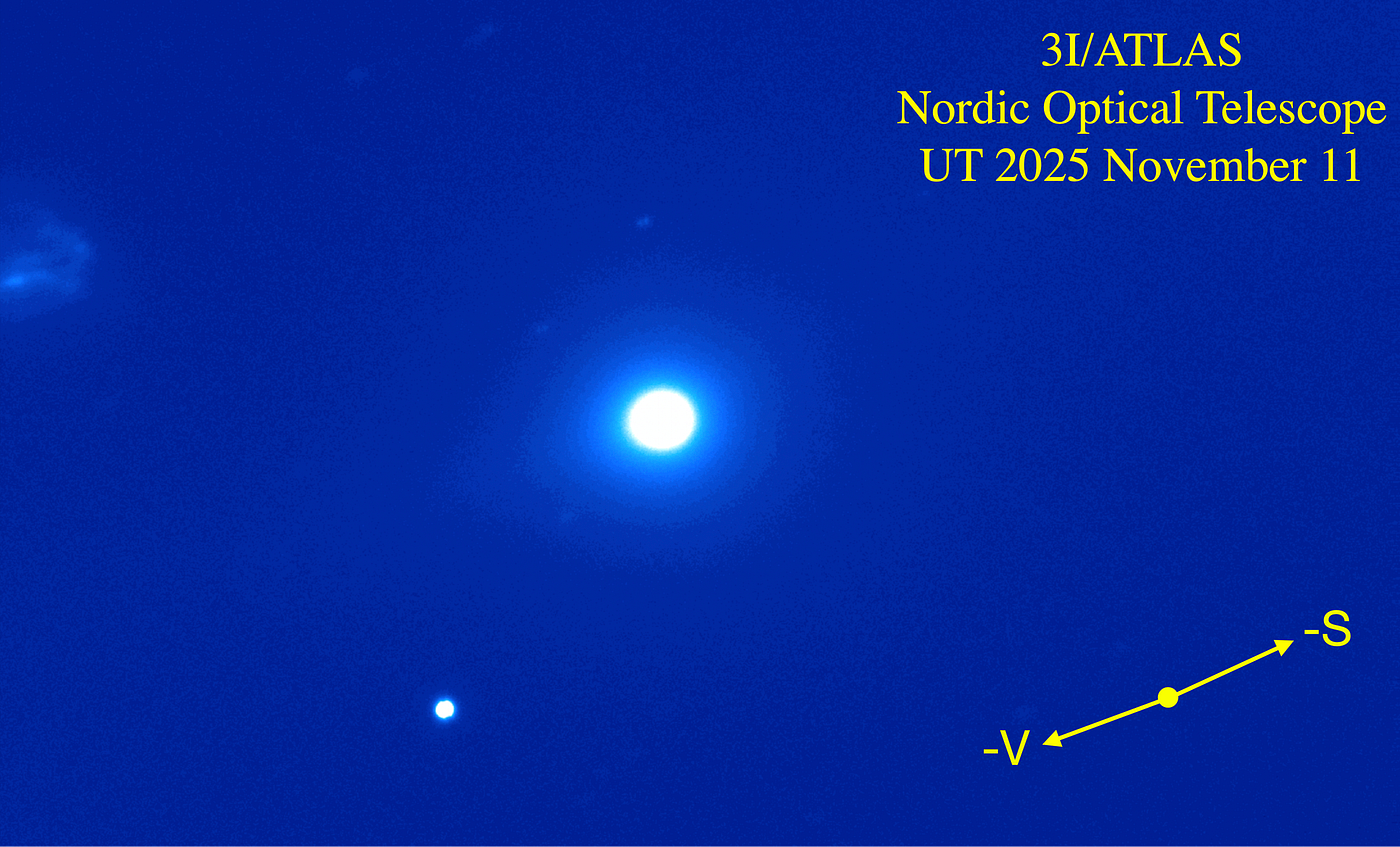
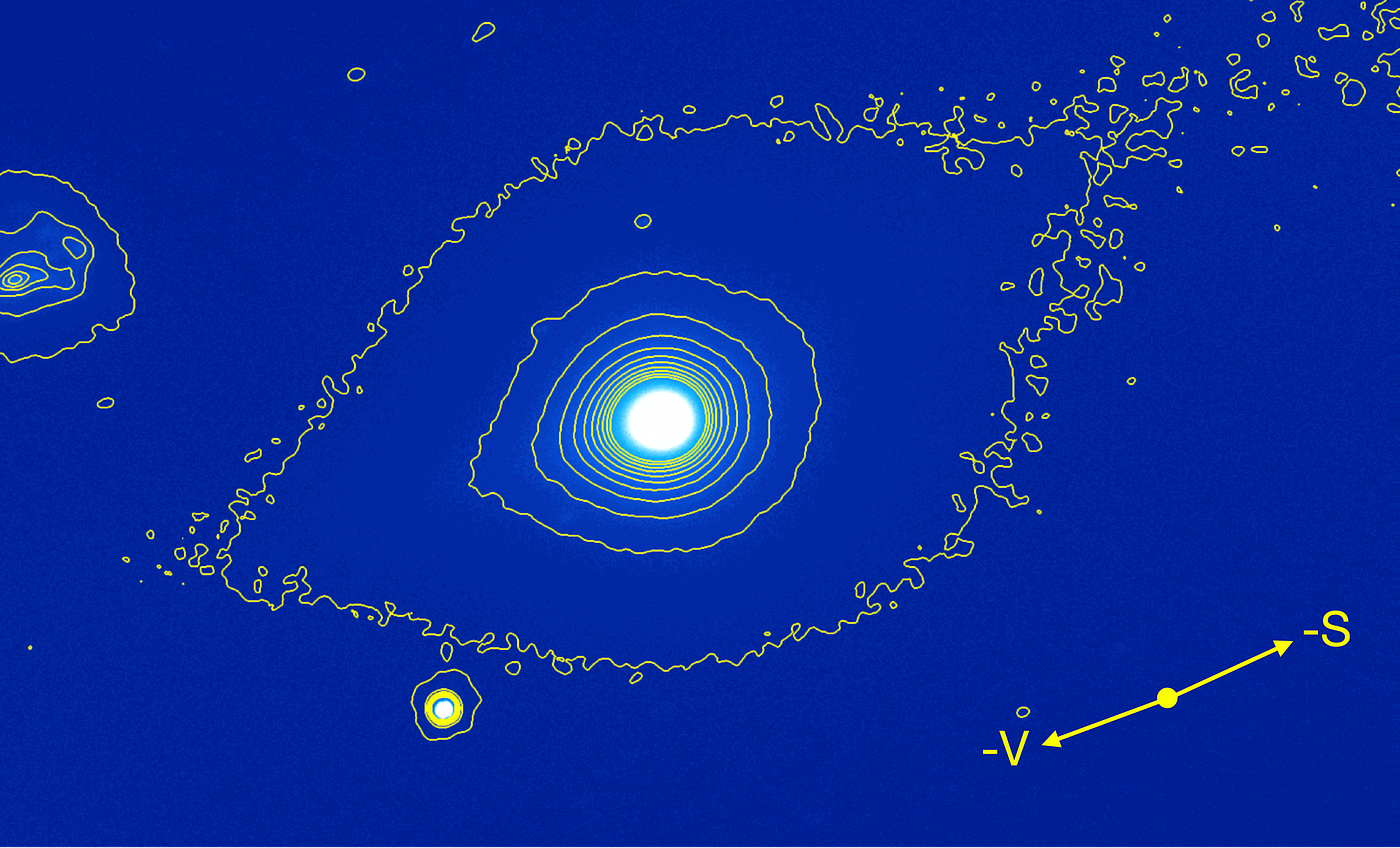
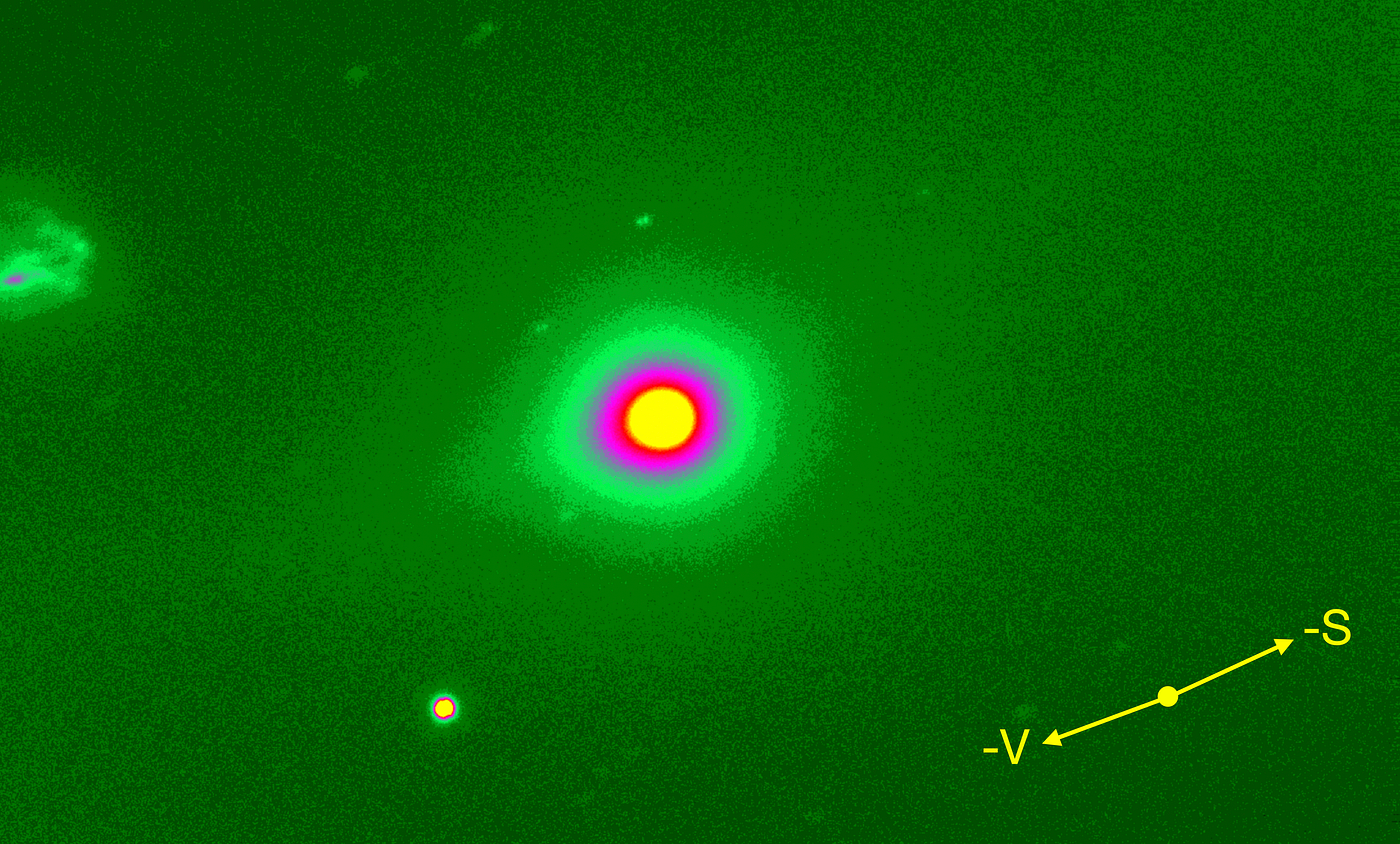
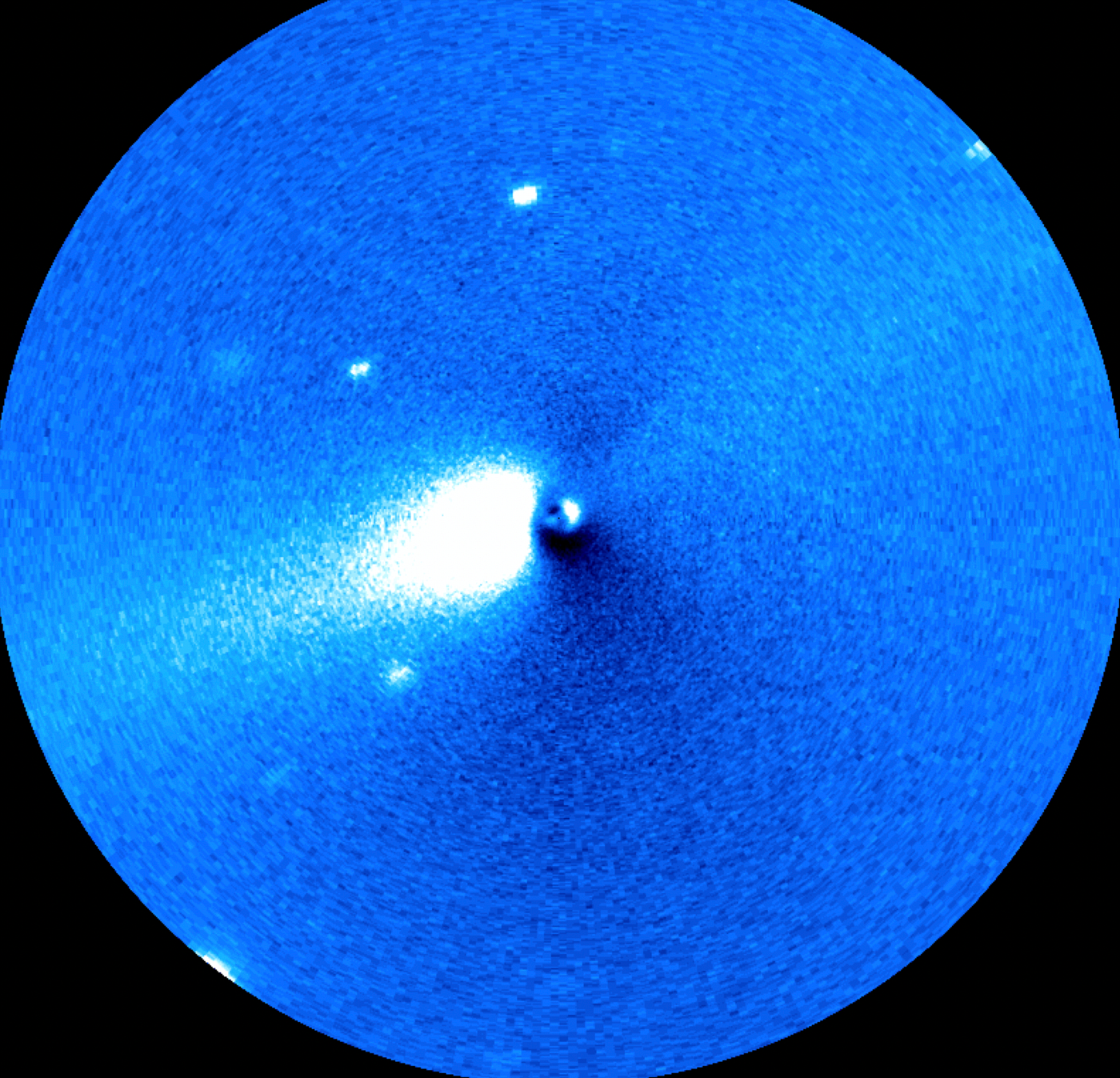
New images of 3I/ATLAS from the Nordic Optical Telescope on November 11, 2025.

The jet is pointing towards the Sun. North is to the top, East to the left, and the imaged region is approximately 0.5 million km wide. The projected anti-solar direction (-S) and negative heliocentric velocity vector (-V) are marked. The diffuse object to the upper left of 3I/ATLAS is a galaxy.

Other discrete objects are stars. The images are: linear stretch (top panel), contoured (second from top), color contoured (third from top), and spatially filtered within a 0.13 million km radius region by subtracting the median signal in concentric annuli centered on the brightest pixel (bottom panel). (Credit: David Jewitt and Jane Luu, posted here)

Breaking News: The interstellar object 3I/ATLAS did not break up near the Sun.
Images taken of 3I/ATLAS on November 11, 2025 show a single body, with no evidence for breakup following the perihelion passage two weeks earlier.

The images, reported here, were taken by David Jewitt and Jane Luu on the Nordic Optical Telescope with a primary mirror of 2.56-meter diameter, located at La Palma in the Canary Islands.

The prominent elongation in the glow surrounding 3I/ATLAS projects to a position angle of 106 (+/-10) degrees. This is close to the projected sunward direction of 115 degrees.

It resembles the image obtained by the Hubble Space Telescope on July 21, 2025, which showed an anti-tail pointing towards the Sun (as reported here and analyzed here). The new image also shows a weaker asymmetry at a position angle of 301 (+/-1) degrees, which is close to the projected anti-solar direction of 295 degrees.

In units of the Earth-Sun separation (astronomical units=au), the distances of 3I/ATLAS from the Sun and Earth were 1.43 au and 2.16 au, respectively. The imaged region is approximately half a million kilometers wide.

The long-range jet structures evident in recent wide-field pictures taken in recent days (see here and here) are not evident in this data, probably because it was taken through an R-band filter that excluded most of the gaseous emission lines.

Given the large-scale jets reported recently, the fact that 3I/ATLAS remains a single body is surprising for a natural comet. In particular, the large-scale image of 3I/ATLAS reported here on November 9, 2029 shows jets reaching out to ~1 million kilometers towards the Sun and ~3 million kilometers in the opposite direction, as discussed here.

For a natural comet, the outflow velocity of the jets is expected to be 0.4 kilometers per second, of order the sound speed of gas at the distance of 3I/ATLAS from the Sun. At that speed, the jets must have persisted over a timescale of 1–3 months.

Given that the jets towards the Sun were stopped by the solar wind at a distance of a million kilometers, I calculated here that their mass density is a few million proton masses per cubic centimeter at a distance of a million kilometers from 3I/ATLAS. The product of this mass density and the outflow speed, implies a mass flux of 5 billion tons per month per area of a million-kilometer on a side.

The sublimation of carbon dioxide (CO2) ice requires an energy of 600 Joules per gram. In order to sublimate ~5 billion tons of CO2 over the perihelion passage period of a month, 3I/ATLAS must have received at least 3x10^{18} Joules. At its perihelion distance, the Sun provided 700 Joules per square meter per second, requiring an absorbing area larger than 1,600 square kilometers.

This is the area of a sphere with a diameter of 23 kilometers, 4 times larger than the maximum diameter of 5.6 kilometers inferred for 3I/ATLAS from the imaging data of the Hubble Space telescope reported here. The required diameter is 51 kilometers for water ice. On natural cometary nuclei, the pockets of ice often cover a small fraction of the total surface, making the above numbers untenable for 3I/ATLAS as a single body that maintained its integrity and did not break up into numerous fragments.

This raises a new anomaly of 3I/ATLAS that must be explained by those who wish to shove the anomalies of 3I/ATLAS under the carpet of traditional knowledge on solar system comets rather than consider alternatives. As Albert Einstein said: “Knowledge is realizing that the street is one way; wisdom is looking in both directions anyway.”

Technological thrusters which point their exhaust towards the Sun would accelerate away from the Sun. This post-perihelion maneuver might be employed by a spacecraft that aims to gain speed rather than slow down through the gravitational assist from the Sun

 

tmkedmw

Banned
Joined
Feb 16, 2013
Messages
34,389
Reaction score
24,575

The Continuing Saga of Anti-Tails and Tails around 3I/ATLAS

https://avi-loeb.medium.com/the-continuing-saga-of-anti-tails-and-tails-around-3i-atlas-75434ba2a390

Avi Loeb

5 min read
19 hours ago

1*05wkUk8RTn4LzeAp9SvB9A.jpeg

Press enter or click to view image in full size

1*QEMFoB2hsoDTh5W0dsFQRg.jpeg

An image of 3I/ATLAS, taken at 22:06 UTC on November 15, 2025, shows a prominent anti-tail along with two tails. The sunward direction is pointing to the lower left corner. (Credit: Teerasak Thaluang, MPC-051, Rayong, Thailand)

As of November 15, 2025, the interstellar object 3I/ATLAS still displays a prominent anti-tail as well as tails, according to a new image released by Teerasak Thaluang from a 0.26-meter telescope in Thailand.

The physics behind the anti-tail of 3I/ATLAS is unclear. For a natural comet, it could be associated with the release of giant dust particles with an effective radius of ~100 micrometers (as suggested by David Jewitt and collaborators here and here). These particles are a million times more massive than the typical micrometer-scale dust which scatters sunlight most effectively because it is comparable in size to the wavelength of the radiation.

Since the ratio of surface area — which scales as particle radius squared, to mass — which scales as radius cubed, is 100 times smaller for these giant particles relative to their smaller counterparts, they will not be accelerated away from the Sun by radiation pressure as effectively as micrometer dust in familiar comets. However, the amount of mass loss in 100-micrometer particles must be 100 times larger than the corresponding value for micrometer particles in order to produce the same brightness of scattered sunlight.

Another possibility is that instead of refractory dust particles that survive solar heating, the scattering of sunlight is produced by fragments of ice which get evaporated before having a chance to turn around and produce a traditional cometary tail away from the Sun (as I suggested with Eric Keto here and here).

Finally, there is the more speculative possibility that the anti-tail is a result of technological thrusters which accelerate 3I/ATLAS away from the Sun through tightly collimated jets that penetrate a million kilometers through the Solar wind because of their high speed. Future spectroscopic data will be able to calibrate the outflow speed and distinguish between natural outgassing which results in a characteristic speed of up to a few hundred meters per second and artificial jets which produce speeds above a few kilometers per second.

Figuring things out through the collection of data resembles the work of a detective. With the flood of data on 3I/ATLAS in the coming weeks — leading to its closest approach to Earth on December 19, 2025, we should be able to figure out its nature.
 
Important Forum Advisory Note
This forum is moderated by volunteer moderators who will react only to members' feedback on posts. Moderators are not employees or representatives of HWZ Forums. Forum members and moderators are responsible for their own posts. Please refer to our Community Guidelines and Standards and Terms and Conditions for more information.
Top