Buddhist Verses & Silent Readings For Reflection (静思语) - Part 6

Knightoftheblackrose

Arch-Supremacy Member
Joined
Oct 18, 2010
Messages
20,030
Reaction score
14,875
Copy%20of%20S-4.jpg


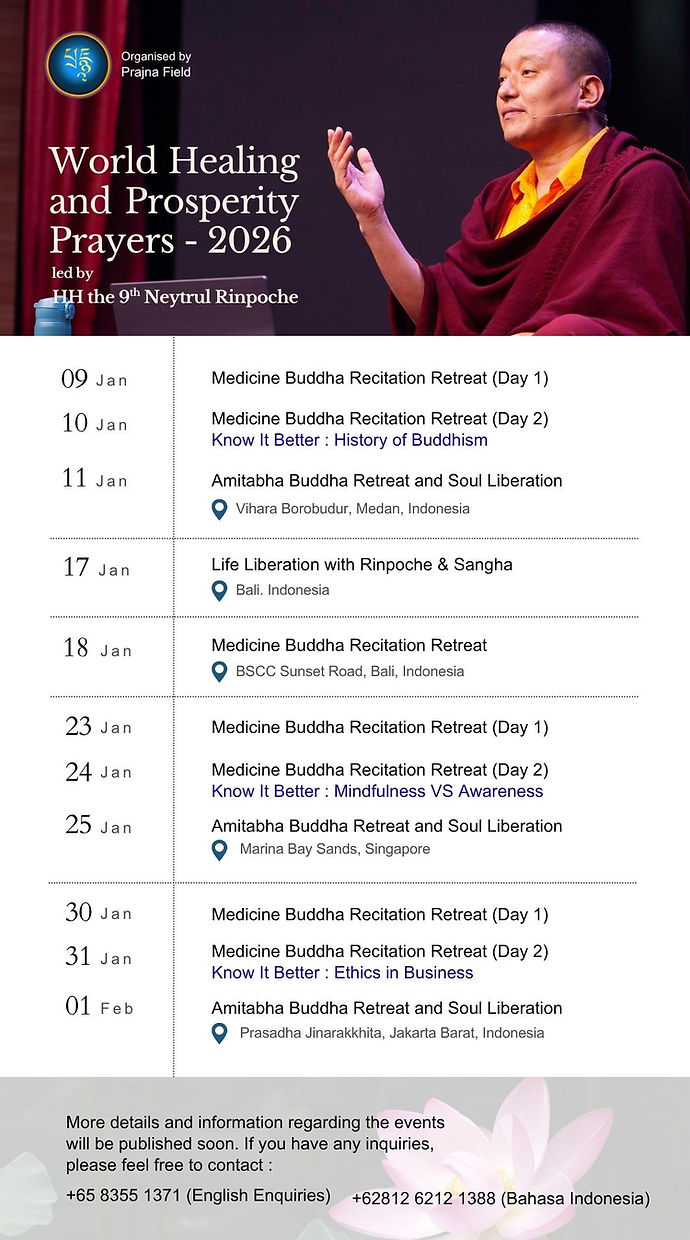
Singapore Event Registration Link:
https://forms.gle/rm2n4RNYyQC3vP119

🙏 🙏 🙏
 

AUTUMN&WINTER

High Supremacy Member
Joined
Sep 29, 2011
Messages
28,236
Reaction score
28,447
I have just finished my online course on 佛说无量寿经. Shifu explained a few important teachings which I would like to share. Shifu said Buddhism is not teaching us to lay flat but to stand firmly 站得稳. This verse in 佛说无量寿经 is very important :设满世界火,必过要闻法,会当成佛道,广度生死流. It means even if this world is in chaos, we must also try our best to learn the Dharma, to attain Buddhahood, liberate from rebirth and help others to liberate from rebirth in samsara. Shifu said if one who does not know Buddhism, one will do the wrong things when face with difficulties in life which lead to more sufferings.
 
Last edited:

AUTUMN&WINTER

High Supremacy Member
Joined
Sep 29, 2011
Messages
28,236
Reaction score
28,447
By reciting Namo Amitabha Buddha, we are protected by the Buddhas and Sages.

念佛佛圣护


Those who verbally recite Amitabha Buddha’s Name are greatly praised. In the Contemplation Sutra, the Buddha praises them as “the pundarika flowers among humans.” “#Pundarika_flower” refers to the great white lotus, which possesses many fine virtues and carries very beautiful meanings, such as fragrance and purity, free from defilement. Those who verbally recite Amitabha Buddha’s Name bear the fragrance of rebirth in the Land of Ultimate Bliss and thus are praised as “pundarika flowers.”


Calling upon the sacred name "Namo Amituofo".


493068024_2766734816851764_9148597796091433524_n.jpg


NAMO KUAN SHI YIN PUSA 南无大慈大悲观世音菩萨


599592158_1897491837809154_596187812586293427_n.jpg


“Meditation is not about getting rid of thoughts or emotions.
It is about changing our relationship with them.”
~ Mingyur Rinpoche


490652440_2753811198144126_928630469955450790_n.jpg


494030050_8735277923241829_6418641069870135792_n.jpg


599462162_1302830501887908_7624289198589776785_n.jpg


599920610_25938236742450180_8092193730132470358_n.jpg
 

waterbright

Senior Member
Joined
Apr 20, 2018
Messages
2,207
Reaction score
11,786
At that time in Vārāṇasī there was young man of good family named Yasa—delicate, a moneylender’s son. He had three palaces: one for the cold season, one for the hot season, and one for the rainy season. During the four months of the rainy season he was entertained in the rainy-season palace by minstrels without a single man among them, and he did not come down once from the palace.

Then the young man Yasa, enjoying himself, provided & endowed with the five strings of sensuality, fell asleep first. Then his retinue fell asleep afterward. An oil lamp was left burning the whole night.

Then Yasa, waking up first, saw his retinue sleeping—one with a lute under her arm, another with a mudiṅga drum around her neck, another with an āḷambara drum on her chest, another with disheveled hair, another drooling, another babbling in her sleep—like a charnel ground, as it were, right within reach. Seeing this, the drawbacks [of sensuality] became apparent, and his mind became established in disenchantment. He exclaimed: “How distressing! How oppressive!”

Then Yasa put on his golden slippers and went to the door of the residence. Non-human beings opened the door, (thinking,) “May there not be any obstacles to Yasa’s Going-forth from home into homelessness.” Then Yasa went to the gate of the city. Non-human beings opened the gate, (thinking,) “May there not be any obstacles to Yasa’s Going-forth from home into homelessness.” Then Yasa went to the Isipatana game reserve.

At that time, the Blessed One, having gotten up as the night was ending, was walking back and forth in the open air. He saw Yasa coming from afar and, on seeing him, got down from the walking path and sat down on a seat laid out.

Yasa, not far from the Blessed One, exclaimed: “How distressing! How oppressive!”

Then the Blessed One said to Yasa, “Yasa, this isn’t distressing. This isn’t oppressive. “Come, Yasa. Sit down. I'll teach you the Dhamma.”

Then Yasa, (thinking,) “He says this isn’t distressing, this isn’t oppressive,” thrilled & exultant, took off his golden slippers, went to the Blessed One and, on arrival, having bowed down to him, sat to one side. As he was sitting there, the Blessed One gave him a graduated talk: a talk on giving, a talk on virtue, a talk on heaven; he proclaimed the drawbacks of, degradation in, & defilement in sensuality, and the rewards of renunciation. Then—when he knew that Yasa was of ready mind, malleable mind, unhindered mind, exultant mind, confident mind—he proclaimed to him the distinctive teaching of the Buddhas: stress, origination, cessation, path. Just as a clean piece of cloth, free from grime, would properly take dye, in the same way, the dustless, stainless Dhamma eye arose for Yasa as he was sitting right there: “Whatever is subject to origination is all subject to cessation.”

Then Yasa’s mother, going up into the palace and not seeing Yasa, went to the moneylender and, on arrival, said to him, “Householder, your son Yasa is nowhere to be seen.”

So the moneylender sent messengers on horseback out in the four directions whereas he himself went to the Isipatana game reserve. He saw the tracks of the golden slippers and, on seeing them, followed them.

The Blessed One saw him coming from afar, and the thought occurred to him, “Why don’t I fabricate a fabrication of supranormal power such that the moneylender, sitting here, wouldn’t see Yasa sitting here?” So the Blessed One fabricated such a fabrication of supranormal power.

The moneylender approached the Blessed One and said, “Perhaps, lord, the Blessed One has seen Yasa, the son of a good family?”

“In that case, householder, sit down. Perhaps, sitting here, you might see Yasa sitting here.”

Then the moneylender—(thinking,) “He says I might, sitting right here, see Yasa sitting here,” thrilled & exultant, bowed down to the Blessed One and sat to one side. As he was sitting there, the Blessed One gave him a graduated talk: a talk on giving, a talk on virtue, a talk on heaven; he proclaimed the drawbacks of, degradation in, & defilement in sensuality, and the rewards of renunciation. Then—when he knew that the moneylender was of ready mind, malleable mind, unhindered mind, exultant mind, confident mind—he proclaimed to him the distinctive teaching of the Buddhas: stress, origination, cessation, path. Just as a clean piece of cloth, free from grime, would properly take dye, in the same way, the dustless, stainless Dhamma eye arose for the moneylender as he was sitting right there: “Whatever is subject to origination is all subject to cessation.”

Then the moneylender, having seen the Dhamma… said to the Blessed One, “Magnificent, lord! Magnificent! Just as if he were to place upright what was overturned, to reveal what was hidden, to show the way to one who was lost, or to carry a lamp into the dark so that those with eyes could see forms, in the same way, has the Blessed One—through many lines of reasoning—made the Dhamma clear. I go to the Blessed One for refuge, to the Dhamma, & to the Saṅgha of monks. May the Blessed One remember me as a lay follower who has gone for refuge from this day forward, for life.”

And so he was the first three-statement lay disciple in the world.

As Yasa’s father was being taught the Dhamma, and as Yasa was reflecting on his own state (of mind) as he saw and knew it, his mind was, through lack of clinging/sustenance, released from effluents. Then the thought occurred to the Blessed One, “As Yasa’s father was being taught the Dhamma, and as Yasa was reflecting on his own state (of mind) as he saw and knew it, his mind was, through lack of clinging/sustenance, released from effluents. It would be impossible for Yasa to revert to the lower life and indulge in sensuality as he did before as a householder. Why don’t I make that fabrication of supranormal power subside?”

So the Blessed One made that fabrication of supranormal power subside. The moneylender saw Yasa sitting there and on seeing him said to him, “Yasa, my son, your mother is lamenting and full of grief. Give your mother her life!”

Then Yasa looked to the Blessed One, so the Blessed One said to the moneylender, “What do you think, householder: For one who has seen and known the Dhamma with the knowledge and vision of one in training, just as you have, reflecting on this state (of mind) as he saw and knew it, whose mind was, through lack of clinging/sustenance, released from effluents: Would it be possible for him to revert to the lower life and indulge in sensuality as he did before as a householder?”

“No, lord.”

“Householder, Yasa has seen and known the Dhamma with the knowledge and vision of one in training, just as you have. Reflecting on his own state as he saw and knew it, his mind was, through lack of clinging/sustenance, released from effluents. It would be impossible for Yasa to revert to the lower life and indulge in sensuality as he did before as a householder.”

“It’s a gain for Yasa, lord, a great gain for Yasa, that his mind is, through lack of clinging/sustenance, released from effluents! May the Blessed One acquiesce to my meal tomorrow, with Yasa as your attendant monk.”

The Blessed One acquiesced with silence.

Then the moneylender, understanding the Blessed One’s acquiescence, got up from his seat, bowed down to the Blessed One, circumambulated him, keeping him to his right, and left.

Then Yasa, not long after the moneylender had left, said to the Blessed One, “May I receive the Going-forth in the Blessed One’s presence?
May I receive the Acceptance?"

“Come, monk,” said the Blessed One. “Well taught is the Dhamma. Live the holy life.”60

That was the venerable one’s Acceptance.

Now there were seven arahants in the world. — Mv 1:7

 

sheamus

Senior Member
Joined
Jun 6, 2017
Messages
1,882
Reaction score
6,897
Ajahn Chah listened to one of his disciples recite the Heart Sutra. When he had finished, Ajahn Chah said, "No emptiness either... no bodhisatta." He then asked, "Where did the sutra come from?" "It’s reputed to have been spoken by the Buddha," the follower replied. "No Buddha," retorted Ajahn Chah. Then he said, "This is talking about deep wisdom, beyond all conventions. How could we teach without them? We have to have names for things, isn’t that so?

(Ajahn Chah)

17 December 2025

Copied
Photo credit. The owner who posted it.
 

sheamus

Senior Member
Joined
Jun 6, 2017
Messages
1,882
Reaction score
6,897
Ajahn Chah listened to one of his disciples recite the Heart Sutra. When he had finished, Ajahn Chah said, "No emptiness either... no bodhisatta." He then asked, "Where did the sutra come from?" "It’s reputed to have been spoken by the Buddha," the follower replied. "No Buddha," retorted Ajahn Chah. Then he said, "This is talking about deep wisdom, beyond all conventions. How could we teach without them? We have to have names for things, isn’t that so?

(Ajahn Chah)

17 December 2025

Copied
Photo credit. The owner who posted it.

this below explanation is from ai..

This is a classic and profound example of Ajahn Chah’s teaching style. He had a unique ability to use "dhamma-combat" to shake a student out of intellectual complacency.
By saying "no Buddha" and "no emptiness," he wasn't being sacrilegious; he was pointing to the very core of the Heart Sutra itself.
The Paradox of the Heart Sutra
The Heart Sutra famously states that "form is emptiness, and emptiness is form." It goes on to negate almost every foundational Buddhist concept: no eyes, no ears, no old age and death, and no Four Noble Truths.
Ajahn Chah’s "rebuttal" was actually a test of the student's understanding:
* Deconstructing Concepts: If the student says everything is empty, Ajahn Chah pushes them to the logical conclusion. If everything is empty, then "Emptiness" as a concept must also be empty. Even the "Buddha" is a label we use to describe an awakened state.
* The Trap of Attachment: People often get "drunk on emptiness." They use the idea of nothingness to avoid the reality of their current experience. Ajahn Chah was pulling the rug out from under the student’s intellectual satisfaction.
The "Middle Way" of Convention
The most beautiful part of this exchange is how Ajahn Chah brings it back down to earth at the end. He acknowledges that while ultimate reality is beyond words, we still live in a world of Sammuti (conventional reality).
| Level of Truth | Ajahn Chah’s Point |
|---|---|
| Ultimate (Paramattha) | There are no fixed entities, no "self," and no "Buddha"—just a flow of phenomena. |
| Conventional (Sammuti) | We need names, rules, and teachers to function and navigate the path to liberation. |
He essentially says: Yes, it is all empty. But if I don't call this a "cup," how can I ask you for a drink? He reminds us not to get so lost in "deep wisdom" that we forget how to be human.
 

sheamus

Senior Member
Joined
Jun 6, 2017
Messages
1,882
Reaction score
6,897
How Can Luangta Siri Stay in Samādhi All Night

Disciple: Venerable, how can you stay in samādhi all night?

Luangta Siri: I can enter for three hours, then shortly after emerging, enter again. Then I can enter samādhi for another two hours. The key is to let the mind enter into the light; after emerging, it can quickly re-enter.

If I want to sit until dawn, I emerge and then re-enter. Each time, I can enter for two hours.
That is, I emerge every two hours, then re-enter, sitting until dawn.

I am already very skilled at this. Whether the mind enters samādhi or not, it remains within the concentrated state because I am very proficient.

Sitting like this, after speaking, I can enter samādhi. It can be this fast because it’s already skilled, very automatic. When we sit in a car, without looking at this or that, as soon as we focus on the breath, ‘thud’ —we enter samādhi.

Back then, I was attached to the bliss of meditation for a long time, so my teacher taught me to practise insight. If one reaches the third level, there is happiness and one-pointedness—it’s extremely joyful. If I emerge to practise insight, after practicing a bit, I enter samādhi again. Because the mind is attached to the bliss of meditation, after practising a bit, it re-enters samādhi.

This is called ‘wooden samādhi’ —it doesn’t give rise to wisdom; you just sit there all night.
We can utilise it skillfully however we like. For example, mettā meditation, the liberation of loving-kindness: when our mind is settled, we can simply spread loving-kindness to others.

Disciple: So, should I become highly proficient in both samatha and vipassanā, practising samatha or vipassanā for as long as I can?

Luangta Siri: You must train in the five masteries. That is, allow yourself to remain in momentary stillness, access stillness, or absorption stillness for as long as you wish, enter whenever you wish, and emerge whenever you wish. I, too, trained in this before; I could enter samādhi whenever I practised.

To enter whenever desired, to remain for as long as desired, to emerge and practise insight whenever desired—I also practised and trained in this before. I could enter samādhi at any time I wished, and emerge whenever I wished.

This is why, through such practice, every part of my body can transform into relics. Even toothpicks can become relics. Even a little bit of my saliva can become relics. Some places collect them, and later they have brought them to show me.

—Luangta Siri, night of 16 November 2025
 

viethai

Arch-Supremacy Member
Joined
Sep 18, 2018
Messages
23,040
Reaction score
33,281
淨空法師:學佛人一定要曉得,養家是佈施!

我們日常生活當中,辛辛苦苦謀生賺錢養家,一定要曉得,養家是佈施! 如果你是在迷位,覺得自己是做牛做馬,賺錢來還家人的債,你憋了一肚子的怨氣,你會生活得很苦!

你念頭一轉,養家是佈施、是供養,你是佈施這一家人、供養這一家人,你就快樂無邊!你不曉得這是佈施,不知道那是供養,你做得好辛苦!你念頭一轉,心情就起了變化,你就快樂了。

這就是覺跟迷,迷的時候,確確實實是討債還債;覺悟的時候,不是討債還債,是在修佈施供養。不要以為到寺廟裡面去捨一點錢,那叫佈施。對,那也是佈施,但無量佈施裡面,你只曉得一種。

你不知道,在日常生活當中,你的所作所為統統是佈施、是供養!譬如,你把家裡整理得清潔整齊,讓一家人生活得舒舒服服,你是在修內財佈施,你是在行菩薩道。

你在公司裡面盡心盡力工作,這是對公司的佈施、對社會的供養。你能夠起這個念頭,你就自在了!

你非常辛勤地工作,就算陞遷輪不到自己,你也不會難過。為什麼?你以智慧、體力、勞力來佈施供養,你法喜充滿,你非常快樂。

何況你修佈施供養,眼前如果沒有得到好的報酬,後來的果報不可思議!
 

viethai

Arch-Supremacy Member
Joined
Sep 18, 2018
Messages
23,040
Reaction score
33,281
The mind loves control. It wants timelines, guarantees, and clear answers. But life rarely unfolds the way we plan it — it unfolds the way we are ready for it.

When you constantly worry about how, you create tension.
When you trust that, you create space.

The right doors open when you stop forcing the wrong ones.
The right people enter when you stop clinging to those who are not meant to stay.
The right opportunities appear when your mind is calm enough to see them.

Patience is not passive waiting — it is quiet confidence.
Openness is not blindness — it is courage to receive.

Buddhist wisdom reminds us that when we stop resisting life and align with the present moment, things begin to flow naturally. Struggle comes from grasping. Peace comes from trust.

You don’t need to rush.
You don’t need to chase.
You don’t need to panic.

Stay patient.
Stay open.
Keep doing your part with sincerity.

What is meant for you will arrive —
often in ways you could never have planned,
but exactly when you are ready to receive it.
 

viethai

Arch-Supremacy Member
Joined
Sep 18, 2018
Messages
23,040
Reaction score
33,281
原諒別人,
等於消除自己的業障。

懂得感恩,
就是在養自己的福氣。

從此刻開始慢慢發心,
確保每一次起心動念都是正能量。

要有慈悲心、感恩心、利他心、喜悅心,
不起壞心思,不起貪嗔癡,說好話,做好事。

如此堅持三個月,
面容、氣色會大大改變,
身邊的機緣也會變好。
 

Lchlch

Honorary Member
Joined
Jul 8, 2021
Messages
130,072
Reaction score
115,454
The mind loves control. It wants timelines, guarantees, and clear answers. But life rarely unfolds the way we plan it — it unfolds the way we are ready for it.

When you constantly worry about how, you create tension.
When you trust that, you create space.

The right doors open when you stop forcing the wrong ones.
The right people enter when you stop clinging to those who are not meant to stay.
The right opportunities appear when your mind is calm enough to see them.

Patience is not passive waiting — it is quiet confidence.
Openness is not blindness — it is courage to receive.

Buddhist wisdom reminds us that when we stop resisting life and align with the present moment, things begin to flow naturally. Struggle comes from grasping. Peace comes from trust.

You don’t need to rush.
You don’t need to chase.
You don’t need to panic.

Stay patient.
Stay open.
Keep doing your part with sincerity.

What is meant for you will arrive —
often in ways you could never have planned,
but exactly when you are ready to receive it.
Thks for your wisdom thoughts
 

AUTUMN&WINTER

High Supremacy Member
Joined
Sep 29, 2011
Messages
28,236
Reaction score
28,447
By reciting Namo Amitabha Buddha, we are protected by the Buddhas and Sages.

念佛佛圣护


When we devote ourselves to reciting Amitabha’s name exclusively, something remarkable happens: all Buddhas watch over us, all bodhisattvas protect us. We receive their blessings and support.
Yes, we’re ordinary beings now. But those who practice Amitabha-recitation will be reborn in the Pure Land. Once there, we become bodhisattvas – and choosing it shows real wisdom.
The Infinite Life Sutra says it well: "How rare it is to find someone with the wisdom of faith!"


Calling upon the sacred name "Namo Amituofo".


600464792_122109129351102587_6832288799777329493_n.jpg


NAMO KUAN SHI YIN PUSA 南无大慈大悲观世音菩萨


601869857_863694766129020_7500322528718456505_n.jpg


Thus the Buddha and many Buddhist masters explained there is no absolute happiness in the three realms, particularly the desire realm (such as humans, animals, and celestial beings (gods)). Although there is happiness in life, it is relative and short-lived; within happiness are seeds of suffering.....
.~ Khenchen Tsultrim Lodro Rinpoche


597397978_4465805387034923_3694920935984371736_n.jpg


601385659_25363227683336832_5295404137994222762_n.jpg


Think about who you are. The “you” in the mirror, the one who remembers the past or worries about the future .. is that really permanent? 𝐀𝐧𝐚𝐭𝐭𝐚, 𝐨𝐧𝐞 𝐨𝐟 𝐁𝐮𝐝𝐝𝐡𝐚’𝐬 𝐝𝐞𝐞𝐩𝐞𝐬𝐭 𝐭𝐞𝐚𝐜𝐡𝐢𝐧𝐠𝐬, says there is no fixed, unchanging self. Everything we call “me” ..our body, thoughts, feelings, memories, even personality … is always moving and changing, like clouds drifting across the sky or waves rolling in the ocean. Science and psychology back this up: our brains are constantly rewiring, moods rise and fall, habits change, and even our personalities evolve over time.


599639281_122200958960516047_7090391516613867588_n.jpg


600324772_122246936492159635_6123169710896345535_n.jpg


581219558_122261789666061567_5961603575262574513_n.jpg


595445462_4190231477917381_2425083242237430863_n.jpg
 
Last edited:
Important Forum Advisory Note
This forum is moderated by volunteer moderators who will react only to members' feedback on posts. Moderators are not employees or representatives of HWZ. Forum members and moderators are responsible for their own posts.

Please refer to our Community Guidelines and Standards, Terms of Service and Member T&Cs for more information.
Top