Valid point. IRR and it’s date exact cousin XIRR are internal rates of return, that means it calculates the returns in a vacuum, without considering anything external such as the opportunity costs of taking the lower payment.
That’s right. An extreme example of this phenomenon (IRR myopia) is to compare $1 million paid today versus $2 million paid a year from now. The latter is better, right? What if you need a $800K medical procedure and have 6 months to live if you don’t get it? Ooops.
Money is quite strange stuff in many respects, and IRRs only get you so far. In some cases they can point you in the wrong direction.
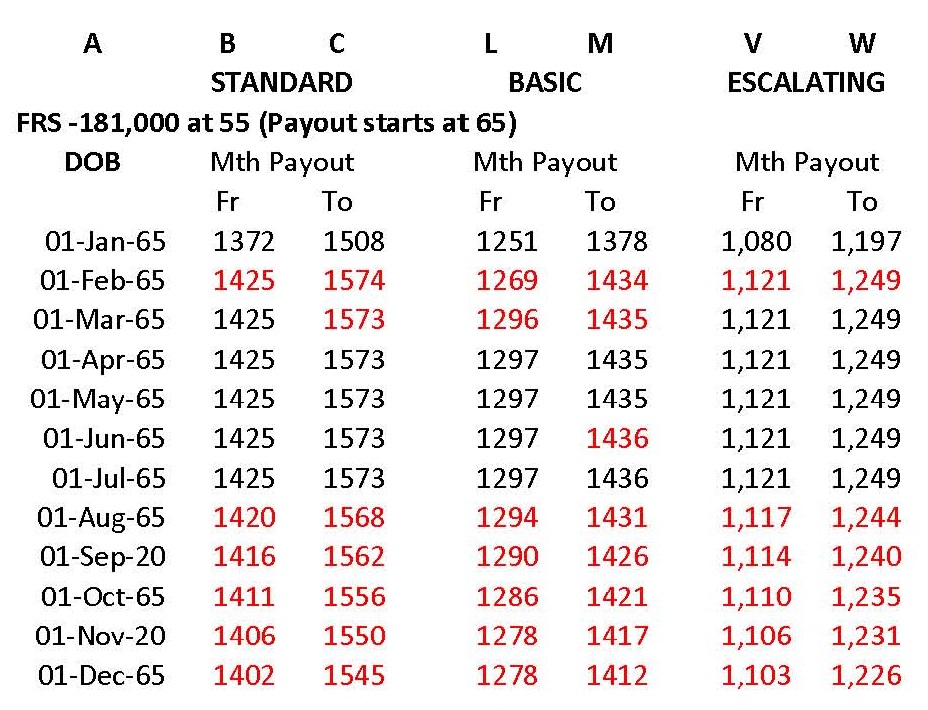
I had dismissed this because the difference didn’t seem material, but I should do the math. I believe the highest risk free rate of return available should be used in this case.
A 4.0% rate seems fair since you could plow the difference back into your Retirement Account. No, it won’t make a huge difference, but it will make some. It’ll tend to shift the “crossover” age down a bit, in particular. Another side benefit is that it’ll increase liquidity (which simple IRR measures don’t capture), particularly in the out years. That initial delta grows over time as the AMPs or CPF LIFE payout bumps grow in size, and so you have the
option to spend that delta instead of plowing it back in. On the Basic Plan you’re permanently at the lower payout level. There’s also the fact the delta, consistently plowed back in, results in a bequest even if you live to age 115. And at some point — it’d be interesting to calculate the age — the bequest actually starts rising after hitting a minimum. The Basic Plan doesn’t do any of that.
All of these nuances are entirely fair and reasonable to calculate when your benchmark is the Basic Plan’s payout stream, because that’s the one you’re ostensibly prepared to live with for the rest of your life. (And your CPF nominees beyond that.) Or, if you aren’t prepared to live with the permanently lower Basic Plan payout stream, then it’s off the table. Either way, fair is fair.
It’s always good to validate our instincts. I have completed two simulations, investing the difference between Basic and Standard at a compounded 2% and 4% rate. Both add a small fraction of a percent, but not enough to move the needle. I don’t think anyone was expecting that it would.
I’m mostly interested in the reduction in “crossover” ages for bequest and IRRs. Those shift a little. Indeed, there is no crossover age in the bequest amount since both fall to zero eventually in a naive partial calculation, but not with Standard Plan plowbacks. The plowbacks result in a permanent bequest, falling first to some minimum then rising thereafter.
More generally this is a byproduct of something I harp on about life annuities: they’re lousy internally for delivering a bequest. But they’re wonderful for defending a bequest, or better yet lifetime gifts. Generally speaking. (Oddly enough, U.S. Social Security virtually guarantees a bequest: about US$200 last I checked, adjusted annually for inflation. None of the CPF LIFE payout plans do that, internally.)
I think we can all agree that the combination of payments and bequest from the Basic plan generates the highest rate of return on the original principle invested in the annuity for the 2 out of 3 members who don’t make it to age 90.
I’m not sure the age is 90, but over ages 70.1 to 8X, yes, that’s correct. (If you’re strictly interested in rate of return maximization, age 70 is your answer.) At age 69.9 you can decide.
That doesn’t mean everyone should choose Basic. And it doesn’t mean highest rate of return is the only thing that matters in the decision of which plan to choose.
That’s right.
There are many nuances, but take a simple case of an unmarried or widowed person... they may not care about the bequest at all, and would prefer higher payments during their lifetime. In fact, it might be better for them to have a “no bequest plan” with even higher payments.
CPF actually offered such a plan (a pure single life annuity) when CPF LIFE was introduced, but unfortunately it wasn’t popular enough to keep. (It might have been more popular if it optionally guaranteed a modest death benefit, something none of the other plans offer.) I’d like to see a “Partner Plan,” though.