If you’re in the market for a new phone and have $500 or less to spend, there are plenty of solid options this year. At the higher end, we have the
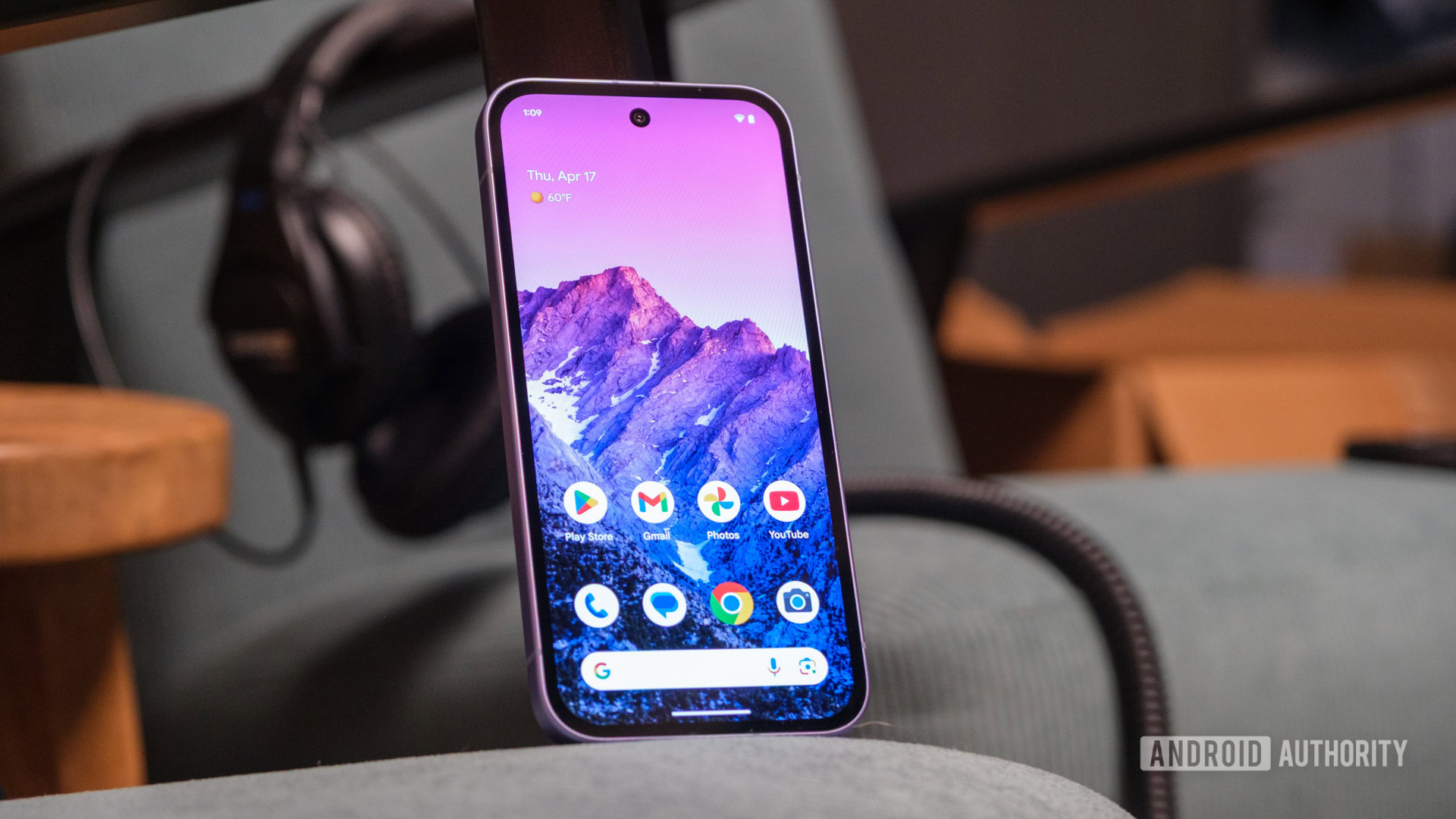
Google Pixel 9a and
Nothing Phone 3a Pro. If you’re looking to save a bit more without sacrificing too many specs, the Samsung Galaxy A36 5G and the standard Nothing Phone 3a are strong contenders. Below that, ultra-budget choices like the Moto G series still have their place. While these phones differ in many ways, one key area to focus on at this price point is the processor.
Thankfully, budget chips aren’t as sluggish as they used to be, but choosing a high-performance processor is still a smart move. Who knows what apps, games, or features your phone might need to handle years down the line? Software support now stretches to four years or more—but the hardware needs to keep up, too. Planning ahead can save you both money and frustration later on.
Here are the key performance specs for these budget-friendly phones so you can see what your money buys.
| Pixel 9a | Galaxy A36 5G | Nothing Phone 3a / Pro | Moto G / Power (2025) |
|---|
| Processor | Tensor G4 | Snapdragon 6 Gen 3 | Snapdragon 7s Gen 3 | Dimensity 6300 |
| CPU | 1x Cortex-X4 (3.1GHz)
3x Cortex-A720 (2.6GHz)
4x Cortex-A520 (1.9GHz) | 4x Cortex-A78 (2.4GHz)
4x Cortex-A55 (1.8GHz) | 1x Cortex-A720 (2.5GHz)
3x Cortex-A720 (2.4GHz)
4x Cortex-A520 (1.8GHz) | 2x Cortex-A76 (2.4GHz)
6x Cortex-A55 (2.0GHz) |
| GPU | Mali-G715 7-core | Adreno 710 | Adreno 710 | Mali-G57 2-core |
| RAM | 8GB | 6/8/12GB | 8/12GB | 4/8GB |
| Years of updates | 7 | 6 | 6 | 2 |
| Price | $500 | $400 | $380 / $460 | $200 / $300 |
There’s a healthy mix of chips here, but the standout is clearly the Google Pixel 9a with its flagship-grade Tensor G4 processor. To find similar performance elsewhere, you’d have to spend more on devices like the
iPhone 16e or Galaxy S24 FE. Naturally, it’s not fair to expect a $200 phone to compete with a $500 one, but the real question is whether the more affordable models offer enough performance to be a smart long-term buy—or if you’re better off spending a bit more now for future-proofing. Let’s dive into the benchmarks.
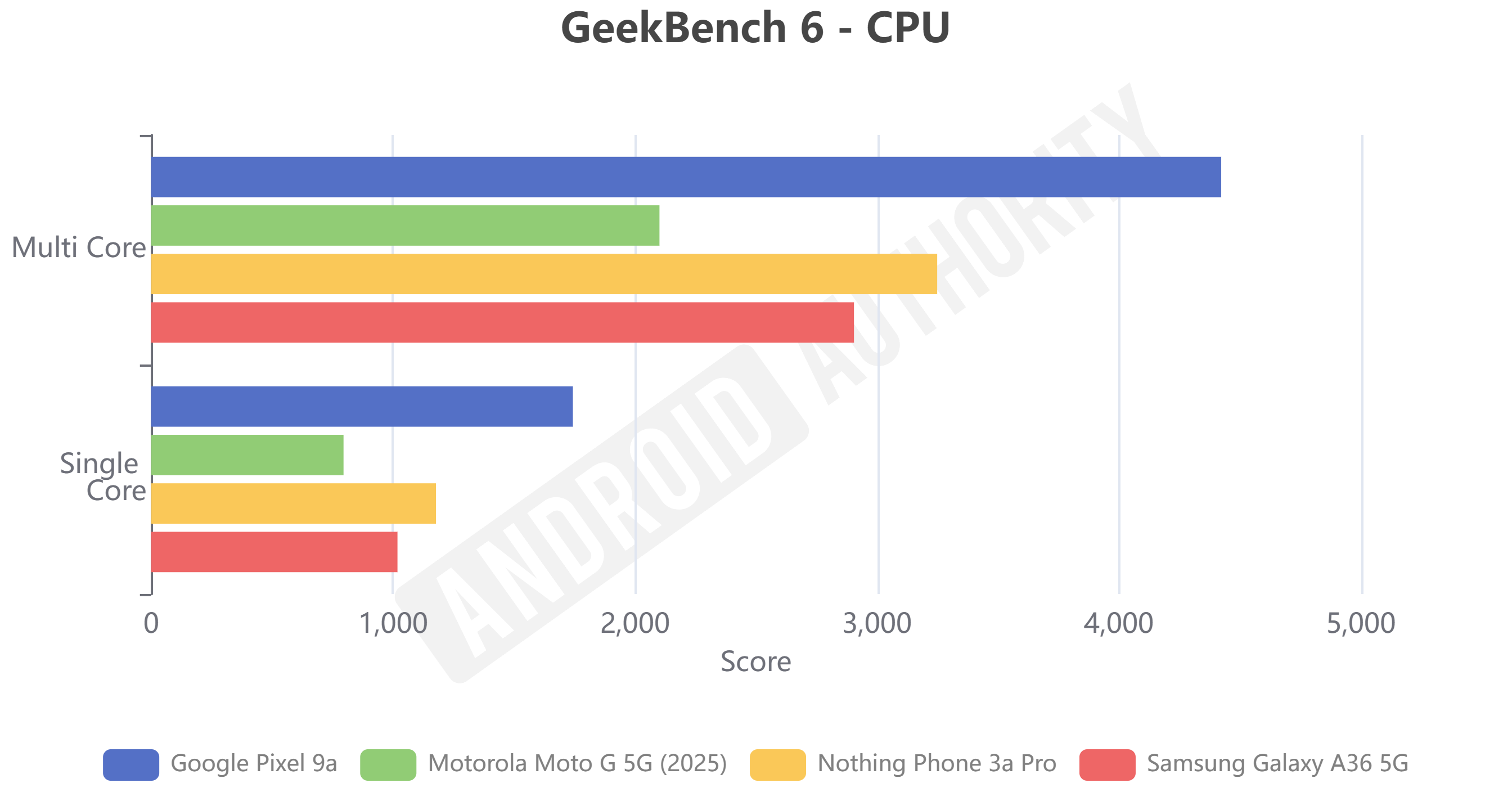
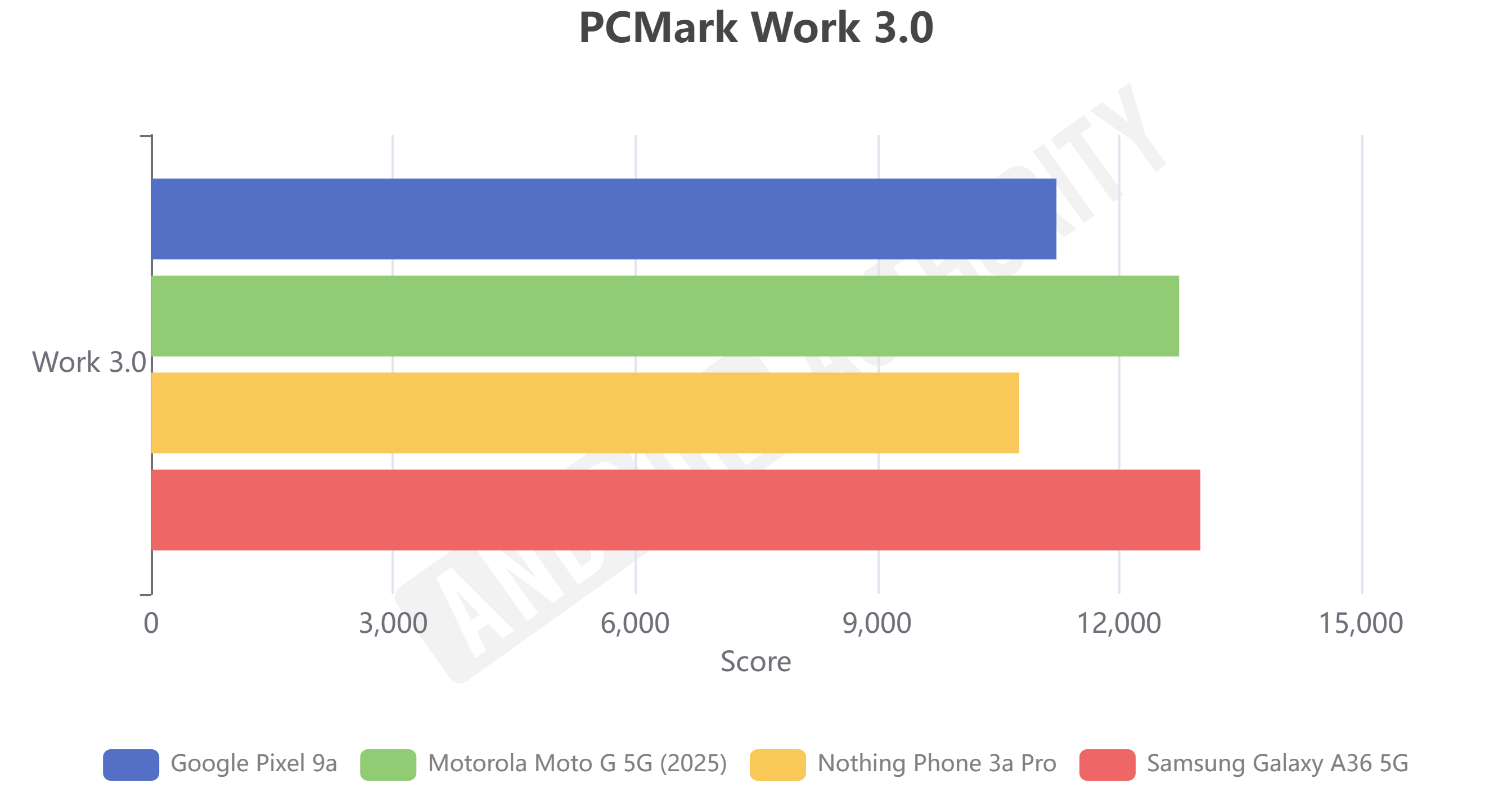
I’ve included the PCMark Work 3.0 test to highlight that all four phones (and their siblings) handle everyday tasks—like document editing, image manipulation, and web browsing—fairly well. Even the ultra-affordable Moto G performs decently for the basics. However, when it comes to more demanding CPU tasks, GeekBench 6 results show clear differences.
The Pixel 9a leads the pack here, thanks to its Tensor G4 chip (nearly identical to the one in the premium Pixel 9 Pro XL), which features a powerful Cortex-X4 core and higher clock speeds. If you want top-tier performance and long-term support, the Pixel 9a is the Android phone to beat, though it’s also the priciest on this list at $500.
When buying for the long-term, performance futureproofing goes a long way.
The Nothing Phone 3a comes in second place, and we had good things to say about its performance in our review, too. Its Snapdragon 7s Gen 3 chip outpaces the Galaxy A36 5G while costing a bit less, so major points there. It’s still behind the Pixel, but its 15% better single-core and 12% better multi-core scores compared to the Galaxy could really make all the difference a few years down the line.
In our
Galaxy A36 5G review, we noted that while Samsung offers six years of software updates, the phone’s performance doesn’t feel like it’ll comfortably match that long-term promise, and our benchmarks suggest the same. Especially compared to the Pixel 9a, which isn’t that much more expensive. Samsung’s One UI goodies to bring the chip to a halt, and it’ll undoubtedly feel even more sluggish before support ends, making it a good example of why performance matters for longevity.
Similarly, the Moto G Stylus (2025), with the same Snapdragon 6 Gen 3 chip and a $400 price tag, is representative of modern affordable phones — passable, but not exceptional.
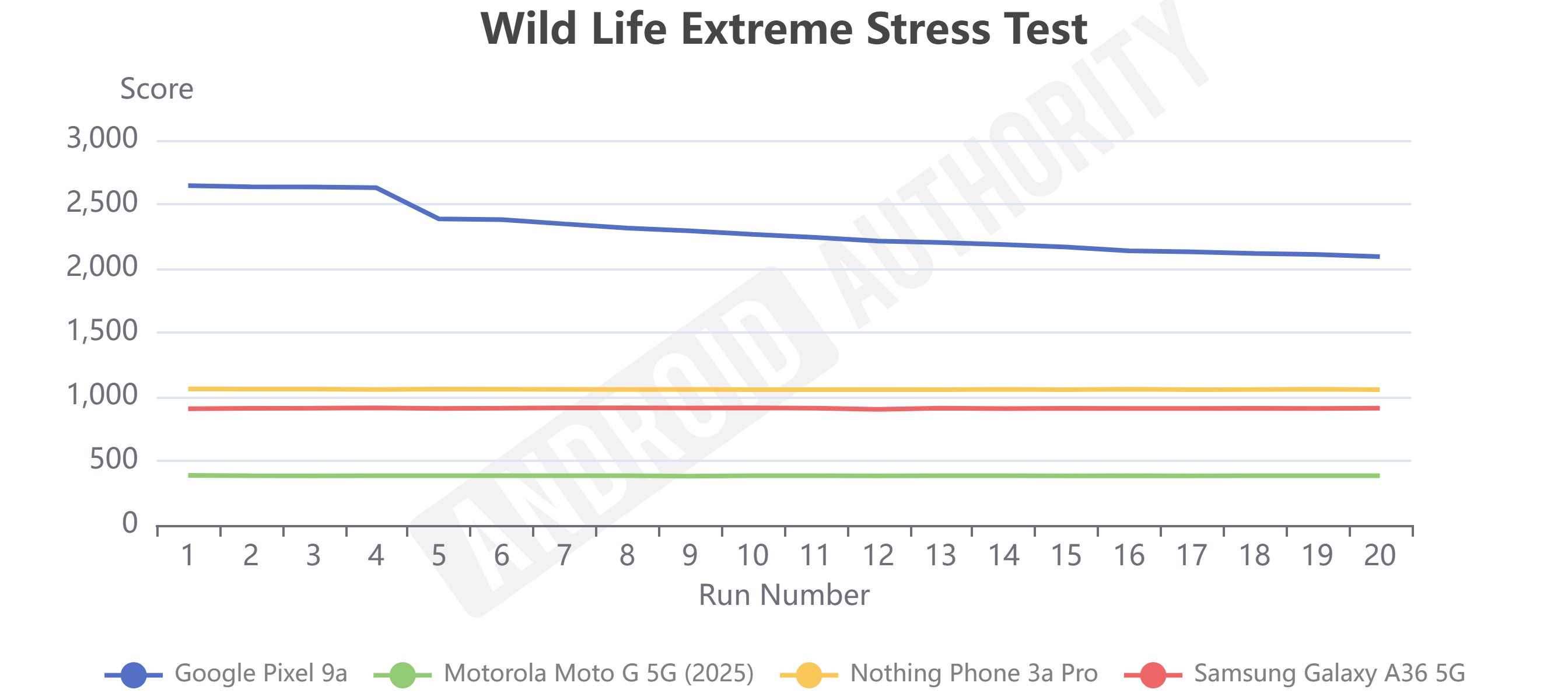
Graphics benchmarks tell virtually the same story. The Pixel 9a easily outpaces the competition with up to 2.5x the peak performance, making it a strong choice for mobile gamers on a budget. Google’s chip might not top charts in the premium space, but the 9a is clearly powerhouse for the price.
The Nothing Phone 3a series also shines here. Its Snapdragon 7s Gen’s Adreno 710 GPU, clocked higher than the Snapdragon 6 Gen 3’s, beats both the Galaxy A36 5G and Moto G Stylus. It’ll hold up for casual gaming today, but may start to struggle with newer, graphics-intensive titles or high-end emulation down the road. Still, that enhanced clock speed means it will hold up better than the competition in years to come.
In any case, if gaming is on your radar, the Pixel 9a is the clear winner at this price.
Which one should you buy?
The Pixel 9a is the best performer on this list, but it’s also the most expensive. But with performance that often doubles its competitors, it’s worth the extra $100 if you want a phone that’ll last. That said, if you must spend less, the Nothing Phone 3a is a fantastic alternative. It performs nearly as well as the Pro model, edges out the Galaxy A36 5G, and offers comparable long-term software support.
Of course, performance isn’t everything. Each of these phones has its strengths, from the Galaxy A36 5G’s fast charging to the 3a Pro’s more advanced cameras. If you’re willing to spend more, the
OnePlus 13R or
Galaxy S24 FE offer near-flagship performance, but at $600 or more, they’re edging into premium territory. Depending on your region, you might also have access to solid options from brands like Xiaomi.
Still, the Pixel 9a hits a sweet spot, offering premium-level power at a price that’s still within reach of the budget-conscious.
Why buy a cheap phone every three years when you can buy a brilliant one that'll last seven?
I haven’t said much about the ultra-affordable Moto G and G Power here because, well, their extremely affordable approach clearly can’t keep up with the more expensive competition. That said, the phones also only offer two years of OS upgrades, meaning that performance doesn’t have to stretch as far over the phone’s lifetime before you’d probably consider an upgrade.
However, I’m not sure this really helps Moto because you’d have to buy three models to receive the same length of support, blowing past an equivalent spend on a Pixel or Nothing Phone. For that cash, you can enjoy far superior performance today and not have to worry about a replacement for years to come.
Of course, the Moto G series remains undeniably cheap, which will always have its appeal, but for the long term, I’d really advise against buying one. Buy the Nothing Phone 3a instead.