Historical Rolling Returns - DCA into STI

Darkzi0n

Arch-Supremacy Member
Joined
Oct 2, 2010
Messages
12,336
Reaction score
0
From the way you phased it, it seems that dividend yield is an overestimation since the price now is lower, which also indirectly indicates that actual dividend yield should be even lower.

Thanks!

No need to thank me. If u notice, I have not taken any position so far. I jus have issue ppl using wrong data or method which may mislead ppl decision, especially when no one question how the data was derived after debating for 7 or 8 pages
 

OngHuatHuat

High Supremacy Member
Joined
Jul 10, 2006
Messages
28,341
Reaction score
2,460
Different methodology actually.

I merely point out the fact that increasing yield could be due to decreasing price. For the case of sti etf, the absolute dividend is relatively constant(you can call it slight increase, though not a lot).

Oh, I didn't cross check with SGX, you mean the information in dividends.sg is not correct?
 

Perisher

Greater Supremacy Member
Deluxe Member
Joined
Jan 5, 2015
Messages
84,162
Reaction score
10,088
I didn't use their yield just their payout numbers and the price at the start of the year.

Different methodology actually.

I merely point out the fact that increasing yield could be due to decreasing price. For the case of sti etf, the absolute dividend is relatively constant(you can call it slight increase, though not a lot).
 

OngHuatHuat

High Supremacy Member
Joined
Jul 10, 2006
Messages
28,341
Reaction score
2,460
That's why the yield % increase, but actual amount not much difference lor, Coz the price is going downhill mah.

If sti going to break 3 k this year end, buying now seems a good take though, but what is the chance?

I didn't use their yield just their payout numbers and the price at the start of the year.
 

Mecisteus

Great Supremacy Member
Joined
Jun 16, 2002
Messages
55,834
Reaction score
12,257
Sorry, didn't follow the entire thread, but you can use excel xirr function to take into account interval of cash inflow and outflow. Should be able to work.

I do know the sophisticated ways of calculating returns either by money or time weighted returns. I posted money weighted return (XIRR) in my blog in 2008 and shared in this forum a couple of times.

But for this exercise, those methods are not feasible because I am dealing with dynamic data periods.
 

Mecisteus

Great Supremacy Member
Joined
Jun 16, 2002
Messages
55,834
Reaction score
12,257
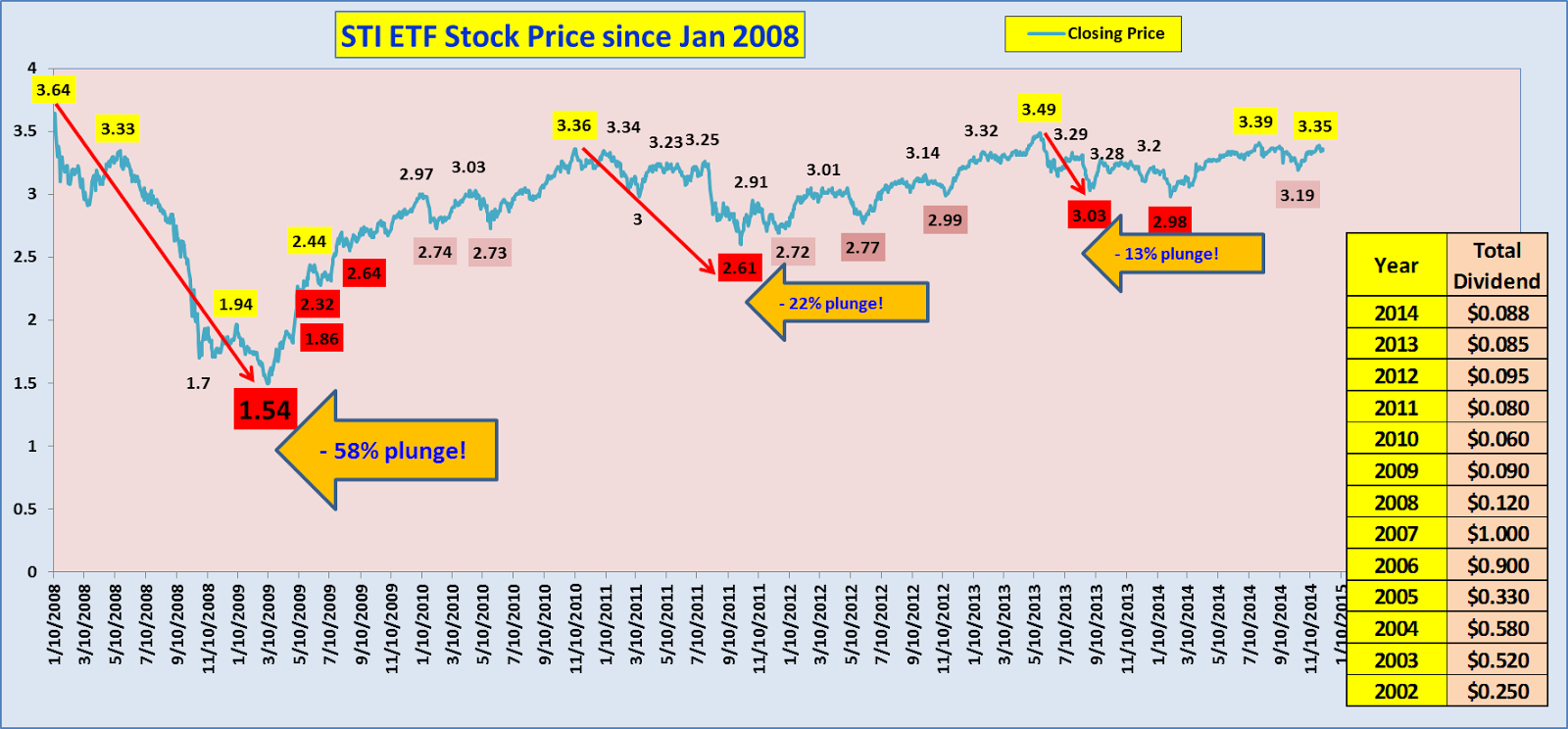
2011 the start price of ES3 is 3.33, dividend was 0.08 or yield of 2.4%
2012 the start price of ES3 is 2.78, dividend was 0.095 or yield of 3.4%
2013 the start price of ES3 is 3.26, dividend was 0.085 or yield of 2.6%
2014 the start price of ES3 is 3.19, dividend was 0.088 or yield of 2.75%
2015 the start price of ES3 is 3.37, dividend was 0.097 or yield of 2.88%
2016 the start price of ES3 is 2.81, dividend was 0.107 or yield of 3.8%

There is clearly a trend of higher dividends according to the last 6 year of records barring 2012. And the yield has risen respectively. Average yield is about 2.97% for the last 6 years.

If anything, it looks like now is a good time to start DCA. One of the lowest price in past 6 years, highest yield.
I think one should start to worry when yield drop or show a consistent level of dropping.

2016 is not over yet, so I believe the yield will go lower once the 2nd half dividends is declared. To be conservative, I guess 3% dividend yield is a safer and logical expectation.

Someone worked out the yields for STI ETF in the past couple of years. The data is not latest though.

STi%2BETF.png
 

Mecisteus

Great Supremacy Member
Joined
Jun 16, 2002
Messages
55,834
Reaction score
12,257
No need to thank me. If u notice, I have not taken any position so far. I jus have issue ppl using wrong data or method which may mislead ppl decision, especially when no one question how the data was derived after debating for 7 or 8 pages

If you have issue with other people using the wrong method, you need to come out with a solution to the so called correct and golden method to do in Excel for this kind of exercise.

By the way, what is the return that you get if you do 20 years DCA (Aug/96 to Jul/16)? The monthly data can be downloaded from yahoo finance.
 

wahkao3

High Supremacy Member
Joined
Mar 6, 2005
Messages
26,802
Reaction score
24
Darkzi0n wrote:
Give you a simplified example:

2011: cost 100, 1 unit
2012: cost 110, 1 unit
2013: cost 105, 1 unit
2014: cost 100, 1 unit
2015: cost 110, 1 unit

2016: 5 units, sell for 110
what you are doing is:
525*(r^5) = 550
=> 100*(r^5) + 110*(r^5) + ... + 110*(r^5) = 550

i kinda get your point now.
are you saying that because I keep adding capital into my portfolio, I need to take in account?

I need to time weight my returns. And to really do this, I need to (1+HPR1)(1+HPR2)......(1+HPRN)
I do agree, time weighted return is the correct way of calculating. But is really tough to do.


what MikeDirnt78 is doing, is simply money weight return. Or IRR calculation?
aXLlc0d.png
 
Last edited:

wahkao3

High Supremacy Member
Joined
Mar 6, 2005
Messages
26,802
Reaction score
24
No need to thank me. If u notice, I have not taken any position so far. I jus have issue ppl using wrong data or method which may mislead ppl decision, especially when no one question how the data was derived after debating for 7 or 8 pages

thanks for pointing out the issue. u are very alert. I missed it myself

a true quant :o
 
Last edited:

wahkao3

High Supremacy Member
Joined
Mar 6, 2005
Messages
26,802
Reaction score
24
http://www.investopedia.com/exam-gu...discounted-cash-flow-time-weighted-return.asp

Time-Weighted Rate of Return
The time-weighted rate of return is the preferred industry standard as it is not sensitive to contributions or withdrawals. It is defined as the compounded growth rate of $1 over the period being measured. The time-weighted formula is essentially a geometric mean of a number of holding-period returns that are linked together or compounded over time (thus, time-weighted). The holding-period return, or HPR, (rate of return for one period) is computed using this formula:

HPR = ((MV1 - MV0 + D1 - CF1)/MV0)


Where: MV0 = beginning market value, MV1 = ending market value,
D1 = dividend/interest inflows, CF1 = cash flow received at period end (deposits subtracted, withdrawals added back)


Money-weighted return = time-weighted return for a single period where the cash flow is received at the end. If the period is any time frame other than one year, take (1 + the result), raised to the power 1/Y and subtract 1 to find the annualized return.
 

Mecisteus

Great Supremacy Member
Joined
Jun 16, 2002
Messages
55,834
Reaction score
12,257
Mine is neither Money nor Time Weighted Return. It is just a simple conversion.
 
Joined
Nov 20, 2014
Messages
261
Reaction score
1
2016 is not over yet, so I believe the yield will go lower once the 2nd half dividends is declared. To be conservative, I guess 3% dividend yield is a safer and logical expectation.

Someone worked out the yields for STI ETF in the past couple of years. The data is not latest though.

STi%2BETF.png

That's a lot of effort you put in there. I'm not going to belittle your work here, I think it's pretty well done.

I guess when an investor tries to DCA, the investors return usually are very different from the historical data. That is because of time weighted variances like someone mentioned.

Oh and about the divideds. I remember sti had a change in their components last year; they kick out three low dividend paying company and replace them with higher ones, at the same time, the weightage of banks and singtel increases. So, I'll think that sti`'s divided will increase in the later part of the year. Proberbly 4%, let's wait and see. =)

Actually what's the purpose of this tread?
 

Perisher

Greater Supremacy Member
Deluxe Member
Joined
Jan 5, 2015
Messages
84,162
Reaction score
10,088
2016 is not over yet, so I believe the yield will go lower once the 2nd half dividends is declared. To be conservative, I guess 3% dividend yield is a safer and logical expectation.

Someone worked out the yields for STI ETF in the past couple of years. The data is not latest though.

STi%2BETF.png

It will only go higher actually because I use the dividends as it is, not the yield from dividends.sg, just the amount of dividends. If there is more dividends in the 2nd half, it will just add on to the yield in 2016.

The price I used is for the start of each year, one can switch and use the end of each year but the result would still be that dividends has been increasing in it's absolute value, just ignore the yield %. That's assuming the value not the yield from dividends.sg is accurate.
 

Mecisteus

Great Supremacy Member
Joined
Jun 16, 2002
Messages
55,834
Reaction score
12,257
It will only go higher actually because I use the dividends as it is, not the yield from dividends.sg, just the amount of dividends. If there is more dividends in the 2nd half, it will just add on to the yield in 2016.

The price I used is for the start of each year, one can switch and use the end of each year but the result would still be that dividends has been increasing in it's absolute value, just ignore the yield %. That's assuming the value not the yield from dividends.sg is accurate.

3% is just a conservative yield. that is why i put a range of 3 to 4% in the 1st post. i dont have the long term data for dividend yield so i am not able to give an accurate number.
 

Mecisteus

Great Supremacy Member
Joined
Jun 16, 2002
Messages
55,834
Reaction score
12,257
A lot of guesswork and time value of money is disregarded. This thread is quite meaningless

Yachtmaster and yyhwin have 1 thing in common. both nicks start with y. Both are not able to give meaningful contribution but are good at criticizing.
 

Mecisteus

Great Supremacy Member
Joined
Jun 16, 2002
Messages
55,834
Reaction score
12,257
Oh and about the divideds. I remember sti had a change in their components last year; they kick out three low dividend paying company and replace them with higher ones, at the same time, the weightage of banks and singtel increases. So, I'll think that sti`'s divided will increase in the later part of the year. Proberbly 4%, let's wait and see. =)

Actually what's the purpose of this tread?

Don't get the wrong idea. I read your posts and I know you are a person who practices DCA if i recall correctly. Good job if you are. I am not trying to ditch this method. In fact, I also strongly advocate all newbies to DIY and do a regular purchase of any stocks of their choice.

But we are often misled that STI can give a total return of 8% or more. I am also guilty of that. My objective is to find the actual returns if someone were to adopt a long term regular purchase of the STI. See and compare the returns on the regular purchase for various 20 year period.

My annualized return is a simplified conversion and I know it is not a perfect one.
 

w1rbelw1nd

Master Member
Joined
Dec 12, 2010
Messages
3,115
Reaction score
6
Don't get the wrong idea. I read your posts and I know you are a person who practices DCA if i recall correctly. Good job if you are. I am not trying to ditch this method. In fact, I also strongly advocate all newbies to DIY and do a regular purchase of any stocks of their choice.

But we are often misled that STI can give a total return of 8% or more. I am also guilty of that. My objective is to find the actual returns if someone were to adopt a long term regular purchase of the STI. See and compare the returns on the regular purchase for various 20 year period.

My annualized return is a simplified conversion and I know it is not a perfect one.
anything based on historical figures is at best a forecast ba... I think as investors, we would still demand 6-8% returns from the equities market, and share prices should adjust accordingly. Of course there will be higher certainty if we expect a >6% returns than a >8% return, and we can manage should always manage our expectations.

Sent from OnePlus A0001 using GAGT
 

Mecisteus

Great Supremacy Member
Joined
Jun 16, 2002
Messages
55,834
Reaction score
12,257
anything based on historical figures is at best a forecast ba... I think as investors, we would still demand 6-8% returns from the equities market, and share prices should adjust accordingly. Of course there will be higher certainty if we expect a >6% returns than a >8% return, and we can manage should always manage our expectations.

I am not doing forecasting here. I am running historical data and its returns. You can demand >X% but if historically it has never delivered close to X%, then the expectation is not realistic.
 
Important Forum Advisory Note
This forum is moderated by volunteer moderators who will react only to members' feedback on posts. Moderators are not employees or representatives of HWZ Forums. Forum members and moderators are responsible for their own posts. Please refer to our Community Guidelines and Standards and Terms and Conditions for more information.
Top