

Kaylin
Great Supremacy Member
- Joined
- Apr 8, 2004
- Messages
- 50,810
- Reaction score
- 70,493
why u eat like beri 清淡?I don't eat butter and I eat malaysia meat
why u eat like beri 清淡?I don't eat butter and I eat malaysia meat
I poor old man...., see my house already know I poor and kiam siapwhy u eat like beri 清淡?
Means you like moi? But I shy bbfayou. 渣男
dont bruffI poor old man...., see my house already know I poor and kiam siap


ah ok. then if u dont run so much would u hv eaten so much carbs?
No bluff, I poor , told you just promoted to middle class...dont bruff
too much reading for nighttime liao la, time for some funny IG beedioshttps://www.hprc-online.org/physica...your-body-burns-fat-and-carbs-during-exercise
Your body’s energy systems
Adenosine triphosphate (ATP) is the molecule that allows your body to use and store energy. It is often described as your body’s “energy currency.” Without it, you aren’t able to create or use energy for activity, metabolism, or brain function. Your body has 3 systems to produce ATP: the phosphagen system, the glycolytic system, and the oxidative system. Which system you primarily use depends on your activity intensity. For extremely high-intensity activity, your body uses the phosphagen system. As intensity decreases from extremely high, you shift to the glycolytic system and, eventually, to the oxidative system for moderate- to low-intensity activity.
The phosphagen system is responsible for producing short-acting, rapidly available energy. When you start physical activity, you use existing stores of ATP quickly. Since you can only store a relatively small amount of ATP, the phosphagen system uses creatine phosphate (CP, also called phosphocreatine) to make more ATP. CP is a molecule your body uses primarily to create ATP very quickly, rather than carbs or fat. You can build your CP stores in two ways. First, you can get it through your diet by eating red meat and fish. Your body also makes CP from amino acids in your liver, kidneys, and pancreas. It’s stored in low levels in your muscles so it’s ready to be used within the first 10 seconds of high- to extremely high-intensity activity. For activity longer than 10 seconds, your body activates the glycolytic system to make more ATP.
The glycolytic system uses carbohydrates—blood glucose and muscle glycogen—to produce ATP. Glycolysis, the process of burning carbs, has two mechanisms, simply called “fast” and “slow.” Fast glycolysis uses no oxygen and can make ATP from glucose quickly, sustaining activity for 2–3 minutes until slow glycolysis has enough time to get started. Fast glycolysis is somewhat inefficient, producing only a small amount of ATP from glucose. Slow glycolysis requires oxygen and takes longer to make ATP because the process involves many more steps than fast glycolysis. While it lacks speed, it efficiently produces more ATP per molecule of glucose—or muscle glycogen—than fast glycolysis does. So, you need both fast and slow glycolysis to produce ATP: the former to meet your immediate need for energy, and the latter to sustain energy.
Your body primarily uses the oxidative system to make ATP when you’re not exercising, during low-intensity exercise, and during moderate-intensity exercise that lasts longer than 3 minutes. It’s also the only energy system that burns fat. It enables you to oxidize (burn using oxygen) all 3 macronutrients—carbs, fat, and protein. However, your system uses protein for energy only in times of starvation and during exercise sessions longer than 90 minutes. Even then, the amount of protein used to produce ATP is small compared to the amounts of carbs and fat used.
When you’re not exercising, about 70% of your ATP is produced from fat and 30% from carbs. When you start low- to moderate-intensity activity, fast and slow glycolysis kick in, and the ratio shifts to nearly 100% carbs. Then, when you exercise longer than 3 minutes, the ratio shifts back to using fat to produce ATP, especially as you reach 30 minutes or longer. During exercise, the highest ratio of fat to carbs you’ll use is about 50:50. Fat oxidation is the slowest but most efficient method of producing ATP. It produces the most ATP per molecule of fat burned.
Since it’s such a slow process, fat loss during exercise requires you to exercise for a long time. A quick 15-minute session will use some fat, but it won’t maximize fat loss. High-intensity exercise and short-duration, moderate-intensity exercise almost exclusively use CP and carbs to produce more ATP. However, fat oxidation continues at a relatively high rate after a long or intense workout to help your body recover and replace ATP.
Weight management
How do your energy systems influence weight management? Managing your weight is largely a game of calories in versus calories out, with some other factors such as genetics and hormone levels. Exercise’s contribution to weight management is based on how you use each of the three energy systems.
Cardiorespiratory (cardio) training burns more calories per hour of exercise than resistance training because it gives your body more time to activate your slow glycolysis and oxidative systems. For cardio, as a general rule, you burn about 100 calories for every mile traveled by foot—walking or running. However, where those calories come from—carbs or fat—depends entirely on the intensity and duration of the exercise. For example, if you walk 2 miles, you’ll burn 200 calories, mostly from carbs but a little from fat because, as you reach the end of your walk, when you’re using mostly slow glycolysis and your oxidative system. If you run 2 miles, you’ll still burn 200 calories, but you will do so faster than with walking and almost exclusively from carbs. Since 2 miles is a fairly short distance, you will probably finish the run in less time than it takes for your body to start the fat-oxidation process. A cardio session should be at least 20–30 minutes and at an intensity of about 70% of your max heart rate in order to maximize fat loss during exercise.
Resistance training for muscular strength and hypertrophy primarily uses the phosphagen system and fast glycolysis for energy. When you’re strength training, most of your workout time is spent resting between the very short but intense periods when you’re actually lifting weight. Your body can burn about 120 calories per hour during intense weightlifting. However, most people will burn fewer calories during a lifting session because they don’t lift at a high enough intensity for a full hour.
Even though resistance training doesn’t get you much of a calorie deficit in the short term, it’s a major player in long-term weight management because it helps increase your resting metabolic rate. When you build muscle, you need to use more energy to keep that muscle. Remember: When you’re not exercising, your body produces most of its energy from fat stores, so resistance training will lead to fat loss over time rather than during a workout. That means you’re reducing fat while building muscle. This is probably what people mean when they say they’re “turning fat into muscle.” It takes at least 6–8 weeks of consistent resistance training to see improvements in muscle mass. By then, your resting metabolic rate will be going up to support the new muscle, and you might find it’s a little easier to shed some extra pounds. Don’t get frustrated if you don’t see immediate results.

I curious ask my witch buddy see the thread she got look at edmw sometimes


like olive oil, feta cheese & fish?
Now then you say witch buddy visits EDMW sometimes.
Did she find any EDMWer that is outstanding, interesting or humorous?

Probably not, I just eat more to sustain my caloric intake for runningah ok. then if u dont run so much would u hv eaten so much carbs?
All I know is that it’s high. Whether it’s healthful or not, I have no clue.I’m not the best at taking care of myself.
Unconventional? As in TCM?
can samurai?https://www.nature.com/articles/s41598-018-38461-y
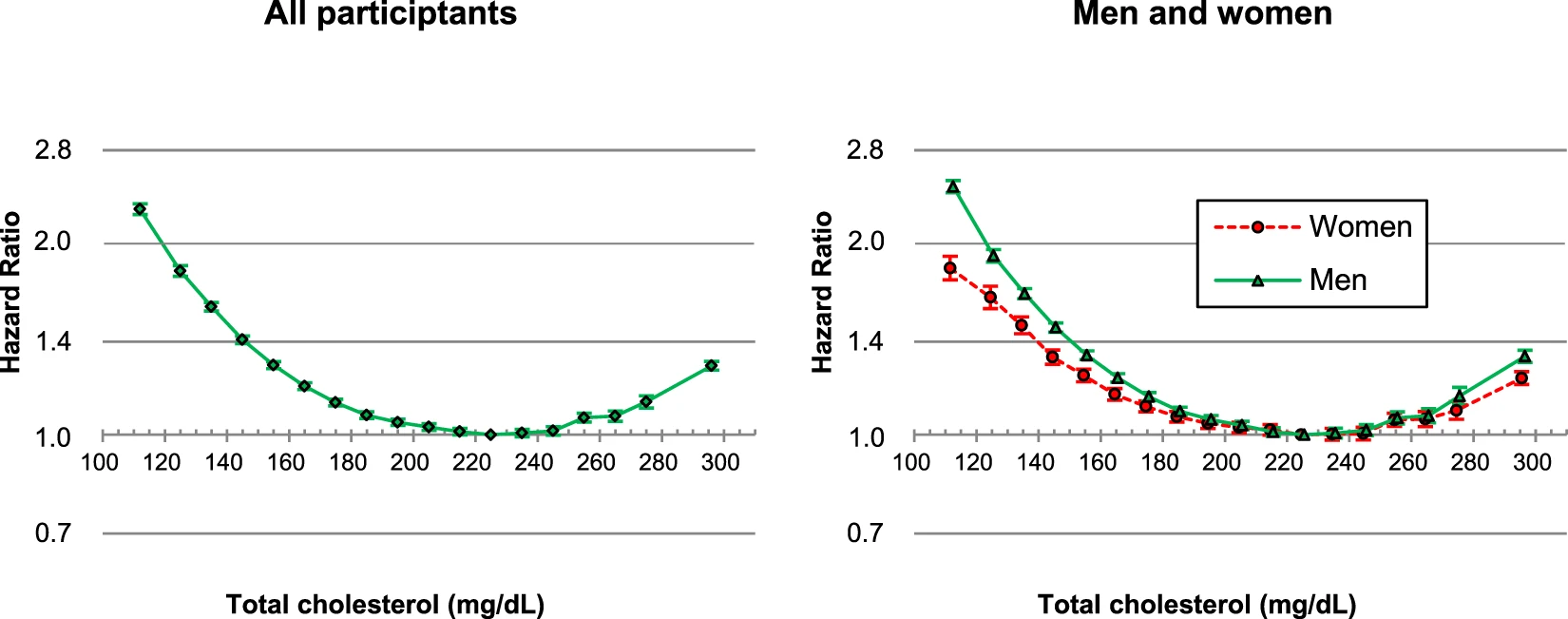
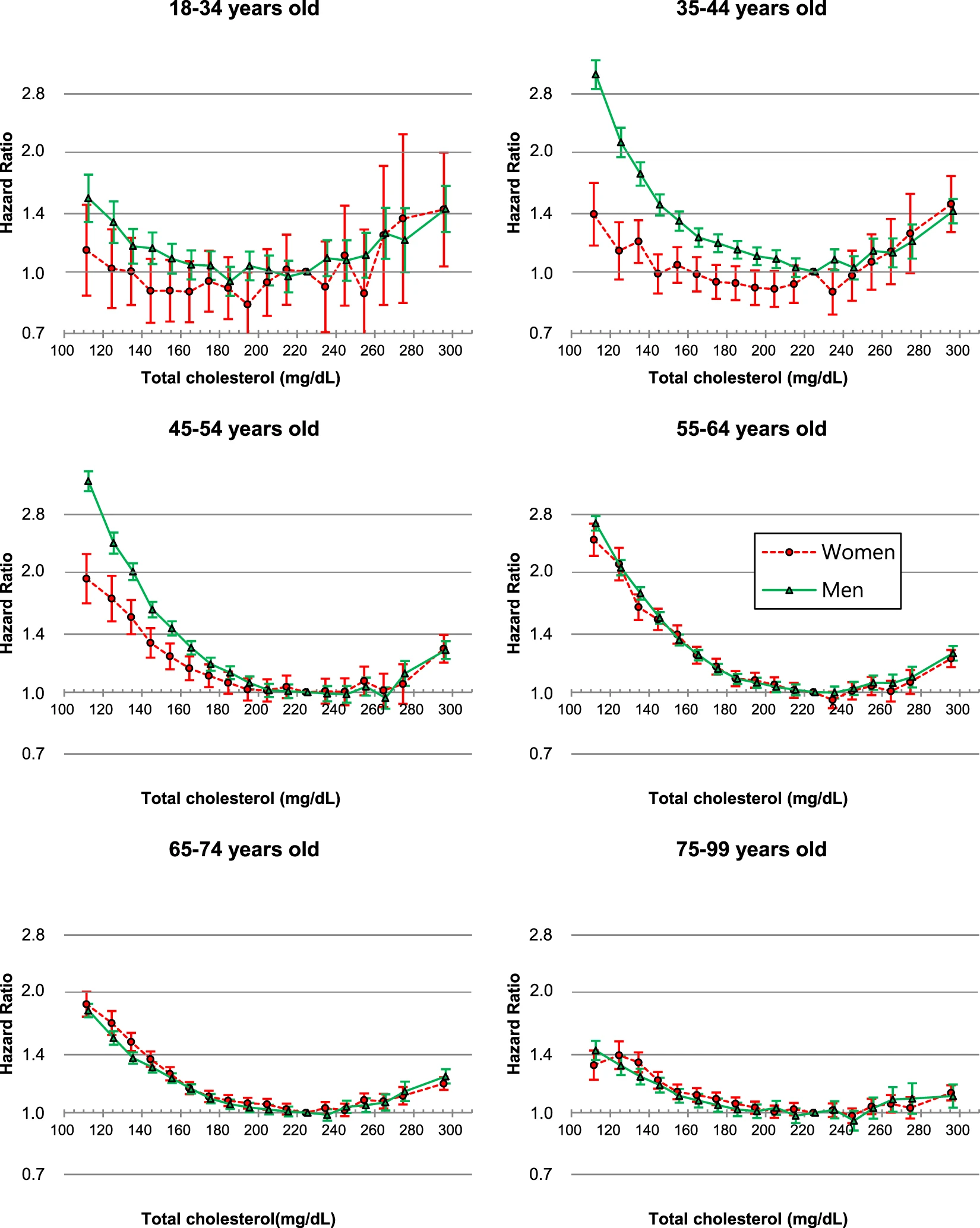
Through a large prospective cohort study among over 12 million participants, we examined whether the association between TC levels and all-cause mortality varied by sex and age, and estimated the sex- and age-specific levels of TC associated with the lowest mortality. Additionally, detailed estimates of the mean (and median) concentrations of TC according to sex and age are presented.
Associations between total cholesterol and mortality
U-curve associations between TC levels and mortality were found in both men and women (Fig. 2). The TC range associated with the lowest mortality was 210–249 mg/dL. When age was further considered, U-curve associations were observed regardless of sex or age (Fig. 3), and the optimal TC range for survival was 210–249 mg/dL for each age-sex group, except for men at 18–34 years (180–219 mg/dL) and for women at 18–34 years (160–199 mg/dL) and at 35–44 years (180–219 mg/dL) (Supplementary Table S3).
Figure 2
Figure 3
can samurai?
thats why ppl looooove to listen to western doc, SMLJ chronic illness also go see loctor. mybfd.The prospective study on 12 million South Korean participants shows that Total Cholesterol (TC) range associated with the lowest mortality was 210–249 mg/dL.
But in Singapore this range the doctor will diagnose you as high cholesterol, then put you on statins for life.

mine is around 225 but there's no obese ppl in my ancestry. i don't visit doctors or dentists except for $5 checkups when available. dental scaling all diy using dental tools and frequent brushingThe prospective study on 12 million South Korean participants shows that Total Cholesterol (TC) range associated with the lowest mortality was 210–249 mg/dL.
But in Singapore this range the doctor will diagnose you as high cholesterol, then put you on statins for life.
u same pattern as me. i've not seen a doctor for decades except for chao keng MC once to claim insurance many years ago. i also see doctor when they offer $5 health checksthats why ppl looooove to listen to western doc, SMLJ chronic illness also go see loctor. mybfd.
its not abt visiting docs but how much u believe what you're told. so if go for $5 check they tell u they suspect this & that or say u need to eat meds will u listen?mine is around 225 but there's no obese ppl in my ancestry. i don't visit doctors or dentists except for $5 checkups when available. dental scaling all diy using dental tools and frequent brushing

wah! we're really a rare breed. but im like why gotta listen to western doc? why their lab reports & numbers call the shots? i call the shot cannot meh? they like to instill fear in ppl, which i cannot tolerateu same pattern as me. i've not seen a doctor for decades except for chao keng MC once to claim insurance many years ago
this doctor was very reasonable. told me the range is man made and not optimized for sinkies lol. he also said nowadays everything can verify online. no need go med sch for interpretation lolits not abt visiting docs but how much u believe what you're told. so if go for $5 check they tell u they suspect this & that or say u need to eat meds will u listen?
