unfinished07
Master Member
- Joined
- May 29, 2004
- Messages
- 3,777
- Reaction score
- 1
ok thanks 
i havent studied at alexandra branch before so cant comment. heard the sensei quite ok.
i might start a new class on Thurs night in Feb, if u all interested can visit my webbie. lol
classes are held in town/Novena
http://dimitri2012.wordpress.com
the hougang branch hougang japanese school any good? Extremely near for me, thinking of signing up for their e1
I wonder if usually sign up with a school basic class will continue all the way? Or let's say hougang school can hop to ikoma or bunka and vice versa, say after first few basic courses?

Possible but it will be better if they are using the same textbook (e.g minna no nihongo). You can let the sensei know which chapter you are at so they can place you in the appropriate class.

wow thank you for fast response, so the schools in SG use the text book are okay right. Like can change school in future if needed.
I think this minna no nihongo is popular textbook used by Ikoma.
I also saw Genki is popular but not sure any school uses here.
Any idea if the text book used by Hougang Jap School is okay?
"we use NIHONGO NO KISO (Previous Version of SHIN NIHONGO NO KISO) "- We give you the Roumaji Version of this textbook and English Translation, so you can study Japanese without difficulties.
Is it good, dunno why I keep reading not good to learn romanji, this one not sure what they meant, is learning hiragana/katakana but with translation to help learning?
wow thank you for fast response, so the schools in SG use the text book are okay right. Like can change school in future if needed.
I think this minna no nihongo is popular textbook used by Ikoma.
I also saw Genki is popular but not sure any school uses here.
Any idea if the text book used by Hougang Jap School is okay?
"we use NIHONGO NO KISO (Previous Version of SHIN NIHONGO NO KISO) "- We give you the Roumaji Version of this textbook and English Translation, so you can study Japanese without difficulties.
Is it good, dunno why I keep reading not good to learn romanji, this one not sure what they meant, is learning hiragana/katakana but with translation to help learning?
Never heard of this way to find out which is class 1 and 2 but I kinda figure what it means.hey 皆さんこんにちは。I know one of the rules to check if a verb is regular one or two is to check its dictionary kei, if いる と える、it is regular 2. But if I'm looking at a a verb in its ます kei, how do you do tell if it's 1 or 2 omg. The rule says look at its ない形, regular 1 has a final vowel a, like that all the verbs belong to regular 1 omg?!
Never heard of this way to find out which is class 1 and 2 but I kinda figure what it means.
It means the end vowel before nai. For example nomanai is class 1 while minai is class 2.
Yup this rule is from the Japanese for busy people 2 textbook, but not sure if it's an official rule. I guess the only official rule is to look at its dictionary form, but as you know we all start from masu kei. I was looking at this exercise to identify regular 1 and 2 verbs in their masu kei, is it possible to do so?
hey 皆さんこんにちは。I know one of the rules to check if a verb is regular one or two is to check its dictionary kei, if いる と える、it is regular 2. But if I'm looking at a a verb in its ます kei, how do you do tell if it's 1 or 2 omg. The rule says look at its ない形, regular 1 has a final vowel a, like that all the verbs belong to regular 1 omg?!
when you look at the verb conjugation, you should be able to recognize the dictionary[dictionary kei]/basic/root form depending which textbooks you are familiar with.
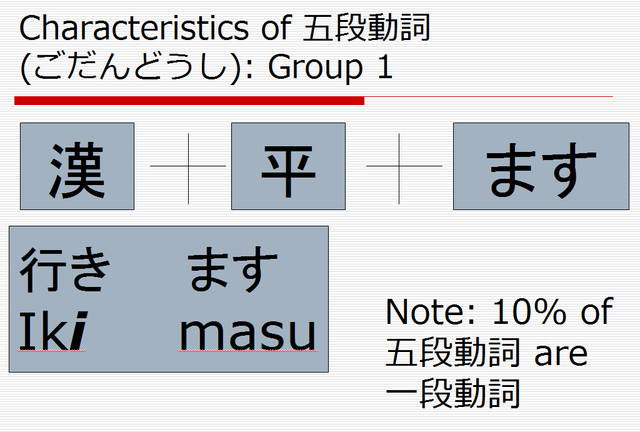
There are two kinds of regular verb in Japanese. One kind, "consonant stem", "group I" or, in Japanese, godan verbs, conjugates such that the rightmost unchanging element is a consonant. For example, (1)iku (to go) conjugates as (2)ikeru, (3)ikinasai, (4)ikanai, (5)ikou. The other group, "vowel stem", "group II", or, in Japanese, ichidan verbs, conjugates such that the rightmost unchanging element is a vowel. For example, taberu (to eat) conjugates as taberareru, tabenasai, tabenai, tabeyou
Japanese verbs are divided into three groups based on the last syllable of the basic (dictionary) form. You need to know which group a verb belongs to in order to produce the conjugated forms.
Grouping rules:
Group II:
Verbs in group II end with the syllable ru (る), with the preceding syllable containing the vowels e or i. Some exceptions are kaeru (帰る "return home"), hashiru (走る "run"), kiru (切る "cut"), iru (要る, "need"), and hairu (入る "enter").
Group I:
Verbs in group I end with syllables ku (く), gu (ぐ), su (す), mu (む), nu (ぬ), bu (ぶ), u (う), tsu (つ), or ru (る). Verbs ending in ru (る) contain the vowels u, o or a in the preceding syllable. Some exceptions are kaeru (帰る "return home"), hashiru (走る "run"), kiru (切る "cut"), iru (要る, "need"), and hairu (入る "enter").
Group III (Irregular):
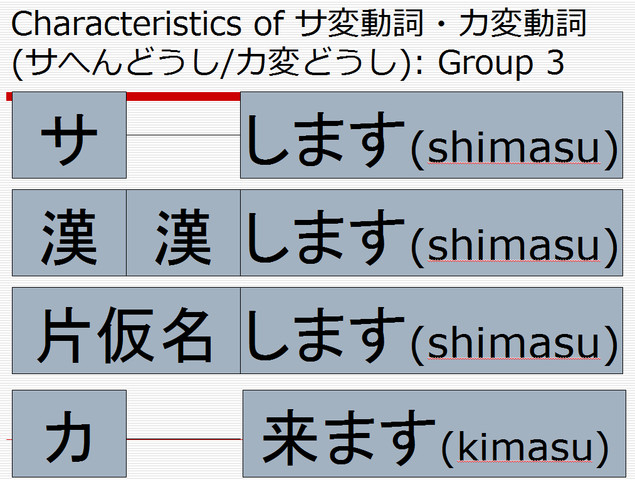
Verbs in group 3 are suru (する "do") or kuru (くる "come").
Good Luck