So does anyone remember about a year-and-a-half back when some clown decided to squat on joshuagiersch dot com and use it to sell pirated copies of
Rich by Retirement?
Sometimes the good guys win.
I think the time has arrived. Planning to start DCAing my warchest.. At maybe 1% every week?
Er mate, 1% a week? Two problems with that:
1) It's going to take
two years to deploy your full warchest, by which time markets will probably be higher;
2) Unless your warchest is gigantic, you're going to be paying a lot of transaction fees for that.
I'd do 15% to 25% a month.
Need help with bond ETFs.
1. Asset allocation 20% equity/80% bonds
That's an incredibly conservative allocation; it's one step above guns and canned goods. Why so conservative?
3. I do not have confidence in ABF in buffering my equity as they barely moved as evidenced in the recent trade war upheaval and the past.
That's exactly the point. The point of bond ETFs is that they don't move much when equity ETFs move.
4. So what ETFs NOT US domiciled, that I can opt for that has the highest bang to protect the equity component [snip a whole bunch of other questions, come on]
I think you're overthinking this A LOT. You're looking for currency hedges (which by definition will reduce your returns) but you're not even trying to hedge back to SGD... you're buying random ETFs and not thinking about what's in them... you're buying hefty chunks of negative-yielding European and Japanese government debt, which is only worthwhile if you think the currency's going to appreciate, but then saying you want to hedge back to dollars...
Look, I'll be honest, I'm not sure what you're trying to do, and that makes it difficult to suggest an appropriate ETF. I'd almost go back to first principles and say "what are you trying to do with this money in the first place, and why do you have such a huge bond allocation?"
If you'd rather I not go back to first principles, tell me what you're after:
* Do you want currency exposure to SGD, USD, a wide range of currencies, or don't care?
* Do you want govvies, corporate bonds, a mix, or don't care?
What drives the price movement of etf ?
Is it the demand/supply of the etf itself on an exchange ?
Or is it based on the index it's tracking ?
Not a noob question at all. It's a little of column A, a lot of column B.
Like anything else, the price of an ETF linked to an index moves up and down based entirely on supply and demand. The difference with an index-linked ETF is that there’s a market maker stepping in to supply new shares if the price goes up too far, or to buy shares if the price goes down too far.
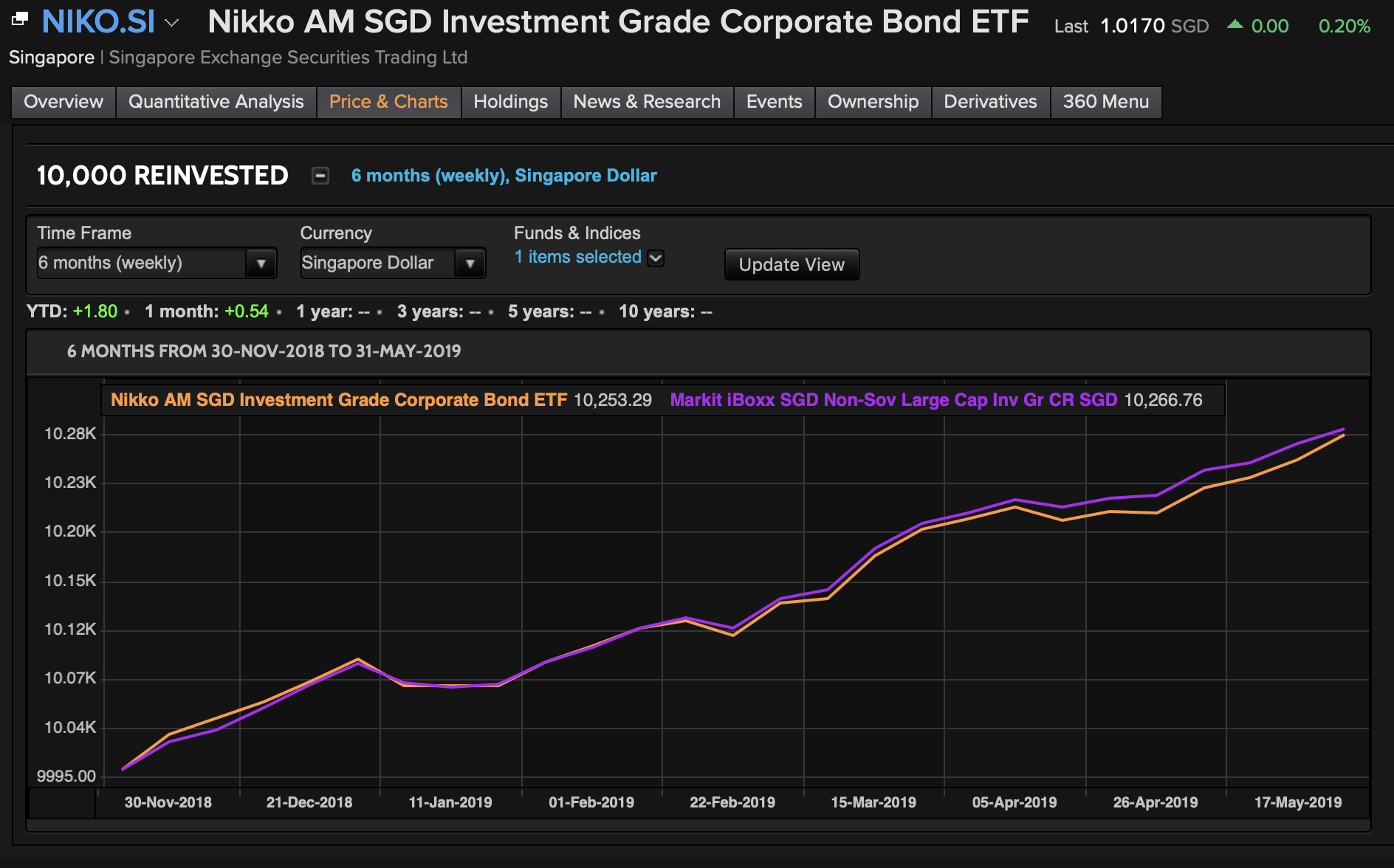
have a query on MBH etf. given the sgd bond prices have gone up quite abit over the last couple of months, why do we not see any increase in MBH pricing?
I don’t think this is correct. MBH is up about 2% since the beginning of 2019, and it’s gone basically tick-for-tick with its benchmark. In the screenshot below, MBH is the orange line, and its benchmark is the purple line. The data includes reinvested dividends.
Interesting observation, thank you
for sharing. Instinctively i would think MBH price is also a matter of supply & demand & market maker actions, thus its price will not efficiently follow market interest rate.
No, this is wrong; and it sort of betrays a fundamental misunderstanding of how market-makers work.
ETF market makers arbitrage any differences between the price of the ETF and the underlying asset, whether that’s a pile of equities or a pile of bonds or a pile of oil futures or a pile of bitcoin hidden under a bird-bath or whatever.
As I mentioned above - if demand for the ETF goes up, then that will drive the price of the ETF above the price of the pile of assets that it holds. And if that happens, the market-maker will step in and sell the ETF to bring its price back down in line with the underlying.
Questions:
1) The brokerage which I have shortlisted for all the 3 funds will be bought via SCB. Should there be diversification among the brokerages?
2) I need help with the step-by-step calculation of the cost of brokerage commission too.
3) Do I have to ensure that the cost of my brokerage costs amounts to 1% or less of invested amount? If yes, what is the recommended way to do this? I am not able to increase the amount used for DCA.
Thank you for taking the time to reply to my lengthy questions.

- Not “diversification”, but some brokers are cheaper than others. If you’re spending $1k or more a month, I recommend using Interactive Brokers for your IWDA, because they’ll work out a bit cheaper.
- a) Finger-in-the-air, your spread at Stanchart’s going to be about half a percent I think. Here’s how I’d reckon it: “One share of IWDA is about 75 SGD, so I’m gonna buy about 13 shares, so I’m gonna pay about $975, so my commission’s going to be the minimum ten dollars”. FX spread costs aren’t counted in your commission. As for b) : yeah, that looks about right. But if you’re hung up on figuring out your commissions down to the cent you’re focusing on something that’s not worth your time.
- No. Keeping your commissions lower as a percentage of your investment is always good, but what you’re doing is good enough. Don’t get too hung up on the commissions; just make sure that you’re investing regularly.
With Maybank KE discontinuing their monthly investment plan, we can actually still continue to RSS with them, but without the convenience of automation right ? The purchase/sale charges should still be the same if I am not wrong ?
0.12% with a minmum of $10.
Nope, the purchase charges are a lot higher - MBKE MIP had a much lower minimum commission, that’s the problem.
May i know if this is a good diversification(
https://advice.moneyowl.com.sg/the-right-portfolios/ )? Understand that the fee is slightly higher than DIY for the convenience of automation. What do u guys think?
No, I’m not a fan. There’s been a lot of noise about these portfolios on here in the last few weeks, but the fees are far too high for what they do. Even if you need an automated service, POSB IS is still better.





 if I have $300-$500 to invest monthly and I have already bought the SSB. What's the recommendation you would have for me?