
Which SCB you apply together with the investment account? Must it be a USD account?Quick update : I've passed the CAR test - now I've placed an order on IWDA and this is result of the fees!
Stamp Duty =34.88
Levy = 0.00
Brokerage Fees = 17.44
GST = 3.66
Total Fees = 55.98 !!
Is this a lot?! It's not been fulfilled yet - not sure if I should get out at these kinds of fees!?
You are using an out of date browser. It may not display this or other websites correctly.
You should upgrade or use an alternative browser.
You should upgrade or use an alternative browser.
*Official* Shiny Things club - Part 2
- Thread starter yukari_san3
- Start date
- Status
- Not open for further replies.
More options
Who Replied?Since VWRA is accumulating (unlike VWRD), and looks at both developed and emerging countries, is this a better choice compared to IWDA, in terms of higher returns? Or has it not been around long enough to predict its long-term performance?
VWRA/VWRD and IWDA track different indexes.
VWRA/D tracks the FTSE Global Index.
IWDA tracks the MSCI World Index.
You can look at these two indexes to see their past performance and what they are made up of to help your decision making.
The only difference between VWRD and VWRA is that one pays the dividends back to you for you to decide what to do with it, and the other automatically reallocates dividends back into the fund.
spadestick
Junior Member
- Joined
- Oct 19, 2017
- Messages
- 22
- Reaction score
- 0
A normal E-saver account, just transfer from the e-saver to the USD securities account and then buy to begin, unfortunately i didnt manage to get it at the right price... i must be doing something wrong... anyway, Shiny has said that the stamp duty is refunded apparently for this particular trade.
Which SCB you apply together with the investment account? Must it be a USD account?
Thanks for the info.A normal E-saver account, just transfer from the e-saver to the USD securities account and then buy to begin, unfortunately i didnt manage to get it at the right price... i must be doing something wrong... anyway, Shiny has said that the stamp duty is refunded apparently for this particular trade.
I thought there's some ongoing promotion where you enjoy $0 brokerage fee when you apply for the online trading account and deposit account. Don't know how it works.
Did it take very long to get both the accounts to get set up as the promo ends tomorrow?
spadestick
Junior Member
- Joined
- Oct 19, 2017
- Messages
- 22
- Reaction score
- 0
The Savings account is on the spot, the Trading accounts (various currencies) took about a few hrs, the actual access to the trading platform took 7working biz days
Thanks for the info.
I thought there's some ongoing promotion where you enjoy $0 brokerage fee when you apply for the online trading account and deposit account. Don't know how it works.
Did it take very long to get both the accounts to get set up as the promo ends tomorrow?
You can say that, but aren't we all looking to minimize our fees as much as possible?Of course in the grand scheme of things, SCB's fees aren't that bad honestly. At least they don't charge custody or monthly maintenance fees.
SCB's 0.4% fx premium is something I can live with.
time and effort is a cost. I could find the best moneychanger rates in Singapore, spend time going there, change US$, and rush to SCB to deposit the US$. But I believe the cost saving is down to something like $1-2 saved for every $1000 deposited (assuming you go only to the moneychanger with the best rate in Singapore - if you go online - some moneylender rates are about the same as SCB).
I recently funded my SCB US$ High account with a US$ cheque drawn from a local bank (cheque was from my stockbroker), there were no charges to deposit the cheque.
Someone in the SCB thread pointed out that he managed to deposit a local US$ cheque directly into the SCB US$ trading account as well. If that's correct, even better


MichealScott
Supremacy Member
- Joined
- Feb 25, 2019
- Messages
- 7,629
- Reaction score
- 1,192
Anyone know of any good app to track your investments? Since most of us are using different broker for different holdings, it will be good to have an app to track our portfolio allocation. Anyone?
Sent from Stamford Bridge using GAGT
Sent from Stamford Bridge using GAGT

highsulphur
Greater Supremacy Member
- Joined
- Aug 16, 2011
- Messages
- 76,408
- Reaction score
- 39,278
Anyone know of any good app to track your investments? Since most of us are using different broker for different holdings, it will be good to have an app to track our portfolio allocation. Anyone?
Sent from Stamford Bridge using GAGT
Excel is your best friend..
At least for me
So can only start trading after 7 biz days?The Savings account is on the spot, the Trading accounts (various currencies) took about a few hrs, the actual access to the trading platform took 7working biz days
Anyone know of any good app to track your investments? Since most of us are using different broker for different holdings, it will be good to have an app to track our portfolio allocation. Anyone?
Sent from Stamford Bridge using GAGT
I'm using My Stocks Portfolio on android. So far so good for me and it shows your earning/losses and the percentage of your entire portfolio
spadestick
Junior Member
- Joined
- Oct 19, 2017
- Messages
- 22
- Reaction score
- 0
Yes, for me at least - the banker said for others it could be 5 biz days... maybe mine’s special case! Finally my IWDA order got filled! Gotta check the stamp duty refund now...
So can only start trading after 7 biz days?

BBCWatcher
Arch-Supremacy Member
- Joined
- Jun 15, 2010
- Messages
- 23,446
- Reaction score
- 4,915
Shiny, with due respect, I think you've got this one backwards on this occasion.It seems like a bet that global markets will continue to outperform Singaporean markets, and I don't think that's a sure thing.
If you're going to overweight a particular country's stock market, that's actually a bet that that particular country's stock market is going to outperform the global average. VWRA and IWDA also include SGX-listed stocks. If DBS goes on a tear and spends the next 20 years soaring to global valuation heights, becoming the next (in valuation terms) Amazon, Apple, Microsoft, or even Facebook -- hey, I cannot totally rule it out
-- then VWRA and IWDA will pick that up, too.No, your basic argument for overweighting the Straits Times Index of 30 stocks that happen to be listed and traded on the Singapore Stock Exchange is that individuals who expect to retire in Singapore (and who have that legal right) ought to overweight Singapore dollar correlates because that's the currency they'll use to support their real lifestyle needs starting some decades in the future. That's why you're suggesting some stock de-diversification, which involves some greater stock portfolio risk. But it's a calculated additional risk in an effort to reduce another risk, currency risk -- to orient to the future retirement spending needs of particular long-term investors.
I agree with the general principle here -- it's sound. But I don't agree with that large an overweighting on a mere 30 stocks listed in one tiny, moribund stock market that soon. I think it's better to ride along with the global average stock market performance to a greater degree then slowly, progressively, ease into a more Singapore dollar-oriented posture within the 7 to 10 year period before retirement. I would also point out that the Singapore dollar itself isn't like most other currencies. Singapore is a small, open economy that doesn't grow wheat, doesn't have large beef herds, doesn't have natural gas reserves, and so forth. Tons of goods and even services are imported, and the Monetary Authority of Singapore (MAS) manages the Singapore dollar as a loose peg to a trade weighted basket of major currencies. There just isn't a lot of long-term currency risk in that, unless we think the MAS will somehow fail in their currency policies.
You've explained previously that you are not a fan of currency hedges in funds themselves. Neither am I. Well, overweighting SGX-listed stocks is a crude currency hedge. (It's crude because, for example, Singtel, one of the STI stocks, is a majority Australian dollar denominated business now.) Should we be advising investors to take 30+ years of currency hedging, on a currency that's loosely pegged to a trade weighted basket of other currencies? I don't think so. How about 7 or 10 years? How about some milder overweighting? How about not 50-50 SGX-Global for 30+ years?
Of course there's also the very real possibility that someone who expects to retire in Singapore doesn't actually end up retiring in Singapore, especially when that person is a 20-something or 30-something young investor just starting out, and as so many Singaporeans (and practically everybody else) fall in love and marry across borders.
Anyway, I agree with the principles, but I disagree with overweighting 30 stocks in one tiny stock market so heavily so early.
A 50-50 split, or thereabouts, actually makes some sense when it comes to U.S. investors. Stocks listed and traded in U.S. stock markets currently are hovering around 5X% (or even up around 60%) of global investable stock market capitalization. Before the recent introduction of truly global stock index funds, U.S. investors had to assemble their stock portfolio using at least two funds: a S&P 500 stock index fund (for example), and a global ex-U.S. stock index fund. And a 50-50 split works pretty well in that case for those investors. But they don't have to do that any more because now there are funds such as VT that do it all automatically. Also, the U.S. "textbooks" properly should be adjusted when translated to the Singapore context, and it just doesn't make sense to drag a 50-50 local-global split across a 30+ year investing life when it comes to the SGX and the Singapore dollar.
Anyway, if somebody wants to do something like this allocation:
20% MBH
15% ES3 or G3B
65% VWRA or IWDA
then save diligently/doggedly, then start adjusting that allocation starting 7 years (or as many as 10) before retirement to be more local bond heavy (certainly), that's fine! That's a perfectly sound approach, very reasonable in the circumstances within this market and this currency.
Last edited:
spadestick
Junior Member
- Joined
- Oct 19, 2017
- Messages
- 22
- Reaction score
- 0
Anyway, if somebody wants to do something like this allocation:
20% MBH
15% ES3 or G3B
65% VWRA or IWDA
then save diligently/doggedly, then start adjusting that allocation starting 7 years (or as many as 10) before retirement to be more local bond heavy (certainly), that's fine! That's a perfectly sound approach, very reasonable in the circumstances within this market and this currency.
Hi BBCWatcher, do you practice this yourself? The current market is very high at the moment, looks scheduled for a crash soon looking at trends - should we just focus on MBH instead just to ride out this "imminent" crash? Thanks, looking to hear both thoughts from the gurus!
Hi BBCWatcher, do you practice this yourself? The current market is very high at the moment, looks scheduled for a crash soon looking at trends - should we just focus on MBH instead just to ride out this "imminent" crash? Thanks, looking to hear both thoughts from the gurus!
if you are predicting crash, you can go and visit the official thread for those predicting imminent crash: https://forums.hardwarezone.com.sg/stocks-shares-indices-92/bears-den-6043485.html No point staying posting here and listening to those non-believers.
BBCWatcher
Arch-Supremacy Member
- Joined
- Jun 15, 2010
- Messages
- 23,446
- Reaction score
- 4,915
No, I'm a U.S. person. Funds such as MBH, ES3, G3B, IWDA, and VWRA are quite inappropriate for me for tax-related reasons.Hi BBCWatcher, do you practice this yourself?
However, I follow the basic principles I've outlined, yes.
That would be trying to time markets, and no, I don't think that's wise....The current market is very high at the moment, looks scheduled for a crash soon looking at trends - should we just focus on MBH instead just to ride out this "imminent" crash?
....But are stock market valuations "very high"? How do you know, and how would you know? For that matter, are bonds "very high"? Home prices?
spadestick
Junior Member
- Joined
- Oct 19, 2017
- Messages
- 22
- Reaction score
- 0
no I don't want to time the market or even seem like thinking about it... just being cautious of getting into the game so late! - it's quite a big step to take because I am mid-life now. I'm only sticking to this thread and book for the moment and hopefully for the rest of my investment life !
!
though I saw this US couple on Youtube living as expats in Portugal off dividends (Vanguard and Fidelity ETFs). Wonder if it is possible as an SG citizen? I managed to capture a screenshot of what they invest in from one of their videos.

! though I saw this US couple on Youtube living as expats in Portugal off dividends (Vanguard and Fidelity ETFs). Wonder if it is possible as an SG citizen? I managed to capture a screenshot of what they invest in from one of their videos.
though I saw this US couple on Youtube living as expats in Portugal off dividends (Vanguard and Fidelity ETFs). Wonder if it is possible as an SG citizen? I managed to capture a screenshot of what they invest in from one of their videos.
There are plenty of local investment blogs featuring a dividend collecting strategy. There are even some bloggers whose username name is Dividend _____, Dividend ____, etc
You can do some research to see if dividend investing is suitable for you. 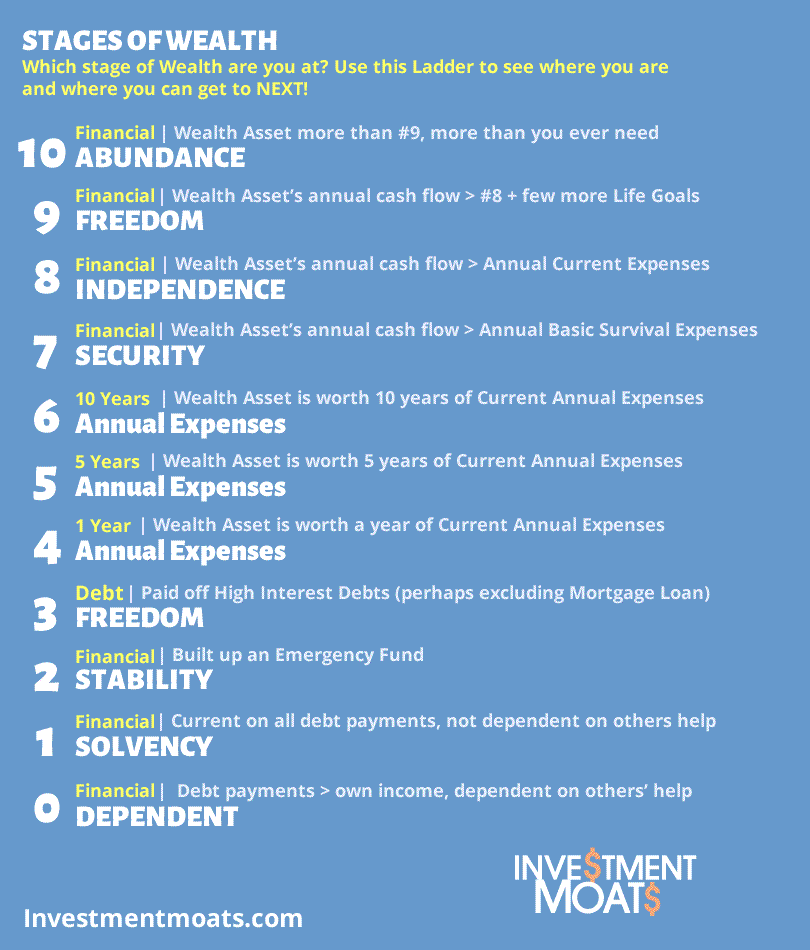
I've already reached stage 7 and working towards stage 8. Bloggers like ASSI probably stage 10 already! Every year, my target is to grow my passive income. Power of CD! But if you want to talk more about dividend investing, there are other threads you can visit to discuss, this thread is more for IWDA investing. I also hold IWDA, but I like WQDV more!
dullthings
Junior Member
- Joined
- Mar 4, 2019
- Messages
- 68
- Reaction score
- 0
Shiny and guys, may I ask how do US domiciled accumulating ETFs work from the perspective of withholding tax? Do we still get charged 30% of withholding taxes on dividends? Or none because the dividends are not distributed to us? Thanks!

Maeda_Toshiie
Supremacy Member
- Joined
- May 12, 2007
- Messages
- 6,310
- Reaction score
- 3
Shiny and guys, may I ask how do US domiciled accumulating ETFs work from the perspective of withholding tax? Do we still get charged 30% of withholding taxes on dividends? Or none because the dividends are not distributed to us? Thanks!
The accumulating funds will still have to pay the WHT to the IRS; they only automatically use the collected dividends, sans the taxed portion, to buy new shares of index components. No, it is not some tax avoidance trick.
Maeda_Toshiie
Supremacy Member
- Joined
- May 12, 2007
- Messages
- 6,310
- Reaction score
- 3
@Shiny
https://www.etfstrategy.com/why-investors-are-flocking-to-synthetic-sp-500-etfs-10339/
Synthetics and WHT. Any comments on this? Thanks.
https://www.etfstrategy.com/why-investors-are-flocking-to-synthetic-sp-500-etfs-10339/
Synthetics and WHT. Any comments on this? Thanks.
- Status
- Not open for further replies.
Important Forum Advisory Note
This forum is moderated by volunteer moderators who will react only to members' feedback on posts. Moderators are not employees or representatives of HWZ Forums. Forum members and moderators are responsible for their own posts.
Please refer to our Community Guidelines and Standards and Terms and Conditions for more information.
