*Official* Shiny Things club - Part 2

Status
Not open for further replies.

Shiny Things

Supremacy Member
Joined
Dec 13, 2009
Messages
9,580
Reaction score
804
May I know your rationale why CME FX futures instead of FX spot? Is it because of the platform offering or just the volatility of FX spot?

Futures and spot FX have basically the same volatility, because they've got the same underlying (give or take the forward points).

Here's the thing: when you're trading "spot FX", what you're probably actually trading is contracts-for-difference (a fancy name for swaps) on spot FX. When you trade a CFD, or even when you just trade leveraged spot FX, you're stuck with your original broker; you can't choose to close out with another broker if you don't like the price they give you; and the broker can charge whatever swap rates they want to keep your position open.

Leveraged spot FX is a ripoff. It's like a casino. (The advertising is even the same!)

If you absolutely must trade FX, the CME's FX futures market is well regulated; liquid, with lots of participants; and low-cost (especially for swaps: futures prices have interbank swap rates built into them).

....Although that begs the question whether the Supplementary Retirement Scheme is worth doing. If part of the deal is that you can only select among mediocre or worse investments, then you need to take that factor into account to decide whether the potential tax savings are valuable and reliably obtainable enough.

Yeah, that's a point. If you've got so much in your SRS account that you have to ask "should I buy this LionGlobal rubbish?", you have too much in your SRS account.

Anyway, I was hoping if someone is kind enough to enlighten me on whether there's anything new and important I should catch up on? It's been over 1.5 years since I bought and read the book, and with the way the world went down over the past year, I'm wondering if any of the advice in the book has lost relevance and no longer applies? Or if there's anything new to add to the pile now.

Annoyingly, yes there is. When I wrote the 2019 edition, Maybank Kim Eng had a really great RSP program, which they've since cancelled (I like to think that was because I brought them too many customers). On the bright side, POSB IS has added MBH to their lineup, which is excellent news. So there've been small changes.

To everyone.... With regards to the 110-age rule, how do you adjust or moderate it according to the number of dependents and/or other liabilities you may have?

I wouldn't change it, but I'd carve out separate buckets for those expenses. The "110 minus your age" rule is designed for retirement savings (or anything else with a fixed timeframe); if you want to save for your kid's college, you'll want to pop that in a separate savings bucket with a much lower risk tolerance (because you'll probably need that money sooner, and be drawing it down more quickly).

Hi Shiny et al

Given that a typical ETF investor will be holding on to their stocks for the long term, does the bid-ask spread difference really make a huge difference to returns? I thought that the spread would be a greater concern for someone who trades ETFs frequently.

This is fair; it won't make a huge difference. But between the illiquidity and low volumes of VWRA, I just don't see a compelling reason to flick my recommendation over from IWDA yet.

Hi ST,

In your book you mentioned for persons retiring in less-developed markets,
generally you recommend split between "global stocks" and "global bonds",
with no USD component

Errrrrrrrr what? That sounds like it might be a typo; if you're retiring in a less-developed market, then "global stocks" and "USD bonds" is what you want. Got a citation?


Good morning all,

I am a total noob at US markets but I have been trading Singapore Reits on POEMS for some time now. I'd like to have some exposure to the US markets and hence I'd like to invest in the Vanguard S&P 500 ETF.

You've jumped ahead of yourself a bit.

Obviously having exposure to global markets is a good idea. But you probably don't want to be balls-out long the US market - you want exposure to European, Japanese, Australian etc etc etc markets as well.

Is there a reason you specifically want to bet on the US? Or do you actually want world equities, not just the USA?
 

pixelspics

Member
Joined
Jun 14, 2009
Messages
392
Reaction score
91
Hi ST,

In your book you mentioned for persons retiring in less-developed markets,
generally you recommend split between "global stocks" and "global bonds",
with no USD component because during currency crises, value of local investment will hurt.

Newbie questions are:

1. does it mean you should buy "global stocks" and "global bonds" using
currencies other than USD?

2. if my understanding of item 1 is correct, isn't it during currency crises,
USD value will be stronger against your local currency in less
developed market? Why we need to avoid USD component?


Thanks in advance for for the time to reply.

Errrrrrrrr what? That sounds like it might be a typo; if you're retiring in a less-developed market, then "global stocks" and "USD bonds" is what you want. Got a citation?

Hi ST,

Below citation from topic of "Retiring Overseas" in page 63 of Rich by Retirement Third Edition.

"If you’re planning to retire in a country with less-developed markets (for example Thailand, India, or Indonesia), I generally recommend to my consulting clients that they not have an allocation to local stocks or bonds—that the split should be between “global stocks” and “global bonds”, with no USD component. This is because these less-developed countries may have less stable markets, and occasionally have currency crises (remember 1998?) which hurt the value of local investments. If this is you, you may want to seek professional advice on how you should allocate your investments."
 

thegreatjedi

Junior Member
Joined
May 16, 2011
Messages
40
Reaction score
2
Hi ST,

Below citation from topic of "Retiring Overseas" in page 63 of Rich by Retirement Third Edition.

"If you’re planning to retire in a country with less-developed markets (for example Thailand, India, or Indonesia), I generally recommend to my consulting clients that they not have an allocation to local stocks or bonds—that the split should be between “global stocks” and “global bonds”, with no USD component. This is because these less-developed countries may have less stable markets, and occasionally have currency crises (remember 1998?) which hurt the value of local investments. If this is you, you may want to seek professional advice on how you should allocate your investments."

There's a 3rd Edition to the book? I only have the 2nd Edition. Where can I get it?
 

spadestick

Junior Member
Joined
Oct 19, 2017
Messages
22
Reaction score
0
Hi Shiny, if i am slowly understanding correctly - the rationale behind the 50/50 split between US/SG ETFs is due to the fluctuating currency exchange risk yes? BBCW premise is that the SG portion should be less due to ES3’s holdings of roughly the same US stocks. Wonder as a result of calculating precisely, what should be the best ratio split instead of a pure 50/50 one.
 

BBCWatcher

Arch-Supremacy Member
Joined
Jun 15, 2010
Messages
23,447
Reaction score
4,919
Hi Shiny, if i am slowly understanding correctly - the rationale behind the 50/50 split between US/SG ETFs is due to the fluctuating currency exchange risk yes? BBCW premise is that the SG portion should be less due to ES3’s holdings of roughly the same US stocks.
That's not my view. My view is that currency risk is already a low risk for long-term Singapore dollar-oriented investors since the Singapore dollar itself is managed as a loose peg to a variety of major, trade-weighted currencies, and also because there's no need (in my view) to drag such a big, crude currency hedge along for decades of saving/investing. In the 7 to 10 year period approaching retirement there's plenty of time to make gradual portfolio adjustments, including for currency-related reasons.

ES3 consists of the 30 Straits Times Index stocks that are listed and traded on the Singapore Stock Exchange. Those particular businesses do a lot of business in Singapore, in Singapore dollars, but they don't do all of their business in Singapore dollars. Singtel, for example, does quite a bit more business in Australian dollars than it does in Singapore dollars, so the Singtel portion of ES3 is a minor slug of Australian dollar currency risk, actually. Nonetheless, I acknowledge that among investable stock funds ES3 (or G3B) is the closest you can get to something that's reasonably Singapore dollar correlated. I just don't think you need such a heavy dollop of ES3/G3B so early for so long as a long-term investor, that's all.

Wonder as a result of calculating precisely, what should be the best ratio split instead of a pure 50/50 one.
For long-term investors expecting to retire in Singapore who are at least 7 to 10 years away from retirement, I think a 20-20-60 split is a reasonable choice (~20% MBH, ~20% ES3 or G3B, ~60% IWDA, VWRA, or LCWD). If you want to reduce the ES3/G3B percentage in order to increase the IWDA/VWRA/LCWD percentage, I wouldn't argue with you.
 

spadestick

Junior Member
Joined
Oct 19, 2017
Messages
22
Reaction score
0
Thanks BBCW! My VWRA is being pummelled now, only IWDA pulling its weight... not sure whats going on.... but just holding for the long ride! Meanwhile playing with some spare cash on the side, 3%ROI per month
 

Okenba

Supremacy Member
Joined
Nov 14, 2012
Messages
5,333
Reaction score
1,005
Thanks BBCW! My VWRA is being pummelled now, only IWDA pulling its weight... not sure whats going on.... but just holding for the long ride! Meanwhile playing with some spare cash on the side, 3%ROI per month

Generally, the difference between the two is in emerging markets and perhaps small cap stocks.
 

tesarise

Senior Member
Joined
Jun 8, 2019
Messages
850
Reaction score
126
I suggest to buy the hardcopy physical book better. $30 investment for a lifetime and you get to keep it forever and refer and refresh if needed.

and keep on referring to it for a lifetime after a new version comes out when updated info?
 

cassowary18

Senior Member
Joined
Jul 17, 2018
Messages
1,801
Reaction score
194
library have, seems 3rd edition already but on-loan now.

Yeah, I got my copy from the library. You'll probably have to cough up $1.55 for the reservation fee and wait a while because there's always a line of people waiting to get the book to read.
 

pixelspics

Member
Joined
Jun 14, 2009
Messages
392
Reaction score
91
library have, seems 3rd edition already but on-loan now.

I suggest to buy the hardcopy physical book better. $30 investment for a lifetime and you get to keep it forever and refer and refresh if needed.

Already bought a copy 8 months ago.

Only previously replied to cassowary18 due to he/she was looking for 3rd edition.

Yeah, I got my copy from the library. You'll probably have to cough up $1.55 for the reservation fee and wait a while because there's always a line of people waiting to get the book to read.

Already bought a copy 8 months ago.
 
Last edited:

Shiny Things

Supremacy Member
Joined
Dec 13, 2009
Messages
9,580
Reaction score
804
Hi ST,

Below citation from topic of "Retiring Overseas" in page 63 of Rich by Retirement Third Edition.

"If you’re planning to retire in a country with less-developed markets (for example Thailand, India, or Indonesia), I generally recommend to my consulting clients that they not have an allocation to local stocks or bonds—that the split should be between “global stocks” and “global bonds”, with no USD component. This is because these less-developed countries may have less stable markets, and occasionally have currency crises (remember 1998?) which hurt the value of local investments. If this is you, you may want to seek professional advice on how you should allocate your investments."

Ooog, I'm going to have to go back and revise that: I think that should read "no local-currency component" instead of "no USD component". Good spot.

Hi Shiny, if i am slowly understanding correctly - the rationale behind the 50/50 split between US/SG ETFs is due to the fluctuating currency exchange risk yes? BBCW premise is that the SG portion should be less due to ES3’s holdings of roughly the same US stocks.

Not quite.

The premise - that BBCW and I both agree on - is that you should have some local stocks (ES3 or G3B) and some global stocks (IWDA), because you don't want to be 100% invested in the local stock market (in case Singapore has a run of bad economic luck) or the global stock market (in case Singapore has a run of good economic luck).

The thing we disagree on is what that split should be; BBCW advocates a heavier weighting to global stocks, because they're not a fan of the Singaporean stock market's growth prospects; I prefer a 50/50 weighting because it's a) easy to follow, and b) gives you more exposure to Singaporean economic growth, because that's ultimately where you're going to be spending your money when you retire.

Thanks BBCW! My VWRA is being pummelled now, only IWDA pulling its weight...

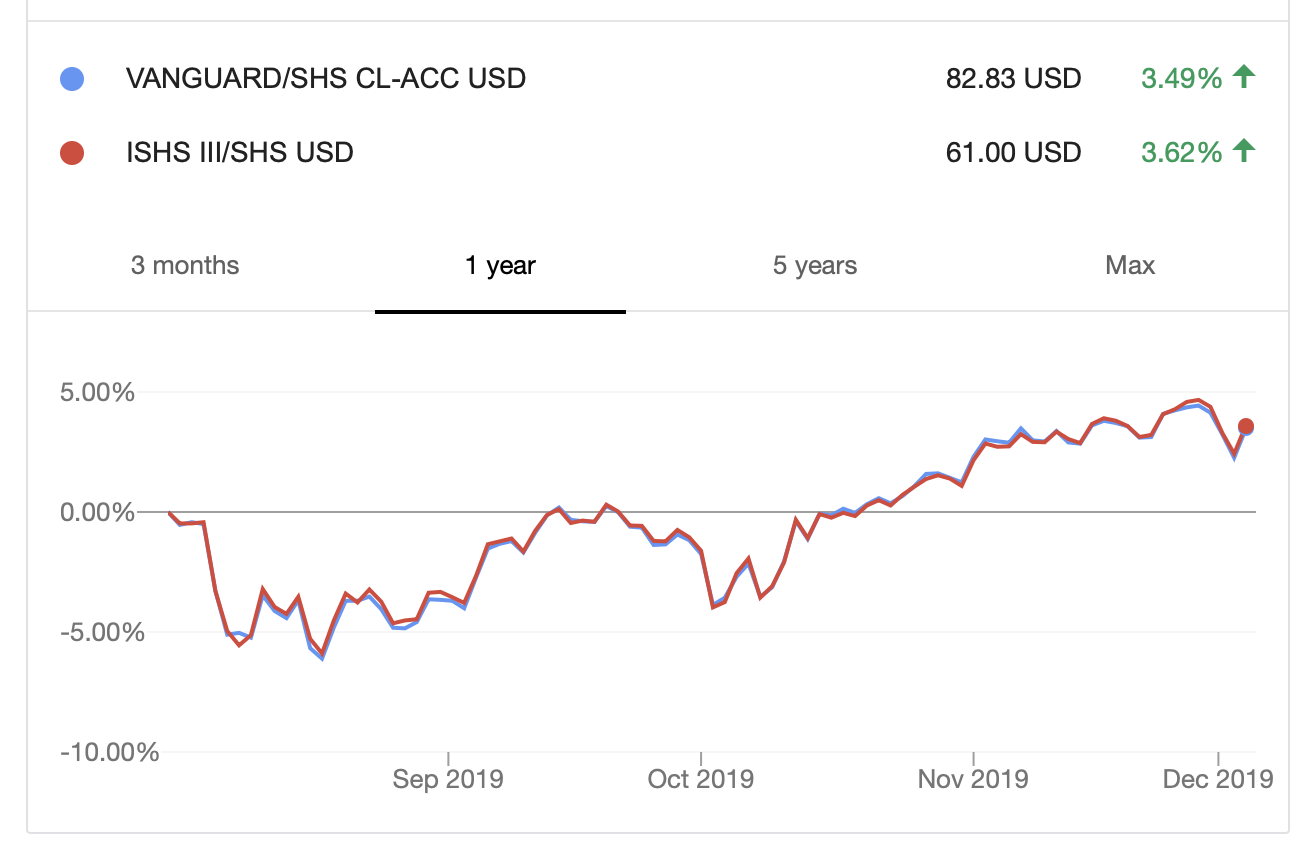
VWRA and IWDA have moved basically tick-for-tick since the two funds were created. I'm not sure what you're looking at?
 

flowerpalms

Great Supremacy Member
Joined
Apr 4, 2018
Messages
56,537
Reaction score
18,153
If got new version of course buy the new version also

But at the moment 3rd ed. Is the latest so go get it first

and keep on referring to it for a lifetime after a new version comes out when updated info?
 
Last edited:

Okenba

Supremacy Member
Joined
Nov 14, 2012
Messages
5,333
Reaction score
1,005
VWRA and IWDA have moved basically tick-for-tick since the two funds were created. I'm not sure what you're looking at?

IWDA doesn't track emerging markets. Even if they have been moving tick for tick now (didn't check) there is no guarantee that they will do so in the future. They do not track the same index and the different indexes also have different purposes.
 

Pikuniku

Junior Member
Joined
Mar 5, 2019
Messages
10
Reaction score
0
Ooog, I'm going to have to go back and revise that: I think that should read "no local-currency component" instead of "no USD component". Good spot.


Not quite.

The premise - that BBCW and I both agree on - is that you should have some local stocks (ES3 or G3B) and some global stocks (IWDA), because you don't want to be 100% invested in the local stock market (in case Singapore has a run of bad economic luck) or the global stock market (in case Singapore has a run of good economic luck).

The thing we disagree on is what that split should be; BBCW advocates a heavier weighting to global stocks, because they're not a fan of the Singaporean stock market's growth prospects; I prefer a 50/50 weighting because it's a) easy to follow, and b) gives you more exposure to Singaporean economic growth, because that's ultimately where you're going to be spending your money when you retire.


VWRA and IWDA have moved basically tick-for-tick since the two funds were created. I'm not sure what you're looking at?


Hi ST,
For "global stock", presumably we can choose IWDA. But what about "global bond"? Is IUAA a good choice?

Thanks
 
Last edited:

commie_rick

Great Supremacy Member
Joined
Feb 13, 2009
Messages
73,168
Reaction score
3,818
I suggest to buy the hardcopy physical book better. $30 investment for a lifetime and you get to keep it forever and refer and refresh if needed.

i prefer softcopy pdf format. if require to look for certain terminology. control F is easy and time saving. mobile, saves physical saves, wont rot or tear
 

Shiny Things

Supremacy Member
Joined
Dec 13, 2009
Messages
9,580
Reaction score
804
IWDA doesn't track emerging markets. Even if they have been moving tick for tick now (didn't check)

I did. Here's the performance of the two funds since VWRA was launched:

IWDA-VWRA.png


there is no guarantee that they will do so in the future. They do not track the same index and the different indexes also have different purposes.

In fact: 90% of VWRA is the same as IWDA. The remaining 10% of VWRA is emerging-market stocks, which might do better or worse than the developed-market stocks in IWDA.
 
Status
Not open for further replies.
Important Forum Advisory Note
This forum is moderated by volunteer moderators who will react only to members' feedback on posts. Moderators are not employees or representatives of HWZ Forums. Forum members and moderators are responsible for their own posts. Please refer to our Community Guidelines and Standards and Terms and Conditions for more information.
Top