

You are using an out of date browser. It may not display this or other websites correctly.
You should upgrade or use an alternative browser.
You should upgrade or use an alternative browser.
3i/Atlas Update!
- Thread starter XcoVar
- Start date
More options
Who Replied?

spunkbrat
Arch-Supremacy Member
- Joined
- Jun 23, 2012
- Messages
- 12,633
- Reaction score
- 7,691
Here is the list, split into three categories, along with the probability, P, associated with each item:
I. Major anomalies with no simple explanation:
1. P=0.00004: The forecasted perijove distance of 3I/ATLAS during its encounter with Jupiter on March 16, 2026 is 53.445 (+/- 0.06) million kilometers, identical to Jupiter’s Hill radius, 53.502 million kilometers (see here). This match was enabled by the non-gravitational acceleration that 3I/ATLAS displayed near perihelion. The rare coincidence might mean that 3I/ATLAS intends to release technological devices as artificial satellites of Jupiter, potentially at Jupiter’s Lagrange points L1 and L2 at the Hill radius — where orbital corrections and fuel requirements are minimal
2. P=0.00005: The arrival time of 3I/ATLAS was fine-tuned to bring it within tens of millions of kilometers from Mars, Venus and Jupiter and be unobservable from Earth at perihelion (see here).
3. P<0.001: The nucleus of 3I/ATLAS is roughly a million times more massive than 1I/`Oumuamua and a thousand times more massive than 2I/Borisov, while moving faster than both (see here and here). There is not enough rocky material in interstellar space to deliver a rock of this mass once per decade to the inner solar system (see here). This suggests that 3I/ATLAS may have targeted the inner solar system rather than was drawn at random from the reservoir of interstellar rocks.
4. P<0.001: During July and August as well as through November of 2025, 3I/ATLAS displayed a sunward jet (anti-tail) that is not an optical illusion from geometric perspective, unlike thousands of known comets (see here). The HiRISE image taken at closest approach of 3I/ATLAS to Mars, confirmed a glowing extension ahead of 3I/ATLAS along the direction of motion (see here). For a technological object, a beam of light or particles might be used to mitigate the risk from micrometeorites or rocks that could impact its surface at a relative speed of order 60 kilometers per second and release a thousand times more energy per unit mass than explosives.
5. P<0.001: The gas plume surrounding 3I/ATLAS contains much more nickel than iron as found in industrially-produced nickel alloys, and a nickel to cyanide ratio that is orders of magnitude larger than for thousands of known comets, including 2I/Borisov (see here). This might indicate an artificial origin of these unusual abundances.
6. P=0.002: The retrograde trajectory of 3I/ATLAS is aligned to within 5 degrees with the ecliptic plane of the planets around the Sun (see here). This suggests that the trajectory may have been designed.

https://avi-loeb.medium.com/anomalies-of-3i-atlas-organized-by-likelihood-af20fb3b6d21
I. Major anomalies with no simple explanation:
1. P=0.00004: The forecasted perijove distance of 3I/ATLAS during its encounter with Jupiter on March 16, 2026 is 53.445 (+/- 0.06) million kilometers, identical to Jupiter’s Hill radius, 53.502 million kilometers (see here). This match was enabled by the non-gravitational acceleration that 3I/ATLAS displayed near perihelion. The rare coincidence might mean that 3I/ATLAS intends to release technological devices as artificial satellites of Jupiter, potentially at Jupiter’s Lagrange points L1 and L2 at the Hill radius — where orbital corrections and fuel requirements are minimal
2. P=0.00005: The arrival time of 3I/ATLAS was fine-tuned to bring it within tens of millions of kilometers from Mars, Venus and Jupiter and be unobservable from Earth at perihelion (see here).
3. P<0.001: The nucleus of 3I/ATLAS is roughly a million times more massive than 1I/`Oumuamua and a thousand times more massive than 2I/Borisov, while moving faster than both (see here and here). There is not enough rocky material in interstellar space to deliver a rock of this mass once per decade to the inner solar system (see here). This suggests that 3I/ATLAS may have targeted the inner solar system rather than was drawn at random from the reservoir of interstellar rocks.
4. P<0.001: During July and August as well as through November of 2025, 3I/ATLAS displayed a sunward jet (anti-tail) that is not an optical illusion from geometric perspective, unlike thousands of known comets (see here). The HiRISE image taken at closest approach of 3I/ATLAS to Mars, confirmed a glowing extension ahead of 3I/ATLAS along the direction of motion (see here). For a technological object, a beam of light or particles might be used to mitigate the risk from micrometeorites or rocks that could impact its surface at a relative speed of order 60 kilometers per second and release a thousand times more energy per unit mass than explosives.
5. P<0.001: The gas plume surrounding 3I/ATLAS contains much more nickel than iron as found in industrially-produced nickel alloys, and a nickel to cyanide ratio that is orders of magnitude larger than for thousands of known comets, including 2I/Borisov (see here). This might indicate an artificial origin of these unusual abundances.
6. P=0.002: The retrograde trajectory of 3I/ATLAS is aligned to within 5 degrees with the ecliptic plane of the planets around the Sun (see here). This suggests that the trajectory may have been designed.
https://avi-loeb.medium.com/anomalies-of-3i-atlas-organized-by-likelihood-af20fb3b6d21

Dinoboyboy
High Supremacy Member
- Joined
- Dec 26, 2019
- Messages
- 28,183
- Reaction score
- 29,111
Has there been a thread to discuss the new movie age of disclosure? Saw the train by day podcast by night show by another botak and it appears the trump administration will likely announce the existence of aliens soon… 
Mechafanboy
Arch-Supremacy Member
- Joined
- Jan 31, 2014
- Messages
- 13,206
- Reaction score
- 9,911
spunkbrat
Arch-Supremacy Member
- Joined
- Jun 23, 2012
- Messages
- 12,633
- Reaction score
- 7,691

An image of 3I/ATLAS, taken on November 22, 2025 at 19:25 UTC with a 0.5-meter telescope. At that time, 3I/ATLAS was close in projection to the galaxy NGC4454 in the sky. The sunward direction is towards the lower left corner. (Credit: Mitsunori Tsumura)
https://www.ibtimes.co.uk/3i-atlas-...resembles-controlled-emission-pattern-1758925
3I/ATLAS Update: Harvard's Avi Loeb Warns Comet's Luminosity Resembles Controlled Emission Pattern
New Utah image of 3I/ATLAS confirms unnatural anomalies. Avi Loeb suggests a controlled emission pattern.
New data on 3I/ATLAS is starting to point toward something even stranger than a thin directed jet — a possible pulsing pattern. Over the last few days, independent captures from Hawaii and Thailand have shown brightness changes that repeat on a roughly sixteen-hour cycle.
These aren’t rumors. These are real, time-stamped observations taken under different skies, with different telescopes, and processed using rotational gradient and Larson–Sekanina filters to isolate the jet structure.
Across these datasets, the same thing keeps showing up:
a narrow, organized jet that brightens, fades, and brightens again — almost like a heartbeat. The nucleus is far too small to produce this on its own, which is why observers think the modulation is coming from the jet itself.
And here’s the part that matters:
If the timing matches the Sun’s geometry, it’s natural outgassing.
If it ignores the Sun entirely, then something else is controlling the cycle.
Sources Featured
• KalopaStars (Hawaii) — 10× refined nucleus zoom, thin jet structure
• Teerasak Thaluang (Thailand, MPC-O51) — rotational gradient / Larson–Sekanina jet detection
• Skywatch Signal — pulse-cycle report
• Grimes / All Day Astronomy — reposts of latest Hawaii images
• Drew Doss — current dimming and anti-tail analysis
• MPC data — 3I/ATLAS positional & motion references
These aren’t rumors. These are real, time-stamped observations taken under different skies, with different telescopes, and processed using rotational gradient and Larson–Sekanina filters to isolate the jet structure.
Across these datasets, the same thing keeps showing up:
a narrow, organized jet that brightens, fades, and brightens again — almost like a heartbeat. The nucleus is far too small to produce this on its own, which is why observers think the modulation is coming from the jet itself.
And here’s the part that matters:
If the timing matches the Sun’s geometry, it’s natural outgassing.
If it ignores the Sun entirely, then something else is controlling the cycle.
Sources Featured
• KalopaStars (Hawaii) — 10× refined nucleus zoom, thin jet structure
• Teerasak Thaluang (Thailand, MPC-O51) — rotational gradient / Larson–Sekanina jet detection
• Skywatch Signal — pulse-cycle report
• Grimes / All Day Astronomy — reposts of latest Hawaii images
• Drew Doss — current dimming and anti-tail analysis
• MPC data — 3I/ATLAS positional & motion references
Last edited:


Hope its aliens
The world need a reset.
Hey Aliens, please attack and destroy the ones with the most and powerful weapons.
Wait
Does that include our cotton come from sheep's army?
https://avi-loeb.medium.com/a-new-hubble-space-telescope-image-of-3i-atlas-926b4c7b2dd0
4 min read
·
2 hours ago
Press enter or click to view image in full size

A post-perihelion image of the interstellar object 3I/ATLAS taken by the Wide Field Camera 3 onboard the Hubble Space Telescope on November 30, 2025. At that time, 3I/ATLAS was 286 million kilometers from Earth. Background stars appear as streaks of light. The glowing halo (coma) has a teardrop shape with an anti-tail elongated towards the Sun. The sunward direction is pointing towards the lower left, as marked by the yellow arrow. (Image credit: NASA, ESA, STScI, D. Jewitt (UCLA), M.-T. Hui (Shanghai Astronomical Observatory). Image Processing: J. DePasquale (STScI).
The interstellar visitor 3I/ATLAS was reobserved by the Hubble Space Telescope from a distance of 286 million kilometers on November 30, 2025, a month after its closest approach to the Sun (perihelion). The image shows a teardrop-shaped glowing halo that extends towards the Sun.
This sunward anti-tail extension was also apparent in the pre-perihelion Hubble image of 3I/ATLAS, taken on July 21, 2025, as 3I/ATLAS was approaching the Sun from a distance that is 56% larger from Earth. The new radius of the glow is about 40,000 kilometers and its anti-tail extension goes out to about 60,000 kilometers.
In a recent paper, accessible here, I suggested that the teardrop of the coma in post-perihelion images of 3I/ATLAS is associated with a large number of macroscopic non-volatile objects that separated from it as a result of its measured non-gravitational acceleration away from the Sun.
My paper predicted that by November 30th, the swarm of objects would be closer to the Sun than 3I/ATLAS by about 60,000 kilometers if the objects overlapped with 3I/ATLAS at perihelion. This separation is in perfect agreement with the anti-tail extension of the teardrop shape in the new Hubble image.
Press enter or click to view image in full size

A pre-perihelion image of 3I/ATLAS by the Hubble Space Telescope on July 21, 2025.
The brightness contours feature an elongation of scattered sunlight towards the Sun and not away from it, as commonly observed for solar system comets. The yellow and green arrows mark, respectively, the projected negative heliocentric velocity vector and the projected anti-solar direction. The angular scale bar of 4” corresponds to 8,650 kilometers at 3I/ATLAS’ distance of 2.98 times the Earth-Sun separation. (Credit: Jewitt et al. 2025)
We are awaiting the release of the full Hubble data set which includes ultraviolet spectroscopy to determine the composition of the gas plume around 3I/ATLAS.
In the meantime, amateur astronomers continue to provide magnificent large-scale images that extend out to millions of kilometers around 3I/ATLAS.
Press enter or click to view image in full size
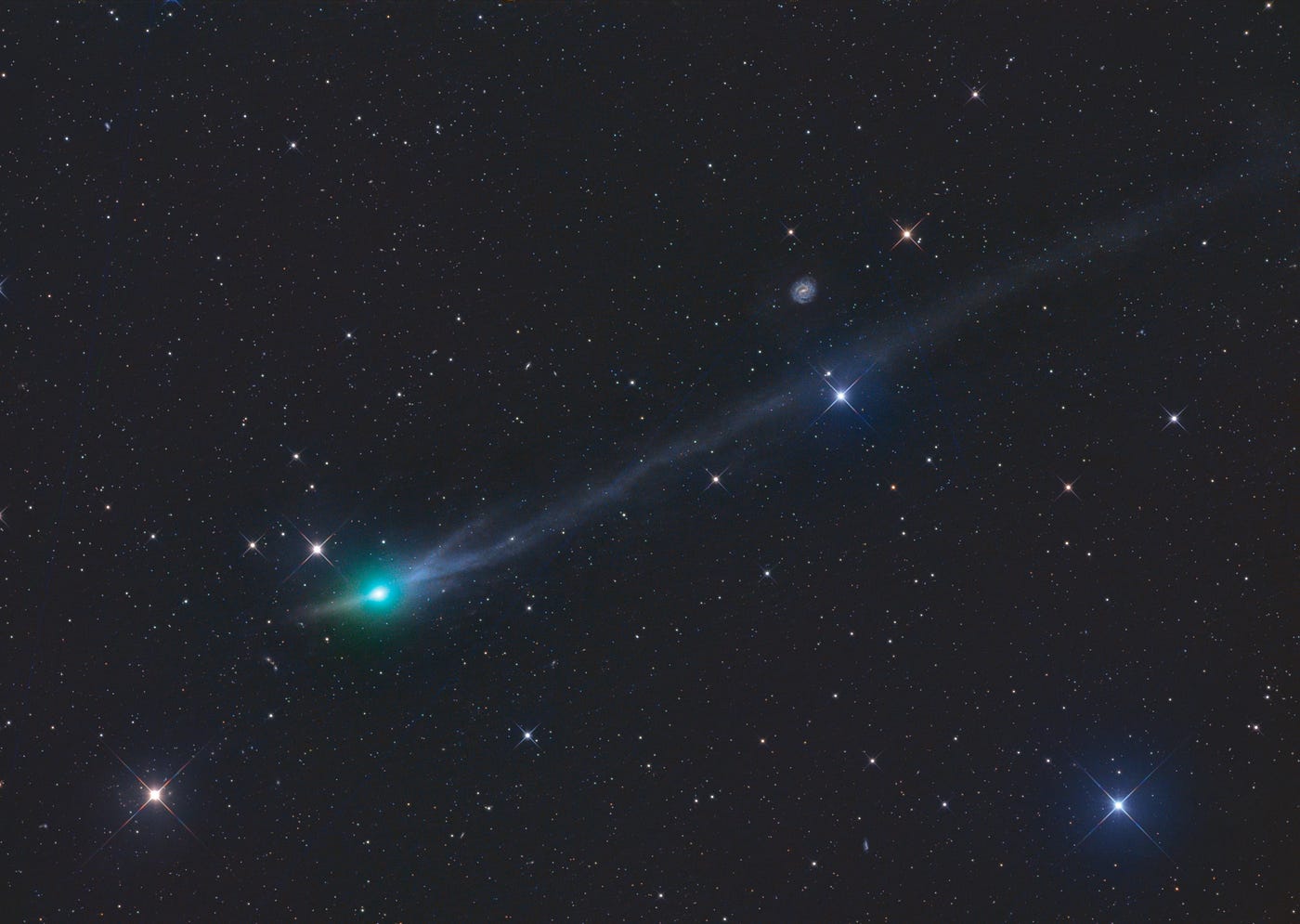
An image of the interstellar object 3I/ATLAS, taken at 1:39 on December 2, 2025 by a 12-inch telescope in Farm Tivoli, Namibia with exposures lasting 20,6,6 and 6 minutes.
North is up. The sunward direction is pointing to the lower left. The field of view is 75 by 110 arcminutes corresponding to 6.1 by 9 million kilometers at the distance of 280 million kilometers between 3I/ATLAS and Earth on that date. (Image credit: Gerald Rhemann and Michael Jäger, posted here)
A New Hubble Space Telescope Image of 3I/ATLAS
Avi Loeb4 min read
·
2 hours ago
Press enter or click to view image in full size
A post-perihelion image of the interstellar object 3I/ATLAS taken by the Wide Field Camera 3 onboard the Hubble Space Telescope on November 30, 2025. At that time, 3I/ATLAS was 286 million kilometers from Earth. Background stars appear as streaks of light. The glowing halo (coma) has a teardrop shape with an anti-tail elongated towards the Sun. The sunward direction is pointing towards the lower left, as marked by the yellow arrow. (Image credit: NASA, ESA, STScI, D. Jewitt (UCLA), M.-T. Hui (Shanghai Astronomical Observatory). Image Processing: J. DePasquale (STScI).
The interstellar visitor 3I/ATLAS was reobserved by the Hubble Space Telescope from a distance of 286 million kilometers on November 30, 2025, a month after its closest approach to the Sun (perihelion). The image shows a teardrop-shaped glowing halo that extends towards the Sun.
This sunward anti-tail extension was also apparent in the pre-perihelion Hubble image of 3I/ATLAS, taken on July 21, 2025, as 3I/ATLAS was approaching the Sun from a distance that is 56% larger from Earth. The new radius of the glow is about 40,000 kilometers and its anti-tail extension goes out to about 60,000 kilometers.
In a recent paper, accessible here, I suggested that the teardrop of the coma in post-perihelion images of 3I/ATLAS is associated with a large number of macroscopic non-volatile objects that separated from it as a result of its measured non-gravitational acceleration away from the Sun.
My paper predicted that by November 30th, the swarm of objects would be closer to the Sun than 3I/ATLAS by about 60,000 kilometers if the objects overlapped with 3I/ATLAS at perihelion. This separation is in perfect agreement with the anti-tail extension of the teardrop shape in the new Hubble image.
Press enter or click to view image in full size
A pre-perihelion image of 3I/ATLAS by the Hubble Space Telescope on July 21, 2025.
The brightness contours feature an elongation of scattered sunlight towards the Sun and not away from it, as commonly observed for solar system comets. The yellow and green arrows mark, respectively, the projected negative heliocentric velocity vector and the projected anti-solar direction. The angular scale bar of 4” corresponds to 8,650 kilometers at 3I/ATLAS’ distance of 2.98 times the Earth-Sun separation. (Credit: Jewitt et al. 2025)
We are awaiting the release of the full Hubble data set which includes ultraviolet spectroscopy to determine the composition of the gas plume around 3I/ATLAS.
In the meantime, amateur astronomers continue to provide magnificent large-scale images that extend out to millions of kilometers around 3I/ATLAS.
Press enter or click to view image in full size
An image of the interstellar object 3I/ATLAS, taken at 1:39 on December 2, 2025 by a 12-inch telescope in Farm Tivoli, Namibia with exposures lasting 20,6,6 and 6 minutes.
North is up. The sunward direction is pointing to the lower left. The field of view is 75 by 110 arcminutes corresponding to 6.1 by 9 million kilometers at the distance of 280 million kilometers between 3I/ATLAS and Earth on that date. (Image credit: Gerald Rhemann and Michael Jäger, posted here)

chech01
Arch-Supremacy Member
- Joined
- Nov 13, 2001
- Messages
- 21,946
- Reaction score
- 3,921
The alien haircut looks like many of the weirdos walking around town. Dont tell me we are already invaded
Important Forum Advisory Note
This forum is moderated by volunteer moderators who will react only to members' feedback on posts. Moderators are not employees or representatives of HWZ Forums. Forum members and moderators are responsible for their own posts.
Please refer to our Community Guidelines and Standards and Terms and Conditions for more information.

