Basic Medishield, good enough for you?

windwaver

High Supremacy Member
Joined
Apr 28, 2000
Messages
34,456
Reaction score
2,834
This thread is not about which is the cheapest private medishield plans but rather basic medishield like C/B2 wards provided by the government.

As we all know, there is much hype about paying more to get private coverage at a great cost especially when we age. On average, the cost of private coverage will hit 4 digits when one hits age 60.

I have done some research but most of the data hypes about private coverage, "what if you don't buy", blah blah blah. Very little data is on people that only has basic C/B2 coverage with the need to co-pay and deductibles.

That said, the recent advertisement on TV shows that with proper planning, a person with basic C/B2 coverage will not go bankrupt even in the event of a huge bill arising from hospital bills. We all know media is one thing, reality is another.

It'll be great if the community here can share real life examples of people you know that only has basic C/B2 medishield coverage but has received treatment and didn't go bankrupt from a huge medical bill.

Feel free to also share your thoughts on having just basic C/B2 coverage.
 

anfielder

Master Member
Joined
Sep 16, 2005
Messages
4,554
Reaction score
2
You can always go and look up the average bill sizes for various treatments in public hospitals and calculate the co-insurance and deductible from there. Doesn't look like the amounts are going to bankrupt any normal person.
https://www.moh.gov.sg/content/moh_...al-Hospital-Bills-By-condition-procedure.html

Of course, there's also medifund for those who genuinely can't afford the co-insurance and deductible for whatever reason.
 

windwaver

High Supremacy Member
Joined
Apr 28, 2000
Messages
34,456
Reaction score
2,834
You can always go and look up the average bill sizes for various treatments in public hospitals and calculate the co-insurance and deductible from there. Doesn't look like the amounts are going to bankrupt any normal person.
https://www.moh.gov.sg/content/moh_...al-Hospital-Bills-By-condition-procedure.html

Of course, there's also medifund for those who genuinely can't afford the co-insurance and deductible for whatever reason.

1446266918488.jpg


Graph to show loss ratio.

Thanks for the information but what I hope this thread will do is to gather information that are from ground up, cases that 'fall through the gap'.
 

antonpoh

Arch-Supremacy Member
Joined
Oct 3, 2012
Messages
15,719
Reaction score
2,774
Ok, let me share what i know so far.

For a person with medishield life, every year we pay $400plus.

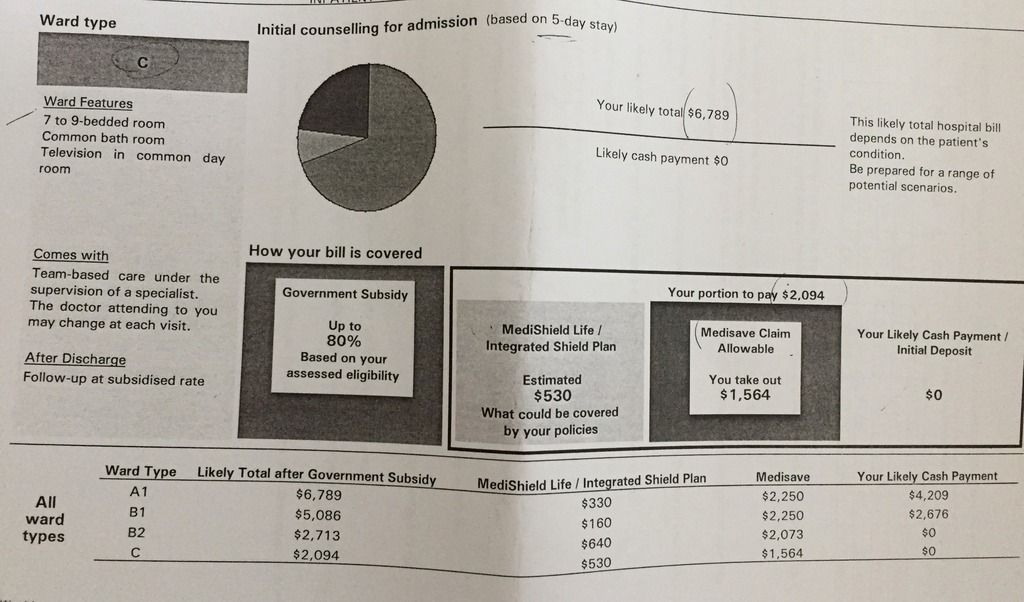
By the time you use Ward C, first $1564 is pay using your Medisave. Any assess gahmen pay up to 80%. For a 5 days stay in Ward C, the Medishield Life policy will pay $530.

BD01DDEE-A5F0-4AA1-93D3-B46DC1D39FD1_zpskkqmd6hq.jpg
 

BBCWatcher

Arch-Supremacy Member
Joined
Jun 15, 2010
Messages
24,446
Reaction score
5,515
On average, the cost of private coverage will hit 4 digits when one hits age 60.
That's overstated, I'd say. Taking a look at AXA's Shield Standard Plan as an example, an individual age 60 (i.e. age 61 at next birthday) would pay an annual premium of $279. The annual premium doesn't hit four figures until age 75 (age 76 at next birthday). Premiums can be paid from high yielding, Singapore tax free Medisave funds.

The Standard Plan (and others like it) is calibrated to cover 100% of public hospital B1 ward costs (90% of B1 for Permanent Residents) after the deductible ($2500 for most, or $3000 past age 80) and co-insurance (10%). Or 80% of public hospital A ward costs if you prefer to stay in a private room. The annual payout limit is $150,000 with no lifetime limit, so you might have to be a bit careful about A ward. You could also chew through that $150K pretty quickly with some of the more expensive prescriptions. Even so, I think it's a pretty good insurance value.

Speaking of PRs (and other non-citizens), medical finances work a bit differently for them. It's more likely they'll need insurance, and more of it, than similarly situated citizens. Keep in mind also that many citizens have non-citizen spouses and/or children, and insurance is often primarily about preserving household wealth. The best insurance decisions often involve different levels of insurance for different people in the household.
 

windwaver

High Supremacy Member
Joined
Apr 28, 2000
Messages
34,456
Reaction score
2,834
Ok, let me share what i know so far.

For a person with medishield life, every year we pay $400plus.

By the time you use Ward C, first $1564 is pay using your Medisave. Any assess gahmen pay up to 80%. For a 5 days stay in Ward C, the Medishield Life policy will pay $530.

BD01DDEE-A5F0-4AA1-93D3-B46DC1D39FD1_zpskkqmd6hq.jpg

Nice table. As long as there's sufficient medisave and no need to choose doctor, it looks affordable even if we reach old age. Like what I mentioned above, will there be cases that 'fall through the crack' where medishield life doesn't work that well?

Think the committee is now re-looking into more sustainable medishield plan and riders so that co-pay and deductibles is incorporated into all range of protection including private.

If that's the case, will people still hang on to their private shield plans with co-pay and deductibles?
 

windwaver

High Supremacy Member
Joined
Apr 28, 2000
Messages
34,456
Reaction score
2,834
That's overstated, I'd say. Taking a look at AXA's Shield Standard Plan as an example, an individual age 60 (i.e. age 61 at next birthday) would pay an annual premium of $279. The annual premium doesn't hit four figures until age 75 (age 76 at next birthday). Premiums can be paid from high yielding, Singapore tax free Medisave funds.

The Standard Plan (and others like it) is calibrated to cover 100% of public hospital B1 ward costs (90% of B1 for Permanent Residents) after the deductible ($2500 for most, or $3000 past age 80) and co-insurance (10%). Or 80% of public hospital A ward costs if you prefer to stay in a private room. The annual payout limit is $150,000 with no lifetime limit, so you might have to be a bit careful about A ward. You could also chew through that $150K pretty quickly with some of the more expensive prescriptions. Even so, I think it's a pretty good insurance value.

Problem is, rider cost will always increase until loss ratio is self sustaining. Most insurance companies are out to make money, not just making ratio 100%. On top of that, not all insurance companies offer standard plan with as charged rider and they know people are at their mercy when it comes to switching companies.
 

BBCWatcher

Arch-Supremacy Member
Joined
Jun 15, 2010
Messages
24,446
Reaction score
5,515
Well sure, but a lot of people cannot afford the remaining medical bills after MediShield Life payouts (if any). If you're a household of one citizen then maybe spending down assets to cover medical bills, then falling into the social safety net, is a reasonable thing to do. That's not everybody, though. If you're quite wealthy then you can viably self-insure. That's not everybody either.

I would also point out that medical insurance tends to be more heavily Singapore tax advantaged than your own medical spending out of pocket. You can buy an Integrated Shield plan out of tax free Medisave funds, or (if my understanding is correct) your employer can buy it for you. In both cases you pay little or no income tax. Yes, in some cases you can spend Medisave funds on medical care, but it's somewhat more restrictive. The tax savings are skewed toward the insurance side, especially if your employer is providing medical insurance as part of your compensation. So even if you can self-insure, even if the insurance company collects a bit of profit (as it should), it still might be sensible to buy medical insurance simply to exploit the income tax savings.
 

anfielder

Master Member
Joined
Sep 16, 2005
Messages
4,554
Reaction score
2
That's overstated, I'd say. Taking a look at AXA's Shield Standard Plan as an example, an individual age 60 (i.e. age 61 at next birthday) would pay an annual premium of $279. The annual premium doesn't hit four figures until age 75 (age 76 at next birthday). Premiums can be paid from high yielding, Singapore tax free Medisave funds.

The Standard Plan (and others like it) is calibrated to cover 100% of public hospital B1 ward costs (90% of B1 for Permanent Residents) after the deductible ($2500 for most, or $3000 past age 80) and co-insurance (10%). Or 80% of public hospital A ward costs if you prefer to stay in a private room. The annual payout limit is $150,000 with no lifetime limit, so you might have to be a bit careful about A ward. You could also chew through that $150K pretty quickly with some of the more expensive prescriptions. Even so, I think it's a pretty good insurance value.

Speaking of PRs (and other non-citizens), medical finances work a bit differently for them. It's more likely they'll need insurance, and more of it, than similarly situated citizens. Keep in mind also that many citizens have non-citizen spouses and/or children, and insurance is often primarily about preserving household wealth. The best insurance decisions often involve different levels of insurance for different people in the household.

Looking at the benefits table for AXA, the standard plan is not as-charged. Only plan A and B are as-charged.

Anyway, the concern of TS seems to be the co-insurance and deductibles. Choosing a standard B1 plan doesn't address this, it only allows for stay in a higher ward class.
 

antonpoh

Arch-Supremacy Member
Joined
Oct 3, 2012
Messages
15,719
Reaction score
2,774
Basic not good enough for me. I need ward with aircon.

I don't know about other hospital but SGH's C & B ward do have aircon. Thanks to the haze from indonesia, most wards are aircon by now.
 

doody_

Supremacy Member
Joined
Nov 27, 2006
Messages
7,508
Reaction score
7
The B and C class wards quite jialat. Not sick also can become sick la. I will pay for A as long as I can.
 

BBCWatcher

Arch-Supremacy Member
Joined
Jun 15, 2010
Messages
24,446
Reaction score
5,515
I quite like what the U.S. has done -- and that President Trump and his party could undo, but that's another story. Medical insurance there is currently regulated such that it actually insures. Here are two examples:

1. By law, there can be no annual or lifetime limits for covered services. If the care is medically necessary, then it's medically necessary.

2. There is an annual out-of-pocket ceiling. That is, your annual, total medical spending on covered services is firmly capped. The 2017 cap is US$7150 per individual and $14300 per family. (You can choose a medical insurance policy with lower caps for a higher premium. The premium may be partially or fully subsidized.)

Yes, those two features cost some money, but they're what catastrophic medical insurance ought to do: cap your financial risk. It's not perfect, of course. If you need long-term nursing home care then that's not all or substantially within the "covered services."

Singapore's insurance market doesn't have these two features, or at least I haven't found any medical insurance policies with these two features. Granted, medical costs are lower in Singapore, but medical bankruptcy is still mathematically possible. In the next "policy revision" the government probably ought to take a look at more firmly capping patient financial exposures. That's really what consumers want, to avoid medical bankruptcy (or medical poverty) risks for them and for their households. That's what I'd want, anyway.

By the way, I think all the U.S. private insurers have to cover emergency and urgent care overseas. They happily do so since such care is less expensive overseas. That said, that's another problem with today's Integrated Shield plans. They only cover care up to "reasonable and customary" Singapore medical costs. In my view that's not enough for Singapore's globally mobile, modern society. The same insurance companies sell a lot of travel medical insurance (at high profit I suspect), so maybe that's the problem.
 

windwaver

High Supremacy Member
Joined
Apr 28, 2000
Messages
34,456
Reaction score
2,834
Here are two examples:

1. By law, there can be no annual or lifetime limits for covered services. If the care is medically necessary, then it's medically necessary.

2. There is an annual out-of-pocket ceiling. That is, your annual, total medical spending on covered services is firmly capped. The 2017 cap is US$7150 per individual and $14300 per family. (You can choose a medical insurance policy with lower caps for a higher premium. The premium may be partially or fully subsidized.)

Yes, those two features cost some money, but they're what catastrophic medical insurance ought to do: cap your financial risk. It's not perfect, of course. If you need long-term nursing home care then that's not all or substantially within the "covered services."

Singapore's insurance market doesn't have these two features, or at least I haven't found any medical insurance policies with these two features. Granted, medical costs are lower in Singapore, but medical bankruptcy is still mathematically possible. In the next "policy revision" the government probably ought to take a look at more firmly capping patient financial exposures. That's really what consumers want, to avoid medical bankruptcy (or medical poverty) risks for them and for their households. That's what I'd want, anyway.

By the way, I think all the U.S. private insurers have to cover emergency and urgent care overseas. They happily do so since such care is less expensive overseas. That said, that's another problem with today's Integrated Shield plans. They only cover care up to "reasonable and customary" Singapore medical costs. In my view that's not enough for Singapore's globally mobile, modern society. The same insurance companies sell a lot of travel medical insurance (at high profit I suspect), so maybe that's the problem.

On top of that, I find that insurance companies operating in Singapore seems to have an issue with claims. What I mean is not the usual straight forward claims but those that involves memos and such (eventually can be claimed).

Insurance companies in Singapore do not bother to obtain information that they need for claims. Most of them just reject a claim and it's the duty of the customer to obtain information for them (many of them still sick).

That uncertainty coupled with what you have listed brings about a very uncertain medical outlook when one gets sick in Singapore.
 

vince123123

Senior Member
Joined
Sep 9, 2000
Messages
2,237
Reaction score
2
This situation is because the insurance companies have no financial incentive to pay out claims. The longer they can delay in paying out, or not pay out at all, the better for their bottom line. Hence, they are not going to be particularly hardworking to speed up the payout process. There is therefore an element of self-interest here.

Although customers can always sue the insurer to compel them to pay out, most lay people do not have the financial means or ability to fight a large insurer.

To equalise the playing field, there should be put in a place a system that financially penalises insurers if they anyhow reject a claim without due dilligence. So if say, for example, the insurer anyhow rejects a $100 claim from a customer, and later it is found by the court that the claim was valid, the insurer should pay 2X, 5X or even 10X the claim as a financial penalty. This will give the insurer some incentive to get their act together than to play the delay/reject game.

Insurance companies in Singapore do not bother to obtain information that they need for claims. Most of them just reject a claim and it's the duty of the customer to obtain information for them (many of them still sick).

That uncertainty coupled with what you have listed brings about a very uncertain medical outlook when one gets sick in Singapore.
 

windwaver

High Supremacy Member
Joined
Apr 28, 2000
Messages
34,456
Reaction score
2,834
This situation is because the insurance companies have no financial incentive to pay out claims. The longer they can delay in paying out, or not pay out at all, the better for their bottom line. Hence, they are not going to be particularly hardworking to speed up the payout process. There is therefore an element of self-interest here.

Although customers can always sue the insurer to compel them to pay out, most lay people do not have the financial means or ability to fight a large insurer.

To equalise the playing field, there should be put in a place a system that financially penalises insurers if they anyhow reject a claim without due dilligence. So if say, for example, the insurer anyhow rejects a $100 claim from a customer, and later it is found by the court that the claim was valid, the insurer should pay 2X, 5X or even 10X the claim as a financial penalty. This will give the insurer some incentive to get their act together than to play the delay/reject game.

Exactly Vince (love your suggestion).

So it's ironic when it comes to buying insurance in Singapore. Insurance companies and agents love it when people pay but prefer not to do anything when paying out. Add this to a ton of bad agents out there and you have a recipe for disaster.

That's why I came up with this thread to see if basic medishield life is really sufficient to protect ourselves through old age. Eldershield is under review, I suppose the committee is going to adjust it for better long term protection.
 

akwl88

Arch-Supremacy Member
Joined
Feb 15, 2016
Messages
10,697
Reaction score
1
http://treeofprosperity.blogspot.sg/2016/06/debunking-arguments-for-integrated.html

Debunking the arguments for Integrated Shield Plans.
Due to a combination of government policy-making and the marketing propaganda being spread by insurance companies, the selling of Integrated Shield Plan (ISPs) have become almost as easy as taking a lollipop away from a child.

For most people, ISPs are a no brainer. The most convincing argument to purchase a ISP is that the deduction of premiums come from the Medisave account so no cash outlay is required. This is a very difficult argument to debunk because Singaporeans have come to believe that Medisave money is not your money and you are better off using it up because it will have no impact to your personal finances.

I did some research by looking at sales brochures of some insurance firms and would like to convince the reader that the basic arguments to buy ISPs is probably unethical and it may even raise legal questions as to whether some sort of misrepresentation may even be taking place when a sale is being made ( Although the only way to confirm this is for a victim to take civil action ).

Here are some points for your consideration:

a) You are already covered by Medishield, do you really need to go beyond that ?

The most important point about ISPs is that you are buying a better ward when you get hospitalised. You need to really ask yourself whether you really need to stay in a Class A ward when you fall sick. This points to the fundamental idea that insurance is about risk transfer. You already have a means of risk transfer via Medishield, do you need to transfer the incremental risk of expensive Class A medical support ?

All Singapore citizens are being covered by Medishield which provides reasonably generous subsidies for hospital stay for class C and B2 wards. When you buy an ISP, you are typically being made to buy insurance for a stay in better wards.

At least for the brochure I examined, the examples of medical costs incurred employ Class A as an illustration which has the tendency to make the medical expenses quite frightening. Your task when looking at this example is to ask your financial adviser to make the same illustration for a class C or B2 ward before you conclude that medical costs are cripplingly expensive in Singapore.

b) Your Medisave account does not contain funny money which is out of your reach and belongs to the PAP.

You know something is wrong with an industry when some agents try to perpetuate the myth that CPF money is government money and not your money.

If they do so they are wrong. Your Medisave is money which belongs to you.

The problem is that you need to understand how CPF-MA flows into CPF-SA which flows into your hands after age 55.

When your CPF Medisave Account (CPF-MA) exceeds the contribution ceiling of $48,500 $49,800, the excess flows into your CPF-SA. This is vitally important because after age 55, you are allowed to withdraw your CPF-OA and CPF-SA if it exceeds the minimum sum of around $161k. More if you pledge the value of your HDB flat to CPF.

What this means is that if you manage your Medisave frugally and spend on only what you need,you can have a larger pot of cash in your hands when you reach 55 years of age.

c) ISP premiums may cost 150% to 200% of your Medisave premiums but it will not seem that way when the sale is made.

Another bugbear of mine is that at least in the illustration shown on some sales brochures, you might observe that the Medisave premiums are only illustrated to be only 10-20% higher than your ISP premiums.

This is due to the practice of the government giving Medishield subsidies based on your economic status. For example, at 41 years of age, my Medishield premium is officially $435. But the government subsidizes part of it, even if I am of a highest income bracket, I only pay $242 a year from my Medisave account.

At least one company I observed puts the pre-subsidy $435 side-by-side with their premium costs to trick the customer into thinking that the difference is not particularly large, when it should be $242 which should be compared against.

To figure this out, the customer must be sharp enough to ask whether the current Medishield premiums incorporate government subsidies.

We know that most ordinary folks would not do that.

d) When you get an ISP, you will literally pay the piper after age 50.

The most damning feature of some ISPs I observed is that, unlike Medishield, you start to incur a cash outlay after you reach 50 or 60 years of age. Based on that sales brochure, this cash outlay can escalate very quickly. Based on the lifespan of a Singaporean male, at age 83, you could be looking at an outlay of $1,000 to $4,000 a year. This effectively exacerbates the longevity risk you face and your monthly payouts from CPF Life may be required to pay off these premiums.

By the time you reach that age, your agent may be long retired or may even have died, you will be shouldering an additional financial burden to maintain your ISP.

In summary, we should start thinking twice about government initiatives which increases the number of accounts which we have. Specifically cordoning money into Medisave will incentivise the private sector to exploit your inherent bias for mental accounting. Parents who invest in a large Child Development Account also tend to spend freely on specialist pediatricians because the medical fees are debited from a separate pool of money designated for childcare. This makes citizens dangerously lazy about their finances.

We are entering a new age with separate spending accounts for keeping fit and getting extra training.

We should always be mindful that these accounts function as some sort of a subsidy for specific industries which are smart enough to exploit our psychological biases.

 

RoLanTo

Master Member
Joined
Jan 1, 2000
Messages
4,221
Reaction score
341
dont know y govt dont operate a not-for-profit insurance arm to do the ISP. keep premium lower.

also, how come ISP premium dont function like car insurance, increase premium of those who consumed and decrease the premium for those who didnt use it, like NCD.

isnt above a better way to deter over-consumption? over-consumption just leads to higher medical cost, higher insurance premium. no benefit at all for us consumer.
 

windwaver

High Supremacy Member
Joined
Apr 28, 2000
Messages
34,456
Reaction score
2,834

Excellent read, especially point b).

dont know y govt dont operate a not-for-profit insurance arm to do the ISP. keep premium lower.

also, how come ISP premium dont function like car insurance, increase premium of those who consumed and decrease the premium for those who didnt use it, like NCD.

isnt above a better way to deter over-consumption? over-consumption just leads to higher medical cost, higher insurance premium. no benefit at all for us consumer.

I agree with rolandto on the part that government should run an insurance arm.

All these insurance companies do not have economy of scale. If the government runs it, the pool will be significantly increased and we will not be at the mercy of insurance companies when it comes to price differences.

http://business.asiaone.com/news/higher-medical-costs-claims-take-toll-3-out-5-ip-insurers. If you read the article above, AIA made an eye-popping profit of S$700.52 million in 2015.
 
Important Forum Advisory Note
This forum is moderated by volunteer moderators who will react only to members' feedback on posts. Moderators are not employees or representatives of HWZ Forums. Forum members and moderators are responsible for their own posts. Please refer to our Community Guidelines and Standards and Terms and Conditions for more information.
Top