http://treeofprosperity.blogspot.sg/2016/06/debunking-arguments-for-integrated.html
Debunking the arguments for Integrated Shield Plans.
Due to a combination of government policy-making and the marketing propaganda being spread by insurance companies, the selling of Integrated Shield Plan (ISPs) have become almost as easy as taking a lollipop away from a child.
For most people, ISPs are a no brainer. The most convincing argument to purchase a ISP is that the deduction of premiums come from the Medisave account so no cash outlay is required. This is a very difficult argument to debunk because Singaporeans have come to believe that Medisave money is not your money and you are better off using it up because it will have no impact to your personal finances.
I did some research by looking at sales brochures of some insurance firms and would like to convince the reader that the basic arguments to buy ISPs is probably unethical and it may even raise legal questions as to whether some sort of misrepresentation may even be taking place when a sale is being made ( Although the only way to confirm this is for a victim to take civil action ).
Here are some points for your consideration:
a) You are already covered by Medishield, do you really need to go beyond that ?
The most important point about ISPs is that you are buying a better ward when you get hospitalised. You need to really ask yourself whether you really need to stay in a Class A ward when you fall sick. This points to the fundamental idea that insurance is about risk transfer. You already have a means of risk transfer via Medishield, do you need to transfer the incremental risk of expensive Class A medical support ?
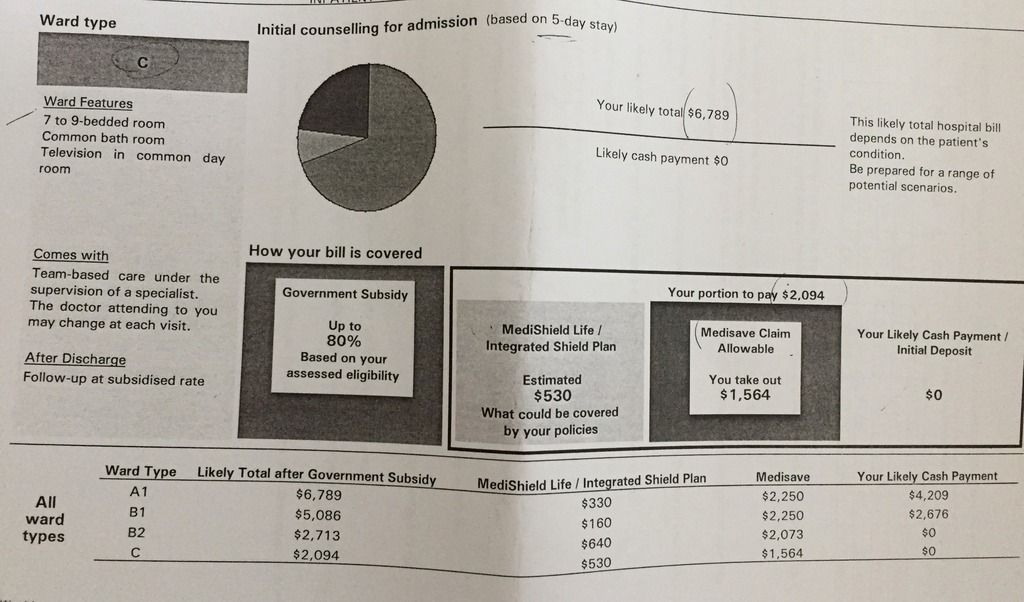
All Singapore citizens are being covered by Medishield which provides reasonably generous subsidies for hospital stay for class C and B2 wards. When you buy an ISP, you are typically being made to buy insurance for a stay in better wards.
At least for the brochure I examined, the examples of medical costs incurred employ Class A as an illustration which has the tendency to make the medical expenses quite frightening. Your task when looking at this example is to ask your financial adviser to make the same illustration for a class C or B2 ward before you conclude that medical costs are cripplingly expensive in Singapore.
b) Your Medisave account does not contain funny money which is out of your reach and belongs to the PAP.
You know something is wrong with an industry when some agents try to perpetuate the myth that CPF money is government money and not your money.
If they do so they are wrong. Your Medisave is money which belongs to you.
The problem is that you need to understand how CPF-MA flows into CPF-SA which flows into your hands after age 55.
When your CPF Medisave Account (CPF-MA) exceeds the contribution ceiling of $48,500 $49,800, the excess flows into your CPF-SA. This is vitally important because after age 55, you are allowed to withdraw your CPF-OA and CPF-SA if it exceeds the minimum sum of around $161k. More if you pledge the value of your HDB flat to CPF.
What this means is that if you manage your Medisave frugally and spend on only what you need,you can have a larger pot of cash in your hands when you reach 55 years of age.
c) ISP premiums may cost 150% to 200% of your Medisave premiums but it will not seem that way when the sale is made.
Another bugbear of mine is that at least in the illustration shown on some sales brochures, you might observe that the Medisave premiums are only illustrated to be only 10-20% higher than your ISP premiums.
This is due to the practice of the government giving Medishield subsidies based on your economic status. For example, at 41 years of age, my Medishield premium is officially $435. But the government subsidizes part of it, even if I am of a highest income bracket, I only pay $242 a year from my Medisave account.
At least one company I observed puts the pre-subsidy $435 side-by-side with their premium costs to trick the customer into thinking that the difference is not particularly large, when it should be $242 which should be compared against.
To figure this out, the customer must be sharp enough to ask whether the current Medishield premiums incorporate government subsidies.
We know that most ordinary folks would not do that.
d) When you get an ISP, you will literally pay the piper after age 50.
The most damning feature of some ISPs I observed is that, unlike Medishield, you start to incur a cash outlay after you reach 50 or 60 years of age. Based on that sales brochure, this cash outlay can escalate very quickly. Based on the lifespan of a Singaporean male, at age 83, you could be looking at an outlay of $1,000 to $4,000 a year. This effectively exacerbates the longevity risk you face and your monthly payouts from CPF Life may be required to pay off these premiums.
By the time you reach that age, your agent may be long retired or may even have died, you will be shouldering an additional financial burden to maintain your ISP.
In summary, we should start thinking twice about government initiatives which increases the number of accounts which we have. Specifically cordoning money into Medisave will incentivise the private sector to exploit your inherent bias for mental accounting. Parents who invest in a large Child Development Account also tend to spend freely on specialist pediatricians because the medical fees are debited from a separate pool of money designated for childcare. This makes citizens dangerously lazy about their finances.
We are entering a new age with separate spending accounts for keeping fit and getting extra training.
We should always be mindful that these accounts function as some sort of a subsidy for specific industries which are smart enough to exploit our psychological biases.