Buddhist Verses & Silent Readings For Reflection (静思语) - Part 6

nubitol

High Supremacy Member
Joined
Jun 28, 2015
Messages
27,488
Reaction score
632
violating 戒 causes repercussion, repercussion causes reverse of 定 to layman learner

when a Buddhist reaches Buddhahood, there is no more 戒 that binds him, because everything is 空 even the Dharma

空 is described because repercussion is man made or self inflict, with strong awareness, a Buddha can overcome suffering from repercussion, because suffering is arise from attachment, and most discussed is attachment to the body
 

AUTUMN&WINTER

High Supremacy Member
Joined
Sep 29, 2011
Messages
28,209
Reaction score
28,328
Is it true that without 戒 there will no 定。

“戒定慧”:由戒生定,由定生慧

I think this is logical. For instance, if one always breaks the precept of lying, will not be at peace. How to arise concentration when one is not at peace?
 
Last edited:

nubitol

High Supremacy Member
Joined
Jun 28, 2015
Messages
27,488
Reaction score
632
戒 and 定 is like traffic light law

when its red, people stop, when green people move, the reason these two exist is so people could move forward without accident

戒 is man made or Buddha (whom was a man) made, there is a reason why it is made so in order for people's consciousness could move forward

violating of 戒 does not means the end of everything, so a person must remain 定

if a paranoid person fear to take a taxi because of existence of traffic law, he will not reach his destination

but a Buddha who has reach the destination and decided to turn back with his newly acquire helicopter, the law of traffic applied to him is different from what a layman thinks

so rules applied differently to varying degree of people

in modern times, such as 戒 of eating meat instead of causes 定, it causes fear of hell to meat eaters thinking they violating 戒

before long, we could see meat eaters and vegan group start fighting in internet which defeat the purpose of 戒

because meat is hot, eating meat causes anger or easily triggered and not calm, but people turns to not calm when just seeing meat eaters which defeat the purpose of 戒
 

Śūnyatā

Master Member
Joined
Dec 15, 2018
Messages
3,889
Reaction score
3,961
Is it true that without 戒 there will no 定。

The mind is like a jar of muddy water. The defilements of the mind are akin to the mud particles that float within the jar. When the jar is shaken, the mud particles turn the water opaque and no light passes through. The more opaque the water, the more obscured our awareness becomes. When awareness diminishes, ignorance manifests.

Our daily activities consist of wholesome and unwholesome types - the latter stir our emotions, incite our desires and blind us to the folly of our attachments. 戒 refers to conscious effort made to reduce and even eliminate unwholesome thoughts and actions so that the mud settles and allows us greater clarity of mind. As mental clarity increases, awareness develops and unease fades. This generates conduciveness for mental stillness, in essence 定.

Without conscious effort to reduce or eliminate unwholesome thoughts and actions, the mind remains turbulent, easily disturbed and filled with noise, and mental stillness becomes ever more unachievable.
 

Konnichiwa

Banned
Joined
Feb 25, 2009
Messages
40,267
Reaction score
2,489
Śūnyatā;129822661 said:
The mind is like a jar of muddy water. The defilements of the mind are akin to the mud particles that float within the jar. When the jar is shaken, the mud particles turn the water opaque and no light passes through. The more opaque the water, the more obscured our awareness becomes. When awareness diminishes, ignorance manifests.

Our daily activities consist of wholesome and unwholesome types - the latter stir our emotions, incite our desires and blind us to the folly of our attachments. 戒 refers to conscious effort made to reduce and even eliminate unwholesome thoughts and actions so that the mud settles and allows us greater clarity of mind. As mental clarity increases, awareness develops and unease fades. This generates conduciveness for mental stillness, in essence 定.

Without conscious effort to reduce or eliminate unwholesome thoughts and actions, the mind remains turbulent, easily disturbed and filled with noise, and mental stillness becomes ever more unachievable.

U achieved 定 already?
Theory easy bro
 

vofzxy

Supremacy Member
Joined
May 15, 2006
Messages
6,275
Reaction score
518
EqEb8eL.jpg


its here ~~~~~~~~~~~~~

if you like a few copies, PM me please
i have <30 of them
 

vofzxy

Supremacy Member
Joined
May 15, 2006
Messages
6,275
Reaction score
518
Is it true that without 戒 there will no 定。

surangama sutra said so....

[size=+1]
The Buddha told Ananda, "You constantly hear me explain in the vinaya that there are three unalterable aspects to cultivation. That is, collecting one's thoughts constitutes the precepts; from the precepts comes samadhi; and out of samadhi arises wisdom. Samadhi arises from precepts, and wisdom is revealed out of samadhi. These are called the 'Three Non- Outflow Studies.' "
[/size]

source -- http://www.cttbusa.org/shurangama6/shurangama6_1.asp

master hsuan hua commentary as well....
 

scheng1

Supremacy Member
Joined
May 20, 2012
Messages
5,795
Reaction score
12,311
Is it true that without 戒 there will no 定。

佛说梵网经卷上, 菩萨心地品之上:

"若佛子。戒心者。非非戒无受者。十善戒无师说法。欺盗乃至邪见无集者。慈良清直正实正见舍喜等。是十戒体性。制止八倒一切性离一道清净。"

This is at a very high level of observing the precept (戒心). Once you can control your thought until this level, you have achieved a very high level of 定.

佛说梵网经卷下, 菩萨心地品之下:
"佛言。佛子。若自杀教人杀方便赞叹杀见作随喜。乃至咒杀。杀因杀缘杀法杀业。乃至一切有命者不得故杀。

是菩萨应起常住慈悲心孝顺心。方便救护一切众生。而自恣心快意杀生者。是菩萨波罗夷罪。"

The way to observe the killing precept is to develop compassion towards all sentient beings, and always think about protecting and saving them.

In short, precepts are to train us to think no evil, say no evil, do no evil. Purify our thought, speech and action 身口意.

Once you achieve 定 through other methods (eg meditation), you will automatically keep the precepts, since you can control your thoughts already. No evil thought will arise, no evil speech will be spoken, no evil act will be done.

Most people concurrently and continuously learn and practice 戒定慧. We do not differentiate that we have to learn 戒 first or 定 first or 慧 first.
 

Śūnyatā

Master Member
Joined
Dec 15, 2018
Messages
3,889
Reaction score
3,961
U achieved 定 already?
Theory easy bro

Every action starts with an idea, a thought, a notion. The proof of the pudding is in the eating. Give it a try and see the results for yourself. Our own life journey is the best laboratory for Buddhist teachings. We don't need to accept teachings at arm's length, instead we should put them into practice and test them objectively for ourselves. My own practice has helped me tremendously in my own journey and allowed me to witness the validity of the teachings encapsulated within the sutras, especially on how they have guided my own understanding and, consequently, awareness of the ego and self. :)
 

waterbright

Senior Member
Joined
Apr 20, 2018
Messages
2,202
Reaction score
11,748
V : The To-the-Far-Shore Chapter (Pārāyana Vagga) — A brahman teacher sends his students to the Buddha to see if the latter is truly awakened.

Prologue

From the delightful city of the Kosalans,

a brahman [Bāvarī]

who had mastered mantras,

aspiring to nothingness, (1)

went to the Southern country.

He, in the land of Assaka,

the neighborhood of Muḷaka,

on the bank of the Godhāvarī,

lived on gleanings & fruits.

Close by was a large village.

And with the income from that village

he performed a great sacrifice.

Having sacrificed the great sacrifice,

he returned again to his ashram.

As soon as he had entered there,

another brahman came along:

thirsty, with

scratched feet,

dirty teeth,

dusty head.

On arrival, he asked Bāvarī

for five hundred [pieces of money].

Bāvarī, on seeing him, invited him to sit down,

asked after what is pleasant & skillful,

and said these words:

“Whatever of mine

that could be given away,

I have disposed of entirely.

Forgive me, brahman,

I don’t have five hundred.”

“If you don’t hand over

to me when I ask,

within seven days,

may your head split

into seven pieces.”

Dissembling, the imposter

proclaimed threats.

Hearing his words,

Bāvarī was distressed.

He wasted away, taking no food,

afflicted with the arrow of grief,

and, with his mind this way,

his heart found no delight in jhāna.

Seeing him nervous & distressed,

a devatā wishing his welfare,

approached Bāvarī

and said these words:

“That imposter, wanting money,

doesn’t discern heads;

has no knowledge of heads

or the splitting of heads.”

Bāvarī:

“You, sir, surely know.

Explain to me when asked:

heads & the splitting of heads.

I will listen to your words.”

The devatā:

“I too don’t know that.

I don’t have that knowledge.

Heads & the splitting of heads:

That is surely the insight of Victors.”

Bāvarī:

“Then who knows surely

in this circle of the earth,

heads & the splitting of heads?

Explain that to me, devatā.”

The devatā:

“Gone forth from the city of Kapilavatthu,

the chief of the world,

a descendant of King Okkāka,

a Sakyan-son, a bringer of light:

He, brahman, is Rightly Self-Awakened,

gone to the far shore of all

dhammas;

attainer of all

direct knowledges & strengths,

one with an Eye that sees all

dhammas;

attainer of the end of all

action,

released in the ending of acquisitions.

He, the One with Eyes,

awakened, blessed,

teaches the Dhamma.

Going to him, you ask him.

He will answer you.”

Hearing the word “Self-Awakened,”

Bāvarī was exultant.

His grief subsided,

and he gained abundant rapture.

So Bāvarī, gratified, exultant,

excited, asked the devatā:

“In which village or town,

or in which country

is the protector of the world?

Going where can we pay homage

to the Self-Awakened One,

supreme among two-footed beings?”

The devatā:

“In Sāvatthī, the Kosalan city,

is the Victor of vast discernment,

of foremost deep intelligence.

He, a matchless Sakyan-son,

effluent-free, a bull among men,

is an expert in the splitting of heads.”

Then Bāvarī addressed his students,

brahmans who had mastered the mantras,

“Come, students, I will explain.

Listen to my words.

He whose appearance in the world

is hard often to gain,

has today arisen in the world,

renowned as Self-Awakened.

Going quickly to Sāvatthī,

see the one supreme

among two-footed beings.”

The students:

“But how, brahman, on seeing him,

will we know for sure

that he’s the One Self-Awakened?

Tell us, who don’t know,

how we will know him.”

Bāvarī:

“There have come down in the mantras

the marks of a Great Man.

Thirty-two are described in all,

step by step.

One in whose body

are the marks of a Great Man

has two destinations.

There isn’t a third.

If he dwells in a home,

he will conquer this world

—without rod, without sword,

but with righteousness—

he will rule.

But if he goes forth

from home into homelessness,

with his roof opened up, (2)

he will be Self-Awakened,

a worthy one unexcelled.

Ask just in your heart

about my caste & clan,

mantras, other students,

and about heads

& the splitting of heads.

If he is awakened,

seeing without obstruction,

he will answer in speech

the questions asked in your heart.”

Having heard Bāvarī’s words,

sixteen brahman students—

Ajita, Tissa-metteyya,

Puṇṇaka & Mettagū,

Dhotaka & Upasīva,

Nanda & Hemaka,

Todeyya & Kappa,

the wise Jatukaṇṇin,

Bhadrāvudha & Udaya,

Posāla the brahman,

Mogharāja the intelligent,

and Piṅgiya the great seer—

all with their own groups,

famed in all

the world,

endowed with jhāna,

delighting in jhāna,

enlightened,

perfume with perfumes (3)

from previous lives,

having bowed down to Bāvarī

and performed circumambulation,

left, setting out for the North,

wearing coiled hair & deer-skins:

first to the establishment of Muḷaka,

then to Māhissatī, Ujjenī, Gonaddhā,

Vedisā, Vanasa,

to Kosambī & Sāketa,

to Sāvatthī, the supreme city,

to Setabya, Kapilavatthu,

the city of Kusinārā,

to Pāva, Bhoganagara,

to Vesālī, the city of the Magadhans,

and then to the Pāsāṇaka shrine,

refreshing & lovely.

Like a thirsty man for cool water,

like a merchant for a great profit,

like one burning from heat

for shade,

quickly they climbed the mountain.

And at that time, the Blessed One,

surrounded by the Saṅgha of monks,

was teaching the monks the Dhamma,

like a lion roaring in the forest.

Ajita saw the Self-Awakened One,

like the sun with radiance in beams, (4)

like the moon come to fullness

on the fifteenth day.

Then, seeing the marks

complete in his body,

he stood to one side, overjoyed,

and in his heart asked the questions:

“Speak concerning his birth,

speak of his clan & marks,

speak of his perfection in the mantras,

and how many brahmans

does he teach?”

The Buddha:

“His age is one hundred & twenty,

and by clan, he is a Bāvarī.

Three are the marks in his body,

three the Vedas he’s mastered.

In the marks & oral traditions,

etymologies & rituals,

he teaches five hundred.

In his own doctrine

he has reached perfection.”

Ajita:

“Proclaim them in detail—

Bāvarī’s marks—

O man supreme,

cutter of craving,

don’t leave us in doubt.”

The Buddha:

“He can hide his face with his tongue,

he has a tuft of hair between his brows,

his male organ is in a sheath:

Know this, young brahman.”

Not hearing anything asked,

but hearing the questions answered,

all the people, excited,

with hands palm-to-palm over their hearts,

thought:

“What deva or Brahmā,

or Inda Sujampati (5)

asked those questions in his heart?

To whom did he [the Buddha] reply?”

Ajita:

“Bāvarī asked about heads

and the splitting of heads.

Explain that, Blessed One.

Subdue our doubt, seer.”

The Buddha:

“Know the head to be ignorance,

and the splitting of the head, knowledge

connected with conviction,

mindfulness, concentration,

desire, & persistence.”

Then, with great joy,

the young brahman,

putting himself in order,

arranging his deer-skin over one shoulder,

fell with his head at the Blessed One’s feet:

“Master, One with Eyes,

Bāvarī the brahman,

together with his students, dear sir—

exultant in mind, happy at heart—

venerate your feet.”

The Buddha:

“May he be happy,

Bāvarī the brahman,

together with his students.

And may you, too, be happy,

young brahman,

and live a long time.

All doubts—

Bāvarī’s

and all of yours:

Ask, now that I’ve given leave,

whatever you wish in your heart.”

Given leave by the Self-Awakened One,

having sat to one side, hands palm-to-palm

over his heart,

Ajita there addressed the first question

to the Tathāgata.

vv. 976–1031

Notes

1. Reading ākiñcāññaṁ with the Thai text of Nd II and of SnA. The Thai text of the prologue here reads āciññaṁ, “practice, custom.” According to SnA, “nothingness” here means freedom from care. However, it might also mean the meditative state of the dimension of nothingness, and the post-mortem deva realm corresponding to that attainment. This would fit in with the fact that, in the following dialogues, two of his students—Upasīva and Posāla—appear to be familiar with this dimension in their meditation, and quiz the Buddha as to what to do after having attained it.

2. See Sn 2:13, note 3.

3. “Perfume” (vāsanā) here means traces of good qualities.

4. Following GD in interpreting vīta- here as meaning “straight.”

5. “Lord of the Well-born,” an epithet for Sakka, king of the devas of the Thirty-three.

 

scheng1

Supremacy Member
Joined
May 20, 2012
Messages
5,795
Reaction score
12,311
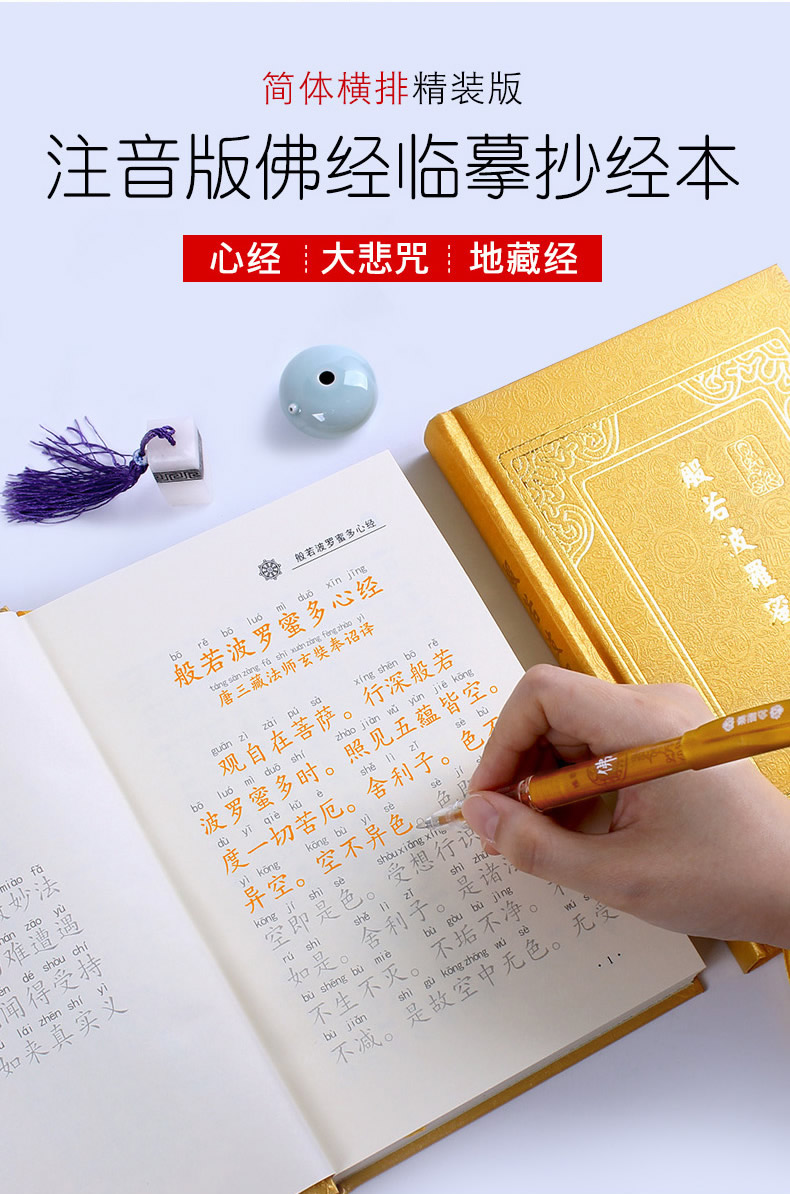
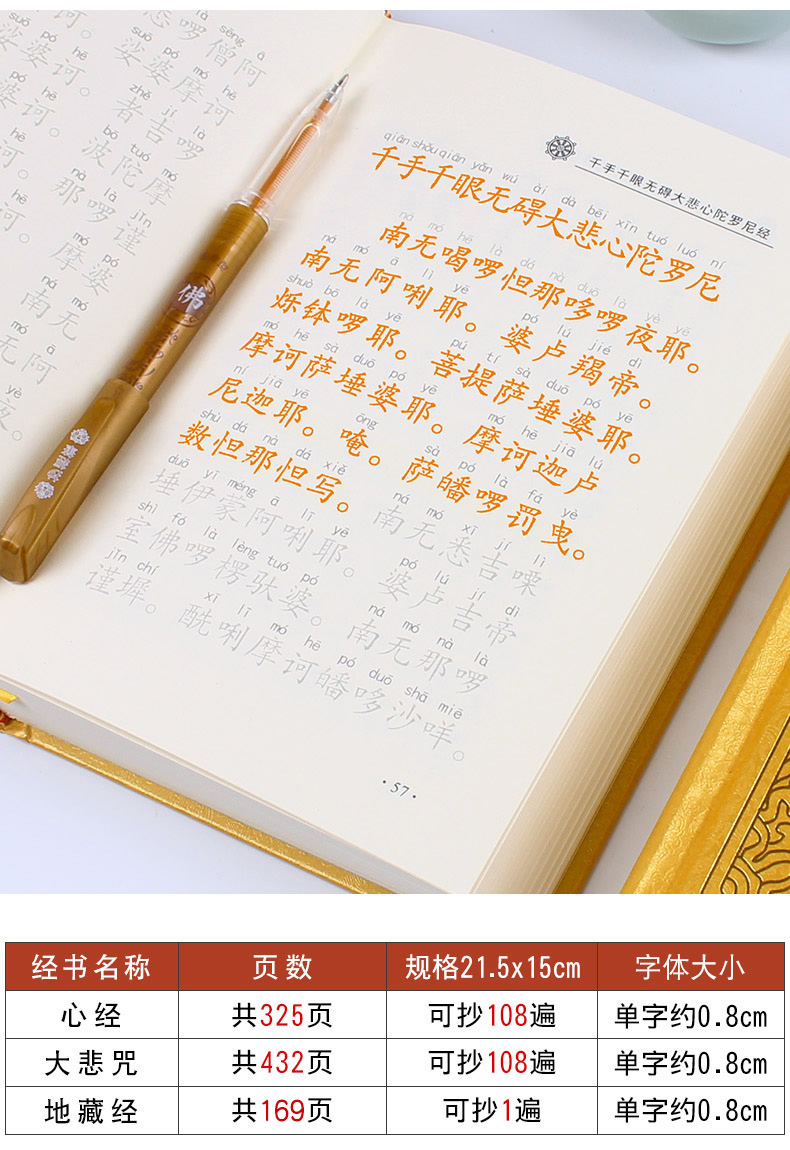
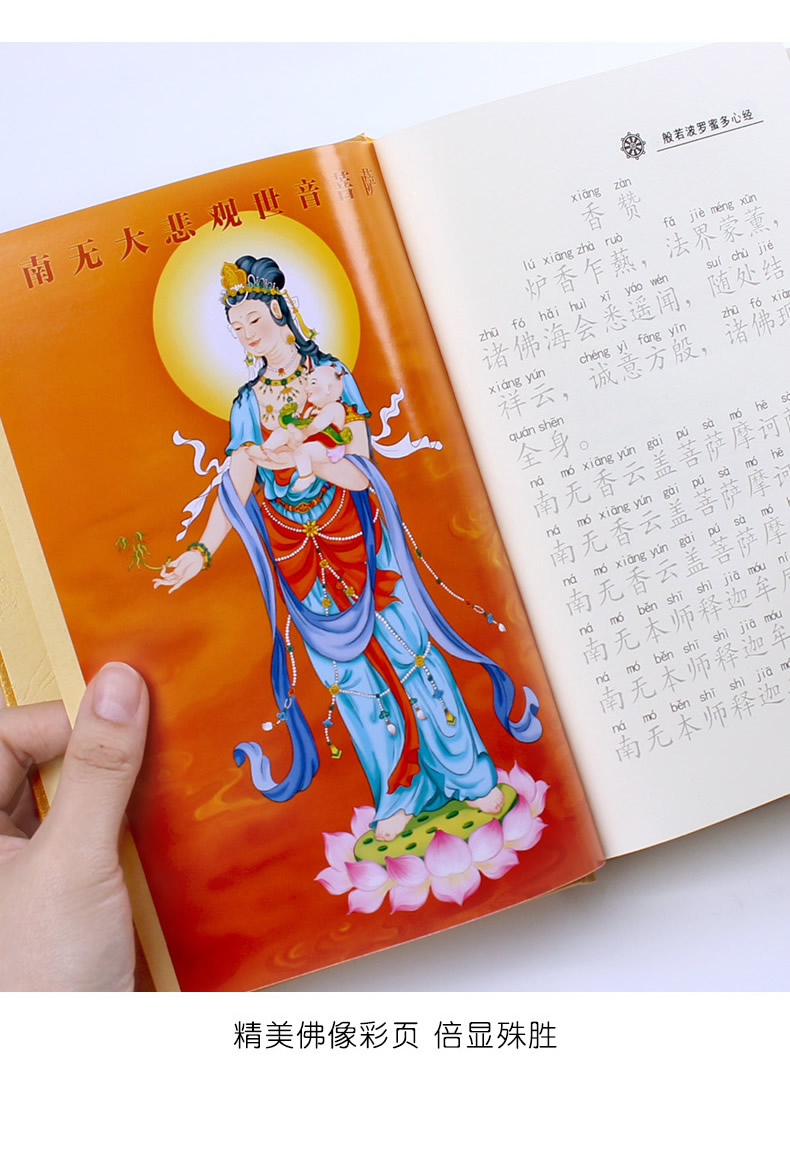
Saw a set of very beautiful 抄经本 in Taobao

https://detail.tmall.com/item.htm?spm=a1z0d.6639537.1997196601.15.26617484hUgHQQ&id=617408146397

O1CN01MKZyet1YOwbC2bUtI_!!2777443050.jpg


Characteristics:
1. Hard cover
2. Simplified Chinese characters
3. Hanyu Pinyu
4. 5 different sutra/mantra: Heart Sutra (108 times), Diamond Sutra, Dabei Zhou (108 tiimes), Medicine Buddha Sutra, Dizang Sutra.
5. Selection of sutra only (choice of single sutra/whole set of 5) or sutra + pen/refills
6. A5 size

If you are interested in getting the sutra with pen/refills, please select Consolidation Sea Shipping (the safest option). The warehouse of Direct Air will reject the package due to "refills" are liquid. So far never face any rejection by Consolidation Air or Sea shipping.

O1CN01cZB6uX1YOwcb4Dbb3_!!2777443050.jpg


O1CN01nEAyNn1YOwbEKC8Wh_!!2777443050.jpg


O1CN01cZB6uX1YOwcb4Dbb3_!!2777443050.jpg
 

waterbright

Senior Member
Joined
Apr 20, 2018
Messages
2,202
Reaction score
11,748
5:1 Ajita’s Questions — A brahman questions the Buddha about mindfulness, discernment, and the cessation of name-and-form.

With what

is the world shrouded?

Because of what

doesn’t it shine?

With what

is it smeared? Tell me.

What

is its great danger & fear?

The Buddha:

With ignorance

the world is shrouded.

Because of stinginess,

heedlessness, (1)

it doesn’t shine.

With longing

it’s smeared—I tell you.

Suffering-stress:

its great danger & fear.

Ajita:

They flow every which way,

the streams. (2)

What is their blocking,

what their restraint—tell me—

with what are they finally stopped?

The Buddha:

Whatever streams

there are in the world:

Their blocking is

mindfulness, mindfulness

is their restraint—I tell you—

with discernment

they’re finally stopped.

Ajita:

Discernment & mindfulness,

name-&-form, dear sir:

Tell me, when asked this,

where are they brought to a halt?

The Buddha:

This question you’ve asked, Ajita,

I’ll answer it for you—

where name-&-form

are brought to a halt

without trace:

With the cessation of consciousness

they’re brought

to a halt. (3)

Ajita:

Those here who have fathomed the Dhamma,

those who are learners,

those who are run-of-the-mill:

When you, dear sir, astute,

are asked this,

tell me their manner of life. (4)

The Buddha:

He

should not hanker

for sensual pleasures,

should be limpid in mind.

Skilled in all mental qualities,

he, the monk, should wander

mindfully.

vv. 1032–1039

Notes

1. The Thai edition notes that this word, in terms of the meter of the line, is excessive.

2. According to Nd II, the streams that ‘flow every which way’ are the streams of craving, views, conceit, defilement, corruption, and ignorance that flow out the six sense media. The first two lines in the translation of Ven. Ajita’s second set of questions (the first half-line in the Pali) is identical to the first half-line in Dhp 340.

3. See DN 11, DN 15, MN 49, and SN 12:67. Asaṅga, in the Yogācārabhūmi, quotes a Sanskrit translation of this sutta that inserts at this point the final question and answer, on the topic of how consciousness is brought to a halt, occurring at the end of the Pali version of Sn 5:14. A manuscript found in Turfan contains a Sanskrit version of this sutta that inserts the same question at the same point, and includes traces of other insertions as well.

4. In SN 12:31, the Buddha quotes this question to Ven. Sāriputta and asks him to answer it. With a little prodding, Ven. Sāriputta gives this extended answer, on which the Buddha places his seal of approval:

“One sees with right discernment that ‘this has come into being.’ Seeing with right discernment that ‘this has come into being,’ one practices for disenchantment with, for dispassion toward, for the cessation of what has come into being. One sees with right discernment that ‘it has come into being from this nutriment.’ Seeing with right discernment that ‘it has come into being from this nutriment,’ one practices for disenchantment with, for dispassion toward, for the cessation of the nutriment by which it has come into being. One sees with right discernment that ‘from the cessation of this nutriment, what has come into being is subject to cessation.’ Seeing with right discernment that ‘from the cessation of this nutriment, what has come into being is subject to cessation,’ one practices for disenchantment with, for dispassion toward, for the cessation of what is subject to cessation. This is how one is a learner.

“And how is one a person who has fathomed the Dhamma?

“One sees with right discernment that ‘this has come into being.’ Seeing with right discernment that ‘this has come into being,’ one is—through disenchantment, dispassion, cessation, through lack of clinging/sustenance—released from what has come into being. One sees with right discernment that ‘it has come into being from this nutriment.’ Seeing with right discernment that ‘it has come into being from this nutriment,’ one is—through disenchantment, dispassion, cessation, through lack of clinging/sustenance—released from the nutriment by which it has come into being. One sees with right discernment that ‘from the cessation of this nutriment, what has come into being is subject to cessation.’ Seeing with right discernment that ‘from the cessation of this nutriment, what has come into being is subject to cessation,’ one is—through disenchantment, dispassion, cessation, through lack of clinging/sustenance—released from what is subject to cessation. This is how one is a person who has fathomed the Dhamma.”
 

AUTUMN&WINTER

High Supremacy Member
Joined
Sep 29, 2011
Messages
28,209
Reaction score
28,328
NAMO 南无阿弥陀佛

三界无安,犹如火宅。众苦充满,甚可怖畏。众生愚痴,常住其中。纵受极苦,不求出离。-印光大师

念佛解脱生死


119746015_10223702820741886_104441451854968952_n.jpg


119737296_2774318906185960_2211867013593749461_n.jpg


Regret is the result of foolishness;
change is the cause of wisdom.


119709242_1238066276527274_74103898416177215_o.jpg


119744926_3823775530985154_2947192191320434933_o.png


119236217_10223686450332636_1055751277654186370_n.jpg


"In our life, we come across eight worldly conditions that no one can escape, they are known as
(i) gain and loss;
(ii) praise and blame;
(iii) fame and disrepute;
(iv) happiness and suffering.

These are the eight worldly conditions that revolve around our life. We face them again and again, and we come across them constantly in life. However, when we experience gain, praise, fame and happiness, we should not be proud of them and we must understand these all are subjected to change. When we experience loss, blame, disrepute and sufferings, we should not regret or worry about them and we should understand that everything is impermanent and happy times are on the way. Then, we can have peace and happiness all the time because we are ready to accept any kinds of situations that come to our life wisely...


119857286_698399177429815_8359040203839432148_n.jpg


119562483_10223686462772947_8486171504407601639_n.jpg


A Peaceful Mind

"When your ears hear sound, let them do their job. When your eyes perform their function with forms, let them do so. When your nose works with smells, let it do its job. When your body experiences sensations, then it perform its natural functions.
Where will problems arise? There are no problems.
In the same way, all those things which belong to the apparent, leave them with the apparent and acknowledge that which is the transcendent.
Simply be the ‘one who knows’, knowing without fixation, knowing and letting things be their natural way.
All things are just as they are."

- Ajahn Chah


119280792_3316868491668884_4944413017916191085_n.jpg
 
Last edited:
Important Forum Advisory Note
This forum is moderated by volunteer moderators who will react only to members' feedback on posts. Moderators are not employees or representatives of HWZ. Forum members and moderators are responsible for their own posts.

Please refer to our Community Guidelines and Standards, Terms of Service and Member T&Cs for more information.
Top