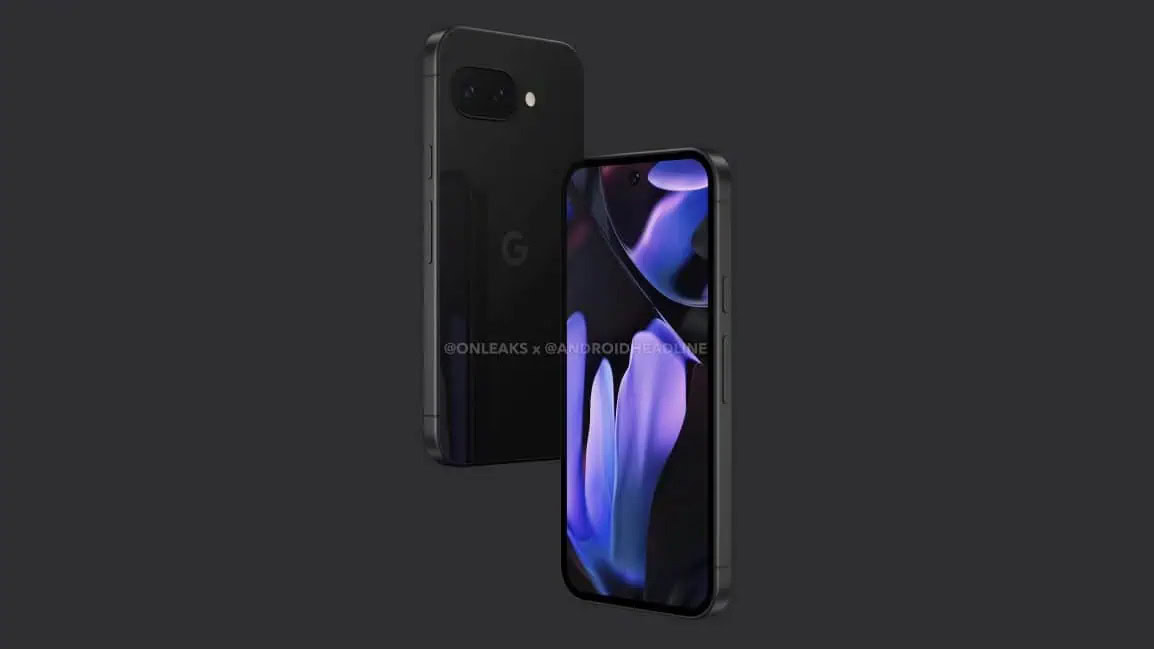
Google Pixel 11 series

limmk

High Supremacy Member
Joined
Jul 5, 2001
Messages
43,212
Reaction score
8,328
TL;DR
  • An Android expert has uncovered codenames for Google’s Tensor G5 and Tensor G6 processors in AOSP code.
  • The Tensor G5 is called Laguna while the Tensor G6 is apparently called Malibu.
  • The Tensor G6 is expected to power the Pixel 11 series.


Google launched the Pixel 9 series a couple of months ago, and it offers a semi-custom Tensor G4 chipset. All signs point to the Pixel 10’s Tensor G5 processor being a significant upgrade for the company, and we’ve now got codenames for this chip and the Tensor G6.

Android Authority contributor Mishaal Rahman (and a Discord member) discovered the codenames for Google’s Tensor G5 and Tensor G6 processors. The codenames Laguna and Malibu, respectively, were spotted in newly updated Android Open Source Project (AOSP) code.


There isn’t much else to go on, but the Laguna name has appeared in previous Tensor G5 leaks. This chip is expected to be a major upgrade for Pixel phones as it’ll be the first Tensor processor manufactured by TSMC. All previous Tensor chips were manufactured by Samsung Foundry, which is thought to offer an inferior manufacturing process. This apparent inferiority has manifested itself in throttling and heating issues for Samsung-made chips in recent years, including Google’s first couple of Tensor processors and the Snapdragon 8 Gen 1. So switching to TSMC should make for Tensor chips with improved performance and reduced heating in theory.

This isn’t the first time we’ve heard about the Pixel 11’s expected processor, either. Business Korea reported last month that Google was working with TSMC to build the Tensor G6 on a 2nm process. Either way, it looks like TSMC-made Google Tensor chips won’t be a once-off occurrence.
 

limmk

High Supremacy Member
Joined
Jul 5, 2001
Messages
43,212
Reaction score
8,328
TL;DR
  • Google is considering adding an under-display infrared (IR) camera to the Pixel 11, based on a leak from Google’s chips division.
  • This would enable more secure and versatile face unlock, addressing limitations of the current face authentication system that relies on regular color cameras.
  • The Tensor G6 chip is expected to support the new IR camera system, potentially matching Apple’s planned under-display Face ID technology for 2026.


As bezels on phones became smaller, the real estate on the front of the phones started to come at a premium. This meant that everything besides a single camera in a punch hole cutout had to go. Perhaps the biggest feature we lost because of this was IR cameras that could be used for fast and secure authentication, even in total darkness.

Thankfully, the feature might finally be coming back. Thanks to a massive leak from Google’s chips division, Android Authority has viewed credible documents indicating Google is considering adding an under-display infrared camera to the Pixel 11.

Bringing back safer face unlock​

Google Pixel 4 Face Unlock


Since the Pixel 7 series, all Google phones have a face authentication solution that uses the regular color camera. While this is a useful feature, it’s nowhere as secure as a dedicated IR camera. Another downside is that it only works when there’s enough light, which makes it much less versatile.

The Pixel 7 wasn’t the first Google phone to feature face unlock, though — the Pixel 4 came with the feature years prior with a slight difference: the phone actually had two IR cameras that allowed it to perform secure authentication even in the dark.

Face unlock on Pixels might be in for another major change soon. According to the documentation we viewed, the Google Tensor G6’s image signal processor will be getting support for an under-display IR camera system. Thanks to a new “lite” front-end (one of the main parts of an ISP) designed specifically for this purpose, the chip will allow both better and much less power-hungry handling of such systems.

Obviously, just because a chip supports a feature doesn’t necessarily mean phones using it will too, but this means that Google is at least considering the feature for the Pixel 11 series. In case the plan goes forward, Google would be matching Pixel’s face unlock support with Apple, which is rumored to launch phones with an under-display IR camera for Face ID in 2026.

Unfortunately, the documentation doesn’t mention whether the regular selfie camera would be under-display, either. Given that Google’s phones have always been focused on camera quality, it’s safe to assume it would remain in a punch hole. Regular under-display cameras still suffer from a noticeable hit to clarity.
 
Last edited:

limmk

High Supremacy Member
Joined
Jul 5, 2001
Messages
43,212
Reaction score
8,328
TL;DR
  • Tensor G5 leak suggests Google could be working on a “next-gen” telephoto camera with 100x zoom capabilities for the Pixel 11 series.
  • This would be aided with machine learning algorithms to achieve 100x zoom for photos and videos.
  • Samsung introduced 100x zoom with the Galaxy S20 Ultra in 2020, while the Pixel 11 is expected to be launched in 2026.


Although the Pixel 9 series was just recently launched, we’re already getting some possible good news about future Google phones. Thanks to a massive leak from Google’s gChips division, we have some clues on features that the Tensor G5 is likely to support, and one of the highlight camera features for the Pixel 11 could be 100x zoom capabilities.

Our report highlights that Google could be working on a “next-gen” telephoto camera that would help bring 100x zoom capabilities to the Pixel 11 series in 2026, as we spotted references to such a camera upgrade in the leaked documents. The hardware would be supported with Tensor G5’s machine learning algorithms to help it achieve 100x zoom for photos and videos. However, we anticipate that the machine learning algorithms could differ for the two media formats.
Beyond 100x zoom, the Tensor G5 could finally bring support for 4K 60fps HDR videos and Cinematic Blur, on-device Night Sight Video, and introduce a new video relight feature.

Samsung introduced 100x zoom with the Galaxy S20 Ultra in 2020. While the end results left much to be desired, the S20 Ultra showed that 100x zoom can be done with the help of periscope zoom lenses. We’re hoping to see better results from Google since it will be six years late to the party, and Google has shown that it can work its magic with great hardware-software synergy.
 

limmk

High Supremacy Member
Joined
Jul 5, 2001
Messages
43,212
Reaction score
8,328
TL;DR
  • Google’s previous “Tensor based Pixel programs have not met its financial targets.”
  • Google Tensor G6 is primarily focused on reducing the price of the chip, as well as making it run cooler and more efficiently.
  • The GPU will lose its ray-tracing abilities, while the CPU gets a slight upgrade.


Google’s Tensor chips have failed to impress performance enthusiasts. Even after four generations, the chips aren’t quite what many had hoped they could be (check out our in-depth Tensor G4 testing for the full picture) and remain a hot topic of discussion in the community. In our previous reporting, we’ve shown how the next-gen Tensor G5 promises to deliver improvements in power efficiency and thermals thanks to the superior TSMC manufacturing process, but its specs still leave a lot to be desired compared to the competition.

Unfortunately, that seems likely to remain the case for at least one more generation, as the Tensor G6, due to be released with the Pixel 11, will bring rather small upgrades. It might even be a downgrade in some areas, but that’s actually for a good reason.

Thanks to an unprecedented leak from Google’s gChips division, Android Authority has viewed documents describing the specifications, as well as the motivations behind Google’s upcoming Tensor G6 chip.

Before we get to the specs of Tensor G6, we should talk a bit about the goals that ultimately led Google to design the chip the way it did. In my opinion, this is the most interesting part of this entire leak from gChips — nobody at Google would ever openly talk about these things. The quotes in the sections below are taken directly from the documents, in order to preserve as much information as possible.

Of course, it’s about the money​

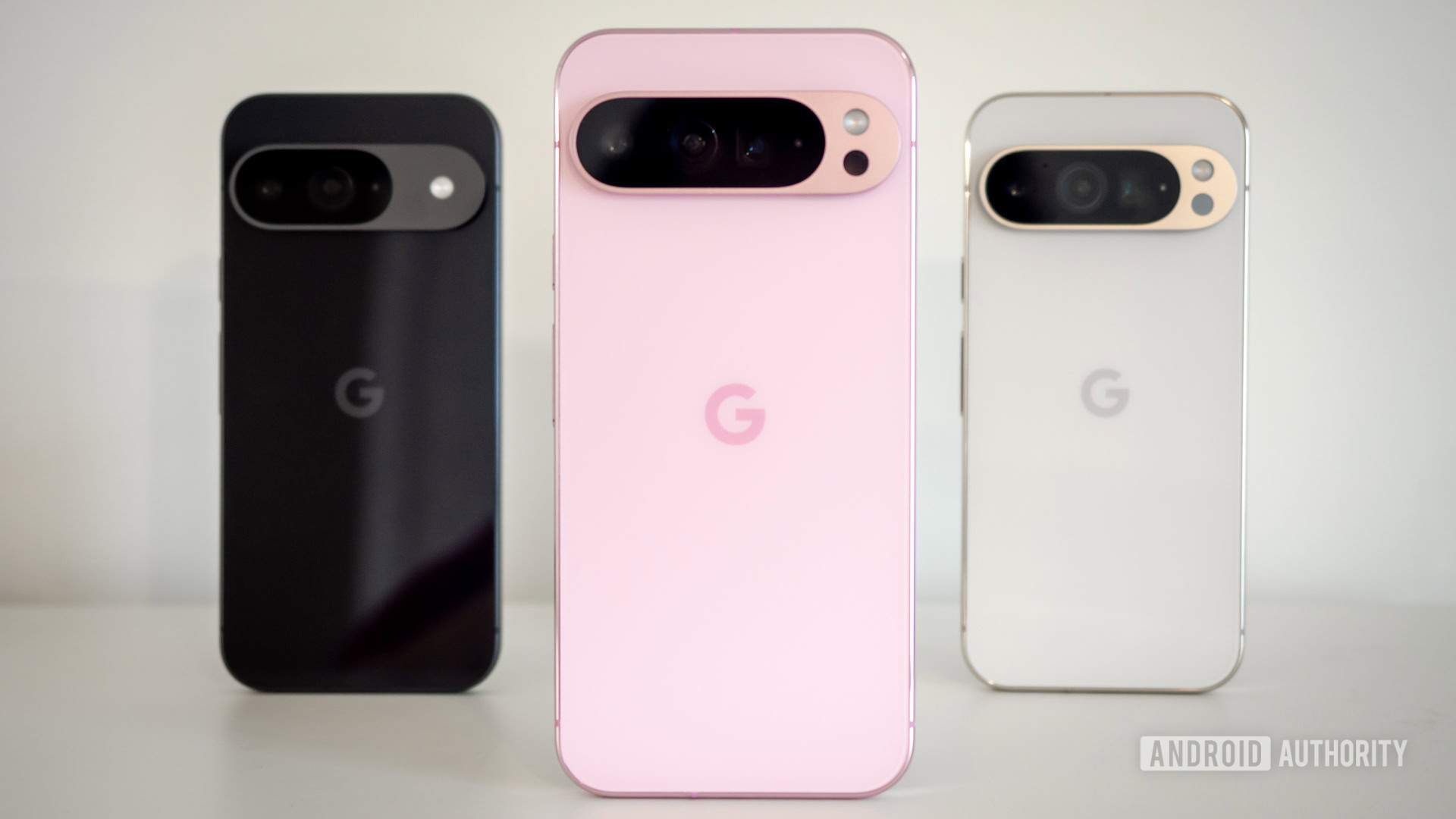
Google-Pixel-9-Pro-XL-in-front-of-9-series


The document we viewed starts with a very interesting piece of information — “Tensor based Pixel programs have not met our financial targets.” While a fairly vague statement, it implies that one of the reasons Google decided to switch to custom chips was potentially lower costs. It’s surprising that even without a giant profit-driven company like Qualcomm in the way, Google has failed to hit the goal. Unsurprisingly, this is one of the areas that’s the focus of optimization for the Tensor G6.

The document also reveals Google’s new financial goal — “AP [Application Process — in other words, the SoC] target is ~$65 to make this business viable.” In comparison, Qualcomm’s recent flagship chips are rumored to cost around $150. This humungous difference makes it even more surprising that Google failed to meet its financial goals for the project before, even if the price was a bit higher. Obviously, there are some upfront costs associated with making a custom chip, but with that big of a per-unit price difference, it suggests something has gone wrong.

Google is aware that Tensor chips aren’t very good​

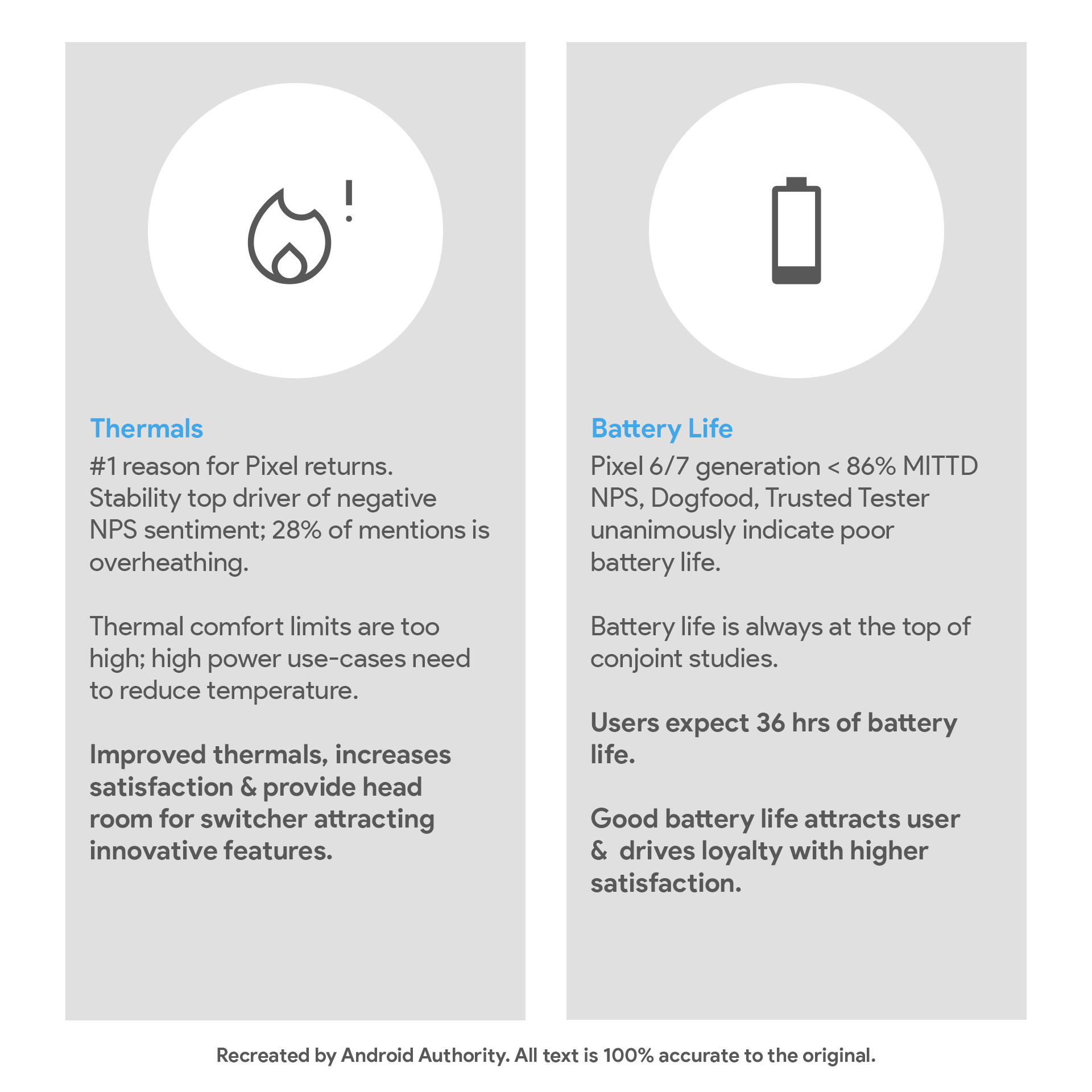
As the title of this section suggests, Google knows about the most common complaints about its chips — bad thermals and poor battery life. Thankfully, it intends to improve the Tensor G6 in these areas. I’ve recreated a part of a graphic from the document just to show how Google talks about these problems (and because it is kinda funny to see it admit the issue).

gChips Tensor G6 presentation recreation


Unfortunately, we lack the full data behind this graphic, but it still provides some interesting insights. First, overheating was the leading cause of returns of Tensor-based Pixel devices. We unfortunately don’t know what “NPS” stands for, but it could be “new Pixel switchers” since similar terminology appears throughout the document. This would mean 28% of new users complained about the thermals! That kind of response tracks with our own polling, too.

Google knows that battery and heat are common complaints about its Tensor series.
Google intends to improve the situation by finding ways to reduce the temperature in high-power use cases. While this is a fairly vague thing to say, we’ve already seen at least one way it will achieve this: the new “Cinematic Rendering Engine” in the chip will reduce the power consumption of video recording with blur by around 40%, which means considerably less heat being emitted.

The second part of the graphic is even more interesting because it shows Google knew how bad the battery life of early Tensor-based Pixels really was — and provides us with a nice figure to back that. Apparently, less than 86% of Pixel 6/7 users made it through the day! The slide doesn’t provide us with any concrete ways Google intends to amend this, but it’s clear it will also be one of the main goals of the Tensor G6.

So how does that translate to the Tensor G6’s specs?​

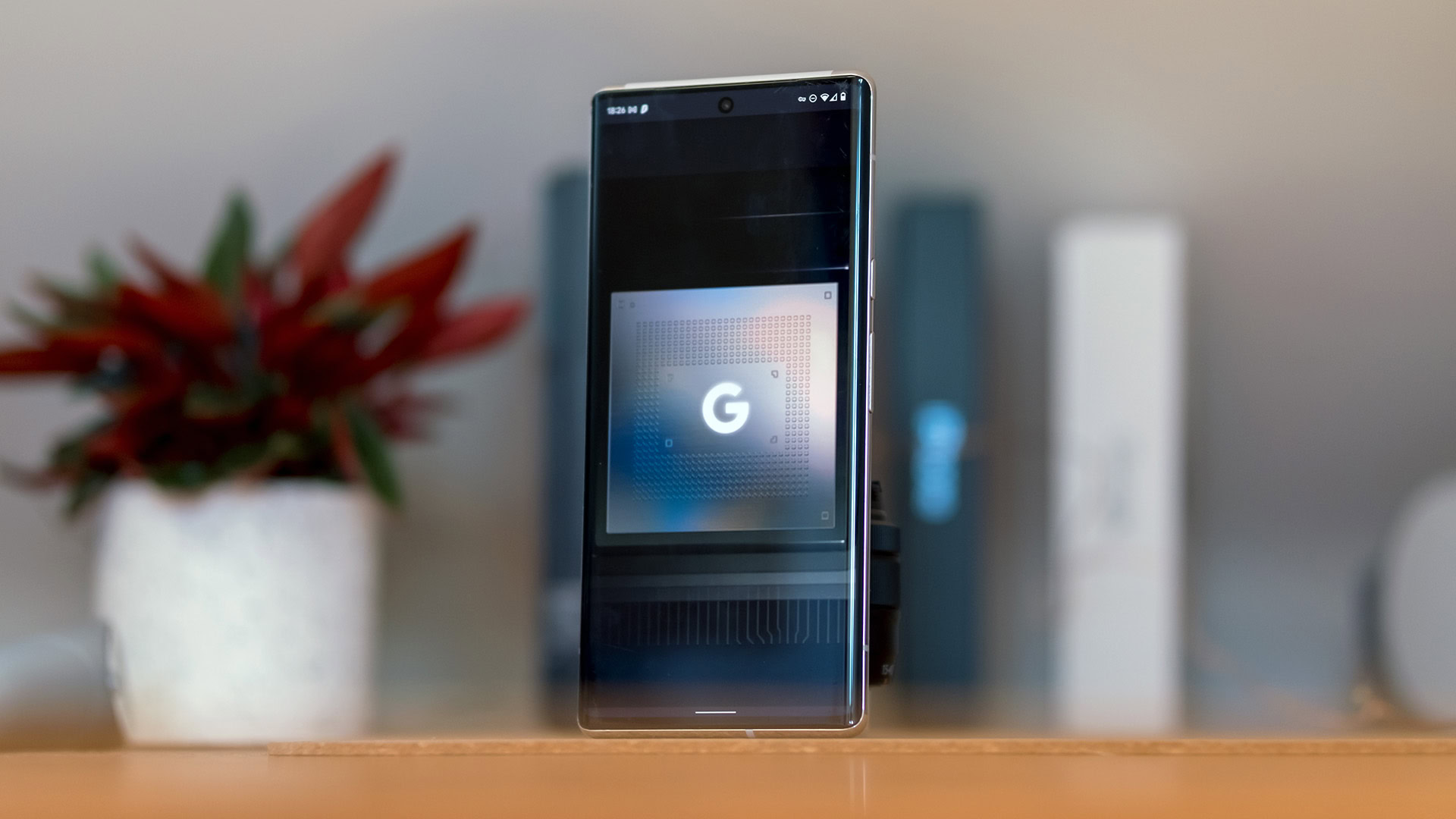
Google Tensor Pixel 6


With all that in mind, we can take a look at what Google actually has in store for the Tensor G6. The main idea seems to be to reduce die area (which reduces cost) while not regressing in terms of features compared to the Tensor G5. The Pixel 10’s chip is pretty massive at 121 mm2. To put that into perspective, the Apple A18 Pro, built on the same process node, is only 105 mm2.

The goal for Tensor G6 is to hit 105 mm2, including the 4% area saving from TSMC’s newer N3P process node (G5 uses N3E). In order to hit that size, virtually all teams had to make sacrifices.

Tensor G6 will have a GPU meant for the original Tensor G4.

One of the clearer examples of this is the GPU. Google initially intended to use a yet-to-be-released IMG EXT GPU, but due to delays, it decided against it. Instead, two options were considered: first, to use the same IMG DXT as in Tensor G5, but without ray-tracing to save area, or to use the solution in the chip codename “Redondo,” which was initially meant to be the Tensor G4 — IMG CXT without ray-tracing. It was eventually decided Google would go for the latter, which leads to a funny situation: the Tensor G6 will have the GPU that was meant to be in the Tensor G4! While the performance is comparable (at least in Google’s projections), this is still, at best, a sidewards step, all for a ~12% die area saving. I compiled the GPU specs in the table below:

Tensor G4 (“zumapro”)“Redondo” (canceled Tensor G4)Tensor G5 (“laguna”)Tensor G6 (“malibu”)
GPUArm Mali-G715 (7 cores)IMG CXT (3 cores)IMG DXT (2 cores)IMG CXT (3 cores)
Frequency900 MHz?1100 MHz1100 MHz
Ray tracingNot supportedNot supportedSupportedNot supported
GPU VirtualizationNot supportedNot supportedSupportedNot supported
Die area14.7 mm^2 (4LPE)14.82 mm^2 (N3E)16.6 mm^2 (N3E)14.1 mm^2 (N3P)

Similar area savings have been made all around the chip. For example, the DSP (digital signal processor) will drop one of its cores in order to save space, and the SLC (system-level cache) will be cut in half to 4MB.
One area that seemingly avoided getting shrunk is the CPU, but don’t expect any major upgrades there. It’s important to mention that the leaked documents were created before the layout was fully finalized, so it might turn out slightly differently.

Google experimented with many configurations and preliminarily settled on using one big Cortex-X930 core (that has yet to be announced) and six Cortex-A730 cores, two of which are configured to be slightly faster (unfortunately, the details here are scarce). Google decided against the use of Cortex-A5xx class cores because they are less efficient. I compiled a table of the CPU specs below:

Tensor G3 (“zuma”)Tensor G4 (“zumapro”)Tensor G5 (“laguna”)Tensor G6 (“malibu”)
Big cluster1x Arm Cortex-X31x Arm Cortex-X41x Arm Cortex-X41x Arm Cortex-X930
Mid cluster4x Arm Cortex-A7153x Arm Cortex-A7205x Arm Cortex-A7256x Arm Cortex-X730
Little cluster4x Arm Cortex-A5104x Arm Cortex-A5202x Arm Cortex-A520-

Unfortunately, the specs alone don’t tell us much about what we can expect in terms of performance. However, just the fact that Google is reducing the core count again means it’s unlikely the new chip will be much faster than its predecessor.

 

Loser

Arch-Supremacy Member
Joined
May 7, 2019
Messages
23,746
Reaction score
10,567
TL;DR
  • Google’s previous “Tensor based Pixel programs have not met its financial targets.”
  • Google Tensor G6 is primarily focused on reducing the price of the chip, as well as making it run cooler and more efficiently.
  • The GPU will lose its ray-tracing abilities, while the CPU gets a slight upgrade.


Google’s Tensor chips have failed to impress performance enthusiasts. Even after four generations, the chips aren’t quite what many had hoped they could be (check out our in-depth Tensor G4 testing for the full picture) and remain a hot topic of discussion in the community. In our previous reporting, we’ve shown how the next-gen Tensor G5 promises to deliver improvements in power efficiency and thermals thanks to the superior TSMC manufacturing process, but its specs still leave a lot to be desired compared to the competition.

Unfortunately, that seems likely to remain the case for at least one more generation, as the Tensor G6, due to be released with the Pixel 11, will bring rather small upgrades. It might even be a downgrade in some areas, but that’s actually for a good reason.

Thanks to an unprecedented leak from Google’s gChips division, Android Authority has viewed documents describing the specifications, as well as the motivations behind Google’s upcoming Tensor G6 chip.

Before we get to the specs of Tensor G6, we should talk a bit about the goals that ultimately led Google to design the chip the way it did. In my opinion, this is the most interesting part of this entire leak from gChips — nobody at Google would ever openly talk about these things. The quotes in the sections below are taken directly from the documents, in order to preserve as much information as possible.

Of course, it’s about the money​

Google-Pixel-9-Pro-XL-in-front-of-9-series


The document we viewed starts with a very interesting piece of information — “Tensor based Pixel programs have not met our financial targets.” While a fairly vague statement, it implies that one of the reasons Google decided to switch to custom chips was potentially lower costs. It’s surprising that even without a giant profit-driven company like Qualcomm in the way, Google has failed to hit the goal. Unsurprisingly, this is one of the areas that’s the focus of optimization for the Tensor G6.

The document also reveals Google’s new financial goal — “AP [Application Process — in other words, the SoC] target is ~$65 to make this business viable.” In comparison, Qualcomm’s recent flagship chips are rumored to cost around $150. This humungous difference makes it even more surprising that Google failed to meet its financial goals for the project before, even if the price was a bit higher. Obviously, there are some upfront costs associated with making a custom chip, but with that big of a per-unit price difference, it suggests something has gone wrong.

Google is aware that Tensor chips aren’t very good​

As the title of this section suggests, Google knows about the most common complaints about its chips — bad thermals and poor battery life. Thankfully, it intends to improve the Tensor G6 in these areas. I’ve recreated a part of a graphic from the document just to show how Google talks about these problems (and because it is kinda funny to see it admit the issue).

gChips Tensor G6 presentation recreation


Unfortunately, we lack the full data behind this graphic, but it still provides some interesting insights. First, overheating was the leading cause of returns of Tensor-based Pixel devices. We unfortunately don’t know what “NPS” stands for, but it could be “new Pixel switchers” since similar terminology appears throughout the document. This would mean 28% of new users complained about the thermals! That kind of response tracks with our own polling, too.

Google knows that battery and heat are common complaints about its Tensor series.
Google intends to improve the situation by finding ways to reduce the temperature in high-power use cases. While this is a fairly vague thing to say, we’ve already seen at least one way it will achieve this: the new “Cinematic Rendering Engine” in the chip will reduce the power consumption of video recording with blur by around 40%, which means considerably less heat being emitted.

The second part of the graphic is even more interesting because it shows Google knew how bad the battery life of early Tensor-based Pixels really was — and provides us with a nice figure to back that. Apparently, less than 86% of Pixel 6/7 users made it through the day! The slide doesn’t provide us with any concrete ways Google intends to amend this, but it’s clear it will also be one of the main goals of the Tensor G6.

So how does that translate to the Tensor G6’s specs?​

Google Tensor Pixel 6


With all that in mind, we can take a look at what Google actually has in store for the Tensor G6. The main idea seems to be to reduce die area (which reduces cost) while not regressing in terms of features compared to the Tensor G5. The Pixel 10’s chip is pretty massive at 121 mm2. To put that into perspective, the Apple A18 Pro, built on the same process node, is only 105 mm2.

The goal for Tensor G6 is to hit 105 mm2, including the 4% area saving from TSMC’s newer N3P process node (G5 uses N3E). In order to hit that size, virtually all teams had to make sacrifices.

Tensor G6 will have a GPU meant for the original Tensor G4.

One of the clearer examples of this is the GPU. Google initially intended to use a yet-to-be-released IMG EXT GPU, but due to delays, it decided against it. Instead, two options were considered: first, to use the same IMG DXT as in Tensor G5, but without ray-tracing to save area, or to use the solution in the chip codename “Redondo,” which was initially meant to be the Tensor G4 — IMG CXT without ray-tracing. It was eventually decided Google would go for the latter, which leads to a funny situation: the Tensor G6 will have the GPU that was meant to be in the Tensor G4! While the performance is comparable (at least in Google’s projections), this is still, at best, a sidewards step, all for a ~12% die area saving. I compiled the GPU specs in the table below:

Tensor G4 (“zumapro”)“Redondo” (canceled Tensor G4)Tensor G5 (“laguna”)Tensor G6 (“malibu”)
GPUArm Mali-G715 (7 cores)IMG CXT (3 cores)IMG DXT (2 cores)IMG CXT (3 cores)
Frequency900 MHz?1100 MHz1100 MHz
Ray tracingNot supportedNot supportedSupportedNot supported
GPU VirtualizationNot supportedNot supportedSupportedNot supported
Die area14.7 mm^2 (4LPE)14.82 mm^2 (N3E)16.6 mm^2 (N3E)14.1 mm^2 (N3P)

Similar area savings have been made all around the chip. For example, the DSP (digital signal processor) will drop one of its cores in order to save space, and the SLC (system-level cache) will be cut in half to 4MB.
One area that seemingly avoided getting shrunk is the CPU, but don’t expect any major upgrades there. It’s important to mention that the leaked documents were created before the layout was fully finalized, so it might turn out slightly differently.

Google experimented with many configurations and preliminarily settled on using one big Cortex-X930 core (that has yet to be announced) and six Cortex-A730 cores, two of which are configured to be slightly faster (unfortunately, the details here are scarce). Google decided against the use of Cortex-A5xx class cores because they are less efficient. I compiled a table of the CPU specs below:

Tensor G3 (“zuma”)Tensor G4 (“zumapro”)Tensor G5 (“laguna”)Tensor G6 (“malibu”)
Big cluster1x Arm Cortex-X31x Arm Cortex-X41x Arm Cortex-X41x Arm Cortex-X930
Mid cluster4x Arm Cortex-A7153x Arm Cortex-A7205x Arm Cortex-A7256x Arm Cortex-X730
Little cluster4x Arm Cortex-A5104x Arm Cortex-A5202x Arm Cortex-A520-

Unfortunately, the specs alone don’t tell us much about what we can expect in terms of performance. However, just the fact that Google is reducing the core count again means it’s unlikely the new chip will be much faster than its predecessor.


Heng moi never wait for pixel 11 if not have to wait for pixel 12 liao. :frown:
 

limmk

High Supremacy Member
Joined
Jul 5, 2001
Messages
43,212
Reaction score
8,328
Heng moi never wait for pixel 11 if not have to wait for pixel 12 liao. :frown:
Ya lor, lucky you didn’t wait! by the time Pixel 12 come, maybe already talking about Pixel 13 sia. faster get your new phone and enjoy first! 💪
 

limmk

High Supremacy Member
Joined
Jul 5, 2001
Messages
43,212
Reaction score
8,328
TL;DR
  • Google is already working on four Pixel 11 series devices with bear-themed codenames.
  • There’s also a Pixel 10a in very early development, with Google currently considering the possibility of equipping it with the same Tensor G4 as the Pixel 9a.


The next Google phones everyone’s looking forward to are the Pixel 9a and the Pixel 10 series, which will feature an all-new Tensor G5 SoC designed completely in-house. Unsurprisingly, however, Google is already thinking even further into the future. Thanks to a source inside Google, Android Authority has viewed documents confirming the codenames for the 2026 Pixel phones.

Unsurprising Pixel 11…​

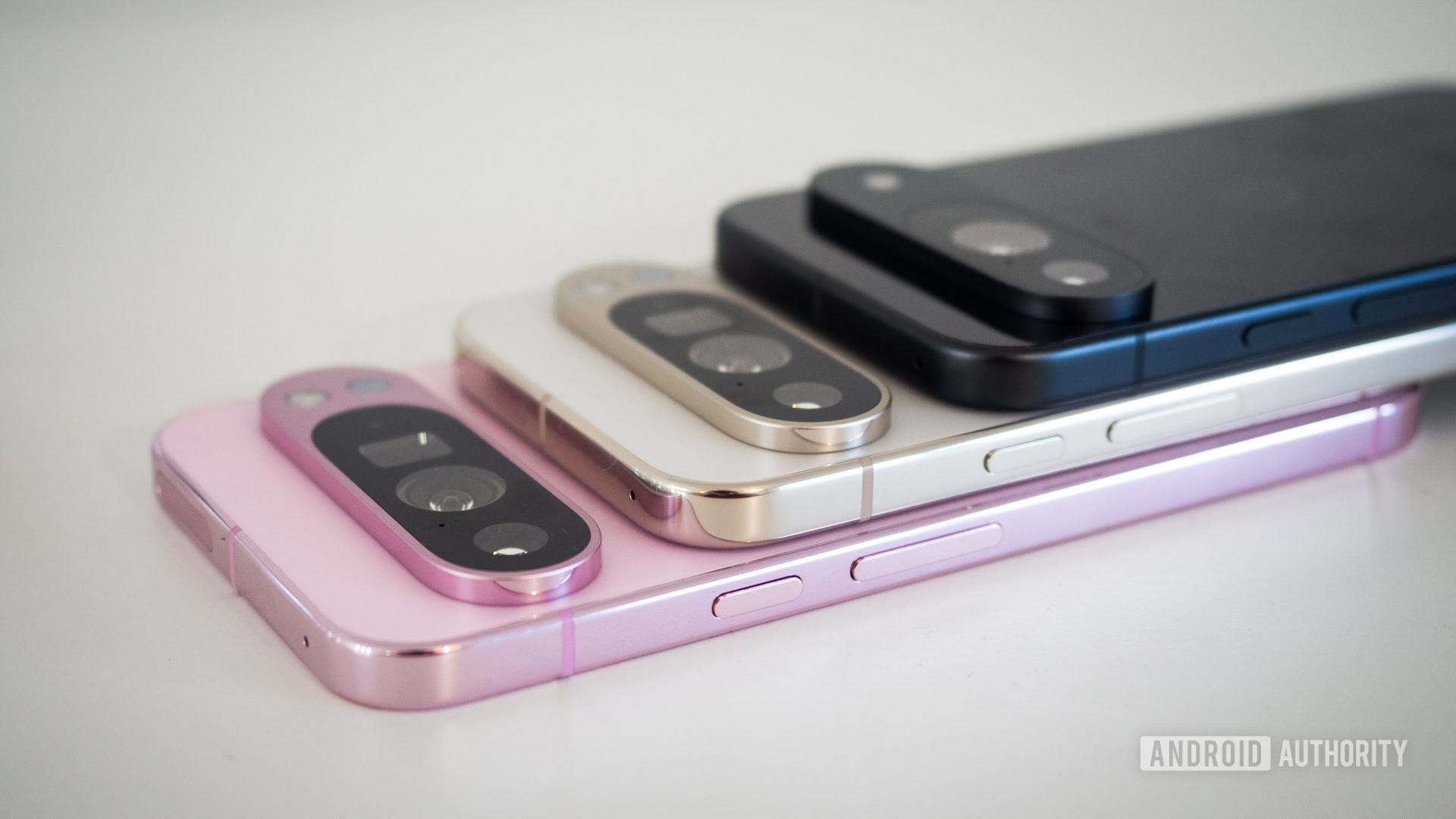
Google-Pixel-9-series-cameras


All Pixel phone generations have codenames themed after a unique animal species, and for the Pixel 10, Google decided to make them bear-themed.

The Pixel 11 series is as follows:
  • Pixel 11 — “cubs” or “4CS4”
  • Pixel 11 Pro — “grizzly” or “CGY4”
  • Pixel 11 Pro XL — “kodiak” or “PKK4”
  • Pixel 11 Pro Fold — “yogi” or “9YI4”
Unsurprisingly, all four of the devices use Google’s second generation fully in-house mobile chip — the Tensor G6, codename “malibu”. The series will launch sometime in the second half of 2026. While that’s still a while away, we’ve already learned quite a bit about what we can expect from the devices thanks to the gChips document leak.

… and a surprising Pixel 10a​

Pixel 9a render 3


While we patiently wait for Google to release the Pixel 9a sometime in the next few months, it is already underway with early planning for a 2026 midrange entry to its lineup. As revealed last year, the Pixel 10 series has equine-related codenames, and the Pixel 10a is no exception with the codename “stallion” (also referred to as “STA5”).
The device is currently at an extremely early stage of development — in fact, sources tell me Google is currently considering whether to even bring the completely custom Tensor G5 to the midrange phone or whether to stick with the Samsung-designed Tensor G4 for one more year.

I haven’t heard any word on why Google would depart from its usual model of having the same chip in its flagship and midrange devices, but it could simply be due to higher cost. The Tensor G5 is a large chip — measuring in at 121 mm^2, it’s significantly bigger than even Apple’s A18 Pro, undoubtedly raising its cost. It’s possible that we will have to wait for the cost-optimized Tensor G6 until we see a completely custom Google SoC in a mid-range phone.
If Google decides to go with the older Tensor G4, the feature set of the Pixel 10a could be severely limited, given that many new Pixel 10 features will rely on the new AI and camera hardware in the Tensor G5.

Google Pixel phones are always evolving​

Pixel 8Pixel 9Pixel 10Pixel 11
-Pixel 9 Pro XL (komodo/KM4)Pixel 10 Pro XL (mustang/MT5)Pixel 11 Pro XL (kodiak/PKK4)
Pixel 8 Pro (husky/HK3)Pixel 9 Pro (caiman/CM4)Pixel 10 Pro (blazer/BZ5)Pixel 11 Pro (grizzly/CGY4)
Pixel 8 (shiba/SB3)Pixel 9 (tokay/TK4)Pixel 10 (frankel/FL5)Pixel 11 (cubs/4CS4)
Pixel 8a (akita/AK3)Pixel 9a (tegu/TG4)Pixel 10a (stallion/STA5)?
-Pixel 9 Pro Fold (comet/CT3)Pixel 10 Pro Fold (rango/RG5)Pixel 11 Pro Fold (yogi/9YI4)

I’ve summarized all the new devices in the table above. While the Pixel 11 isn’t anything we didn’t expect, the potential Pixel 10a chip change is a surprise and a reminder that Google is constantly adjusting its mobile lineup. The Pixel 9a already started breaking the rules of what we expect from the a-series Pixels by using an inferior modem than the Pixel 9 series, and it looks like Google might continue this trend with the 10a.
 

limmk

High Supremacy Member
Joined
Jul 5, 2001
Messages
43,212
Reaction score
8,328


Google’s upcoming Pixel 11 series (2026) is reportedly set to feature a Tensor G6 chip built on TSMC’s advanced 2nm process. This significant leap could finally position Google’s chips ahead of competitors in manufacturing technology, promising enhanced performance and efficiency for future Pixel phones.
Big news is buzzing in the world of smartphone chips, especially for Google Pixel enthusiasts. Recent reports suggest that the upcoming Pixel 11 series might finally put Google’s Tensor processors at the very forefront of mobile technology thanks to TSMC’s cutting-edge 2nm process for the Tensor G6 chip. The company is expected to launch these devices sometime in 2026.

The potential move wouldn’t just be another incremental upgrade; it could be a game-changer. For years, Google’s custom Tensor chips, while powerful in their own right, have often lagged a generation behind competitors like Qualcomm in terms of manufacturing process technology. The very first Tensor chip, released in 2021, used a 5nm process when rivals were already on 4nm. It took until the Tensor G3 for Google to catch up to the 4nm node. Even the upcoming Tensor G5 is set to transition to a 3nm process with TSMC.

Google Pixel 11’s Tensor G6 could be one of the first 2nm chips on the market​

But if the whispers about the Tensor G6 are true, Google is not just catching up. The Mountain View giant could directly jump ahead of the most advanced chip technology. Qualcomm’s Snapdragon 8 Elite chipset, a future competitor, is still anticipated to stick with a 3nm process. This means the Tensor G6 could, for the very first time, see a Google-designed chip among the leaders regarding raw process technology. However, it wouldn’t be the first to launch a 2nm SoC—that would be Samsung with the Exynos 2600 from the Galaxy S26 lineup.

What does a 2nm process mean for you? In simple terms, smaller nanometer numbers usually translate to more transistors packed into the same space. A higher pixel density results in higher performance. Plus, the smaller the chip, the more energy-efficient it should be. Imagine even faster AI processing, longer battery life, and smoother experiences across your Pixel phone.

Google’s Tensor chips have always focused on optimizing AI and machine learning tasks directly on the device. However, this foundational shift to a more advanced manufacturing process would give them a substantial hardware advantage. It would allow Google’s software innovations to truly shine with better underlying efficiency.

Of course, these are still leaks, and plans can evolve in the fast-paced world of chip development. But for now, the prospect of the Pixel 11 arriving with a 2nm Tensor G6 is a really promising one. It signals a new era where Google’s silicon ambitions could finally be “ahead of the curve.”
 

xonix

Arch-Supremacy Member
Joined
Mar 24, 2001
Messages
17,587
Reaction score
1,689
Pixel 1 / 2 / 3 same design
Pixel 4 / 5 same design
Pixel 6 / 7 / 8 same design
Pixel 9 / 10 / 11 same design ?
:unsure:
 
Last edited:

xonix

Arch-Supremacy Member
Joined
Mar 24, 2001
Messages
17,587
Reaction score
1,689
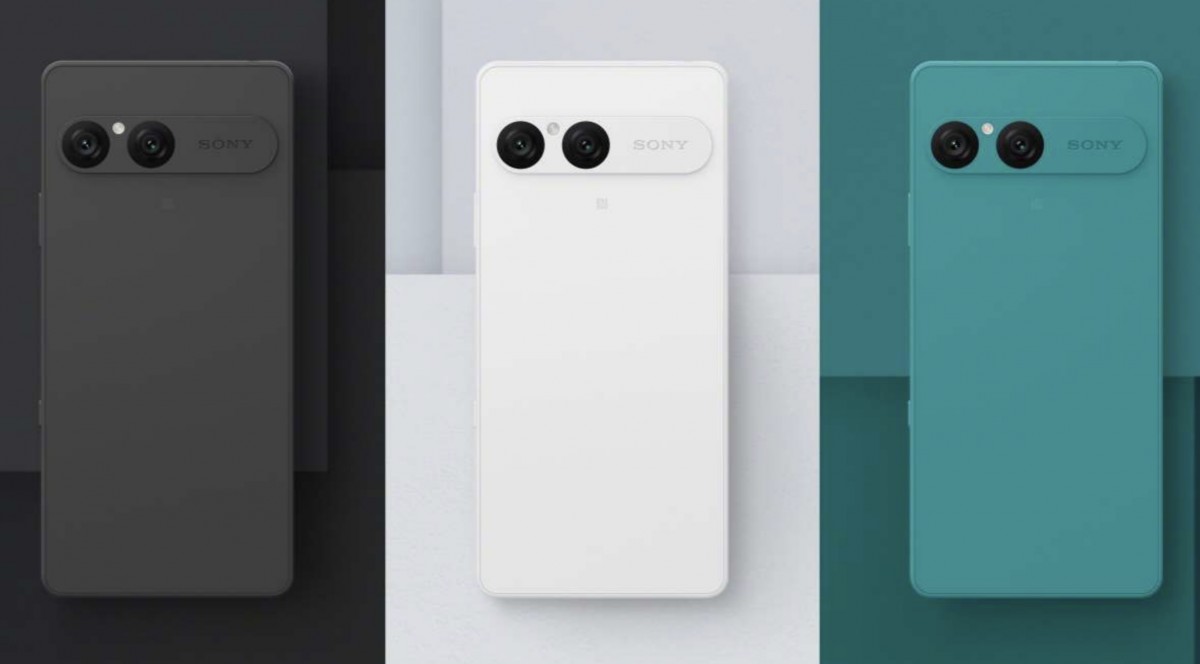
Sony did it better than Google :sneaky: ( in my opinion )

Sony Xperia 10 VII

gsmarena_003.jpg
 
Important Forum Advisory Note
This forum is moderated by volunteer moderators who will react only to members' feedback on posts. Moderators are not employees or representatives of HWZ Forums. Forum members and moderators are responsible for their own posts. Please refer to our Community Guidelines and Standards and Terms and Conditions for more information.
Top