
You are using an out of date browser. It may not display this or other websites correctly.
You should upgrade or use an alternative browser.
You should upgrade or use an alternative browser.
Surge Protector
- Thread starter csc12345678
- Start date
More options
Who Replied?
cybertech
Arch-Supremacy Member
- Joined
- Dec 3, 2000
- Messages
- 16,575
- Reaction score
- 1,555
Solve my long term problem whenever changing ceiling fan speed, off/on Heater switch or even open fridge door will cause my PC USB TV Tuner and USB HDMI Capture to freeze
After getting this (suppose to protect surge and spikes) and connect the 8 ways power extension to it, so far no more problem.

Since seeing this thread again and let me update on my problem.
The power surge protector still did not solve my problem, ie whenever my mom doing the washing machine work, my USB HDMI Capture still freeze

Read about Ferrite beads help reduce EMI/RFI and happen to found two pieces in my office.
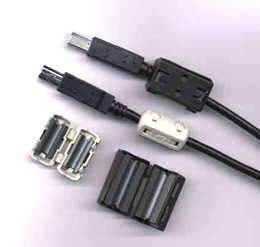
Clip-on one of this onto the USB HDMI capture cable and for months the live video from the USB HDMI Capture box never freeze any more don't care open/close fridge door, changing ceiling fan speed or washing machine doing the spinning process
Use a simple rule to identify the electrician that knows his stuff. He knows that no protector does protection. And that a protector is only effective when connected low impedance (ie less than 3 meters, hardwire has no splices, no sharp wire bends, etc) to what does all protection - earth ground.Anyone here can recommend a good electrician for installing a whole house surge protector?
Earth ground is an electrode in earth. Wall receptacles safety ground is not earth ground. Only better electricians know that. And understand why a protector is only as effective as its earth ground.
Tiny spikes from a washer, ceiling fan, and fridge switch are not surges. How do any create a voltage that well exceeds 500 volts? They don't.The power surge protector still did not solve my problem, ie whenever my mom doing the washing machine work, my USB HDMI Capture still freeze
Defined is noise. Typically only a few tens of volts or less. Something is apparently wrong inside a PC USB TV Tuner (or some connected part) since noise (or even 500 volt spikes) must be made irrelevant by its power supply. Apparently even a tiny filter in that Soundtech adapter (that would be inferior to what must be inside all electronics) is doing more. Apparently what must exist is missing.
Power protector would ignore any spike below its let-through voltage (ie 500 volts). Surges are voltages that high - can cause damage. Noise is ignored by protectors since it does not do damage; is only an irritation; must already have been made irrelevant. Noise is eliminated by filters that must be inside all electronics or further reduced by series mode filters.
It cured a symptom. It did not fix a defect.


napoleon bohlumpar
Banned
- Joined
- Aug 14, 2015
- Messages
- 7,184
- Reaction score
- 2,055
i got an UN-used Chang Lightspeed CLS6400mk2.........it cost $850 back in 2006 when i bought it...........believe it or not - never used..........
anyone interested ?........see below website for info on their technology (founder worked for NASA)...............below link for pictures of it..........
https://www.changlightspeed.com/
https://www.google.com/search?q=cha...TQQ_AUIEigB&biw=1536&bih=671&dpr=1.25#imgrc=_
anyone interested ?........see below website for info on their technology (founder worked for NASA)...............below link for pictures of it..........
https://www.changlightspeed.com/
https://www.google.com/search?q=cha...TQQ_AUIEigB&biw=1536&bih=671&dpr=1.25#imgrc=_
most interesting read.
may i know from posters here explanation as to what happened to my fan.
i plug a usb wall charger to charge phone in the hall, the usb charge light was on, but no charging took place.
i then went into the bedroom.
i plug in a usb charger to a power strip to charge my phone. the power strip is connected to a wall socket, and next to this wall socket a standing fan is plugged into it. ie a two sockets wall. once again, there were no charging of the phone.
i discovered very much later on the circuit breaker had actually tripped.
what happened after is my fan ( 2 pin euro plug ) cannot be switched on at the switch, but the remote control of the fan is able to turn on the fan and work accordingly.
thanks in advance. curious to know what could have happened.
may i know from posters here explanation as to what happened to my fan.
i plug a usb wall charger to charge phone in the hall, the usb charge light was on, but no charging took place.
i then went into the bedroom.
i plug in a usb charger to a power strip to charge my phone. the power strip is connected to a wall socket, and next to this wall socket a standing fan is plugged into it. ie a two sockets wall. once again, there were no charging of the phone.
i discovered very much later on the circuit breaker had actually tripped.
what happened after is my fan ( 2 pin euro plug ) cannot be switched on at the switch, but the remote control of the fan is able to turn on the fan and work accordingly.
thanks in advance. curious to know what could have happened.
Last edited:
lowandhighseas
Banned
- Joined
- Jan 13, 2020
- Messages
- 336
- Reaction score
- 0
A higher number indicates greater protection. Look for a protector that is at least rated at 200 to 400 joules. For better protection, look for a rating of 600 joules or more. So better read carefully.

AnTiLooP
Supremacy Member
- Joined
- Jan 1, 2000
- Messages
- 6,222
- Reaction score
- 84
After reading this thread I feel rather self scammed for buying a surge protector.
In fact, I seem to feel that it's more of a real risk at creating a fire than a standard power strip would.
Weston: so in further layman terms, those surge protectors by belkin and Co, what they do is "fail" and self sacrifice when it detects a load above its stated reading and in turn, may just break and burn.
If so, isn't a risk of fire very real ? I'd rather my appliances go bonk than risking a house fire!
In fact, I seem to feel that it's more of a real risk at creating a fire than a standard power strip would.
Weston: so in further layman terms, those surge protectors by belkin and Co, what they do is "fail" and self sacrifice when it detects a load above its stated reading and in turn, may just break and burn.
If so, isn't a risk of fire very real ? I'd rather my appliances go bonk than risking a house fire!
TheInfernoX
Junior Member
- Joined
- Jun 9, 2015
- Messages
- 5
- Reaction score
- 2
After reading this thread I feel rather self scammed for buying a surge protector.
In fact, I seem to feel that it's more of a real risk at creating a fire than a standard power strip would.
Weston: so in further layman terms, those surge protectors by belkin and Co, what they do is "fail" and self sacrifice when it detects a load above its stated reading and in turn, may just break and burn.
If so, isn't a risk of fire very real ? I'd rather my appliances go bonk than risking a house fire!
You should get a surge protective device (SPD) Type II for your whole house. These are installed on the consumer unit/distribution board (DB) of your house. They are better than those Type III power outlet/extension cord surge protectors, which can only handle lower surge currents.
Furthermore, they usually have built-in indicators and safety protection when the device is about to fail.
An example SPD Type II found on a DB:
youtube[.]com/watch?v=5OuirPKoY0c
As a point of note, I will also recommend everyone to change your RCCB/RCD (previously ELCB) on your DB from a Type AC to a Type A, which will protect your house from pulsating DC faults (generated by most modern smart/electronic devices) and regular AC faults (that Type AC protects).
Edit: Unfortunately, I cannot post links due to being a new user.
Last edited:
Never mix up surge protector vs AC noise filtering circuit.
Surge protector is a very simple device usually consist of Varistor and Fuse. This is why after surge detection, usually the device is required to change or replace a new fuse.
AC noise filtering usually is build with capacitor and coil. The higher the rating the more expensive it cost.
Example of previous post where one washing machine result in interference to HDMI devices, is probably due to some issue with the washing machine (eg, not grounded probably or motor is generating lots of electrical noise.
PS, Varistor is a very cheap component. You can find it from Shopee or other major platform. for Singapore case, a 240v one will do the job. If you has bad ATX power supply used for PC. You can also find this component in the power supply. Usually is blue color.
Surge protector is a very simple device usually consist of Varistor and Fuse. This is why after surge detection, usually the device is required to change or replace a new fuse.
AC noise filtering usually is build with capacitor and coil. The higher the rating the more expensive it cost.
Example of previous post where one washing machine result in interference to HDMI devices, is probably due to some issue with the washing machine (eg, not grounded probably or motor is generating lots of electrical noise.
PS, Varistor is a very cheap component. You can find it from Shopee or other major platform. for Singapore case, a 240v one will do the job. If you has bad ATX power supply used for PC. You can also find this component in the power supply. Usually is blue color.
Last edited:

segafan
Senior Member
- Joined
- Jun 13, 2004
- Messages
- 945
- Reaction score
- 29
You should get a surge protective device (SPD) Type II for your whole house. These are installed on the consumer unit/distribution board (DB) of your house. They are better than those Type III power outlet/extension cord surge protectors, which can only handle lower surge currents.
Furthermore, they usually have built-in indicators and safety protection when the device is about to fail.
An example SPD Type II found on a DB:
youtube[.]com/watch?v=5OuirPKoY0c
As a point of note, I will also recommend everyone to change your RCCB/RCD (previously ELCB) on your DB from a Type AC to a Type A, which will protect your house from pulsating DC faults (generated by most modern smart/electronic devices) and regular AC faults (that Type AC protects).
Edit: Unfortunately, I cannot post links due to being a new user.
After experiencing some random power trips at home, I am quite inclined to make this "upgrade". (FYI, my electrical usage at home is very regular; the power trip happened out of the blue for a few nights and has stopped since then. Been more than 16 months now without incident.)
Question for your sir, as I am am not at all familiar with the whole technicalities:
Assuming I could go to any local electrician,
(i) what specifically should i tell them? "My DB, change Type AC to Type A" and "install SPD Type II"??
(ii) Any specific brand? Or must use the same one that is used my existing DB? I think mine shows this brand "ABB", the stock/ default from HDB BTO.
So once this is installed, would you think i still need those individual surge protector extension plugs?
Many thanks in advance for your advice!
Risk of surges is quite rare. Only hype and advertising claim surges occur daily to protect profit margins. How many dishwashers, clock radios, central air, LED & CFL bulbs, recharging electronics, refrigerators, RCD, microwaves, door bells, dimmer switches, clock radios, and smoke detectors were damaged by a surge today - or in the past ten years? What is protecting them? Invisible protectors?If so, isn't a risk of fire very real ? I'd rather my appliances go bonk than risking a house fire!
Surges are rare. Best protection at each appliance is already inside each appliance. Concern is only for that rare surge that will be incoming to everything. Can damage anything. So a Category C (Type 1 or Type 2) protector is connected low impedance (ie less than 3 meters) to single point earth ground. Only then is a surge nowhere inside.
Effective protectors never do protection. Never. Effective protectors are only a connecting device to what does best protection. Earth ground. As Ben Franklin demonstrated over 250 years ago. As has been standard in all facilities that cannot have damage - over 100 years ago.
No plug-in protector (or UPS) can do that. None. Worse, that profit center Type 3 (Category A or B) protector is so grossly undersized that it must remain either 10 or 20 meters from a power board and earth ground. Otherwise those tiny joule protectors can create fires.
Effective protectors, from other companies known for integrity, come with numbers that define protection. Lightning is typically 20,000 amps. So a minimal 'whole house' protector is 50,000 amps. Effective devices also come with numbers that say how effective.
Plug-in protectors (Category A or B) are recommended subjectively. So that consumers will not learn about the five cent protector parts selling for $25 or $80 in a power strip. And even tinier protection inside a UPS.
What most needs protection by a 'whole house' solution. Least robust appliances in a house (as demonstrated by spec numbers): that plug-in protector and UPS. Best protection costs about $1 per protected appliance. So that protection remains functional even for many decades after many direct lightning strikes.
Protectors never have an indicator that they are about to fail. That is the lie intentionally generated to protect sales. When a protector is grossly undersized, then a typically 1 amp thermal fuse must disconnect only protectors parts. And leave a surge fully connected to an appliance. No problem. A surge too tiny to damage any appliances can also destroy that tiny joule MOV protector part.
A thermal fuse disconnects that MOV to avert a house fire. That tripped fuse is reported by the Protector Good light. That light only says that protector was so grossly undersized that a fuse had to disconnect it. To avert catastrophic failure.
Sometimes that fuse does not trip fast enough. Then this happens: https://imgur.com/hwCWHMW
MOV manufacturers are quite blunt about this. MOVs must not be so grossly undersized to fail catastrophically. Again, that protector good light can never report an acceptable failure more - degradation. That light only says that protector was so grossly undersized that a fuse had to disconnect it.
Did they forget to mention this in those sales brochures? Along with all those missing specification numbers?
Only Category C (whole house) protectors are sufficiently sized to provide effective protection. And only if connected low impedance (ie less than 3 meters) to the other item that does all protection - earth ground.
Last edited:
An outage (voltage dropping to zero) is not a surge (a voltage approaching or exceeding 1000 volts). Long before asking for a solution, first an anomaly must be defined.After experiencing some random power trips at home, I am quite inclined to make this "upgrade".
Surges are events that do damage in microseconds. No fuse or circuit breaker ever protects from that. Fuses and circuit breaker disconnect an appliance tens or 100 milliseconds later AFTER that microseconds event has done damage. Or after something else has caused damage. So that a damaged appliance (due to a surge or due to so many other anomalies) does not harm humans.
Now we are discussing three completely different and unrelated anomalies.
Noise: maybe tens of volts. No protector or fuse or any other solution for other anomalies will do anything for noise. Noise is eliminated when electronics power supplies are properly designed. So no series mode filter is necessary. If noise is incoming to electronics via the safety ground, then something is wrong with household wiring. Or that noise generator must be fixed.
A series mode filter, to be effective for noise, typically weighs 20+ kilograms. Its passive components must be that large to be effective.
Any recommendation that is not discussing such numbers is best ignored. Any recommendation without first defining the anomaly is always suspect. Often best ignored.
IMHO.
Surge, big or small, a surge is a surge.
Just like a big car or small car, still a car.
According to a dictionary,
anomaly - something that deviates from what is standard, normal, or expected.
If it is expected, it is no longer an anomaly.

Surge, big or small, a surge is a surge.
Just like a big car or small car, still a car.
According to a dictionary,
anomaly - something that deviates from what is standard, normal, or expected.
If it is expected, it is no longer an anomaly.
So put numbers to it. Electronics will convert a *thousands joule* surge into low, stable, DC voltages that safely power semiconductors. No damage.Surge, big or small, a surge is a surge.
How many joules will destroy a plug-in protector? Thousand joules? What can destroy a protector is also, at the exact same time, also going through attached appliances.
No problem. A surge, that destroys a protector, is made irrelevant by superior protection already inside electronics.
Meanwhile another surge can be *hundreds of thousands of joules*. That one may overwhelm robust protection inside appliances. So that surge must not be anywhere inside. Facilities that cannot have damage will earth one 'whole house' protector so that all appliances are protected. From something completely different; also called a surge.
How different? *Thousand joules* verses *hundreds of thousands of joules*.
No plug-in protector claims to protect from either. Electronics already make that smaller one irrelevant. One properly earthed 'whole house' protector means that larger one is not incoming to any appliances. Then best protection, inside all appliances, is not overwhelmed.
Other anomalies include reverse polarity, harmonics, frequency variation, sag or brownout, bad power factor, overcurrent, high voltage, open safety ground, EMC/EMI, blackout, noise, flicker, RFI, and floating neutral. Those anomalies are irrelevant here.
Anomalies do no damage only when expected and planned for accordingly.
So put numbers to it. Electronics will convert a *thousands joule* surge into low, stable, DC voltages that safely power semiconductors. No damage.
How many joules will destroy a plug-in protector? Thousand joules? What can destroy a protector is also, at the exact same time, also going through attached appliances.
No problem. A surge, that destroys a protector, is made irrelevant by superior protection already inside electronics.
Meanwhile another surge can be *hundreds of thousands of joules*. That one may overwhelm robust protection inside appliances. So that surge must not be anywhere inside. Facilities that cannot have damage will earth one 'whole house' protector so that all appliances are protected. From something completely different; also called a surge.
How different? *Thousand joules* verses *hundreds of thousands of joules*.
No plug-in protector claims to protect from either. Electronics already make that smaller one irrelevant. One properly earthed 'whole house' protector means that larger one is not incoming to any appliances. Then best protection, inside all appliances, is not overwhelmed.
Other anomalies include reverse polarity, harmonics, frequency variation, sag or brownout, bad power factor, overcurrent, high voltage, open safety ground, EMC/EMI, blackout, noise, flicker, RFI, and floating neutral. Those anomalies are irrelevant here.
Anomalies do no damage only when expected and planned for accordingly.
I re-phrase.
Is plug-in surge protector sufficient for power surge ?
If it is expected, it is no longer an anomaly.
You can make it as irrelevant as you like.
All anomalies are expected by educated consumers. Anomalies that are unexpected are called failures. Damage directly traceable to a human who fails to become educated.Is plug-in surge protector sufficient for power surge ? If it is expected, it is no longer an anomaly.
Also obvious. Power surge can be hundreds of thousands of joules. Plug-in protectors only claim thousands joule protection. Near zero. Plug-in protectors are sufficient to protect profit margins; not appliances.
Humans who are educated (learn facts and numbers), instead, earth one 'whole house' protector. Then a potentially destructive surge (an anomaly) was both expected and made harmless. Then nobody even knew a surge existed. Then best protection from that anomaly also costs tens of times less money.

ridiculous?
High Supremacy Member
- Joined
- Oct 24, 2014
- Messages
- 28,246
- Reaction score
- 4,575
Which of these brands is more reliable for power socket? For surge and non surge type. Thanks.
a-tech sum powerpac daiyo morries masterplug soundteoh belkin
a-tech sum powerpac daiyo morries masterplug soundteoh belkin
Last edited:
Important Forum Advisory Note
This forum is moderated by volunteer moderators who will react only to members' feedback on posts. Moderators are not employees or representatives of HWZ Forums. Forum members and moderators are responsible for their own posts.
Please refer to our Community Guidelines and Standards and Terms and Conditions for more information.
