reddevil76
Member
- Joined
- Jan 2, 2011
- Messages
- 121
- Reaction score
- 0
For thickness, I think the artistic direction should dictate it. For example, if you look at KC Leather Craft carved wallets, they use thicker leather to achieve the depth of the carving.
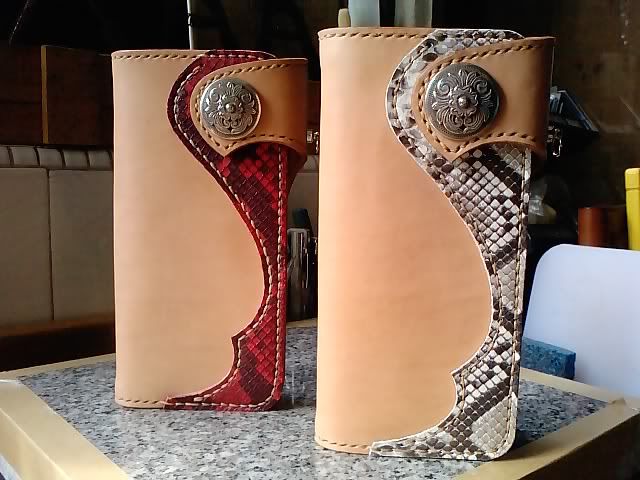
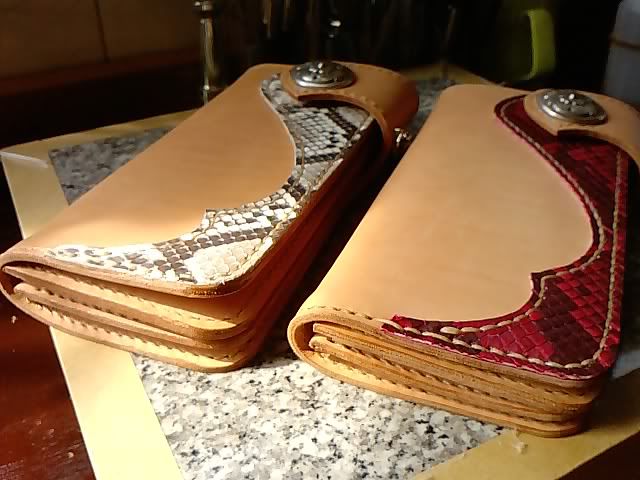
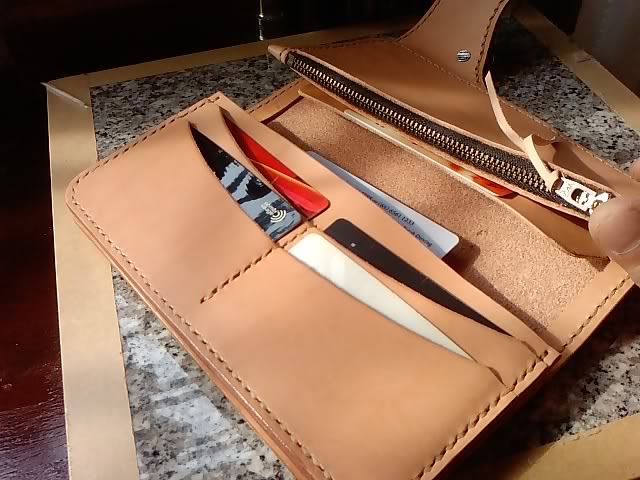
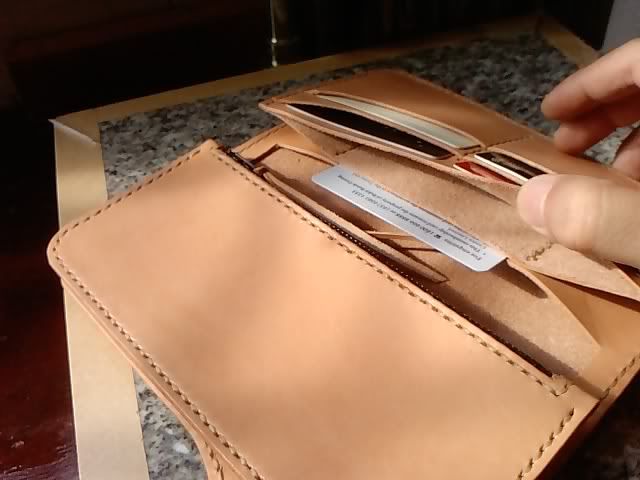
For me, I use 3-4 or 4-5 oz. 3-4 oz for the entire wallet if its a plain design, but skive down the pieces for the card compartments. If I want to do stamping, I will use 4-5 oz for the outer, and 3-4 oz for everything else.
I try not to use a too big difference in thickness for exterior and interior because I don't wish to have a sturdy outer look, but floppy insides.
Regarding quality of veg tan leathers, some time ago, Lipsu posted some good info about veg tan leathers. And then Kuroba also posted some info regarding grades.
Just to recap, the main feature of veg tan leather is its ability to emboss and carve. Press a fingernail onto veg tan leather and the mark should stay, and it should be slightly darker than the surrounding area. Embossing is almost like burnishing a shape/pattern on the surface of the leather. It is this exact quality of being able to burnish that allows veg tan leather to "evo" as we call it. The friction of our movement "burnishes" the surface, creating a darker shade in protuding areas.
Thus, the difference between a good quality veg tan as opposed to a poor quality veg tan is its ability to hold embossing and carving both in shape and shade
Grades of the tannery usually refers to the amount of blemishes on the hide. For eg. Top grade will be very clean, B grade occasional blemishes, C grade more blemishes. But this is usually relevant only to the artisan, because he has to consider if his work is small enough to cut around the blemishes or not. To the end user buying the product, it makes NO difference because A, B & C is still tanned by the same tannery using the same process.
When I first started, for natural veg tan, I could only get my hands on this variety available locally tanned by some tannery in Asia. I made a wallet for myself, and after 2-3 months of usage, I found that it was only getting dirtier, but not aging at all. To me, a dirty stained wallet DOES NOT equal to an aged wallet. The aging should be an actual darkening of the leather colour.
So I junked it and in the next couple of months, I tried several types by buying them in small pieces over Ebay, but no luck.
Finally, I read about Hermann Oak in US, and decided to order some to try. When I first received it, immediately I did some test stamping on it, and was impressed. The stamped impressions was crisp and clear, and the recessed areas was significantly darkers than the raised areas.


This proves that this is indeed a good carving leather. Curious, I searched up Hermann Oak on google and finally linked to a youtube video of their tannery.
In the video, it is revealed that true vegetable tanning process takes a few months. While modern chrome tanning only takes a day.
This lead me to think about the acrid smell of the lousy veg tan that I used to use when I started as compared to the lovely leather smell of this Hermann Oak.
I start to suspect that to cut costs and speed up the process, veg tan from these asian countries are not tanned the traditional way and some modern chemicals are mixed into it to speed up the process.
This could explain the acrid smell. And because of this, it could also explain why the leather so difficult to "evo", because if you remember as I said earlier, it is the traditional tanning process than lends the leather its burnishing character. So any "bypass" of this process will impair this burnishing ability.
So even if you are going for a plain wallet without carving or embossing, you should still aim for a good quality veg tan leather as eventually the embossing ability of the leather will directly affect how well it "evos".
For me, I use 3-4 or 4-5 oz. 3-4 oz for the entire wallet if its a plain design, but skive down the pieces for the card compartments. If I want to do stamping, I will use 4-5 oz for the outer, and 3-4 oz for everything else.
I try not to use a too big difference in thickness for exterior and interior because I don't wish to have a sturdy outer look, but floppy insides.
Regarding quality of veg tan leathers, some time ago, Lipsu posted some good info about veg tan leathers. And then Kuroba also posted some info regarding grades.
Just to recap, the main feature of veg tan leather is its ability to emboss and carve. Press a fingernail onto veg tan leather and the mark should stay, and it should be slightly darker than the surrounding area. Embossing is almost like burnishing a shape/pattern on the surface of the leather. It is this exact quality of being able to burnish that allows veg tan leather to "evo" as we call it. The friction of our movement "burnishes" the surface, creating a darker shade in protuding areas.
Thus, the difference between a good quality veg tan as opposed to a poor quality veg tan is its ability to hold embossing and carving both in shape and shade
Grades of the tannery usually refers to the amount of blemishes on the hide. For eg. Top grade will be very clean, B grade occasional blemishes, C grade more blemishes. But this is usually relevant only to the artisan, because he has to consider if his work is small enough to cut around the blemishes or not. To the end user buying the product, it makes NO difference because A, B & C is still tanned by the same tannery using the same process.
When I first started, for natural veg tan, I could only get my hands on this variety available locally tanned by some tannery in Asia. I made a wallet for myself, and after 2-3 months of usage, I found that it was only getting dirtier, but not aging at all. To me, a dirty stained wallet DOES NOT equal to an aged wallet. The aging should be an actual darkening of the leather colour.
So I junked it and in the next couple of months, I tried several types by buying them in small pieces over Ebay, but no luck.
Finally, I read about Hermann Oak in US, and decided to order some to try. When I first received it, immediately I did some test stamping on it, and was impressed. The stamped impressions was crisp and clear, and the recessed areas was significantly darkers than the raised areas.
This proves that this is indeed a good carving leather. Curious, I searched up Hermann Oak on google and finally linked to a youtube video of their tannery.
In the video, it is revealed that true vegetable tanning process takes a few months. While modern chrome tanning only takes a day.
This lead me to think about the acrid smell of the lousy veg tan that I used to use when I started as compared to the lovely leather smell of this Hermann Oak.
I start to suspect that to cut costs and speed up the process, veg tan from these asian countries are not tanned the traditional way and some modern chemicals are mixed into it to speed up the process.
This could explain the acrid smell. And because of this, it could also explain why the leather so difficult to "evo", because if you remember as I said earlier, it is the traditional tanning process than lends the leather its burnishing character. So any "bypass" of this process will impair this burnishing ability.
So even if you are going for a plain wallet without carving or embossing, you should still aim for a good quality veg tan leather as eventually the embossing ability of the leather will directly affect how well it "evos".
Last edited: