The Leather Thread

reddevil76

Member
Joined
Jan 2, 2011
Messages
121
Reaction score
0
For thickness, I think the artistic direction should dictate it. For example, if you look at KC Leather Craft carved wallets, they use thicker leather to achieve the depth of the carving.

For me, I use 3-4 or 4-5 oz. 3-4 oz for the entire wallet if its a plain design, but skive down the pieces for the card compartments. If I want to do stamping, I will use 4-5 oz for the outer, and 3-4 oz for everything else.

I try not to use a too big difference in thickness for exterior and interior because I don't wish to have a sturdy outer look, but floppy insides.

Regarding quality of veg tan leathers, some time ago, Lipsu posted some good info about veg tan leathers. And then Kuroba also posted some info regarding grades.

Just to recap, the main feature of veg tan leather is its ability to emboss and carve. Press a fingernail onto veg tan leather and the mark should stay, and it should be slightly darker than the surrounding area. Embossing is almost like burnishing a shape/pattern on the surface of the leather. It is this exact quality of being able to burnish that allows veg tan leather to "evo" as we call it. The friction of our movement "burnishes" the surface, creating a darker shade in protuding areas.

Thus, the difference between a good quality veg tan as opposed to a poor quality veg tan is its ability to hold embossing and carving both in shape and shade

Grades of the tannery usually refers to the amount of blemishes on the hide. For eg. Top grade will be very clean, B grade occasional blemishes, C grade more blemishes. But this is usually relevant only to the artisan, because he has to consider if his work is small enough to cut around the blemishes or not. To the end user buying the product, it makes NO difference because A, B & C is still tanned by the same tannery using the same process.

When I first started, for natural veg tan, I could only get my hands on this variety available locally tanned by some tannery in Asia. I made a wallet for myself, and after 2-3 months of usage, I found that it was only getting dirtier, but not aging at all. To me, a dirty stained wallet DOES NOT equal to an aged wallet. The aging should be an actual darkening of the leather colour.

So I junked it and in the next couple of months, I tried several types by buying them in small pieces over Ebay, but no luck.

Finally, I read about Hermann Oak in US, and decided to order some to try. When I first received it, immediately I did some test stamping on it, and was impressed. The stamped impressions was crisp and clear, and the recessed areas was significantly darkers than the raised areas.

TestStamp3.jpg


TestStamp2.jpg


TestStamp1.jpg


This proves that this is indeed a good carving leather. Curious, I searched up Hermann Oak on google and finally linked to a youtube video of their tannery.

In the video, it is revealed that true vegetable tanning process takes a few months. While modern chrome tanning only takes a day.

This lead me to think about the acrid smell of the lousy veg tan that I used to use when I started as compared to the lovely leather smell of this Hermann Oak.

I start to suspect that to cut costs and speed up the process, veg tan from these asian countries are not tanned the traditional way and some modern chemicals are mixed into it to speed up the process.

This could explain the acrid smell. And because of this, it could also explain why the leather so difficult to "evo", because if you remember as I said earlier, it is the traditional tanning process than lends the leather its burnishing character. So any "bypass" of this process will impair this burnishing ability.

So even if you are going for a plain wallet without carving or embossing, you should still aim for a good quality veg tan leather as eventually the embossing ability of the leather will directly affect how well it "evos".
 
Last edited:

reddevil76

Member
Joined
Jan 2, 2011
Messages
121
Reaction score
0
A side note: if you are buying leather from a maker's perspective, personally I found it more cost effective in the long run to buy the most expensive grade.

The Hermann Oak I had was a B grade, it had some blemishes here and there. After siam here, siam there, I ended up with alot of scrap and this actually brought up my unit cost for actual usable leather.

So recently, I bought a side of Tandy's top of the line Royal Meadow which I understand is from UK.

Although it is ridiculously expensive, it is also very clean and hopefully I will have less wastage from it. Will get around to trying it after using up the last few sq ft of my Hermann Oak.
 

reddevil76

Member
Joined
Jan 2, 2011
Messages
121
Reaction score
0
holla.
just want to ask how much veg tan leather should I get and what thickness should i get if i want to make a mid wallet or prehaps buying back to singapore and find a craftmen to do my design.

anyway i'm in guangzhou doing my fyp, coming back soon in a weeks time.
any leather tools I can get there? one foot long of 30mm leather cost abt 22 rmb which I believe is quite cheap uh.

If you wish to learn, no harm starting out with the cheaper variety. Buy about 10 sq foot in 1.8 - 2mm thickness. This thickness should be "neutral" enough for a variety of projects.

However, if you are going to buy leather and find a craftsman to make something for you, maybe you wanna consider that in most cases, when you buy a handmade leather product, you are not paying for leather, but you are actually paying for the time, sweat and tears of the craftsman. That's why a leather bag can be half the cost of a complicated wallet, yet twice the amount in materials. Because it is the workmanship that you are paying for, not the weight of the materials. So supplying your own leather isn't going to save you much. Besides, each craftsman has their own preference for materials to work with.

However, since you are already there, and you have some spare change, no harm just buying some if you intend to practice some crafting in future. Do remember to take a business card so if you find that you like the leather, can always find them again.
 

JesusLovesUs

Senior Member
Joined
Feb 3, 2009
Messages
1,346
Reaction score
0
If you wish to learn, no harm starting out with the cheaper variety. Buy about 10 sq foot in 1.8 - 2mm thickness. This thickness should be "neutral" enough for a variety of projects.

However, if you are going to buy leather and find a craftsman to make something for you, maybe you wanna consider that in most cases, when you buy a handmade leather product, you are not paying for leather, but you are actually paying for the time, sweat and tears of the craftsman. That's why a leather bag can be half the cost of a complicated wallet, yet twice the amount in materials. Because it is the workmanship that you are paying for, not the weight of the materials. So supplying your own leather isn't going to save you much. Besides, each craftsman has their own preference for materials to work with.

However, since you are already there, and you have some spare change, no harm just buying some if you intend to practice some crafting in future. Do remember to take a business card so if you find that you like the leather, can always find them again.

where can I buy the leather and tools in singapore?
Intend to make messenger bag and laptop sleeves.(no stamping)
I saw you on leatherworking.net too!!

I saw one of your keyring leather pouch stitched with leather/sinew thread.
What is the stitching method called?
 
Last edited:

Kuroba

Senior Member
Joined
Dec 15, 2010
Messages
904
Reaction score
0
For thickness, I think the artistic direction should dictate it. For example, if you look at KC Leather Craft carved wallets, they use thicker leather to achieve the depth of the carving.

For me, I use 3-4 or 4-5 oz. 3-4 oz for the entire wallet if its a plain design, but skive down the pieces for the card compartments. If I want to do stamping, I will use 4-5 oz for the outer, and 3-4 oz for everything else.

I try not to use a too big difference in thickness for exterior and interior because I don't wish to have a sturdy outer look, but floppy insides.

Regarding quality of veg tan leathers, some time ago, Lipsu posted some good info about veg tan leathers. And then Kuroba also posted some info regarding grades.

Just to recap, the main feature of veg tan leather is its ability to emboss and carve. Press a fingernail onto veg tan leather and the mark should stay, and it should be slightly darker than the surrounding area. Embossing is almost like burnishing a shape/pattern on the surface of the leather. It is this exact quality of being able to burnish that allows veg tan leather to "evo" as we call it. The friction of our movement "burnishes" the surface, creating a darker shade in protuding areas.

Thus, the difference between a good quality veg tan as opposed to a poor quality veg tan is its ability to hold embossing and carving both in shape and shade

Grades of the tannery usually refers to the amount of blemishes on the hide. For eg. Top grade will be very clean, B grade occasional blemishes, C grade more blemishes. But this is usually relevant only to the artisan, because he has to consider if his work is small enough to cut around the blemishes or not. To the end user buying the product, it makes NO difference because A, B & C is still tanned by the same tannery using the same process.

When I first started, for natural veg tan, I could only get my hands on this variety available locally tanned by some tannery in Asia. I made a wallet for myself, and after 2-3 months of usage, I found that it was only getting dirtier, but not aging at all. To me, a dirty stained wallet DOES NOT equal to an aged wallet. The aging should be an actual darkening of the leather colour.

So I junked it and in the next couple of months, I tried several types by buying them in small pieces over Ebay, but no luck.

Finally, I read about Hermann Oak in US, and decided to order some to try. When I first received it, immediately I did some test stamping on it, and was impressed. The stamped impressions was crisp and clear, and the recessed areas was significantly darkers than the raised areas.

TestStamp3.jpg


TestStamp2.jpg


TestStamp1.jpg


This proves that this is indeed a good carving leather. Curious, I searched up Hermann Oak on google and finally linked to a youtube video of their tannery.

In the video, it is revealed that true vegetable tanning process takes a few months. While modern chrome tanning only takes a day.

This lead me to think about the acrid smell of the lousy veg tan that I used to use when I started as compared to the lovely leather smell of this Hermann Oak.

I start to suspect that to cut costs and speed up the process, veg tan from these asian countries are not tanned the traditional way and some modern chemicals are mixed into it to speed up the process.

This could explain the acrid smell. And because of this, it could also explain why the leather so difficult to "evo", because if you remember as I said earlier, it is the traditional tanning process than lends the leather its burnishing character. So any "bypass" of this process will impair this burnishing ability.

So even if you are going for a plain wallet without carving or embossing, you should still aim for a good quality veg tan leather as eventually the embossing ability of the leather will directly affect how well it "evos".

Excelllennttt post
Although I think veg tanned leather can darken in areas more frequently handled because of the oil from our hands transferring to the leather too, aside from being burnished.

Ive been wondering about the relative importance of the factors that will allow a leather product to age well. Up till now I still can't find any reliable information on it. Reddevil did you happen to read this somewhere, or is this from your observations?

Reason I ask is because I don't think ease of burnishing straight away dictates the quality of leather and how well it will age. Veg tanned horsehide burnishes way more easily than cowhide, but that doesn't really mean horsehide > cowhide.
 

reddevil76

Member
Joined
Jan 2, 2011
Messages
121
Reaction score
0
Excelllennttt post
Although I think veg tanned leather can darken in areas more frequently handled because of the oil from our hands transferring to the leather too, aside from being burnished.

Ive been wondering about the relative importance of the factors that will allow a leather product to age well. Up till now I still can't find any reliable information on it. Reddevil did you happen to read this somewhere, or is this from your observations?

Reason I ask is because I don't think ease of burnishing straight away dictates the quality of leather and how well it will age. Veg tanned horsehide burnishes way more easily than cowhide, but that doesn't really mean horsehide > cowhide.

The oil in our hands helps, but the main catalyst is still friction.

Like I said earlier, these are my own conclusions and they could be wrong for all I know. However, I use the word "burnish" loosely as I was trying to keep the post as layman as possible. I was also referring to grain surface burnish rather than just edges.

But what I was trying to say is that the tooling qualities of a leather is the tell tale sign of its aging ability. And this also includes its ability to absorb moisture evenly.

Which comes back to your comment on oil from our hands.

If you touch the Hermann Oak, even if your hands seems dry and not sweaty, sometimes you may find a 'wet' mark where your finger was, and then it disappears very quickly. This is how deep and fast the leather absorbs moisture. When i case the leather for stamping, the water spreads very evenly and deeply.

I have tried casing the cheap ones before, and you can see "puddles" here and there on the surface after you swipe it with a wet sponge. Some areas absorb, some areas resist. Same results trying to dye it. It came as no surprise that this leather also 'evo' in patches.

I'm sure your recent W&C won't have this problem, it is well-liked by leather carvers. Take a piece of scrap, carry it in your pocket for a while, and see for yourself :D
 
Last edited:

reddevil76

Member
Joined
Jan 2, 2011
Messages
121
Reaction score
0
where can I buy the leather and tools in singapore?
Intend to make messenger bag and laptop sleeves.(no stamping)
I saw you on leatherworking.net too!!

I saw one of your keyring leather pouch stitched with leather/sinew thread.
What is the stitching method called?

Since you don't intend to tool or stamp, you don't need to necessarily get veg tan. In this case, it is possible to buy good quality leather locally. Especially oil tan leathers, quite abit of good quality variety available.

But tools I don't think so. All of us get it overseas. Unless you wanna buy a tool here and there from those who have spare tools to let go. But it will be very haphazard and difficult for you to assemble a good working set.

The key pouch was done with edge lacing. Some locals call it "padi stitching".
 

JesusLovesUs

Senior Member
Joined
Feb 3, 2009
Messages
1,346
Reaction score
0
Since you don't intend to tool or stamp, you don't need to necessarily get veg tan. In this case, it is possible to buy good quality leather locally. Especially oil tan leathers, quite abit of good quality variety available.

But tools I don't think so. All of us get it overseas. Unless you wanna buy a tool here and there from those who have spare tools to let go. But it will be very haphazard and difficult for you to assemble a good working set.

The key pouch was done with edge lacing. Some locals call it "padi stitching".

ok.. but you havent told me where to buy the leather locally D:
thanks for the reply!
 

Kuroba

Senior Member
Joined
Dec 15, 2010
Messages
904
Reaction score
0
The oil in our hands helps, but the main catalyst is still friction.

Like I said earlier, these are my own conclusions and they could be wrong for all I know. However, I use the word "burnish" loosely as I was trying to keep the post as layman as possible. I was also referring to grain surface burnish rather than just edges.

But what I was trying to say is that the tooling qualities of a leather is the tell tale sign of its aging ability. And this also includes its ability to absorb moisture evenly.

Which comes back to your comment on oil from our hands.

If you touch the Hermann Oak, even if your hands seems dry and not sweaty, sometimes you may find a 'wet' mark where your finger was, and then it disappears very quickly. This is how deep and fast the leather absorbs moisture. When i case the leather for stamping, the water spreads very evenly and deeply.

I have tried casing the cheap ones before, and you can see "puddles" here and there on the surface after you swipe it with a wet sponge. Some areas absorb, some areas resist. Same results trying to dye it. It came as no surprise that this leather also 'evo' in patches.

I'm sure your recent W&C won't have this problem, it is well-liked by leather carvers. Take a piece of scrap, carry it in your pocket for a while, and see for yourself :D

I see. Thanks for your insights. Pretty much makes sense. I guess the bottom line is good quality leather will always make a better product, whether you are tooling or not.

Yes I meant burnishing on the grain surface. That time I put my keys in my horsehide wallet, less than 1 week later can see 1 dark spot because my keys protrude out and cause that area to be rubbed on more. But yeah the edges burnish real nice and easily too. I have a feeling if the leather embosses well, the edges will burnish better too. Probably linked to the same property.

Interested in the local leather source too! :o
 

verynerd

Member
Joined
May 9, 2010
Messages
363
Reaction score
22
images


images


images


Hi artisan,Can you custom make something similar to this?because i find your design inspired by pastry and fruits.no offence.
 
Last edited:

kazuki666

Arch-Supremacy Member
Joined
Jul 16, 2004
Messages
14,827
Reaction score
221
reddevil: the wallets are nice lor. The bill slot is the slot below the card slots?
mind sharing the materials u used for them? (u intend to sell either of them? :p )
 

reddevil76

Member
Joined
Jan 2, 2011
Messages
121
Reaction score
0
reddevil: the wallets are nice lor. The bill slot is the slot below the card slots?
mind sharing the materials u used for them? (u intend to sell either of them? :p )

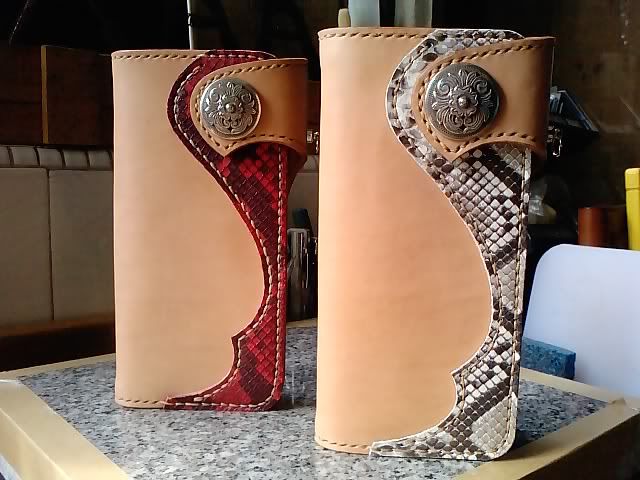
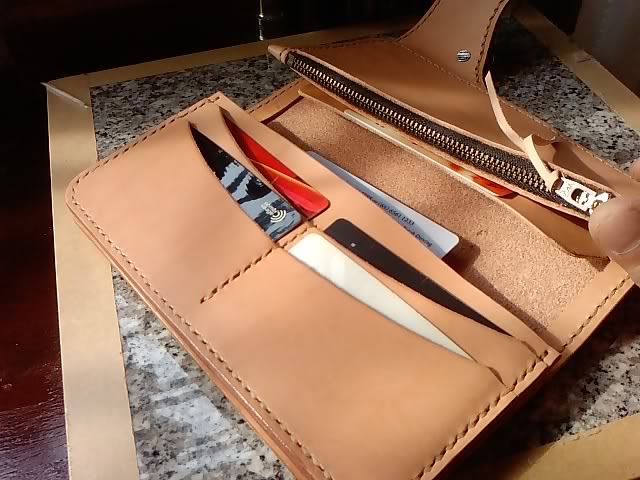
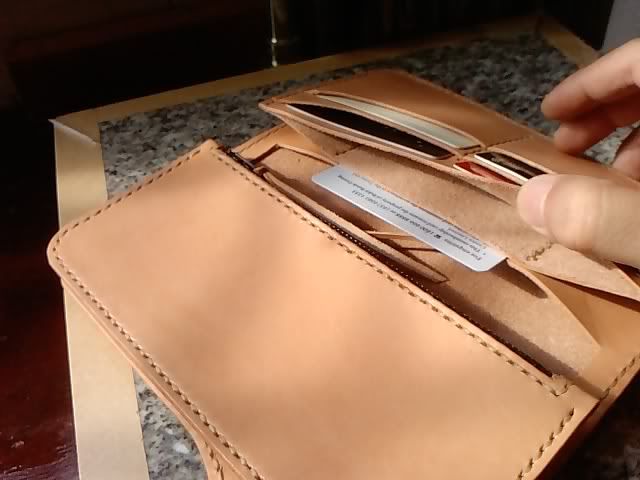
Actually the bill slot is designed beneath the coin compartment. I have done a flap easy for the thumb to pry it open. So when you turn the wallet clockwise, both coins and bills are accessible to you.

However, the 2 slots beneath the card slots will accommodate $50 notes comfortably. So it is up to the user.

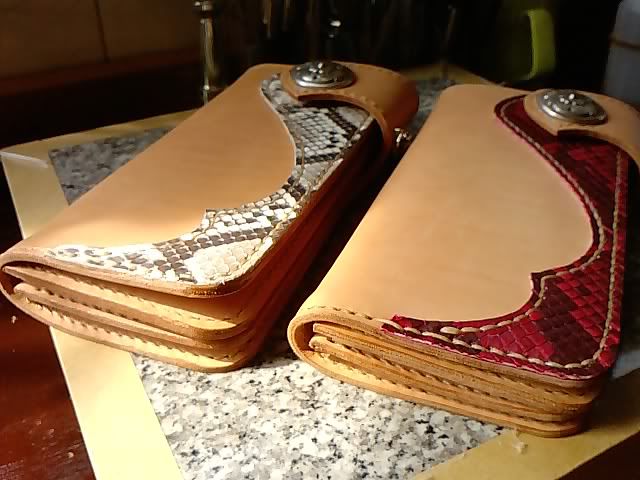
The wallet is entirely made up of natural veg tan from Hermann Oak Tannery. You can see the very nice, dark, flesh side that is typical of them. The trimmings are genuine python.

I do intend to sell them at $240. However, someone has already contacted me regarding the red one. He seems very sure that he will be getting it (tomorrow coming to view) So that leaves the white one.
 
Last edited:

reddevil76

Member
Joined
Jan 2, 2011
Messages
121
Reaction score
0
I wonder what's the average age of the guys hanging around this thread? Seems that the few that I have met so far is surprised that I am a 35 yr old uncle :s13:

Is it because everyone here is 18-25???

Anyway, so that you don't get a shock in case we meet in future, here is a few pics my bro snapped of me (the uncle as Kuroba said he should call me) working on the wallets I've just posted.

Recently shifted from my bedroom to the balcony for more space..

DSCF0863.jpg


DSCF0870.jpg


DSCF0879.jpg
 

Kuroba

Senior Member
Joined
Dec 15, 2010
Messages
904
Reaction score
0
Nice workspace, uncle :)
Much cleaner than mine.

Good choice on moving to out from your bedroom. I suspect sleeping with with all the chemicals in the bedroom is not healthy long term. Too bad I got no where to move out to for now :(

By the way I notice you have a stitching pony! Bought or DIY?
 
Last edited:

reddevil76

Member
Joined
Jan 2, 2011
Messages
121
Reaction score
0
Nice workspace, uncle :)
Much cleaner than mine.

Good choice on moving to out from your bedroom. I suspect sleeping with with all the chemicals in the bedroom is not healthy long term. Too bad I got no where to move out to for now :(

By the way I notice you have a stitching pony! Bought or DIY?

Actually my dyes, finishes, and all my hardware are still kept in the room. No more space here. But yes, at least the glue, and thinner is out here.

But actually smell was never a problem, noise and leather dust is worse. Over here, I don't have to clean up so thoroughly once I'm done for the day.

Pony is from Tandy. Needed some modifications on the tightening screws before it could work properly. But what to expect for US$20.. haha...
 
Important Forum Advisory Note
This forum is moderated by volunteer moderators who will react only to members' feedback on posts. Moderators are not employees or representatives of HWZ Forums. Forum members and moderators are responsible for their own posts. Please refer to our Community Guidelines and Standards and Terms and Conditions for more information.
Top