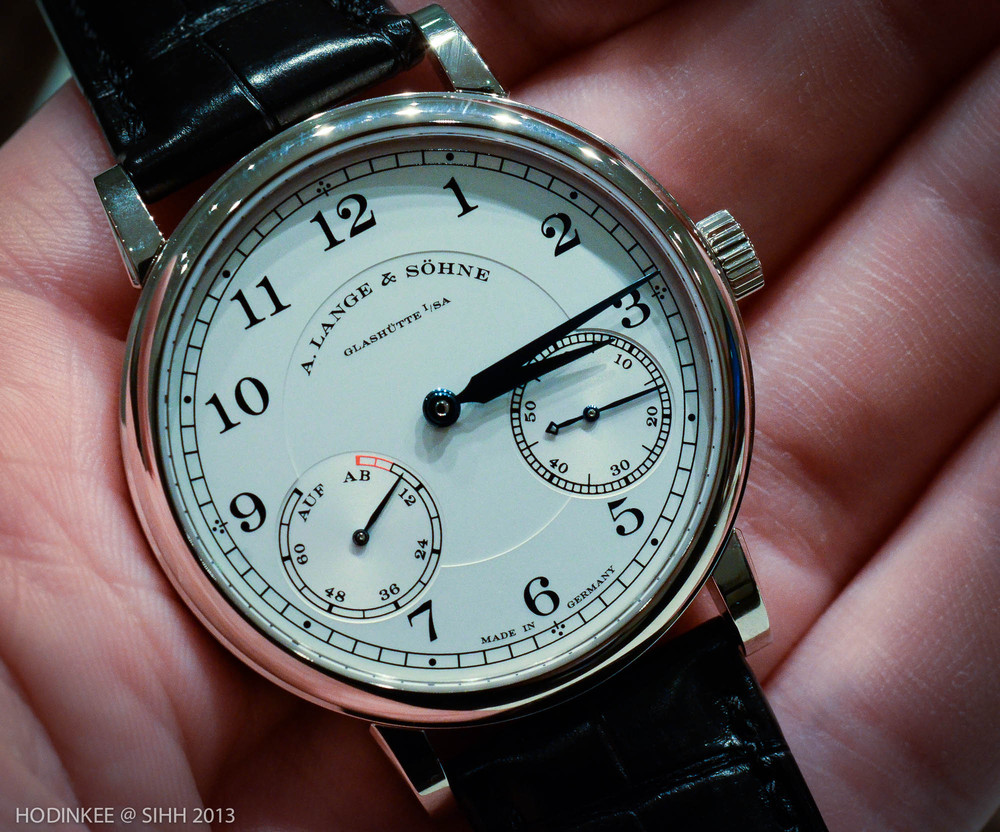
How A. Lange & Söhne goes about making watches
A step-by-step guide to how A. Lange & Söhne makes a wristwatch
A. Lange & Söhne family building in Glashütte in Germany’s Saxony province.
Hidden away in Glashütte in Germany’s Saxony province, A. Lange & Söhne is one of the world’s finest watch brands. In an industry dominated by Swiss brands, Lange is a quintessentially German brand that makes magnificent timepieces in a quintessentially German way. On a recent visit to the brand’s manufacturing facilities in Glashütte, we were surprised by how un-industrial the workshops and production facilities look like.
In many ways, the watchmakers at Lange continue to put together their watches, both simple and complex, in methods that have changed very little over the 168 years of the brand’s existence. Of course, state-of-the-art machines are used to make certain components and strategic parts, and watchmakers no longer toil with ancient hand tools. Still, every single watch that comes out of the Lange factory is lavished attention by several pairs of hands over several manhours. These hands belong to engineers, technicians, watchmakers, electroplaters, jewellers, micro-mechanics and even fine artists.
So how does a brand like A. Lange & Söhne go about making watches? This is what we were told:
1. A big idea
All Lange watches live at least two lives. Before even a single part of a watch has been manufactured, let alone assembled, the designers and watchmakers sit together to first create a concept. After weeks, months and even years of agonizing over every little detail, this concept is then translated into a series of drawings that outline every single component. And watches run into hundreds of components.
2. Prototype
Each new concept is brought to life in the form of a prototype piece. Prototypes are often entirely made by hand and involve a significant investment in time, manpower and material. But the idea is to make sure that a particular watch concept is ready to be produced at scale.
3. Part by part
The first real step in actually making a watch is cutting hundreds of little pieces out of sheet metal. Most of this cutting is done by machines that are precise to fractions of a fraction of a millimetre. Modern watch movements are getting both smaller and more complex at the same time. This means that most of these parts have almost no tolerance for deviations in shape or size. The base plate—the main piece of metal on which the movement is mounted and which is usually visible through the glass caseback—is itself measured at more than 100 different places in order to make sure that every hole, curve and facet is perfectly machined.
4. Finishing
The manufactured parts then go through several stages of finishing. Initially, this involves smoothing off edges, rounding off holes, removing burrs, and eliminating any minor imperfections left over from the manufacturing process.
5. Cosmetic finishing
Next, several components are subjected to cosmetic surface finishes such as stripes or pearlage—a series of overlapping circular polishes. It is common for many brands to only use these time-consuming finishes on parts that are visible on the outside. At Lange, however, surface finishes are mandatory on many parts that are enclosed within the movement. Lange watchmakers claim this is both a certain obsession with perfection and can also have beneficial impact on the watch’s operation.
6. Micro art
Certain timepieces are decorated with little flourishes of art. Lange has a team of engravers who finish certain parts, such as balance cocks, with hand-engraving. The effect is visually superb. But they also add an element of uniqueness to the watch: each engraver has an individual style, and no two engravings are ever the same. Also, some customers place orders for personalized engraved designs.
7. A good polish
The final treatment on a component, usually, is a thorough polish. And depending on the part and its shape, this can take from a few hours to several days. The process is not only exhausting, but also fraught with frustration—a perfectly hand-polished part can often be scratched during assembly. This means it is sent back to be polished all over again. Over-polish it, though, and it becomes unfit for use. You have to start all over again. Nein!
8. Modules
A Lange mechanical watch has hundreds of parts. And many of these parts are grouped into individual modules. In the next stage of manufacturing, and the first stage of assembly, these modules are painstakingly put together. Modules can range from the exceedingly simple to the nerve-shreddingly complex that requires an expert to spend hours peering through a microscope.
9. First assembly
Every Lange watch is assembled not once, but twice. In the first assembly, all the modules and parts are put together to ensure structural and operational integrity. If anything doesn’t work perfectly, it is repaired or replaced. Some of Lange’s more complicated watches can take weeks to assemble, and these are usually reserved for only the most experienced master watchmakers.
10. Second assembly
If the assembly proceeds without incident…the watch is broken down again to the smallest parts, cleaned, oiled, double-checked, sometimes refinished and decorated, and then put together again. Most brands are happy to assemble a watch just once. Lange is not like most brands. And like we said before, even the slightest scratch or dent…and it’s back to Step 8.
11. A case for quality
Now that we have a functioning movement, the beating heart of the watch is encased and subjected to a quality control system that runs for up to six weeks. Only after it passes a battery of tests is the watch ready to be packed and shipped.