

wwenze
Greater Supremacy Member
- Joined
- Dec 2, 2002
- Messages
- 86,878
- Reaction score
- 30,453
really? sauce?
Sauce = Mathematics and understanding of the storage device

really? sauce?
Sauce = Mathematics and understanding of the storage device


Sauce = Mathematics and understanding of the storage device

really? sauce?
Glad you answered your own question and then more.
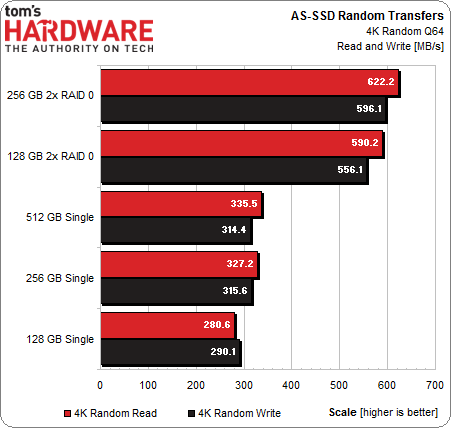
Yup, the key here is queue depth.
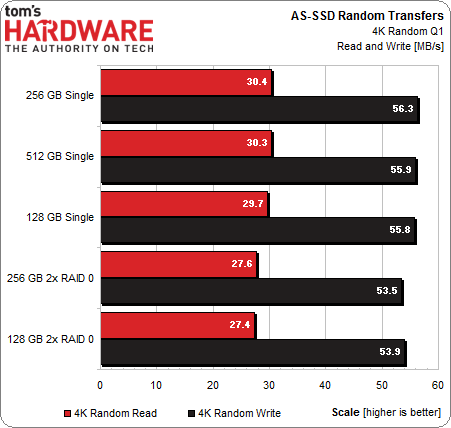
But to explain why performance drops in QD1: Because 4k is a very small data read. One storage unit (or page, or superpage... whatever term is getting used) within the drive is 4k at least, usually way, way bigger. Therefore, when you are trying to read a 4k file, the drive only needs to read one unit. Even if you have multiple drives, it is still one unit. In fact, the additional address translation (i.e. digging up which drive holds the data) is the one that causes latency to be higher. Yupz, when we do 4k, we're really measuring latency, not throughput.
Higher queue depths essentially allows the drive to behave more like a sequential read in terms of performance, since read requests are queue but can actually be carried out in parallel, assuming you keep the queue filled.
One easy explanation is because the drive's superpage size is as big or bigger than 32 * 4k
Example: 16kB page * 4 planes * 4 channels
Don't even need that many to hit 32x 4k
I mean... there's the graph above, right? Basically you see the throughput still increasing with QD, that means at that point, you are still not fully utilizing the throughput of the single drive yet, so adding more drives in parallel won't help.
So simply based on the fact that even at QD32 the speed is less than sequential...
One additional implication with write speed is... probably the drive is also waiting more for the entire buffer to fill up before they can program a page.

getting a bit too technical for me

PERFECT! Thanks for the heads up,.. I just placed the order
Estimated delivery: 17 Jun 2020 - 29 Jun 2020


Mind sharing as well? TIA~

i have this problem on cruial MX500 too

I see that quite a few of the members here recommended this model
https://www.amazon.sg/Western-Digit...11&ascsubtag=77da13fc5af64e93980d72c451b44f0f
I was initially gonna buy the ADATA XPG 8200 Pro 1TB for my laptop as i am using the same one for my desktop now but the local price is quite high at $259 +/-.
Wanna ask members here that the WD Black can run hot so can it still be used in a laptop. I am waiting for my LG GRAM 14 2020 to arrive next week and wanna upgrade the SSD.
Thank you.
...
Wanna ask members here that the WD Black can run hot so can it still be used in a laptop. I am waiting for my LG GRAM 14 2020 to arrive next week and wanna upgrade the SSD.
Thank you.
Bought WD Black $186 (on sale) for my brother laptop and he never complain anything.thinking to buy evo 860 for him but he is using old laptop so i went on with WD Black instead.so far he still running it with no issue of overheating
u can check out this offer too
Sabrent Rocket Q 1TB @ Amazon include with amazon coupon S$14.24 =$187 with shipping
https://www.amazon.com/Sabrent-Rock...coding=UTF8&psc=1&refRID=S15QNZW7KHSDMRC2E7WR
or
Silicon Power 1TB NVMe M.2=$185
=$202 with shipping
https://www.amazon.com/Silicon-Powe...coding=UTF8&psc=1&refRID=NT599CV34ERGRD56CKCK
if u Prime subscriber the shipping is free
WD Black is the most power efficient PCIe 3.0 SSD around so it will run the coolest.
Thank you for your assurance. At first, i was a little worried about the thermals as this SSD doesn't comes with at least a thin heatsink.

