Google Pixel 10 series

limmk

High Supremacy Member
Joined
Jul 5, 2001
Messages
41,198
Reaction score
8,166
Seems like P10 is dead even before it is born based on Android Authority. Was still thinking to upgrade from P8P... Anyone using P9P or P9PXL? any reviews?
Dead in the water. Whatever improvements is shaping up to be primarily A.I. software gatekeeping.

I'm using P9P but honestly unless you have a bias for pixel UI you would get much better package elsewhere like OP13.
Yeah, everything now just feels like A.I. restrictions more than real upgrades. moi also feeling a bit sian with Pixel nowadays — other brands really giving better value and features loh
 

anthonygreenisreal

Arch-Supremacy Member
Joined
Oct 2, 2014
Messages
13,963
Reaction score
7,554
Seems like P10 is dead even before it is born based on Android Authority. Was still thinking to upgrade from P8P... Anyone using P9P or P9PXL? any reviews?
Me still P9PXL. Currently using OnePlus 13 and used to have pixel 8 and Samsung S24 Ultra. IMO it's worth to upgrade to the pixel 9 pro. Especially now can get at good price. Have seen prices dropped to $1050 range for pixel 9 pro XL 256gb during online sales.

The pixel 9 pro and pro XL is leaps between than the pixel 8 series for real, in terms of battery life and thermal management. The modem is also much better. Can hang with my OP13 and S24U.
 

Loser

Arch-Supremacy Member
Joined
May 7, 2019
Messages
23,592
Reaction score
10,487
Me still P9PXL. Currently using OnePlus 13 and used to have pixel 8 and Samsung S24 Ultra. IMO it's worth to upgrade to the pixel 9 pro. Especially now can get at good price. Have seen prices dropped to $1050 range for pixel 9 pro XL 256gb during online sales.

The pixel 9 pro and pro XL is leaps between than the pixel 8 series for real, in terms of battery life and thermal management. The modem is also much better. Can hang with my OP13 and S24U.
You never say the but then... part. :grin:
 

anecdoctal

Member
Joined
Feb 4, 2022
Messages
152
Reaction score
53
Was thinking to try back China phones but I don't like their UI after having tried Huawei back in the days of P30 Pro... Was thinking about OnePlus 13 or Xiaomi Ultra 14 or 15. Any feedback compared to native android on Pixel?
 

anthonygreenisreal

Arch-Supremacy Member
Joined
Oct 2, 2014
Messages
13,963
Reaction score
7,554
Was thinking to try back China phones but I don't like their UI after having tried Huawei back in the days of P30 Pro... Was thinking about OnePlus 13 or Xiaomi Ultra 14 or 15. Any feedback compared to native android on Pixel?
I have pixel 9 pro XL and OnePlus 13.
The UI is better on the OP13. Pixel 9 XL doesn't even have double tap to lock screen.
 

RyanJ

Great Supremacy Member
Joined
Jun 18, 2015
Messages
70,956
Reaction score
69,612
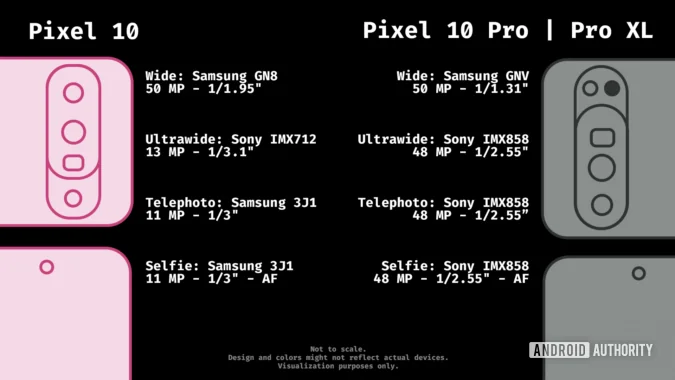
Sensor sizes across various Pixel generations. Similar sizes may not mean they are not using newer sensors.

p10camv1-675w-380h.png.webp


Pixel 9 Pro
Primary : 1/1.31-inch sensor.
Ultra-wide : 1/2.55-inch sensor,
Telephoto : 1/2.55-inch sensor.

Pixel 8 Pro
Primary : 1/1.31 inch sensor
Ultra-wide: ?1/2.55-inch sensor
Telephoto: 1/2.55" inch sensor

Pixel 7 Pro
Primary: 1/1.31-inch sensor
Ultra-wide: 1/2.86-inch sensor
Telephoto : 1/2.55-inch sensor

Pixel 6 Pro
Primary: 1/1.31 inch sensor
Ultra-wide: 1/2.86 inch sensor
Telephoto : 1/2.0 inch sensor

Pixel 4 and 5 Pro
Primary : 1/2.55 inch sensor
Telephoto : 1/3.6 inch sensor

* Pixel direction is likely to use even more and more computational and Ai to 'improve' photos instead of pushing for major optical/sensor hardware tweaks.

* If Tensor becomes powerful enough Pixel may just need an average low detailed photo from a tiny sensor to "recreate" stable diffusion-like details into image like how Adobe and some image softwares are using Ai do to Up-Scaling / creating details.
 

Loser

Arch-Supremacy Member
Joined
May 7, 2019
Messages
23,592
Reaction score
10,487
Sensor sizes across various Pixel generations. Similar sizes may not mean they are not using newer sensors.

p10camv1-675w-380h.png.webp


Pixel 9 Pro
Primary : 1/1.31-inch sensor.
Ultra-wide : 1/2.55-inch sensor,
Telephoto : 1/2.55-inch sensor.

Pixel 8 Pro
Primary : 1/1.31 inch sensor
Ultra-wide: ?1/2.55-inch sensor
Telephoto: 1/2.55" inch sensor

Pixel 7 Pro
Primary: 1/1.31-inch sensor
Ultra-wide: 1/2.86-inch sensor
Telephoto : 1/2.55-inch sensor

Pixel 6 Pro
Primary: 1/1.31 inch sensor
Ultra-wide: 1/2.86 inch sensor
Telephoto : 1/2.0 inch sensor

Pixel 4 and 5 Pro
Primary : 1/2.55 inch sensor
Telephoto : 1/3.6 inch sensor

* Pixel direction is likely to use even more and more computational and Ai to 'improve' photos instead of pushing for major optical/sensor hardware tweaks.

* If Tensor becomes powerful enough Pixel may just need an average low detailed photo from a tiny sensor to "recreate" stable diffusion-like details into image like how Adobe and some image softwares are using Ai do to Up-Scaling / creating details.
If same sensor size then the improvement will be marginal at best. If mostly software improvement then we can expect some if not all will be available to pixel 9 series also.
 

eversomighty

Senior Member
Joined
May 17, 2018
Messages
1,773
Reaction score
775
Sensor sizes across various Pixel generations. Similar sizes may not mean they are not using newer sensors.

p10camv1-675w-380h.png.webp


Pixel 9 Pro
Primary : 1/1.31-inch sensor.
Ultra-wide : 1/2.55-inch sensor,
Telephoto : 1/2.55-inch sensor.

Pixel 8 Pro
Primary : 1/1.31 inch sensor
Ultra-wide: ?1/2.55-inch sensor
Telephoto: 1/2.55" inch sensor

Pixel 7 Pro
Primary: 1/1.31-inch sensor
Ultra-wide: 1/2.86-inch sensor
Telephoto : 1/2.55-inch sensor

Pixel 6 Pro
Primary: 1/1.31 inch sensor
Ultra-wide: 1/2.86 inch sensor
Telephoto : 1/2.0 inch sensor

Pixel 4 and 5 Pro
Primary : 1/2.55 inch sensor
Telephoto : 1/3.6 inch sensor

* Pixel direction is likely to use even more and more computational and Ai to 'improve' photos instead of pushing for major optical/sensor hardware tweaks.

* If Tensor becomes powerful enough Pixel may just need an average low detailed photo from a tiny sensor to "recreate" stable diffusion-like details into image like how Adobe and some image softwares are using Ai do to Up-Scaling / creating details.
if this is true, pixel 10 main sensor is.. :rolleyes:
 

RyanJ

Great Supremacy Member
Joined
Jun 18, 2015
Messages
70,956
Reaction score
69,612
If same sensor size then the improvement will be marginal at best. If mostly software improvement then we can expect some if not all will be available to pixel 9 series also.

if this is true, pixel 10 main sensor is.. :rolleyes:

Xperia 1 VI uses smaller main sensor, S25 Ultra main sensor also 1/1.31", Pixel should be "safe" to continue same strategy for another 2-3 generations .
 

Loser

Arch-Supremacy Member
Joined
May 7, 2019
Messages
23,592
Reaction score
10,487
Xperia 1 VI uses smaller main sensor, S25 Ultra main sensor also 1/1.31", Pixel should be "safe" to continue same strategy for another 2-3 generations .
But those cannot fight the Chinese flagships. :frown:
 

limmk

High Supremacy Member
Joined
Jul 5, 2001
Messages
41,198
Reaction score
8,166


As Pixel 10 leaks keep rolling, a set of alleged wallpapers for the Pixel 10, Pixel 10 Pro, and Pixel 10 Pro XL have hit the web as a bit of a departure from the company’s prior themes.

Each new generation of Pixel – especially in the Tensor era – has brought with it a new theme for its wallpaper set. The Pixel 6 had plant-themed wallpapers (alongside a batch of Material You wallpapers), Pixel 7 focused on feathers, Pixel 8 used geodes and crystal formations, and Pixel 9 had floral-inspired themes with “Swirling Petals.”

With the Pixel 10 series, Google seems to be going a different route, at least according to a new batch of wallpapers posted by Mystic Leaks on Telegram.

These new wallpapers seem to have a theme along the lines of glass or perhaps lenses. The base Pixel 10 gets a set of extremely vibrant wallpapers with a huge variety of colors, while the Pro phones are far more subdued with darker tones of black, grey, blue, and green. All of the wallpaper variants will likely be available across all three devices, but it does continue the ongoing trend of “Pro” devices doing away with any sort of vibrancy in their colors.

Pixel_10_YEL_MysticLeaks.jpg
Pixel_10_PPL_MysticLeaks.jpg
Pixel_10_BUE_MysticLeaks.jpg
Pixel_10_BLK_MysticLeaks.jpg


Pixel 10 Wallpapers

Pixel_10_Pro_WHT_MysticLeaks.jpg
Pixel_10_Pro_GRY_MysticLeaks.jpg
Pixel_10_Pro_GRN_MysticLeaks.jpg
Pixel_10_Pro_BLK_MysticLeaks.jpg


Pixel 10 Pro Wallpapers


limmk

High Supremacy Member
Joined
Jul 5, 2001
Messages
41,198
Reaction score
8,166
Pixel_10_Pro_XL_WHT_MysticLeaks.jpg
Pixel_10_Pro_XL_GRY_MysticLeaks.jpg
Pixel_10_Pro_XL_GRN_MysticLeaks.jpg
Pixel_10_Pro_XL_BLK_MysticLeaks.jpg


Pixel 10 Pro XL Wallpapers

Google is expected to launch the Pixel 10 series around August with the same core designs, a new TSMC-made chip, and some other fairly minor overall changes.
 

limmk

High Supremacy Member
Joined
Jul 5, 2001
Messages
41,198
Reaction score
8,166


When the Google Pixel 9a launched earlier this month, it ushered in a brand new design and a number of enhancements that made it one of the best Pixel experiences so far. Chief among the improvements is the display's spec sheet, which now looks identical to the more expensive Pixel 9 series in nearly every way.

While that's great for most users, a subset of the population cannot use any Pixel display without getting serious headaches, and the Pixel 9a didn't do anything to help that. When I asked the company if it would consider upgrading the PWM dimming rate or adding a flicker-reduction accessibility option, I fully expected to get the standard "we'll look into this," but never actually hear back. Instead, six weeks later, Google returned an amazing statement I didn't expect.

"Google...indicated their teams are aware and investigating this. You can expect updates later this year," a Google representative told me.

Here's why this is significant. Since I've been writing about PWM dimming over the past two years, many companies have been willing to discuss PWM dimming and how their products are working toward improving displays for everyone, including those with accessibility needs.

Google and Samsung have been completely silent on the issue, no matter how many times I've asked, so this marks the first time that stance has changed for at least one of these companies. And while Google didn't explicitly mention the Pixel 10, it seems quite possible that any updates coming "later this year" regarding displays could line up with the Pixel 10 launch.

Why this matters​

The Google Pixel 9a in Iris compared to the Pixel 9 in Peony.


I'm sensitive to phones that use slow PWM dimming rates and have been for at least the past few years. Every single Google Pixel, Samsung Galaxy, or Apple iPhone with an OLED screen uses PWM dimming. That means the only phones I can use daily without headaches are from brands like OnePlus, Honor, Nothing, and a handful of other brands that have begun to prioritize eye health over pure display quality tests.

For too many years, displays have been made to ace display quality tests instead of paying attention to the humans who have to use them every day. This includes tricks like slow-rate PWM dimming — often 240Hz or 480Hz — as they allow manufacturers to push brightness levels and color accuracy of OLED screens beyond what was considered feasible just a few years ago. As you might gather, this causes health issues among people who are "allergic" to PWM dimming, as I'll refer to it.

It's worth noting that I have no medical history of headaches, migraines, epilepsy, or other issues that might cause light sensitivity. I've also never worn glasses until summer 2023 when I was diagnosed with an astigmatism in my left eye. In other words, there was no reason to think I would be someone susceptible to flickering lights.

Comparing the fast, low modulation PWM rate of the Vivo X100 Pro (left) with the slow, high modulation PWM rate of the Google Pixel 9 Pro XL (right).


Last summer, I got in contact with a custom kernel developer who was able to find the line of code to change the Pixel 8 Pro's PWM rate. It made the phone usable for me again, but rooting a modern phone isn't a great option if you like making NFC payments or using 2-factor authentication apps, as it violates most app security protocols.

So, the only real option anyone like me has of using a Pixel phone full-time again is if Google gives users a way to adjust the PWM rate or disable it completely. While some users care more about having top-notch display quality at any cost, I'd rather switch to a minimalist E Ink phone and forego display quality if it means saving my eyes and avoiding physical pain every day.

Thankfully, I don't have to do anything that extreme. Phones like the OnePlus 13 and Honor Magic 7 Pro offer dimming rates 8-16x faster than what Google's latest Pixel phones offer, but Google's change in stance could finally reverse that gap in the spec sheet.

What to expect from the Pixel 10's display​

Holding all the different colors of the Google Pixel 9 and Pixel 9 Pro


There's no reason to think that Google will suddenly deprioritize display quality as its foremost concern for the Pixel 10. I fully expect the Pixel 10 to either stick with 240Hz PWM dimming or go the Galaxy S24/S25 Ultra route and upgrade that to 480Hz as the default display configuration. That wouldn't be helpful for PWM-sensitive people at all, as the rate ideally needs to be 1920Hz or higher for it to be comfortable. But this new stance from Google could mean one of several things.

Google could be adding a new accessibility mode for flicker-sensitive people that reduces the amount of display flicker. Motorola did this with its Motorola Edge Plus 2023 phone and has included a "flicker-reduction" feature on every single OLED-equipped phone since then, even the latest Razr 2025 phones. Motorola's full DC-dimming method was unique until Xiaomi and OnePlus offered a similar option a year later, but have yet to offer that option outside of China.

Google could also offer a hybrid dimming mode that utilizes DC dimming at high brightness and high-Hz PWM dimming at low brightness. This has become the new industry standard among most smartphone brands in 2025, including Nothing, OnePlus, Xiaomi, Honor, Vivo, RealMe, and plenty of others.

Comparing the dimming technologies between the Google Pixel 9 Pro XL, iPhone 14 Pro Max, OnePlus 13, and Honor Magic 7 Pro


It's also possible that Google simply upgrades the PWM rate across the board and at all brightness levels. Google, Apple, and most Samsung Galaxy devices currently use PWM dimming at all brightness levels, and while companies like Vivo offer similar "Full PWM" modes, they do it at rates as high as 2140Hz. Again, 5-8x faster than the big three offer.

Either avenue Google takes is going to be a positive step for all users, not just those of us who have already become sensitive to the harsh PWM dimming associated with some lights and displays. User-selectable options and customization have long been staples of the Android world, and it's always good to see Google considering options for users who need them, not just things we might want.

Of course, the final possibility is that Google could do nothing and that I'm just being overly hopeful. That said, we will have to wait and see what we get when the Pixel 10 launches.

 

limmk

High Supremacy Member
Joined
Jul 5, 2001
Messages
41,198
Reaction score
8,166

Understanding Google's Pixel 10 Pro Pricing Decisions​

2025’s smartphones are facing increased retail prices, with pressure on several fronts, including the rising price of raw materials and the impact of US tariffs on the Chinese market, conspiring to push up the cost to consumers. Yet Google’s Pixel 10 and Pixel 10 Pro devices are expected to be price-matched to last year’s Pixel 9 and Pixel 9 Pro… with one exception.

Pixel 10 Pro To Continue Pixel 9 Pro Promise

The Pixel series has always had half an eye on value for money. While they don't fit the traditional 'flagship killer' status of being mid-range smartphones that offer the majority of flagship features, the Pixel series has always produced handsets that offer more specs than rival smartphones at a similar price point.

Last year, the Pixel 9 was priced at $799 for the entry-level model, and the Pixel 9 Pro was priced at $999, both with 128 GB of storage. Let's not forget that the Pixel 9 family represented the second generation of generative AI on smartphones and sat on the bleeding edge of AI. The Android-powered competition followed a few months later (and arguably Apple has still to catch up to the first generation of AI found in the Pixel 8).

Combining ground-breaking AI at a competitive price point allowed Google to set the tone in the market, and the Android partners soon followed. The market was defined by Google, and in Google's favor. And with the lower prices and a significant marketing push, the Pixel became a more common sight in the real world.

Pixel 10 Pro Pricing

This makes the current information from the supply chain all the more interesting. Google is expected to maintain the $799 and $999 pricing for the Pixel 10 and Pixel 10 Pro models. There's probably more value in gathering AI data and the annual subscriptions to the premium level of the Google Gemini AI client than there is in bumping up the profit margin by $50.

I'm sure the Pixel team have to prove their financial worth to the mothership. Still, the Pixel line-up is not critical to the company's bottom line and likely has a bit of leeway thanks to the Pixel platform's ancillary income.

Pixel 10 Pro XL Is The Disappointing Surprise

The one potential difference is with the largest model. The Pixel 10 Pro XL is expected to add $100 to the Pixel 9 Pro XL's sticker price and go on sale at $1,199.

Given that the Pixel 9 Pro XL model with 256 GB of storage was priced at $1,199, last year's $1,099 model with 128 GB of storage could leave the Pixel 10 family. That would maintain the price of the 10 Pro XL 256 GB, and everything stays steady across the board. Alternatively, the larger display and potentially larger battery may push the bill of materials to the point where the team has no option but to push the price up.

Both options will separate the Pixel 10 Pro and Pixel 10 Pro XL for consumers. There will be a simple $200 step per model, and the potential for a $100 step between the models with increased storage.

That will mark the Pixel 10 as the standard for all, the 9 Pro for the more discerning customer, and the 10 Pro XL as the phone that challenges the premium space.

It's not without risk. Consumers are becoming more price-conscious in the current climate, and the increased price of the 10 Pro XL could push many away from the largest Pixel. Google will hope they take a step back to the Pixel 10 Pro, but if the attraction is the larger screen of the XL, they may move to another manufacturer.

// forbes
 
Important Forum Advisory Note
This forum is moderated by volunteer moderators who will react only to members' feedback on posts. Moderators are not employees or representatives of HWZ Forums. Forum members and moderators are responsible for their own posts. Please refer to our Community Guidelines and Standards and Terms and Conditions for more information.
Top